Listen to this Post
Introduction
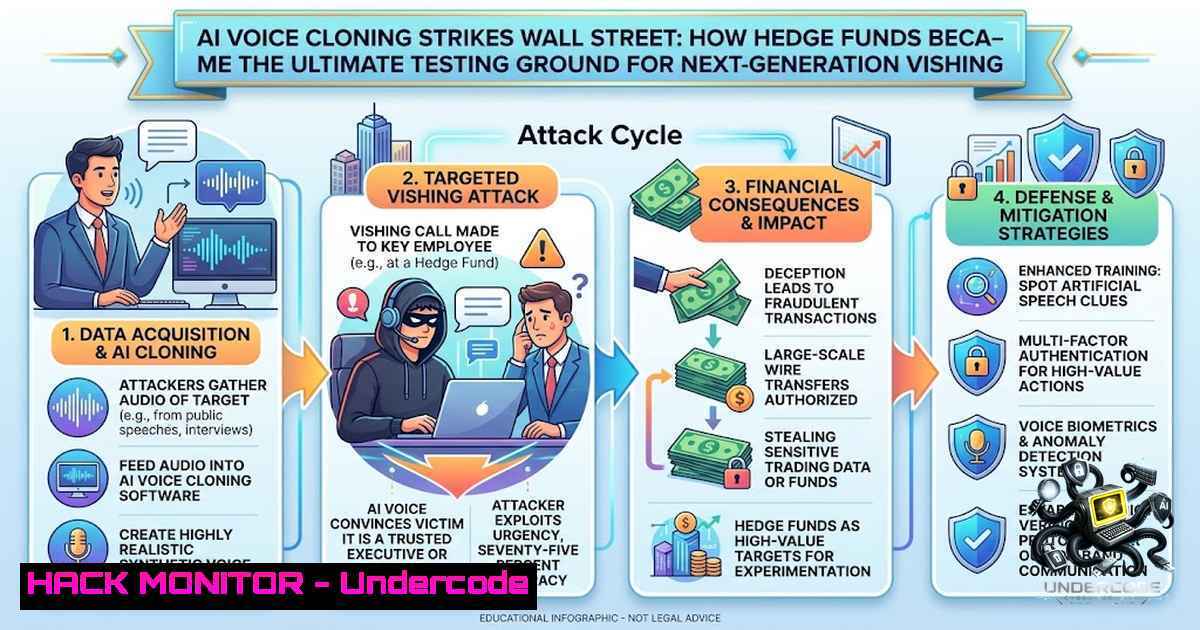
A coordinated wave of AI-powered voice phishing (vishing) attacks has targeted some of the world’s largest hedge funds—including Point72 Asset Management, Citadel, Millennium Management, and Two Sigma Investments—exposing a fundamental vulnerability in enterprise security: the human voice is no longer a trustworthy biometric. Leveraging AI voice cloning technology that requires as little as 30 seconds of audio harvested from public sources like podcasts, earnings calls, or social media, attackers successfully impersonated trusted executives and IT personnel to manipulate employees into surrendering credentials and system access. This campaign marks a critical inflection point where generative AI has commoditized social engineering, scaling what was once a manual, labor-intensive fraud technique into an automated, mass-targeted threat capable of hitting 1,000 organizations with the same effort previously required to target 50.
Learning Objectives
- Understand the technical mechanics of AI voice cloning and how attackers harvest, synthesize, and deploy synthetic audio in real-time vishing campaigns
- Master defensive architectures including out-of-band verification, voice biometrics, and help desk hardening against AI-powered impersonation
- Implement practical Linux and Windows security controls to detect, log, and respond to vishing-related Indicators of Compromise (IoCs)
You Should Know
- The Technical Anatomy of an AI Vishing Attack
Modern AI vishing attacks follow a structured kill chain that mirrors traditional cyberattacks but with a distinctly human-centric entry vector. The attack begins with reconnaissance, where threat actors scrape publicly available audio from YouTube videos, earnings call recordings, podcast appearances, and even voicemail greetings. Using generative AI models—many of which are now openly available or accessible via inexpensive APIs—attackers can create a convincing voice clone with as little as 30 seconds of source audio.
The delivery phase involves real-time voice synthesis, where attackers use low-latency AI voice clones to conduct live phone calls. Unlike pre-recorded messages, these systems can adapt dynamically to the target’s responses, making the interaction feel natural and urgent. In the Wall Street campaign, attackers posed as IT support personnel—a favored tactic also used by the Scattered Spider cybercriminal group—to persuade employees to reset passwords or install remote access tools.
The exploitation phase capitalizes on the human element: urgency, authority, and familiarity. Attackers impersonate C-suite executives demanding immediate fund transfers or IT staff requiring credential verification. Two Sigma, managing $75 billion in assets, successfully blocked the attempt, but Point72 confirmed it had been targeted, though no client data was compromised.
Technical Indicators to Monitor:
On Linux systems, audit voice-related communication channels and anomalous authentication events:
 Monitor failed authentication attempts that may follow vishing success
sudo grep "Failed password" /var/log/auth.log | tail -20

Check for unusual sudo usage (potential post-vishing privilege escalation)
sudo grep "sudo:" /var/log/auth.log | grep -v "COMMAND=/usr/bin/"

Audit outbound network connections from workstations (potential C2 beaconing)
sudo netstat -tunap | grep ESTABLISHED | awk '{print $5}' | sort | uniq -c | sort -1r
On Windows systems, enable advanced audit logging to detect anomalous access:
 Enable PowerShell script block logging for credential theft detection
Set-ItemProperty -Path "HKLM:\SOFTWARE\Policies\Microsoft\Windows\PowerShell\ScriptBlockLogging" -1ame "EnableScriptBlockLogging" -Value 1

Audit successful and failed logon events (Event IDs 4624, 4625)
Get-WinEvent -LogName Security | Where-Object { $_.Id -in 4624,4625 } | Select-Object TimeCreated, Id, Message | Format-Table -AutoSize

Monitor for new scheduled tasks (potential persistence)
Get-ScheduledTask | Where-Object { $_.State -1e "Disabled" } | Select-Object TaskName, State, Actions
2. Out-of-Band Verification: The First Line of Defense
The most effective defense against AI voice cloning is to eliminate voice-only approvals for sensitive actions. Security experts now advocate for mandatory out-of-band verification—requiring that any high-stakes request (fund transfers, password resets, system access) be confirmed through a separate, independent communication channel.
Step-by-Step Implementation Guide:
- Policy Definition: Identify all high-risk actions currently approved via phone. This includes wire transfers, credential resets, help desk access grants, and VPN provisioning.
-
Channel Separation: Designate secondary channels that cannot be simultaneously compromised. For example, if the initial request comes via phone, require confirmation through Slack/Teams with cryptographic identity verification, or via a dedicated mobile app with biometric authentication.
-
Code Phrase Protocol: Establish dynamic code phrases that change weekly. These should be shared only through secure, pre-authorized channels and never repeated over the phone.
-
Technical Enforcement: Implement help desk ticketing systems that require dual approval. On Linux, use `sudo` with `NOPASSWD` disabled and require two-factor authentication for privilege escalation:
 Configure sudo to require authentication and log all commands
echo "Defaults timestamp_timeout=0" >> /etc/sudoers
echo "Defaults log_output" >> /etc/sudoers
echo "Defaults logfile=/var/log/sudo.log" >> /etc/sudoers
On Windows, implement Just Enough Administration (JEA) to limit what help desk staff can execute:
 Create a constrained PowerShell endpoint for help desk
New-PSSessionConfigurationFile -Path .\HelpDesk.pssc -SessionType RestrictedRemoteServer -VisibleCmdlets @('Get-Process', 'Get-Service', 'Restart-Service') -VisibleFunctions @('Get-UserInfo') -TranscriptDirectory C:\Logs\PSSessions

Register the constrained endpoint
Register-PSSessionConfiguration -1ame HelpDeskEndpoint -Path .\HelpDesk.pssc -Force
3. Voice Biometrics and Deepfake Detection
Enterprise-grade voice biometrics and deepfake detection are rapidly becoming essential controls. Solutions like Reality Defender and ValidSoft now offer real-time audio analysis that can distinguish between human and synthetic voices by analyzing micro-fluctuations, spectral patterns, and unnatural acoustic artifacts. The technology works by creating a biometric voiceprint for each authorized user and comparing incoming calls against this baseline.
Detection Techniques:
- Spectral Analysis: AI-generated voices often lack the natural micro-variations in pitch and timbre present in human speech. Detection algorithms analyze these spectral patterns to flag anomalies.
- Phoneme Consistency: Synthetic voices sometimes struggle with consistent phoneme pronunciation across different contexts. Detection tools look for these inconsistencies.
- Latency Patterns: Real-time voice synthesis introduces predictable latency that can be detected through careful analysis of call metadata.
Implementation on Linux (SIP and VoIP Monitoring):
 Monitor SIP traffic for anomalous call patterns (requires sipdump)
sudo tcpdump -i eth0 -s 0 -w sip_traffic.pcap port 5060

Analyze call metadata with sipparser
sipparser -i sip_traffic.pcap | grep -E "Call-ID|From|To|User-Agent"

Set up real-time alerting for calls from unfamiliar numbers
tail -f /var/log/asterisk/security | grep -i "failed" | while read line; do
echo "$(date): ALERT - Suspicious call detected: $line" >> /var/log/voice_alerts.log
 Trigger SIEM alert
curl -X POST http://siem.local/api/alerts -d "{\"source\":\"asterisk\",\"message\":\"$line\"}"
done
4. Help Desk Hardening: Removing Agent Discretion
Help desks represent the single most vulnerable point in the vishing attack chain. Attackers impersonate employees requesting password resets, and agents—trained to be helpful—often comply. The solution is to remove agent discretion for sensitive actions.
Hardening Steps:
- Self-Service Password Reset: Implement mandatory self-service portals that require multi-factor authentication. Eliminate phone-based resets entirely.
-
Callback Verification: For any phone-based request, agents must initiate a callback to a pre-registered number. Never trust incoming caller ID—it can be spoofed.
-
Scripted Pushback: Train agents with exact scripts to challenge suspicious requests. Give them permission to say no without fear of negative performance reviews.
-
Timed Holds: Implement mandatory timed holds for high-risk actions, giving security teams time to verify requests through secondary channels.
Linux Implementation (PAM and SSH Hardening):
 Configure PAM to require MFA for all authentication
echo "auth required pam_google_authenticator.so" >> /etc/pam.d/sshd
echo "auth required pam_permit.so" >> /etc/pam.d/common-auth

Disable password authentication entirely (force key-based + MFA)
sed -i 's/^PasswordAuthentication yes/PasswordAuthentication no/' /etc/ssh/sshd_config
systemctl restart sshd

Log all SSH access attempts with detailed metadata
echo "LogLevel VERBOSE" >> /etc/ssh/sshd_config
systemctl restart sshd
5. Reducing the Attack Surface: Executive Exposure Management
C-suite executives are prime targets because their voices are publicly available and their authority carries weight. Organizations must actively reduce executive digital footprints.
Practical Steps:
- Audio Footprint Reduction: Limit public speaking engagements that are recorded and distributed. When possible, edit long monologues into shorter clips and remove identifiable voice patterns.
-
Social Media Audits: Remove personal phone numbers, email addresses, and voice samples from public profiles.
-
Deepfake Monitoring: Deploy digital risk protection tools that continuously scan for cloned voices or impersonation attempts across platforms.
-
Executive Communication Policy: Require all executive communications involving sensitive matters to be conducted through encrypted, authenticated channels.
Network-Level Protections (Linux Firewall and IDS):
 Block known malicious VoIP and phishing domains
sudo iptables -A OUTPUT -d malicious-domain-list.txt -j DROP

Set up Snort rules for detecting vishing-related traffic patterns
echo "alert tcp any any -> any 5060 (msg:'Suspicious SIP Traffic'; content:'INVITE'; sid:1000001;)" >> /etc/snort/rules/local.rules

Monitor DNS queries for suspicious domains (potential C2)
sudo tcpdump -i any -1 port 53 | grep -E "(A|AAAA)\?.(clone|voice|phish|vish)" | while read line; do
echo "$(date) - Suspicious DNS: $line" >> /var/log/dns_alerts.log
done
6. Continuous Simulation and Workforce Training
Awareness training alone is insufficient. Organizations must conduct live AI vishing simulations to test employee responses in realistic scenarios.
Simulation Framework:
- Voice Clone Generation: Create synthetic voice clones of key executives using the same tools available to attackers. This helps employees understand how convincing these attacks can be.
-
Phased Rollout: Start with obvious simulations and progressively increase sophistication.
-
Closed-Loop Intelligence: Feed external threat intelligence directly into training programs. When new attack techniques emerge (e.g., the Bank of America phishing campaign identified by Huntress), update simulations immediately.
-
Metrics Tracking: Measure and report on simulation outcomes, focusing on behavioral changes rather than just completion rates.
Linux Logging and Alerting for Training Exercises:
 Set up logging for all simulated vishing attempts
echo "Vishing Simulation: $(date) - Target: $target - Result: $result" >> /var/log/vishing_sim.log

Integrate with SIEM for real-time visibility
logger "Vishing simulation alert - $target responded with $response"

Automate report generation
cat /var/log/vishing_sim.log | awk '{print $NF}' | sort | uniq -c > /var/reports/vishing_metrics.txt
What Undercode Say
- The Economics of Cyberattacks Have Fundamentally Shifted: Vinod Paul of Align Managed Services captured the essence: attackers who once needed weeks to manually target 50 organizations can now reach 1,000 with the same effort—a 20x scale-up. This means no organization, regardless of size, is immune. The cost of attacking has plummeted while the cost of defending continues to rise.
-
Voice Is the New Email—and We Are Not Ready: For two decades, email phishing dominated the threat landscape. Organizations built robust defenses around email filtering, SPF/DKIM/DMARC, and user training. Voice security remains a blind spot. The 2026 Voice Threat Survey reveals that security leaders are only now beginning to recognize voice as a legitimate attack vector deserving the same strategic attention as email, endpoints, and identity. This delay in recognition mirrors the early days of email phishing—and the consequences will be equally severe.
-
Regulatory and Insurance Implications Are Accelerating: FINRA has already established its Financial Intelligence Fusion Center to coordinate responses. Meanwhile, cyber insurance carriers have split between policies that explicitly exclude AI-generated deepfake fraud and those that cover it. Organizations must understand their coverage and advocate for explicit inclusion of AI vishing in their policies. The question of whether social engineering language responds to a voice clone rather than a hacked email account is becoming a central underwriting issue.
-
The Human Element Remains the Weakest Link—and the Strongest Defense: Two Sigma successfully blocked the attack because its security team responded rapidly to the vishing campaign. This demonstrates that while AI can create convincing impersonations, well-trained, empowered employees remain the ultimate defense. The solution is not to eliminate human judgment but to augment it with technical controls that make it easier to do the right thing.
Prediction
-
-1 The acceleration of AI vishing will trigger a wave of regulatory mandates over the next 12–18 months. FINRA, the SEC, and international counterparts will likely mandate out-of-band verification for financial transactions above certain thresholds, similar to how SWIFT introduced mandatory confirmation protocols after the Bangladesh Bank heist. Organizations that delay implementation will face both regulatory penalties and increased insurance premiums.
-
-1 The cyber insurance market will bifurcate sharply. Carriers that explicitly exclude AI-generated deepfake fraud will create a two-tier market where only the most sophisticated firms can afford comprehensive coverage. This will disproportionately impact mid-sized hedge funds and asset managers that lack the resources to implement enterprise-grade voice security but cannot afford to self-insure against multi-million-dollar social engineering losses.
-
+1 Voice biometrics and deepfake detection will become as ubiquitous as email filtering. Just as every enterprise now deploys spam filters and anti-phishing tools, voice security platforms will become standard infrastructure. The technology is already available—Reality Defender, ValidSoft, and others offer real-time detection. The challenge is integration and adoption, not technology readiness.
-
+1 The attack will drive innovation in identity verification. We are witnessing the death of voice as a standalone biometric. The future lies in multi-modal authentication—combining voice, behavioral patterns, device fingerprinting, and out-of-band confirmation into a unified identity fabric. This will ultimately make systems more secure than they were before AI voice cloning emerged, forcing a necessary evolution in how we think about digital identity.
▶️ Related Video (74% Match):
https://www.youtube.com/watch?v=0xQPkNKRzhg
🎯Let’s Practice For Free:
🎓 Live Courses & Certifications:
Join Undercode Academy for Verified Certifications
🚀 Request a Custom Project:
Secure, high-velocity infrastructure and disruptive technological engineering. Contact our engineering team for high-tier development and proprietary systems:
[email protected]
💎 Smart Architecture | 🛡️ Secure by Design | ⭐ Trusted by Thousands
IT/Security Reporter URL:
Reported By: Johnmccormick Cioninja – Hackers Feeds
Extra Hub: Undercode MoN
Basic Verification: Pass ✅


