Listen to this Post
Introduction:
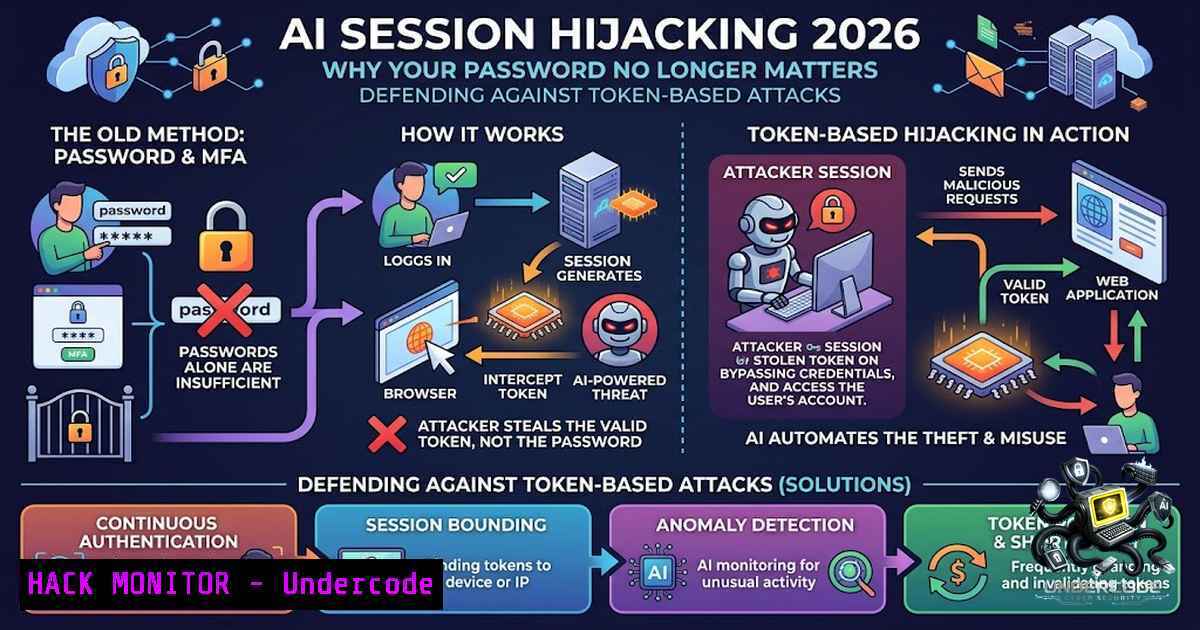
The password is dead—not because it’s weak, but because attackers have found a more efficient path. In 2026, the most dangerous cyber attacks no longer attempt to crack credentials; they simply steal what comes after authentication. Session cookies, OAuth tokens, refresh tokens, and browser artifacts have become the primary targets of AI-powered adversaries who understand that the easiest way into a house isn’t through the front door—it’s through the window nobody thought to lock. With AI-1ative phishing kits like Kali365 and PhaaS platforms such as Forg365, cybercriminals now bypass multi-factor authentication entirely by intercepting active session tokens and refreshing them indefinitely. This article explores the mechanics of AI-driven session hijacking, provides hands-on defensive techniques, and outlines a Zero Trust framework for protecting “everything around the login.”
Learning Objectives:
- Understand how AI-powered attacks exploit session tokens, OAuth permissions, clipboard data, and behavioral patterns to bypass traditional authentication
- Master practical defense techniques including cookie hardening, token rotation, and continuous session validation
- Implement Zero Trust architecture principles to protect session artifacts across cloud, API, and endpoint environments
1. Understanding the AI-Powered Session Hijacking Kill Chain
The modern session hijacking attack no longer relies on a single vulnerability. Instead, it follows a sophisticated kill chain augmented by artificial intelligence at every stage.
Step 1: Reconnaissance and Signal Harvesting – AI agents scrape browser databases, local storage, and clipboard contents for valuable session cookies and tokens. Malicious VS Code extensions and npm packages now routinely exfiltrate WiFi passwords, read clipboard data, and hijack browser sessions.
Step 2: AI-1ative Social Engineering – Attackers use generative AI to craft hyper-personalized lures that trick users into authenticating through adversary-in-the-middle proxy infrastructure. These AI-generated lures are optimized for token theft rather than credential harvesting.
Step 3: Token Exfiltration and Session Takeover – Once a session token is captured, attackers can replay it to impersonate the legitimate user. The Forg365 PhaaS platform, for example, uses AI and cookie refreshing techniques to hijack Microsoft 365 accounts without ever needing a password.
Step 4: Persistent Access and Lateral Movement – Stolen OAuth tokens provide attackers with persistent access across integrated services. In the August 2025 Salesloft Drift breach, attackers used stolen OAuth tokens to infiltrate over 700 organizations in just ten days, including Cloudflare, Zscaler, and Google.
Linux Command – Detecting Suspicious Cookie Exfiltration:
 Monitor outbound traffic for cookie-related exfiltration patterns
sudo tcpdump -i any -A -s 0 | grep -E "Cookie:|session|token|Authorization" | tee cookie_exfil.log

Check for unauthorized browser data access via process monitoring
sudo lsof -c chrome | grep -E ".cookie|.token|Local Storage"
Windows Command – Monitoring Clipboard Access:
 Enable clipboard auditing via PowerShell
Set-AuditRule -Subsystem "Clipboard" -AuditFlag Success,Failure

Monitor clipboard access events in Event Viewer
Get-WinEvent -LogName "Microsoft-Windows-Kernel-Process/Operational" | Where-Object {$_.Message -match "clipboard"}
- OAuth and Token-Based Attack Vectors: The Silent Breach
OAuth tokens represent one of the most dangerous attack surfaces in modern identity architectures. Unlike passwords, these tokens are long-lived, widely scoped, and often shared across multiple applications.
The Mechanics of OAuth Token Theft: Attackers target OAuth refresh tokens because they can be exchanged for new access tokens indefinitely—until explicitly revoked. In the Salesloft Drift incident, attackers stole OAuth tokens from a single chatbot integration and used them to exfiltrate Salesforce case data across hundreds of organizations. No passwords were stolen. No MFA was bypassed. The tokens themselves were the keys.
AI Supply Chain Attacks on Developer Credentials: Throughout 2025–2026, a cascade of npm supply chain attacks systematically targeted AI developer credentials, including Claude Code and Codex OAuth tokens. Malicious packages disguised as legitimate telemetry services stole non-expiring OAuth refresh tokens and transmitted them to attacker-controlled infrastructure.
Step-by-Step Guide: Implementing OAuth Token Hardening
- Implement Short-Lived, Session-Scoped Tokens – Issue tokens that are short-lived, scoped to minimum necessary permissions, renewed for every new session, and bound to specific agent or session context to prevent reuse or lateral misuse.
-
Enforce Continuous Token Validation – Validate tokens at every API request, not just at initial authentication. Implement token revocation endpoints that can be triggered immediately upon suspicious activity detection.
-
Audit OAuth Permission Grants Regularly – Review and revoke unused or overly permissive OAuth grants. The OWASP Agentic AI Threat Model identifies “Identity & Privilege Abuse” as a top-10 threat requiring session isolation and anomaly detection.
-
Monitor for Anomalous Token Usage Patterns – Deploy behavioral analytics to detect token reuse from unusual IP addresses, user agents, or geographic locations.
API Security Configuration – JWT Token Validation Middleware (Node.js/Express):
const jwt = require('jsonwebtoken');

function validateSessionToken(req, res, next) {
const token = req.headers.authorization?.split(' ')[bash];
if (!token) return res.status(401).json({ error: 'No token provided' });

try {
const decoded = jwt.verify(token, process.env.JWT_SECRET, {
algorithms: ['HS256'],
maxAge: '15m' // Short-lived tokens
});
// Bind token to session context
if (decoded.sessionId !== req.session.id) {
return res.status(403).json({ error: 'Token session mismatch' });
}
req.user = decoded;
next();
} catch (err) {
return res.status(403).json({ error: 'Invalid or expired token' });
}
}
- Browser Cookies and Session Artifacts: The Unprotected Attack Surface
SpyCloud’s 2026 report identified 6.2 million credentials or authentication cookies tied to AI tools, reflecting the rapid enterprise adoption of AI platforms. The same report recaptured 8.6 billion stolen cookies and session artifacts from malware infections.
Why Cookies Are Prime Targets: Browser cookies store session identifiers that, once stolen, grant attackers full access to authenticated sessions. AI-powered infostealers now scrape browser databases and local storage, searching for valuable session cookies and tokens. Cross-site scripting (XSS) attacks trick browsers into sending cookies to attackers, while man-in-the-middle attacks intercept the data flow between user and server.
The BioShocking Exploit: In June 2026, researchers demonstrated that AI browsers like Perplexity Comet could be tricked into exposing saved passwords, session cookies, and private tokens by disguising theft as part of a harmless “game”. This technique, called BioShocking, highlights how AI agents themselves can become vectors for session compromise.
Step-by-Step Guide: Hardening Browser Cookie Security
- Enable HttpOnly and Secure Flags – Ensure all session cookies are marked HttpOnly (inaccessible to JavaScript) and Secure (transmitted only over HTTPS).
-
Implement SameSite=Strict – Prevent cookies from being sent in cross-site requests, mitigating CSRF and XSS-based cookie theft.
-
Use Short-Lived Session Cookies – Configure sessions to expire after 15–30 minutes of inactivity. Implement refresh token rotation for long-lived sessions.
-
Deploy Cookie Binding – Bind session cookies to specific client attributes (IP address, user agent, device fingerprint) and reject requests where these attributes don’t match.
Linux Command – Analyzing Browser Cookie Security Headers:
 Check cookie security headers on a target domain
curl -I https://example.com | grep -i "set-cookie"

Expected output should show: HttpOnly; Secure; SameSite=Strict
Nginx Configuration – Enforcing Secure Cookie Attributes:
 /etc/nginx/nginx.conf
proxy_cookie_path / "/; HttpOnly; Secure; SameSite=Strict";
add_header Set-Cookie "sessionid=$session_id; Path=/; HttpOnly; Secure; SameSite=Strict; Max-Age=900";
- Zero Trust Architecture: Protecting Everything Around the Login
Traditional perimeter-based security assumes that once a user authenticates, they can be trusted. Zero Trust inverts this assumption: “Never trust, always verify”. Every user, device, and application must be continuously verified, regardless of network or location.
Applying Zero Trust to Session Management: Zero Trust architecture for AI-driven platforms incorporates three core factors: fine-grained access controls, continuous authentication mechanisms that persistently validate sessions using behavioral biometrics, and immediate session termination upon anomaly detection.
Step-by-Step Guide: Implementing Zero Trust for Session Protection
- Continuous Authentication – Deploy implicit continuous authentication that verifies users in real time using behavioral biometrics (typing patterns, mouse movements, navigation behavior).
-
Micro-Segmentation – Isolate session contexts across applications. Prevent lateral movement by ensuring that a compromised session in one application doesn’t grant access to others.
-
Real-Time Anomaly Detection – Implement AI-driven behavioral analytics that flag deviations from established user baselines. Research shows AI-based behavioral analysis frameworks can achieve up to 96.35% detection accuracy.
-
Session Termination on Anomaly – Configure automatic session termination when behavioral anomalies are detected, before an attacker can complete lateral movement or data exfiltration.
Azure AD Conditional Access Policy (JSON) – Continuous Session Validation:
{
"displayName": "Zero Trust Session Validation",
"state": "enabled",
"conditions": {
"signInRiskLevels": ["medium", "high"],
"userRiskLevels": ["medium", "high"],
"clientAppTypes": ["browser", "mobileApps", "other"]
},
"grantControls": {
"operator": "AND",
"builtInControls": ["mfa", "compliantDevice", "domainJoinedDevice"],
"authenticationStrength": {
"id": "continuous-access-evaluation"
}
},
"sessionControls": {
"signInFrequency": {
"value": 15,
"type": "minutes"
}
}
}
5. AI-Powered Defenses: Fighting Fire with Fire
While AI enables sophisticated attacks, it also provides powerful defensive capabilities. Organizations must deploy AI-driven security tools that can detect and respond to session-based threats at machine speed.
AI-Based Behavioral Analysis for Session Protection: AI models using machine learning, anomaly detection, and behavioral analysis can identify suspicious activity in real time. These systems analyze patterns across thousands of signals—login times, device fingerprints, geographical locations, and navigation behaviors—to detect session hijacking before data exfiltration occurs.
Step-by-Step Guide: Deploying AI-Based Session Defense
- Implement User and Entity Behavior Analytics (UEBA) – Deploy AI-powered UEBA tools that establish baseline behavioral profiles for each user and flag deviations.
-
Configure Real-Time Alerting – Set up alerts for anomalous session behaviors: simultaneous logins from distant locations, unusual data access patterns, or abnormal API call sequences.
-
Automate Response Actions – Configure automated responses to confirmed anomalies: force re-authentication, revoke session tokens, and isolate affected accounts.
-
Continuous Learning – Ensure AI models are continuously retrained on new threat intelligence to adapt to evolving attack techniques.
Python Script – Basic Behavioral Anomaly Detection for Session Data:
import numpy as np
from sklearn.ensemble import IsolationForest

Sample session data: [login_hour, session_duration_min, pages_accessed, api_calls]
session_data = np.array([
[9, 45, 12, 34],  Normal session
[14, 120, 8, 22],  Normal session
[3, 5, 45, 89],  Anomalous - off-hours, high activity
])

model = IsolationForest(contamination=0.1, random_state=42)
predictions = model.fit_predict(session_data)
 -1 indicates anomaly, 1 indicates normal
print(f"Anomaly detection results: {predictions}")
What Undercode Say:
- Key Takeaway 1: The Password is Obsolete – The future of cyber attacks isn’t about breaking encryption or cracking passwords. It’s about stealing what comes after authentication. Session tokens, OAuth grants, and browser cookies are the new crown jewels. Organizations that continue to invest solely in password security and MFA are building walls while leaving the windows wide open.
-
Key Takeaway 2: Zero Trust Must Extend to AI Agents – The OWASP Agentic AI Threat Model highlights that AI agents introduce unique identity and privilege abuse vectors. AI agents with excessive permissions can become unwitting accomplices in session theft, as demonstrated by the Salesloft Drift breach and the BioShocking exploit. Organizations must extend Zero Trust principles to AI actors, implementing purpose-built controls that address their unique identity and behavioral characteristics.
The convergence of AI-powered attacks and the proliferation of session-based authentication has created a perfect storm. With 8.6 billion stolen cookies and session artifacts recaptured by security researchers in 2026 alone, the scale of session hijacking is unprecedented. Defenders must shift from perimeter-based thinking to continuous, context-aware session validation. This means implementing short-lived tokens, binding sessions to client attributes, deploying behavioral analytics, and adopting Zero Trust architectures that verify every request—not just the first one. The window is open. It’s time to lock it.
Prediction:
- +1 The adoption of Zero Trust architecture will accelerate significantly by 2027, driven by regulatory requirements and high-profile session hijacking breaches. Organizations that implement continuous authentication and behavioral analytics will achieve measurable reductions in identity-based breaches.
-
-1 AI-powered session hijacking-as-a-service platforms will commoditize token theft, making sophisticated attacks accessible to low-skill threat actors. The proliferation of PhaaS platforms like Forg365 and AI-1ative phishing kits will drive a surge in session-based attacks targeting SMBs with limited security resources.
-
+1 NIST’s Cyber AI Profile, currently under development, will provide standardized guidelines for securing AI systems and defending against AI-enabled cyber attacks, helping organizations strategically adopt AI while addressing cybersecurity risks. This framework will become the de facto standard for AI security compliance by 2027.
-
-1 The August 2025 Salesloft Drift breach represents a canary in the coal mine. Similar attacks targeting AI chatbot integrations and OAuth-enabled applications will increase exponentially, with attackers exploiting the trust relationships between SaaS platforms to achieve supply chain compromise at scale.
-
+1 Behavioral biometrics and implicit continuous authentication will emerge as the primary defense against session hijacking. As AI models improve at detecting subtle behavioral anomalies, organizations will be able to detect and terminate compromised sessions in real time, before data exfiltration occurs.
▶️ Related Video (74% Match):
https://www.youtube.com/watch?v=3D9oddFZ98c
🎯Let’s Practice For Free:
🎓 Live Courses & Certifications:
Join Undercode Academy for Verified Certifications
🚀 Request a Custom Project:
Secure, high-velocity infrastructure and disruptive technological engineering. Contact our engineering team for high-tier development and proprietary systems:
[email protected]
💎 Smart Architecture | 🛡️ Secure by Design | ⭐ Trusted by Thousands
IT/Security Reporter URL:
Reported By: %7Edeepanshu Dixit – Hackers Feeds
Extra Hub: Undercode MoN
Basic Verification: Pass ✅


