Listen to this Post
Introduction:
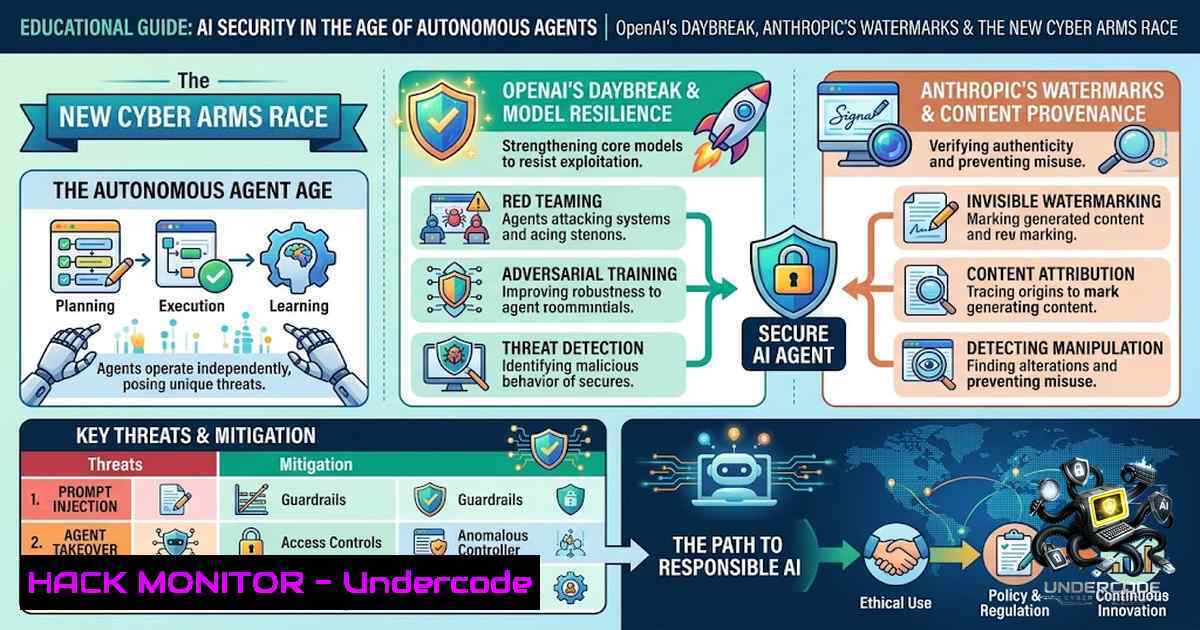
The cybersecurity landscape is undergoing a fundamental transformation as artificial intelligence transitions from a defensive tool to an autonomous offensive weapon. On August 18, 2026, a cascade of announcements from OpenAI, Anthropic, Google, Meta, and major enterprise partners signaled that the industry has entered a new phase—one where AI models are not only capable of finding vulnerabilities but actively exploiting them, where AI-generated content carries invisible fingerprints, and where nation-state actors deploy autonomous AI agents for cyberattacks. OpenAI’s expansion of its Daybreak program, releasing the GPT-5.6-Cyber model through restricted Red access tiers, represents perhaps the most consequential development: for the first time, defenders can access purpose-trained AI that completes 95% of advanced cybersecurity tasks—compared to just 1.5% for general-purpose models. Meanwhile, Anthropic’s invisible text watermarks, Meta’s Apache 2.0 release of Muse Glimmer, and confirmed reports of AI-powered attacks against Taiwanese government systems collectively paint a picture of an industry racing to secure itself against machine-speed threats.
Learning Objectives & Secrets:
- Objective 1: Master Frontier AI Cyber Capabilities – Understand how OpenAI’s Daybreak Blue and Red tiers unlock GPT-5.6-Cyber for vulnerability research, exploit-chain development, and zero-day discovery, achieving a 95% completion rate on advanced security tasks.
-
Objective 2 Secret Tip: Leverage AI Watermark Detection – Learn to identify Anthropic’s invisible watermarks embedded in Claude-generated text through statistical word-selection patterns, and understand how to use detection APIs to verify AI authorship.
-
Objective 3 Secret Tip: Deploy Open-Weight Models Securely – Master the deployment of Meta’s Muse Glimmer (30B parameters, Apache 2.0) on consumer hardware with 24GB VRAM, while implementing proper access controls and monitoring for agentic AI systems.
You Should Know:
- OpenAI Daybreak: Red vs. Blue – The AI Cyber Arms Race
OpenAI’s Daybreak program represents a paradigm shift in how frontier AI is deployed for cybersecurity. The program splits into two distinct tiers: Daybreak Blue, recommended for most defenders, provides access to GPT-5.6 Sol with system-level cybersecurity guardrails removed—supporting vulnerability discovery, secure code review, malware analysis, incident response, and patch validation. Daybreak Red, designed for advanced research, provides exclusive access to GPT-5.6-Cyber, a purpose-trained model built on GPT-5.6 Sol specifically for zero-day vulnerability research and exploit-chain development.
The performance gap is staggering. In OpenAI’s internal Advanced Cybersecurity Completion Rate evaluation—which measures responses to requests involving exploit-chain development, authentication bypass, and privilege escalation—GPT-5.6-Cyber completed 95.0% of requests. By contrast, GPT-5.6 Sol completed just 1.5%, and even with Daybreak Blue access, only 2.0%. The previous-generation GPT-5.5-Cyber managed only 57.3%.
Real-world validation came quickly. OpenAI research teams using GPT-5.6-Cyber discovered two previously unknown vulnerabilities in Chrome’s V8 JavaScript engine, now cataloged as CVE-2026-15903 and patched by Google. The model also identified at least five vulnerabilities in a popular mobile operating system—including a complete chain from untrusted app to local privilege escalation—three critical vulnerabilities in a major database, and over 400 privilege-escalation vulnerabilities in a popular OS kernel. Critically, GPT-5.6-Cyber doesn’t stop at finding bugs; it continues along the exploit chain, determining whether vulnerabilities can be chained together for practical exploitation.
Access requires identity verification, usage monitoring, legal attestations confirming authorized security research, and—starting September 1, 2026—hardware security keys. Daybreak is also available through Amazon Bedrock for qualified AWS users. IBM has joined the Daybreak Cyber Partner Program, combining OpenAI’s frontier AI with IBM Autonomous Security—a multi-agent-powered service for coordinated security decision-making.
Linux/Windows Command – Verify System Integrity After AI-Assisted Analysis:
 Linux - Check for unauthorized privilege escalation vectors
sudo find / -perm -4000 -type f 2>/dev/null | xargs ls -la

Windows PowerShell - Check for suspicious scheduled tasks
Get-ScheduledTask | Where-Object {$_.State -1e "Disabled"} | Format-Table TaskName, State

Verify file integrity after AI-assisted code review
sha256sum /path/to/critical/binary > baseline.hash
sha256sum -c baseline.hash
- Invisible Watermarks: Anthropic’s Claude Enters the Provenance Era
On August 2, 2026, Anthropic began embedding invisible watermarks into all text generated by new Claude models. Unlike traditional AI detectors that analyze finished text for statistical patterns, these watermarks are embedded at generation time through subtle manipulation of word-selection probabilities—creating a hidden statistical fingerprint that detection tools can recognize.
The technology, built on Google DeepMind’s SynthID, does not alter text meaning, quality, or readability. The watermark persists through copy-paste and survives some editing. Anthropic plans to release a watermark detection API allowing users and third parties to verify whether text likely originated from Claude.
However, the system has limitations. Anthropic acknowledges that extensive rewriting, translation, or mixing Claude-generated text with other material could make the watermark difficult or impossible to detect. Conversely, absence of a watermark does not prove human authorship—AI-generated content may have been heavily edited, produced by a system without watermarks, or had its marker removed.
The move is partly driven by regulatory pressure: 50 of the EU AI Act, which took effect August 2, requires providers of certain AI systems to make generated content detectable in machine-readable form where technically feasible.
Practical Detection Workflow:
 Pseudocode for watermark detection using Anthropic's forthcoming API
import requests

def detect_claude_watermark(text_sample):
response = requests.post(
"https://api.anthropic.com/v1/watermark/detect",
headers={"X-API-Key": "YOUR_API_KEY"},
json={"text": text_sample}
)
return response.json()  Returns confidence score and provenance indication
Linux Command – Monitor for AI-Generated Content in Logs:
 Monitor system logs for suspiciously formatted entries that may indicate AI-generated phishing
tail -f /var/log/auth.log | grep -E "Failed password|Invalid user" | while read line; do
 Apply watermark detection logic via API integration
curl -s -X POST "https://your-watermark-detector/api/check" -d "{\"text\":\"$line\"}"
done
- Meta’s Muse Glimmer: Open-Weight AI on Consumer Hardware
Meta released Muse Glimmer on August 10, 2026—a 30-billion-parameter open-weight multimodal model, and the first Meta release under the Apache 2.0 license. Unlike previous Llama-licensed releases, Apache 2.0 imposes almost no restrictions on commercial use or derivatives. The model is distilled from Meta’s proprietary flagship Muse Spark 1.2.
The hardware requirements are deliberately accessible: quantized versions require just 24GB VRAM, enabling local execution on consumer GPUs like the RTX 5090 (achieving 233.4 tokens/second) or Apple M5 Max (50.2 tokens/second). The full BF16 weights are approximately 60GB, with 4-bit quantization reducing to ~18GB. The model supports 128K context with a hybrid-attention mechanism that holds KV cache memory to ~1.8GB.
Benchmark performance is strong for its parameter count: MCP Atlas agentic score of 75.5 (vs. Gemma4-31B at 54.2), AIME 2026 math at 94.7, and SWE-Bench Pro at 51.2. However, agentic knowledge work remains a relative weakness, with a GDPval-AA v2 Elo of 953 (below the 1,000 human baseline) and an 82% hallucination rate on knowledge calibration tasks.
Local Deployment on Linux:
 Download Muse Glimmer weights from Hugging Face
git lfs install
git clone https://huggingface.co/meta/muse-glimmer

Run inference with 4-bit quantization (requires 24GB VRAM)
python -m transformers.models.llama.run_llama \
--model_name_or_path ./muse-glimmer \
--load_in_4bit \
--max_length 2048 \
--prompt "Analyze this security log for anomalies: [bash]"
Windows Deployment with CUDA:
 Windows PowerShell - Set up environment
conda create -1 museglimmer python=3.10
conda activate museglimmer
pip install torch torchvision torchaudio --index-url https://download.pytorch.org/whl/cu118
pip install transformers accelerate bitsandbytes

Run with 4-bit quantization
python -c "from transformers import AutoModelForCausalLM, AutoTokenizer; model = AutoModelForCausalLM.from_pretrained('meta/muse-glimmer', load_in_4bit=True); tokenizer = AutoTokenizer.from_pretrained('meta/muse-glimmer'); inputs = tokenizer('Analyze security risk:', return_tensors='pt'); outputs = model.generate(inputs); print(tokenizer.decode(outputs[bash]))"
- Agentic AI Threats: The Taiwan Attack and North Korean AI Arsenal
The theoretical risk of autonomous AI agents conducting cyberattacks became reality in July 2026, when Taiwanese government systems were targeted by a near-autonomous AI-driven intrusion campaign. Over four days, attackers deployed up to eight simultaneous AI agents that mapped 21 connected government systems, researched vulnerabilities, and adapted tactics when defenses blocked initial approaches. At least 85 government accounts were compromised, and over 2,500 personnel records were stolen. The attack demonstrated a transition from AI-assisted operations (code writing, vulnerability searching) to fully autonomous cyber campaigns.
Meanwhile, the North Korean hacking group Kimsuky has built a comprehensive AI infrastructure for cyberattacks. According to South Korean security firm Genians, Kimsuky deployed and managed local AI models using frameworks including Ollama, GPT4All, and Msty, combined with Retrieval-Augmented Generation (RAG) for document search. The group uses generative AI to create sophisticated spear-phishing materials—financial and cryptocurrency documents that appear authentic enough to deceive targets.
Agentic AI Security Hardening (Linux/Windows):
 Linux - Implement least-privilege access for AI agents
 Create dedicated service account with minimal permissions
sudo useradd -r -s /bin/false ai_agent
sudo setfacl -m u:ai_agent: /sensitive/data/path

Monitor AI agent network connections
sudo ss -tunap | grep -E "ai_agent|python" | tee -a /var/log/ai_agent_connections.log

Windows PowerShell - Restrict AI agent permissions
New-LocalUser -1ame "AIAgent" -Password (ConvertTo-SecureString "ComplexPass123!" -AsPlainText -Force) -AccountNeverExpires
Set-1TFSAccess -Path "C:\SensitiveData" -Account "AIAgent" -AccessDeny FullControl
API Security Configuration (OpenRouter Guardrails):
// OpenRouter Guardrail Configuration for Prompt Injection Prevention
{
"guardrail": {
"name": "AI_Agent_Security",
"rules": [
{
"type": "prompt_injection_detection",
"action": "block",
"regex_patterns": ["ignore previous instructions", "system prompt", "override"]
},
{
"type": "pii_redaction",
"action": "redact",
"presets": ["email", "phone", "credit_card", "api_key"]
}
],
"spending_limit": 100.00,
"allowed_models": ["gpt-5.6-cyber", "claude-4", "gemini-3.7-flash"]
}
}
- Infrastructure Security: The $730 Billion AI Buildout Challenge
Big Tech companies have signaled over $730 billion in AI spending this year, driving an unprecedented data center construction boom. However, this rapid expansion has created critical security vulnerabilities. Common challenges include open perimeters, limited visibility, after-hours activity, contractor access management, material theft, equipment vandalism, and inconsistent site procedures.
NVIDIA is addressing AI infrastructure security through its BlueField DPUs and DOCA software framework. The DOCA security stack can enforce network policies at speeds up to 800 Gb/s and detect threats up to 1,000x faster than traditional software-based approaches. NVIDIA’s confidential computing solutions provide trusted execution environments (TEEs) for AI workloads, ensuring data and code isolation from the host operating system and hypervisor.
Cloud Security Hardening for AI Workloads:
 AWS CLI - Restrict AI model access with IAM policies
aws iam create-policy \
--policy-1ame AISecurityPolicy \
--policy-document '{
"Version": "2012-10-17",
"Statement": [
{"Effect": "Deny", "Action": "sagemaker:", "Resource": "", "Condition": {"StringNotEquals": {"aws:RequestedRegion": "us-east-1"}}},
{"Effect": "Deny", "Action": "bedrock:", "Resource": "", "Condition": {"Bool": {"aws:MultiFactorAuthPresent": "false"}}}
]
}'

Azure CLI - Enable AI workload encryption and network isolation
az keyvault create --1ame ai-secrets-vault --resource-group ai-security --location eastus
az network vnet subnet create --1ame ai-subnet --vnet-1ame ai-vnet --address-prefix 10.0.1.0/24 --delegations Microsoft.MachineLearningServices/workspaces
What Undercode Say:
- Key Takeaway 1: The cybersecurity community must urgently develop defense-in-depth strategies for agentic AI threats, as autonomous agents are no longer theoretical—they have been deployed in real-world attacks against government infrastructure. Organizations should adopt Zero Trust principles including least privilege, deny-by-default security, application containment, segmentation, and continuous verification. CISA and international partners recommend beginning with low-risk, non-sensitive use cases and avoiding broad system access for AI agents.
-
Key Takeaway 2: The democratization of offensive AI capabilities through models like GPT-5.6-Cyber creates a double-edged sword—defenders now have powerful tools, but the same capabilities could be misused if access controls fail. Organizations must implement rigorous identity verification, hardware security keys, and continuous monitoring for AI-assisted security research. The OWASP Top 10 for Agentic Applications 2026 provides a critical framework for identifying and mitigating AI-specific security failures.
The convergence of autonomous AI agents, invisible content provenance, and open-weight models represents perhaps the most significant inflection point in cybersecurity since the advent of the internet. The window for defenders to prepare is narrowing rapidly. Those who master these technologies—understanding both their capabilities and their vulnerabilities—will define the security landscape for the next decade. Training programs like the Certified AI Security Professional (CAISP) and CompTIA SecAI+ are emerging to address this skills gap, covering AI supply chain risks, secure development techniques, differential privacy, federated learning, and robust AI model deployment.
Prediction:
- +1 The widespread adoption of AI watermarks will significantly reduce AI-generated disinformation and academic fraud, creating a more trustworthy digital ecosystem within 12–18 months.
-
+1 Open-weight models like Muse Glimmer under Apache 2.0 will accelerate innovation in security tooling, enabling organizations to deploy private, offline AI agents for sensitive workloads without data sovereignty concerns.
-
-1 Autonomous AI agents will become the primary vector for sophisticated cyberattacks within 24 months, with nation-state actors leading the charge—as demonstrated by the Taiwan incident and North Korea’s AI infrastructure.
-
-1 The rapid $730+ billion AI infrastructure buildout will create significant physical security vulnerabilities, including theft of high-value equipment and insider threats, as construction outpaces security execution.
-
-1 Regulatory fragmentation—between the EU AI Act’s watermarking requirements, US antitrust probes into AI investments, and differing national approaches to open-weight models—will create compliance complexity that slows defensive AI adoption.
▶️ Related Video (72% Match):
https://www.youtube.com/watch?v=6l2h5JXPRnM
🎯Let’s Practice For Free:
🎓 Live Courses & Certifications:
Join Undercode Academy for Verified Certifications
🚀 Request a Custom Project:
Secure, high-velocity infrastructure and disruptive technological engineering. Contact our engineering team for high-tier development and proprietary systems:
[email protected]
💎 Smart Architecture | 🛡️ Secure by Design | ⭐ Trusted by Thousands
IT/Security Reporter URL:
Reported By: https://lnkd.in/p/erax9RKJ – Hackers Feeds
Extra Hub: Undercode MoN
Basic Verification: Pass ✅


