Listen to this Post
Introduction:
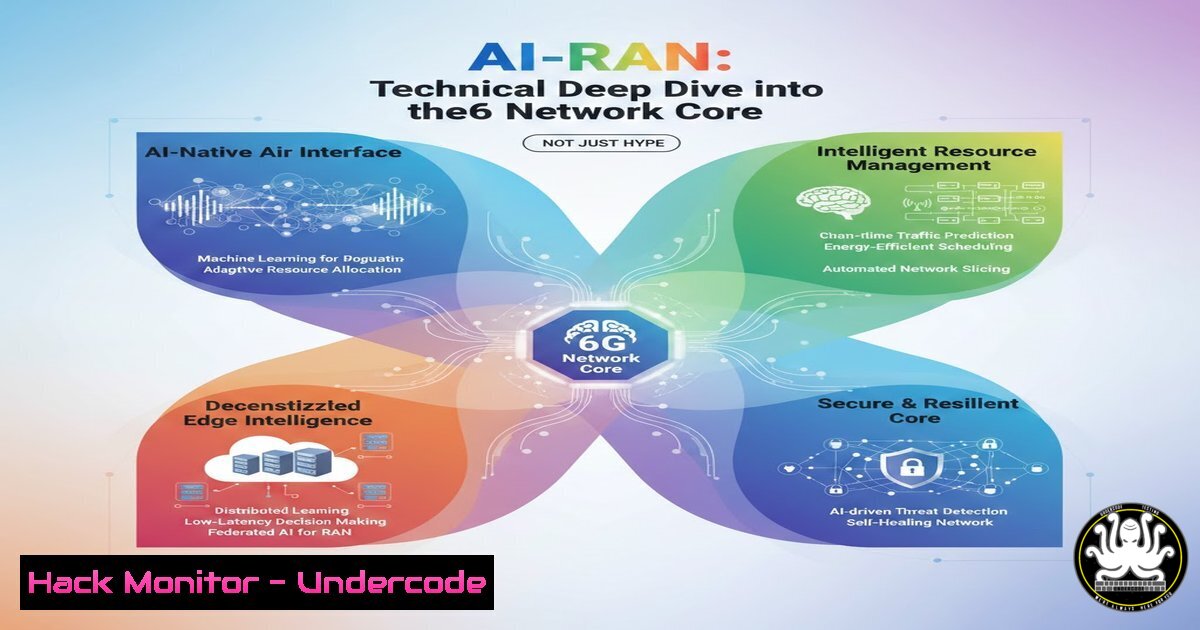
The convergence of Artificial Intelligence (AI) and telecommunications infrastructure is no longer theoretical. AI-RAN (AI-Radio Access Network) represents a paradigm shift where mobile network base stations are repurposed as distributed AI data centers. While this promises unprecedented efficiency and low-latency edge computing, it also introduces a sprawling new attack surface for cyber threats. This article dissects the architecture of AI-RAN, providing hands-on configurations for security professionals to understand the risks and hardening requirements of this 6G-enabling technology.
Learning Objectives:
- Understand the three core architectural models of AI-RAN (AI for RAN, AI and RAN, AI on RAN).
- Learn to simulate AI-RAN edge nodes and configure network isolation using Linux.
- Identify API security vulnerabilities in RAN Intelligent Controllers (RIC).
- Implement traffic monitoring and anomaly detection for AI-assisted network slicing.
1. Deconstructing the AI-RAN Stack: The “Three Architectures”
To secure AI-RAN, one must first understand its hybrid nature. It is not a single product but a combination of three distinct workloads sharing the same physical hardware at the cell site. This breaks the traditional air-gap between the Radio Unit (RU) and the data center.
Extended Explanation:
Leonard Lee’s post highlights three key aspects:
- AI for RAN: Using Machine Learning (ML) models to optimize beamforming, Massive MIMO, and power consumption. This runs on the same DSPs (Digital Signal Processors) that handle the radio traffic.
- AI and RAN: Co-location of general AI workloads (e.g., autonomous driving inference, smart city video analytics) on the same server as the RAN stack. This turns a cell tower into an edge data center.
- AI on RAN: Utilizing the RAN’s low-latency connection to deliver AI services to end-users, essentially treating the network as a pipe for AI data.
Step‑by‑step guide: Simulating a Collocated Environment for Security Testing
To understand the resource contention and isolation risks, we can simulate this on a Linux server using `cgroups` and network namespaces.
- Simulate the RAN Workload (using DPDK): RAN functions often use DPDK (Data Plane Development Kit) for high-speed packet processing. This requires hugepages and CPU isolation.
Reserve 1GB hugepages (simulate RAN requirement)
echo 1024 | sudo tee /sys/kernel/mm/hugepages/hugepages-2048kB/nr_hugepages
Isolate CPU cores for RAN (e.g., cores 0-3)
sudo grubby --update-kernel=ALL --args="isolcpus=0,1,2,3"
-
Simulate the AI Workload (using a container): Run a standard AI inference model (like TensorFlow serving) in a container, ensuring it cannot starve the RAN process.
Create a cgroup for the AI workload limiting CPU to cores 4-7
sudo mkdir /sys/fs/cgroup/cpu/AI_Workload
sudo sh -c "echo 400000 > /sys/fs/cgroup/cpu/AI_Workload/cpu.cfs_quota_us"  Limit to 4 cores
Run a stress test to simulate AI load
sudo cgexec -g cpu:AI_Workload docker run --rm --cpuset-cpus="4-7" ubuntu stress --cpu 4
2. Securing the RAN Intelligent Controller (RIC) APIs
AI-RAN relies heavily on the RIC, an open controller that uses standardized interfaces (E2, A1, O1) to manage the RAN. These interfaces are API-driven (often HTTP/REST or message queues like Kafka) and are a prime target for attackers.
Step‑by‑step guide: Auditing and Hardening RIC Interfaces
We will simulate a Near-Real-Time RIC (Near-RT RIC) and audit its exposed endpoints.
- Simulate a RIC Endpoint: Using a simple Python HTTP server to mimic a vulnerable xApp (microservice running on the RIC).
python3 -m http.server 8080 --directory /tmp/ DON'T DO THIS IN PRODUCTION
- Scan for Open Endpoints: Use `nmap` and `gobuster` to find hidden APIs.
Scan for open ports on the RIC
nmap -sT -p- <RIC_IP_Address> -oN ric_scan.txt
Brute force directories on a web server (simulating A1 interface)
gobuster dir -u http://<RIC_IP>:8080 -w /usr/share/wordlists/dirb/common.txt
- Implement mTLS for E2 Interface: The E2 interface connects the RIC to the base stations (E2 Nodes/gNBs). It must be encrypted and authenticated.
– Generate certificates for the RIC and the gNB.
– Configure O-RAN compliant software (e.g., using the O-RAN SC (Software Community) near-rt-ric simulator) to require client certificates.
3. Network Slicing and Traffic Anomaly Detection
AI-RAN enables dynamic network slicing, where a “slice” of the network is dedicated to specific AI services (e.g., a slice for autonomous vehicles with guaranteed latency). An attacker compromising an AI application could attempt to “bleed” into other slices.
Step‑by‑step guide: Monitoring Slice Performance with eBPF
We can use eBPF (extended Berkeley Packet Filter) to monitor latency and packet drops on specific virtual interfaces representing slices.
1. Create Virtual Slices (using Linux Bridges):
 Create two network namespaces to represent different slices
ip netns add slice1_auto
ip netns add slice2_iot
 Create veth pairs to connect them
ip link add veth1a type veth peer name veth1b
ip link set veth1b netns slice1_auto
2. Deploy an eBPF Monitor for Packet Drops:
Compile and run a simple eBPF program that hooks into the `kfree_skb` kernel function to record IP addresses causing packet drops (a sign of congestion or attack).
 Example using BCC tools
sudo tcplife  Monitors TCP sessions
 Or use a dedicated tool for drops
sudo /usr/share/bcc/tools/tcpretrans  Shows TCP retransmissions (latency spikes)
3. Simulate a DoS Attack on a Slice: From one namespace, flood the other to see if the monitor catches the anomaly.
 In slice1_auto namespace
ip netns exec slice1_auto hping3 -S --flood <IP_of_slice2>
4. Power Consumption Attacks (AI for RAN Exploitation)
AI-RAN aims to reduce power consumption via AI. However, if the AI model that controls power savings is poisoned, an attacker could force the radios into high-power states, causing physical damage or draining backup batteries.
Step‑by‑step guide: Testing Model Integrity on Edge Devices
We will simulate a model loaded onto an NVIDIA Jetson (common in edge AI) and test its response to adversarial input.
- Load a Sleep Mode Model: Create a simple Python script that decides to put the radio to sleep based on traffic load.
- Craft Adversarial Input: Generate network traffic that mimics low-load signatures but contains malicious packets.
Using Scapy to send crafted packets
from scapy.all import
Send a single packet with a specific flag to trick the model
send(IP(src="192.168.1.100", dst="cell_tower_ip")/TCP(flags="F"))  FIN flag might indicate session end
- Monitor Power Draw: Check the GPU/Rail voltages on the edge device to see if the AI incorrectly kept the radio active.
On Jetson
sudo tegrastats
5. Zero Trust for the Fronthaul
The fronthaul connects the Remote Radio Unit (RRU) to the Distributed Unit (DU). In AI-RAN, this is often Ethernet-based (eCPRI). If an attacker gains access to this network, they can inject false IQ data.
Step‑by‑step guide: Securing Fronthaul with MACsec
MACsec (IEEE 802.1AE) provides encryption at Layer 2, which is crucial for the low-latency requirements of eCPRI.
1. Check NIC Support:
ethtool eth0 | grep macsec
2. Configure MACsec on Linux:
 On DU side
ip link add link eth0 macsec0 type macsec encrypt on
ip macsec add macsec0 tx sa 0 pn 1 on key 01 02030405060708090a0b0c0d0e0f10
ip link set macsec0 up
 On RRU side, configure with the same key and corresponding rx sa
6. 5G Core (5GC) Exposure to AI Applications
The “AI on RAN” model exposes the 5G Core’s Network Exposure Function (NEF) to third-party AI applications. Misconfigured NEF APIs can allow external apps to request QoS changes or device location.
Step‑by‑step guide: Testing NEF API Permissions
Using `curl` to interact with a simulated NEF (like free5GC) to test for privilege escalation.
1. Authenticate as a Fake Application:
curl -X POST http://<NEF_IP>:<port>/api/v1/authentication -d '{"app_id": "malicious_app", "password": "test"}'
2. Attempt to Modify QoS:
 Attempt to request high bandwidth for a specific UE (Subscriber)
curl -X POST http://<NEF_IP>/api/v1/3gpp-asession-with-qos/v1/ \
-H "Authorization: Bearer [bash]" \
-d '{"ueId": "imsi-208930000000001", "qosReference": "9"}'  QoS 9 = GBR (Guaranteed Bitrate)
3. Audit Logs: Check the NEF logs for unauthorized access attempts.
journalctl -u free5gc-nef.service | grep -i "malicious_app"
What Undercode Say:
- The Edge is the New Perimeter: AI-RAN collapses the data center and the tower. Hardening traditional RAN protocols (CPRI/eCPRI) is no longer enough; security teams must now patch Linux kernels, container runtimes, and AI models at the cell site.
- API Sprawl is the Primary Risk: The O-RAN architecture is driven by open interfaces (A1/E2). Without strict mTLS and API gateways, every xApp becomes a potential entry point to the mobile core.
- AI Models are Configuration Files: In an AI-RAN world, poisoning the beamforming model is equivalent to corrupting a routing table. Integrity validation of AI models (using TPMs or secure boot) is as critical as cryptographic verification of software updates.
The convergence of AI and the RAN is not just an evolution; it is a re-architecture of the internet’s edge. Security strategies must shift from protecting a physical hut at the base of a tower to protecting a distributed, virtualized, and intelligent cloud environment exposed to the elements. If the telecom industry fails to implement zero-trust principles at the silicon and API level, the ultra-low latency promised by 6G will come at the cost of ultra-high vulnerability.
Prediction:
Within the next 24 months, the first major breach attributed to AI-RAN will occur not via a radio wave, but through a vulnerable third-party AI application (xApp) deployed on a RAN Intelligent Controller. This attack will allow lateral movement from the public internet into the mobile operator’s core network, bypassing traditional perimeter defenses. This event will force the O-RAN Alliance to mandate hardware-based trusted execution environments (TEEs) for all AI workloads running on RAN hardware.
▶️ Related Video (80% Match):
🎯Let’s Practice For Free:
IT/Security Reporter URL:
Reported By: Stuart Wood – Hackers Feeds
Extra Hub: Undercode MoN
Basic Verification: Pass ✅


