Listen to this Post
Introduction
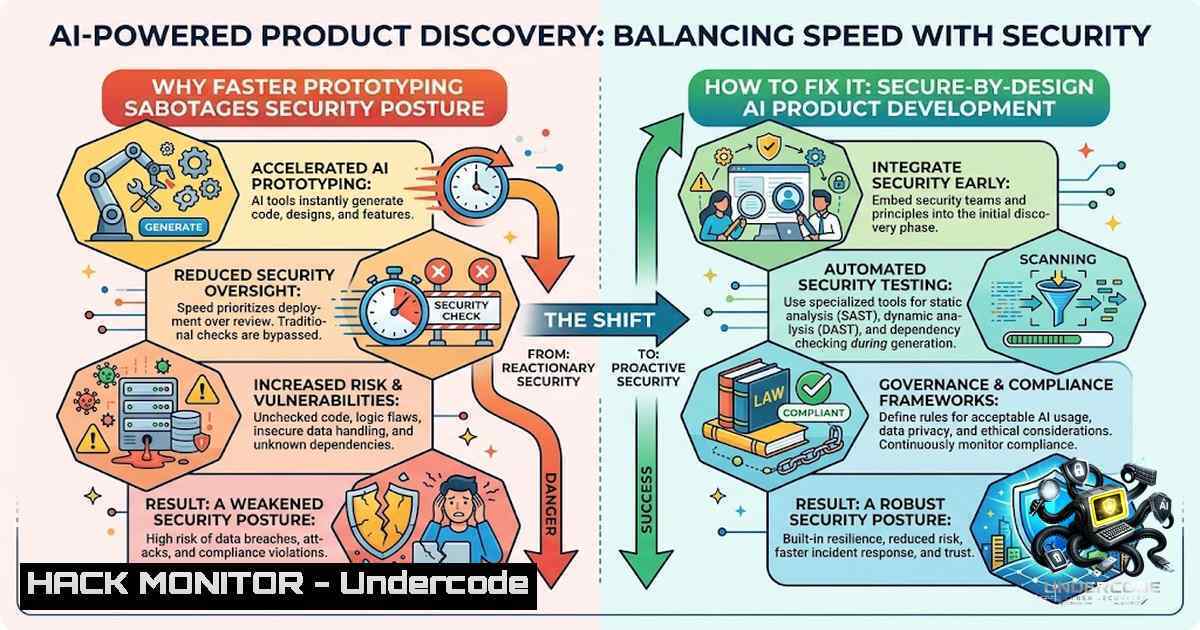
The integration of AI coding assistants like Claude Code into product development has created a dangerous illusion: that shipping prototypes faster equates to building better, more secure products. As Tom Frauenfelder recently highlighted, product leaders are discovering that while AI can collapse the distance between disciplines, a generated prototype does not prove customer value, production architecture, or commercial viability. This article bridges the gap between AI-assisted development and cybersecurity, exploring how to transform rapid prototyping from a security liability into a strategic advantage through disciplined testing, threat modeling, and continuous validation.
Learning Objectives
- Understand the “AI efficiency paradox” and its implications for product security and development workflows
- Implement secure AI-assisted coding practices that balance speed with security validation
- Apply practical threat modeling and testing frameworks to AI-generated prototypes
- Master Linux and Windows commands for securing AI development environments
- Integrate continuous security validation into AI-powered product discovery loops
You Should Know
- The AI Efficiency Paradox: When Speed Becomes a Security Vulnerability
The core insight from Frauenfelder’s analysis is that AI tools enable teams to “build the answer faster than we can prove we asked the right question”. In cybersecurity terms, this translates to deploying vulnerable code faster than we can validate it. Atlassian’s “AI efficiency paradox” describes the gap between individual output and business results—but there’s also a security paradox: AI-generated code often contains subtle vulnerabilities that human reviewers might miss because the volume of output overwhelms traditional review processes.
What This Means for Security Teams:
When a product leader can generate an interactive prototype in hours rather than weeks, the traditional security gate—where engineers review code before deployment—becomes a bottleneck that teams are tempted to bypass. The prototype becomes “just a more visual and tangible question”, but when that question is deployed to production environments, it becomes a real attack surface.
Linux Commands for Securing AI Development Environments:
 Audit installed AI/ML packages for known vulnerabilities
pip list --outdated | grep -E "tensorflow|torch|transformers|langchain"

Check for exposed API keys in your codebase
grep -r "API_KEY|SECRET|TOKEN" --include=".py" --include=".js" ./src/

Set up a pre-commit hook to scan for secrets
cat > .git/hooks/pre-commit << 'EOF'
!/bin/bash
if grep -r "sk-[a-zA-Z0-9]" ./; then
echo "❌ OpenAI API key detected in plaintext!"
exit 1
fi
EOF
chmod +x .git/hooks/pre-commit
Windows Commands (PowerShell):
 Scan for hardcoded credentials in Python files
Select-String -Path .\src.py -Pattern "API_KEY|SECRET|TOKEN|password"

Check for vulnerable package versions
pip list --outdated | Select-String "tensorflow|torch|transformers"
- The Discovery Loop: Retiring Uncertainty at the Lowest Sensible Cost
Frauenfelder emphasizes that “product discovery is not a ceremony we complete before building. It is the work of retiring uncertainty at the lowest sensible cost”. In security, this translates to continuous threat modeling—retiring security uncertainty through the cheapest possible validation method before investing in full-scale implementation.
Step-by-Step Guide to Security-First Discovery:
- Assumption Mapping: For every AI-generated prototype, document the security assumptions you’re making. Example: “This API endpoint assumes authentication is handled by the gateway.”
-
Risk-Based Testing Selection: Match your testing method to the risk level:
– Low risk → Conversation/peer review
– Medium risk → Static analysis + dependency scanning
– High risk → Interactive penetration testing with realistic data
- The “Smallest Credible Test”: Turn each security assumption into the smallest test that can disprove it. For an authentication assumption, that might be a single curl command:
 Test if an endpoint is accessible without authentication
curl -X GET https://your-api.com/protected-endpoint -v

Test for SQL injection in AI-generated query parameters
curl "https://your-api.com/search?q=' OR '1'='1" -v
- Learning Loop Integration: Security findings should feed back into the discovery loop immediately, not wait for a formal security review.
OWASP ZAP Automation for AI Prototypes:
 Quick security scan of a local AI prototype
docker run -v $(pwd):/zap/wrk:rw -t owasp/zap2docker-stable \
zap-baseline.py -t http://localhost:3000 -r scan_report.html
- API Security in the Age of AI-Generated Endpoints
AI assistants excel at generating REST API endpoints, but they often produce endpoints with security misconfigurations. Frauenfelder’s observation that “AI may collapse some of the distance between those disciplines”is particularly relevant here—the distance between generating an API and securing it can collapse dangerously.
Common AI-Generated API Vulnerabilities:
- Missing rate limiting
- Excessive data exposure in responses
- Insecure direct object references (IDOR)
- Missing input validation on AI-generated parameters
API Security Hardening Checklist:
 Example: Rate limiting configuration for Express.js (generated by AI, secured by you)
rateLimit:
windowMs: 15  60  1000  15 minutes
max: 100  Limit each IP to 100 requests per windowMs
standardHeaders: true  Return rate limit info in the `RateLimit-` headers
legacyHeaders: false  Disable the `X-RateLimit-` headers
skipSuccessfulRequests: false
Testing API Security with curl and jq:
 Test for rate limiting
for i in {1..200}; do
curl -s -o /dev/null -w "%{http_code}\n" https://your-api.com/endpoint
done | sort | uniq -c

Test for IDOR by incrementing user IDs
for id in {1..100}; do
curl -s "https://your-api.com/users/$id" | jq '.email'
done
Windows PowerShell Equivalent:
 Test rate limiting
1..200 | ForEach-Object {
(Invoke-WebRequest -Uri "https://your-api.com/endpoint" -UseBasicParsing).StatusCode
} | Group-Object
4. Cloud Hardening for AI-Powered Applications
AI prototypes often get deployed to cloud environments without proper hardening. The “polished prototype” that appears in an afternoontypically lacks the security controls that would be present in a production-grade deployment.
Step-by-Step Cloud Hardening for AI Prototypes:
- Identity and Access Management (IAM): Create service accounts with least-privilege permissions. Never use root credentials for AI model access.
 AWS: Create a restricted IAM user for AI services
aws iam create-user --user-1ame ai-prototype-service
aws iam attach-user-policy --user-1ame ai-prototype-service \
--policy-arn arn:aws:iam::aws:policy/AmazonS3ReadOnlyAccess
- Network Security: Restrict inbound access to only necessary IP ranges.
 AWS: Update security group to restrict access
aws ec2 authorize-security-group-ingress \
--group-id sg-12345678 \
--protocol tcp \
--port 443 \
--cidr 203.0.113.0/24  Replace with your office IP range
- Secrets Management: Use cloud-1ative secrets managers instead of environment variables.
 AWS: Store an OpenAI API key in Secrets Manager
aws secretsmanager create-secret \
--1ame ai-prototype/openai-key \
--secret-string '{"api_key":"sk-..."}'

Retrieve the secret in your application
aws secretsmanager get-secret-value \
--secret-id ai-prototype/openai-key \
--query SecretString \
--output text | jq -r '.api_key'
Azure CLI Equivalent:
 Azure: Create a Key Vault and store a secret
az keyvault create --1ame ai-prototype-kv --resource-group ai-rg
az keyvault secret set --vault-1ame ai-prototype-kv \
--1ame openai-key --value "sk-..."

Retrieve the secret
az keyvault secret show --vault-1ame ai-prototype-kv \
--1ame openai-key --query value -o tsv
5. Vulnerability Exploitation and Mitigation in AI-Generated Code
Understanding how AI-generated code can be exploited is essential for building secure prototypes. The “richer starting point” that AI provides to engineering teamscan also be a richer attack surface if not properly vetted.
Common Exploitation Vectors in AI-Generated Code:
- Prompt Injection: If your AI prototype accepts user input that gets passed to an LLM, attackers can craft inputs that manipulate the model’s behavior.
 Vulnerable AI-generated code
def process_user_query(user_input):
response = openai.ChatCompletion.create(
model="gpt-4",
messages=[{"role": "user", "content": user_input}]
)
return response.choices[bash].message.content

Mitigation: Input sanitization and output filtering
def process_user_query_safe(user_input):
 Remove potential injection patterns
sanitized = re.sub(r'<|.?|>', '', user_input)
 Add system prompt to constrain behavior
messages = [
{"role": "system", "content": "You are a safe assistant. Never execute commands."},
{"role": "user", "content": sanitized}
]
response = openai.ChatCompletion.create(
model="gpt-4",
messages=messages,
temperature=0.1  Reduce creativity for safety
)
return response.choices[bash].message.content
- Dependency Confusion: AI assistants often suggest package names that don’t exist, creating opportunities for typosquatting attacks.
Mitigation: Dependency Scanning
 Check for dependency confusion vulnerabilities
npm audit --production

Use a private registry for internal packages
npm config set registry https://your-private-registry.com/

Verify package integrity with checksums
npm install --package-lock-only
npm ci  Uses package-lock.json to verify integrity
6. Continuous Security Validation in the Discovery Loop
The “learning loop” that belongs to “product, design and engineering together”must also include security. Continuous validation ensures that security keeps pace with development speed.
Building a Security Validation Pipeline:
- Pre-commit Hooks: Run security scans before code is committed.
 .pre-commit-config.yaml
repos:
- repo: https://github.com/Yelp/detect-secrets
rev: v1.4.0
hooks:
- id: detect-secrets
args: ['--baseline', '.secrets.baseline']
- repo: https://github.com/astral-sh/ruff-pre-commit
rev: v0.4.0
hooks:
- id: ruff
args: [--fix, --exit-1on-zero-on-fix]
- CI/CD Security Gates: Integrate security scanning into your pipeline.
 GitHub Actions security workflow
name: Security Scan
on: [push, pull_request]
jobs:
security:
runs-on: ubuntu-latest
steps:
- uses: actions/checkout@v4
- name: Run Trivy vulnerability scanner
uses: aquasecurity/trivy-action@master
with:
scan-type: 'fs'
scan-ref: '.'
format: 'sarif'
output: 'trivy-results.sarif'
- name: Upload Trivy results to GitHub Security tab
uses: github/codeql-action/upload-sarif@v3
with:
sarif_file: 'trivy-results.sarif'
- Runtime Security Monitoring: Monitor AI prototypes in staging environments.
 Monitor for unusual API calls
tail -f /var/log/api-access.log | grep -E "403|500|attack|injection"

Set up real-time alerts for security events
while true; do
if grep -q "SQL injection|XSS" /var/log/api-access.log; then
echo "⚠️ Security event detected!" | mail -s "Security Alert" [email protected]
fi
sleep 60
done
What Undercode Say
- Key Takeaway 1: The “AI efficiency paradox” creates a security blind spot—faster prototyping without corresponding security validation leads to faster vulnerability deployment. Organizations must treat security validation as a parallel track to development, not a post-hoc gate.
-
Key Takeaway 2: Product discovery should include security discovery. By treating security assumptions as hypotheses to be tested at the “lowest sensible cost”, teams can identify vulnerabilities before they become production issues. This shift-left approach transforms security from a bottleneck into a strategic enabler.
Analysis: The intersection of AI-assisted development and cybersecurity represents both a significant threat and a transformative opportunity. The threat is clear: AI lowers the barrier to entry for building complex applications, meaning more developers (and non-developers) are creating code that may lack fundamental security controls. The opportunity is equally compelling: AI can be trained to generate secure code by default, suggest security improvements, and automate vulnerability detection. The organizations that will succeed are those that recognize that “the real advantage is not faster building. It is faster learning”—and that learning must include security lessons. This requires a cultural shift where security is not seen as friction but as an integral part of the discovery process. The tools exist (SAST, DAST, dependency scanning, secrets detection); the challenge is integrating them into AI-powered workflows without sacrificing the speed that makes AI valuable.
Prediction
- +1 AI coding assistants will evolve to include built-in security scanners by 2027, automatically flagging vulnerabilities in generated code before it’s ever committed to a repository. This will reduce the “AI efficiency paradox” gap by 60-70%.
-
-1 The proliferation of AI-generated prototypes will lead to a 300% increase in API-related data breaches by 2026, as teams deploy insecure endpoints without proper validation. The average cost per breach will exceed $5 million.
-
+1 Security teams will adopt AI-powered threat modeling tools that can analyze prototypes in real-time, providing instant feedback on security posture. This will shift the industry from reactive vulnerability management to proactive security-by-design.
-
-1 The skills gap between AI development and security expertise will widen, with only 15% of organizations having adequate security coverage for their AI projects by 2025. This will create a premium market for AI security consultants.
-
+1 Open-source security frameworks specifically designed for AI-generated code will emerge, providing standardized validation pipelines that integrate with popular AI development tools. These frameworks will become as common as OWASP is for web applications.
▶️ Related Video (76% Match):
https://www.youtube.com/watch?v=-ZWXJM9cGgI
🎯Let’s Practice For Free:
🎓 Live Courses & Certifications:
Join Undercode Academy for Verified Certifications
🚀 Request a Custom Project:
Secure, high-velocity infrastructure and disruptive technological engineering. Contact our engineering team for high-tier development and proprietary systems:
[email protected]
💎 Smart Architecture | 🛡️ Secure by Design | ⭐ Trusted by Thousands
IT/Security Reporter URL:
Reported By: Tom Frauenfelder – Hackers Feeds
Extra Hub: Undercode MoN
Basic Verification: Pass ✅


