Listen to this Post
Introduction:
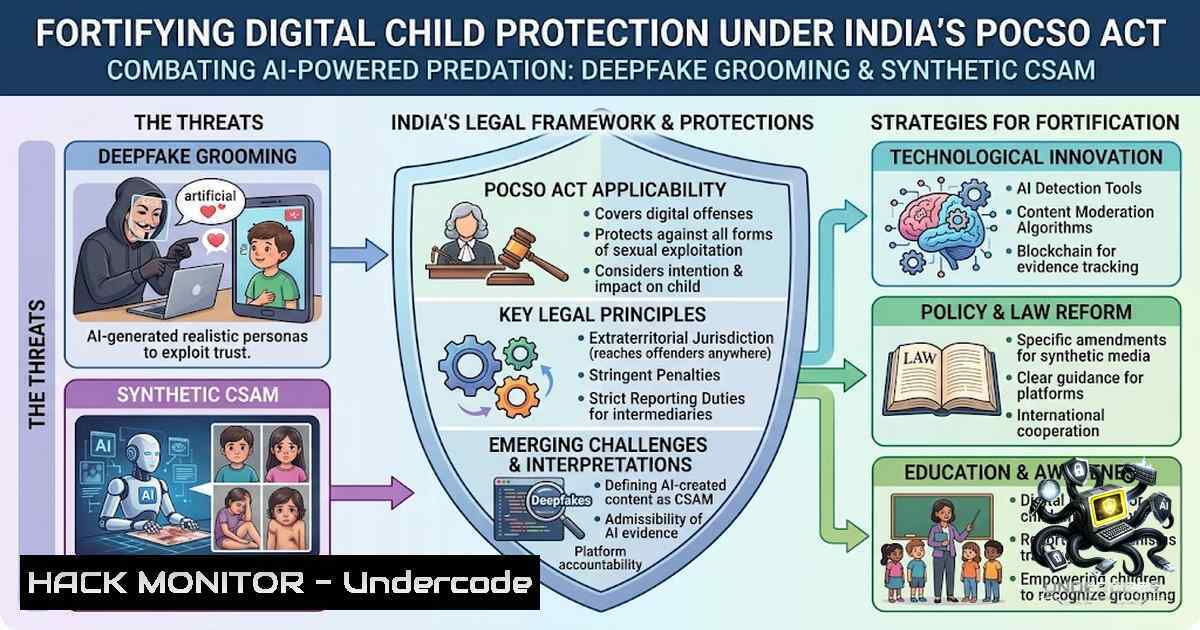
The digitization of childhood has introduced a dark parallel: a surge in AI-enhanced cyber grooming, deepfake exploitation, and synthetic Child Sexual Exploitation and Abuse Material (CSEAM). As predators leverage generative AI to analyze behavioral patterns and craft manipulative narratives at scale, India’s Protection of Children from Sexual Offences (POCSO) Act faces unprecedented challenges, demanding a fusion of legal evolution and technical countermeasures to safeguard minors in the digital arena.
Learning Objectives:
- Understand the technical modus operandi of AI-enhanced cyber grooming and its implications for child safety.
- Master the deployment of machine learning and NLP-based detection tools for identifying predatory conversations.
- Navigate the legal framework under the POCSO Act, IT Act 2000, and recent amendments addressing AI-generated CSEAM.
You Should Know:
1. Understanding AI-Enhanced Cyber Grooming: Technical Modus Operandi
Cyber grooming is a deliberate, manipulative process where an offender builds trust with a minor through emotional manipulation, flattery, or deception, with the intent to exploit or coerce the child. The COVID-19 pandemic accelerated the rise of online grooming, with India’s existing legal architecture proving “demonstrably insufficient” in addressing these evolving harms.
Technical Threat Vectors:
Modern predators employ AI-driven tools to:
- Analyze behavioral patterns and emotional vulnerabilities of children across social media platforms.
- Generate convincing synthetic personas using deepfake technology and AI chatbots.
- Deploy large language models to craft personalized, manipulative conversations at scale.
Detection Challenge: Predatory behavior frequently unfolds gradually and is masked by conversational normality, making it exceptionally difficult for parents, educators, and even existing automated moderation tools to detect.
Forensic Analysis Commands (Linux/macOS):
For digital forensic investigators analyzing potential grooming communications:
 Extract chat logs from common messaging platforms
 WhatsApp database extraction (Android backup)
adb pull /data/data/com.whatsapp/files/Backups/msgstore.db.crypt12 ~/forensics/

Parse JSON chat exports for pattern analysis
cat chat_export.json | jq '.messages[] | select(.text | contains("age") or contains("photo") or contains("meet"))' > suspicious_patterns.json

Timeline analysis of communication patterns
grep -E "^(To|From):" chat_log.txt | cut -d' ' -f2- | sort | uniq -c | sort -1r

Extract metadata from images (EXIF) to verify location claims
exiftool -CreateDate -GPSLatitude -GPSLongitude suspect_images/.jpg

Network traffic analysis for suspicious domains
tcpdump -i eth0 -1n -s0 -v 'port 443 or port 80' -w grooming_traffic.pcap
- AI-Powered Detection and Prevention: Building a Digital Shield
India’s apex child-rights body, the National Commission for Protection of Child Rights (NCPCR), has begun deploying AI-based tools to detect and prevent the circulation of CSAM. This initiative includes AI-powered scanning tools that detect CSAM patterns, deepfakes, grooming indicators, and repeat offenders.
Implementation Steps for AI-Based Detection:
- Deploy NLP Models: Utilize Natural Language Processing (NLP) to analyze text-based communications for grooming indicators, drawing on case studies from Meta, Thorn, and Interpol.
- Integrate Hashing Systems: Implement hashing tools like PhotoDNA to assign unique IDs to known CSAM and block re-upload attempts.
- Leverage Deep Learning: Use deep learning algorithms to differentiate between synthetic and real media, addressing the challenge of AI-generated CSAM.
- Automate Flagging: Set up automated flagging and triage systems to help cyber units act faster.
Windows Command for System Hygiene (Run as Administrator):
 List all startup entries (Registry and File system)
Get-CimInstance Win32_StartupCommand | Select-Object Name, Command, User

Check for scheduled tasks created by non-system accounts
schtasks /query /fo LIST /v | findstr "TaskName" /A:5

Display active network connections and associated processes
netstat -ano | findstr ESTABLISHED

Scan for hidden services (e.g., stalkerware)
Get-Service | Where-Object {$<em>.StartType -eq 'Automatic' -and $</em>.Status -eq 'Running'} | Select-Object Name, DisplayName

Use Sysinternals Autoruns for deep persistence
autoruns64.exe /accepteula -a
- Legal Framework and Regulatory Evolution: The POCSO Act and IT Rules
The POCSO Act, 2012, criminalizes all forms of sexual offenses against minors, while the IT Act, 2000 (Section 67B) prohibits the publication, transmission, or browsing of child sexual abuse content. However, neither explicitly regulates AI-generated CSAM, exposing a significant regulatory gap.
Landmark Legal Shift: On September 23, 2024, the Supreme Court of India delivered a landmark judgment in Just Rights for Children Alliance v. S Harish, criminalizing the downloading, viewing, possession, and storage of CSEAM, whether shared or not. The court also mandated replacing the term “Child Pornography” with CSEAM to cover the generative nature of content.
Recent Amendments (February 2026): The government amended the IT Rules to address harms arising from synthetically generated information (SGI), including deepfakes and AI-generated content, requiring intermediaries to remove unlawful content within three hours of receipt of an order.
- Cloud Hardening and API Security: Protecting Digital Identities
To prevent account takeover and cyberharassment via compromised credentials, organizations must implement robust cloud identity security measures.
Azure AD Hardening Commands (PowerShell):
 Enable Multi-Factor Authentication (MFA) for all users
Get-MsolUser -All | Set-MsolUser -StrongAuthenticationRequirements @{RelyingParty=""; State="Enabled"}

Review sign-in logs for anomalies
Get-AzureADAuditSignInLogs -Filter "createdDateTime ge 2026-01-01" | Where-Object {$_.RiskLevel -eq 'high'}

Block legacy authentication
Set-AzureADPolicy -Definition @('{"TokenLifetimePolicy":{"Version":1,"MaxAgeSingleFactor":"00:10:00"}}') -DisplayName "BlockLegacyAuth" -IsOrganizationDefault $true
AWS IAM Best Practices:
 List all IAM users and their access keys
aws iam list-users --query 'Users[].[UserName,CreateDate]' --output table
aws iam list-access-keys --user-1ame <username>

Enforce MFA for all users
aws iam get-account-summary | jq '.SummaryMap.AccountMFAEnabled'

Rotate access keys automatically
aws iam update-access-key --access-key-id <key-id> --status Inactive --user-1ame <username>
5. Vulnerability Exploitation and Mitigation: Securing the Ecosystem
The rapid rise of AI-generated deepfake CSAM and AI-based grooming necessitates proactive vulnerability management.
Linux Commands for System Hardening:
 Update system packages
sudo apt update && sudo apt upgrade -y

Check for open ports and listening services
ss -tulpn

Install and configure fail2ban for intrusion prevention
sudo apt install fail2ban -y
sudo systemctl enable fail2ban
sudo systemctl start fail2ban

Audit system for known vulnerabilities
sudo apt install lynis -y
sudo lynis audit system

Monitor system logs for suspicious activity
sudo auditd -l
sudo ausearch -m USER_LOGIN -ts recent
6. Incident Response and Evidence Collection
A structured incident response plan is critical for addressing cyber grooming and CSAM cases.
Step-by-Step Guide:
- Preserve Evidence: Immediately isolate the device and create a forensic image.
- Collect Artifacts: Gather browser history, chat logs, and system logs.
- Document Timeline: Record all communication patterns and timestamps.
- Report to Authorities: File a complaint through the National Cyber Crime Reporting Portal or the POCSO e-Box.
- Engage Forensic Experts: Utilize specialized tools like ChildShield-Forensics for safe triage via hashes and YARA rules.
Python Script for Basic Triage:
import os
import hashlib

def calculate_sha256(file_path):
sha256_hash = hashlib.sha256()
with open(file_path, "rb") as f:
for byte_block in iter(lambda: f.read(4096), b""):
sha256_hash.update(byte_block)
return sha256_hash.hexdigest()

Example usage
evidence_dir = "/evidence"
for root, dirs, files in os.walk(evidence_dir):
for file in files:
file_path = os.path.join(root, file)
print(f"{file_path}: {calculate_sha256(file_path)}")
What Undercode Say:
- Key Takeaway 1: The convergence of AI and child exploitation demands a paradigm shift in legal interpretation—the POCSO Act must explicitly criminalize AI-generated CSEAM and grooming behaviors.
- Key Takeaway 2: Technological solutions, including NLP-based detection and deep learning algorithms, are essential for proactive identification of predatory patterns, but they must be complemented by robust legal frameworks and ethical guidelines.
Analysis: The legal and technical landscape is evolving rapidly, yet significant gaps remain. While the Supreme Court’s landmark judgment and recent IT Rules amendments represent progress, the lack of explicit provisions for AI-generated content in the POCSO Act undermines enforcement efforts. Moreover, the scalability of AI-driven threats—from deepfake extortion to automated grooming—outpaces current detection capabilities. A multi-stakeholder approach, integrating law enforcement, technology companies, and child protection agencies, is imperative. Initiatives like NCPCR’s AI deployment and the ‘Sahyog’ portal for expedited takedown of unlawful content are steps in the right direction. However, sustained investment in forensic capacity, public awareness, and international cooperation is essential to build a resilient digital ecosystem for children.
Prediction:
- +1 The integration of AI-driven detection tools and enhanced legal frameworks will likely lead to a significant reduction in undetected cyber grooming cases over the next three years, provided there is consistent enforcement and inter-agency coordination.
- +1 The global push for stricter regulations on AI-generated content, as seen with Australia’s social media ban for minors and the EU AI Act, will influence India to adopt more comprehensive legislation, potentially setting a benchmark for developing nations.
- -1 However, the rapid evolution of adversarial AI techniques, including deepfake overlays and synthetic personas that bypass age verification, poses a persistent challenge that may outpace regulatory and technological responses, leading to a transient increase in sophisticated attacks.
- -1 Without adequate investment in cyber forensic labs and specialized training for law enforcement, the gap between reported incidents and successful prosecutions may widen, undermining public trust in the legal system.
▶️ Related Video (76% Match):
🎯Let’s Practice For Free:
🎓 Live Courses & Certifications:
Join Undercode Academy for Verified Certifications
🚀 Request a Custom Project:
Secure, high-velocity infrastructure and disruptive technological engineering. Contact our engineering team for high-tier development and proprietary systems:
[email protected]
💎 Smart Architecture | 🛡️ Secure by Design | ⭐ Trusted by Thousands
IT/Security Reporter URL:
Reported By: Diksha 722a0a406 – Hackers Feeds
Extra Hub: Undercode MoN
Basic Verification: Pass ✅


