Listen to this Post
Introduction:
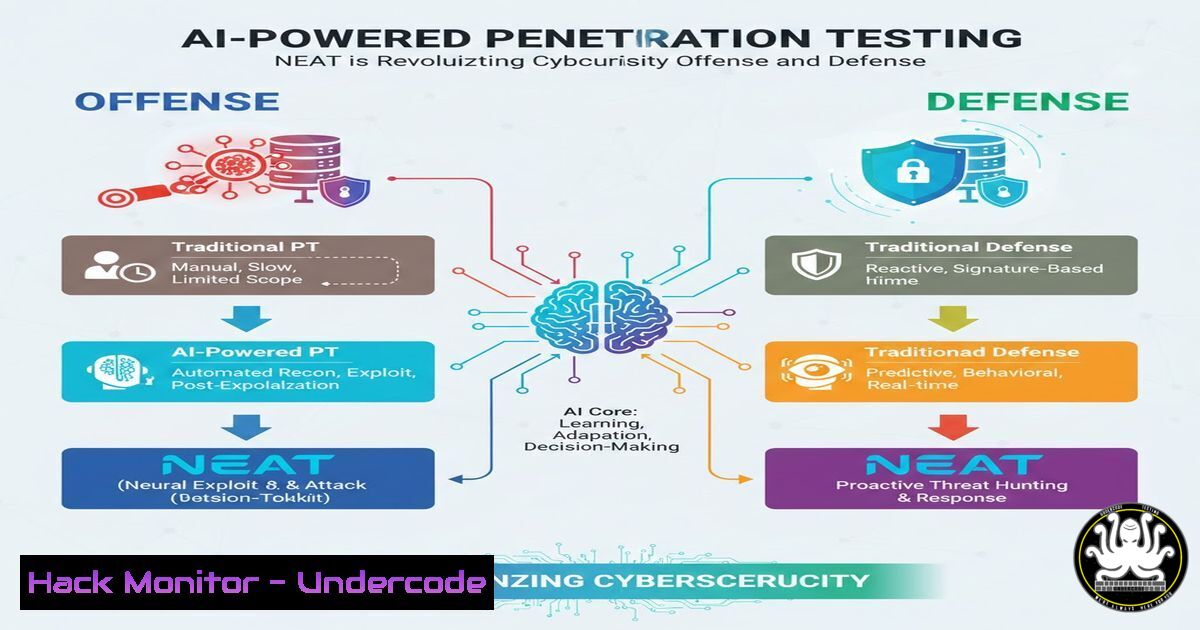
The landscape of cybersecurity is undergoing a seismic shift with the integration of Artificial Intelligence into offensive security tools. Platforms like NEAT (Network Exploitation and Assessment Tool), developed by Randy B. of Security 360, LLC, are demonstrating how AI can automate and enhance complex penetration testing workflows, potentially reducing the time from initial reconnaissance to full system compromise from days to minutes. This evolution represents a dual-edged sword for the security community, offering powerful new capabilities for defenders while simultaneously lowering the barrier to entry for sophisticated attacks.
Learning Objectives:
- Understand the core components and capabilities of next-generation, AI-driven penetration testing frameworks.
- Learn how to implement basic AI-assisted reconnaissance and vulnerability scanning using command-line tools and scripts.
- Develop mitigation strategies to defend against AI-powered cyber threats targeting network infrastructure.
You Should Know:
1. The Architecture of AI-Powered Penetration Testing Tools
AI-enhanced security tools like NEAT typically integrate several core components: a reconnaissance engine, a vulnerability analysis module, an AI-driven decision engine, and an automated exploitation framework. The AI component continuously learns from successful exploitation techniques, adapting its approach based on the target environment. This allows the tool to make intelligent decisions about which attack vectors to pursue next, significantly increasing the success rate compared to traditional, sequential scanning.
Step-by-step guide explaining what this does and how to use it:
Step 1: Target Definition. The tool is provided with a target scope, such as an IP range or domain name.
Step 2: Automated Reconnaissance. The AI initiates broad and deep reconnaissance, using both active and passive techniques to build a comprehensive map of the target.
Step 3: Data Correlation and Analysis. The AI correlates discovered services, versions, and potential misconfigurations against a knowledge base of vulnerabilities and exploits.
Step 4: Exploitation Planning. The decision engine prioritizes attack paths, often using techniques like privilege escalation chains, to achieve the defined goal (e.g., domain admin access).
2. Automating Reconnaissance with AI Scripting
Before an AI can plan an attack, it requires data. The reconnaissance phase is often automated using scripts that combine classic tools. An AI might generate and execute a script that uses `masscan` for ultra-fast port discovery followed by `nmap` for detailed service interrogation.
Step-by-step guide explaining what this does and how to use it:
Step 1: Rapid Port Scanning. Use `masscan` to quickly identify open ports across a wide range.
masscan -p1-65535 192.168.1.0/24 --rate=1000 -oG masscan_output.txt
Step 2: Service Interrogation. Feed the results into `nmap` for version detection and script scanning.
nmap -sV -sC -p- -iL masscan_output.txt -oA detailed_scan
Step 3: AI-Powered Analysis. The AI parses the `nmap` output, identifying services like an outdated Apache `httpd` or a weakly configured SMB share, and flags them for deeper investigation.
3. AI-Driven Web Application Vulnerability Scanning
Traditional web scanners use predefined signatures. AI-enhanced scanners, however, can learn the normal behavior of an application and intelligently fuzz parameters to discover novel injection flaws, business logic errors, and insecure direct object references (IDOR) that signature-based tools would miss.
Step-by-step guide explaining what this does and how to use it:
Step 1: Crawling. The tool deeply crawls the web application to map all endpoints, parameters, and user flows.
Step 2: Behavioral Analysis. The AI establishes a baseline of normal application behavior and response patterns.
Step 3: Intelligent Fuzzing. It then generates and tests a wide array of malicious payloads for SQLi, XSS, and command injection, analyzing responses for subtle anomalies that indicate a vulnerability.
Step 4: Proof-of-Creation. For critical vulnerabilities, the tool may automatically craft a proof-of-concept exploit.
4. Exploitation and Post-Exploitation Automation
The true power of AI in tools like NEAT is its ability to chain low-severity vulnerabilities to achieve a high-impact compromise. For example, it might use a compromised web shell to perform lateral movement by dumping and cracking Windows password hashes.
Step-by-step guide explaining what this does and how to use it:
Step 1: Initial Foothold. The tool exploits a vulnerability (e.g., in a web app) to upload and execute a web shell or a reverse shell payload.
 Example: Using curl to trigger a reverse shell from a web vulnerability
curl -X POST http://target.com/upload.php -F "[email protected]"
Step 2: Privilege Escalation. The AI may run automated privilege escalation checks on the compromised host.
On Windows, it might use tools like PowerSploit’s PrivescCheck.
On Linux, it would run scripts to check for misconfigured `sudo` rights, SUID binaries, or kernel exploits.
Step 3: Lateral Movement. Using credentials harvested from the initial host, the tool attempts to authenticate to other systems on the network, often using the PSExec method or WMI calls on Windows.
 Example of using psexec from the Metasploit framework after gaining credentials
use exploit/windows/smb/psexec
set RHOSTS 192.168.1.10
set SMBUser victim_domain\user
set SMBPass password123
exploit
5. Hardening Defenses Against AI-Powered Attacks
Defending against these automated threats requires a multi-layered, intelligent defense strategy. Relying solely on traditional signature-based antivirus and firewalls is no longer sufficient.
Step-by-step guide explaining what this does and how to use it:
Step 1: Implement Strong Network Segmentation. Isolate critical network segments to prevent lateral movement. Use strict firewall rules that only allow necessary traffic.
Step 2: Enforce the Principle of Least Privilege. Regularly audit user and service account permissions. Ensure no user or system service has more privileges than absolutely required.
Step 3: Deploy Endpoint Detection and Response (EDR). EDR solutions can detect and block the anomalous behavior and process chains that AI-powered tools rely on, which traditional AV might miss.
Step 4: Patch Management and Vulnerability Scanning. Maintain a rigorous and rapid patch management cycle. Use your own vulnerability scanner regularly to find and fix issues before an AI-driven attacker can exploit them.
- The Role of AI in Proactive Defense (AI vs. AI)
The same AI technology powering offensive tools is being deployed defensively. Security Information and Event Management (SIEM) systems with AI capabilities can analyze log data in real-time to identify subtle, multi-stage attacks that would be invisible to human analysts.
Step-by-step guide explaining what this does and how to use it:
Step 1: Data Aggregation. The defensive AI aggregates logs from endpoints, network devices, cloud instances, and applications.
Step 2: Behavioral Baselining. It learns the normal “pattern of life” for the network, users, and devices.
Step 3: Anomaly Detection. The AI flags deviations from the baseline, such as a user logging in at an unusual time from a foreign country, or a host initiating connections to a known command-and-control server.
Step 4: Automated Response. Advanced systems can automatically isolate compromised hosts or block malicious IP addresses, creating a self-healing network defense.
What Undercode Say:
- The democratization of advanced hacking capabilities is imminent. Tools like NEAT will put nation-state-level attack techniques into the hands of less-skilled threat actors, dramatically increasing the threat landscape for all organizations.
- The speed of cyber attacks is accelerating exponentially. Human-led penetration tests will remain valuable for depth, but AI-driven attacks will operate on a timescale that necessitates fully automated defensive responses.
Analysis: The development of NEAT and similar platforms is not just an incremental improvement; it’s a paradigm shift. The cybersecurity industry is entering an arms race where AI agents will battle other AI agents. For blue teams, this means defense can no longer be a static set of policies but must become a dynamic, adaptive, and intelligent system. The core skills for security professionals will shift from manual tool operation to designing, training, and managing these AI systems, and interpreting their complex outputs. The ethical implications are also profound, requiring robust controls and governance around the development and use of such powerful offensive technologies.
Prediction:
Within the next 2-3 years, AI-powered penetration testing will become the standard for security assessments, leading to a “patch or perish” reality for organizations. Simultaneously, we will see the rise of fully autonomous “Red vs. Blue” AI simulations running continuously within corporate networks, identifying and mitigating vulnerabilities in real-time before human attackers can find them. This will eventually lead to a new era of “Autonomous Cyber Defense,” where the majority of low-to-mid-level attacks are handled by AI systems, allowing human analysts to focus on strategic threats and complex threat hunting.
🎯Let’s Practice For Free:
IT/Security Reporter URL:
Reported By: Activity 7398205320277172225 – Hackers Feeds
Extra Hub: Undercode MoN
Basic Verification: Pass ✅


