Listen to this Post
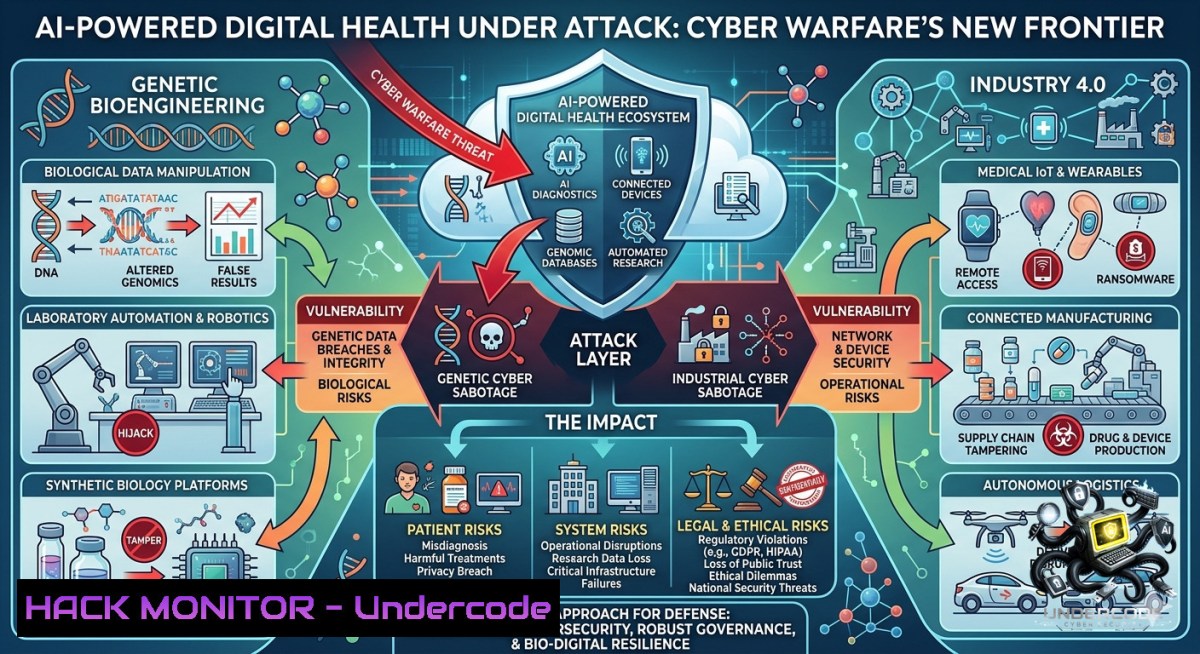
Introduction:
The convergence of robotics, artificial intelligence, and genetic bioengineering—collectively driving Industry 4.0—has revolutionized digital health, but it has also exponentially expanded the attack surface for cybercriminals. As biological data pipelines and AI-driven diagnostic tools become interconnected, securing these systems is no longer optional; it is a matter of patient safety and national security. This article extracts technical vulnerabilities from the “Digital Health AI” and “Genetic Bioengineering” domains, providing actionable cybersecurity, IT, and AI training pathways to harden these emerging technologies.
Learning Objectives:
– Identify attack vectors in AI-powered health robotics and genomic data workflows.
– Implement Linux and Windows security commands to protect digital health APIs and bioinformatics pipelines.
– Apply cloud hardening and vulnerability mitigation techniques specific to Industry 4.0 medical devices.
You Should Know:
1. Securing Robotic Process Automation (RPA) in Healthcare Environments
Robotic surgical systems and automated lab robots often run on legacy RPA frameworks vulnerable to command injection and privilege escalation. To assess and harden these systems, start by enumerating open ports and running processes.
Step‑by‑step guide (Linux – for robot control servers):
 Scan for exposed RPA services (e.g., port 8080, 5000)
sudo nmap -sV -p 5000,8080,8443 <robot-IP>

 List all running processes and filter for automation-related binaries
ps aux | grep -E "robot|automation|rpa"

 Check for weak file permissions on RPA configuration files
find /etc/robot/ -type f -perm 0777 -ls

 Harden by removing world-writable permissions
sudo chmod 750 /etc/robot/config.yaml
Windows command (for RPA controllers):
 Get all services related to robotics
Get-Service | Where-Object {$_.DisplayName -like "robot" -or $_.DisplayName -like "automation"}

 Audit registry keys for RPA auto-start
reg query HKLM\SOFTWARE\Microsoft\Windows\CurrentVersion\Run
Mitigation: Enforce least privilege with AppLocker (Windows) or SELinux (Linux) to restrict RPA binaries. Use `auditd` on Linux to monitor access to automation scripts.
2. Hardening AI Model Integrity in Digital Health Diagnostics
Attackers can poison training data or steal AI models from digital health platforms via insecure APIs. Protect model endpoints using API gateways with mutual TLS (mTLS) and input validation.
Step‑by‑step guide (API security with curl and Docker):
 Test for model extraction vulnerability (replace <API_URL>)
curl -X POST https://<api-endpoint>/v1/model/predict -H "Content-Type: application/json" -d '{"input": "test"}' -v

 Implement rate limiting with iptables (Linux)
sudo iptables -A INPUT -p tcp --dport 443 -m limit --limit 10/min -j ACCEPT

 Run a model serving container with read-only root filesystem
docker run --read-only --cap-drop=ALL --cap-add=NET_BIND_SERVICE -p 8501:8501 tensorflow/serving
Windows PowerShell (API monitoring):
 Monitor inbound connections to the model server
Get-1etTCPConnection -LocalPort 8501 | Select-Object LocalAddress, RemoteAddress, State

 Set up a Windows Firewall rule to allow only specific IP ranges
New-1etFirewallRule -DisplayName "Model API Restrict" -Direction Inbound -LocalPort 8501 -Protocol TCP -RemoteAddress 192.168.1.0/24 -Action Allow
Training course: OWASP API Security Top 10 – focus on broken object level authorization (BOLA) and excessive data exposure.
3. Genetic Data Encryption and Access Control for Bioengineering Pipelines
Genomic sequencing data is a prime ransomware target. Encrypt data at rest and in transit using verified cryptographic tools, and enforce strict access controls.
Linux commands (GPG and OpenSSL):
 Encrypt a genomic FASTA file with symmetric AES-256
gpg --symmetric --cipher-algo AES256 --passphrase-file key.txt genome.fasta

 Decrypt
gpg --decrypt genome.fasta.gpg > genome_decrypted.fasta

 Alternatively, use OpenSSL for file encryption
openssl enc -aes-256-cbc -salt -in raw_data.vcf -out encrypted.vcf.enc -pass pass:strongpassword

 Set immutable bit on critical bioinformatics directories
sudo chattr +i /data/genomic_repository/
Windows commands (BitLocker and EFS):
 Enable BitLocker on the drive storing genetic data
Manage-bde -on C: -UsedSpaceOnly -RecoveryPassword

 Encrypt individual file using EFS (Encrypting File System)
cipher /E /S "D:\GenomicData"

 Verify EFS certificates
cipher /C "D:\GenomicData\patient_123.vcf"
Cloud hardening: Use AWS KMS or Azure Key Vault with key rotation policies. Never hardcode keys – implement IAM roles with least privilege.
4. Industry 4.0 IoT Device Hardening for Medical Sensors
Wearable health monitors and implantable sensors often use insecure MQTT or CoAP protocols. Perform network isolation and firmware integrity checks.
Step‑by‑step guide (Linux as network gateway):
 Isolate IoT VLAN using iptables (block IoT to internal LAN)
sudo iptables -A FORWARD -i eth0 -o wlan0 -j DROP  Assume eth0=LAN, wlan0=IoT

 Capture and analyze MQTT traffic (port 1883)
sudo tcpdump -i wlan0 port 1883 -A -c 50

 Check for default credentials in MQTT broker config
grep -i "password\|user" /etc/mosquitto/mosquitto.conf
Windows command (network segmentation using netsh):
 Create a firewall rule to block IoT device subnet (e.g., 10.0.0.0/24) from accessing medical records server
New-1etFirewallRule -DisplayName "Block IoT to EHR" -Direction Outbound -RemoteAddress 10.0.0.0/24 -LocalAddress 192.168.10.50 -Action Block
Vulnerability exploitation/mitigation: Simulate a DoS attack on MQTT using `mqtt-spoof` (Kali Linux), then mitigate by enabling authentication and TLS on the broker.
5. Training Courses and Certifications for AI & Cybersecurity Convergence
To defend AI-driven digital health systems, professionals need cross-disciplinary training. The following verified courses cover adversarial machine learning, bioinformatics security, and cloud hardening.
Recommended training paths:
– Securing AI Pipelines (SANS SEC595): Hands-on with model extraction and data poisoning.
– CISSP – Domain 3 (Security Architecture) for Industry 4.0: Focus on medical IoT.
– Ethical Hacking for Healthcare (CEH v12 with medical device labs).
– NIST SP 1800-27 (Securing Telehealth Remote Patient Monitoring Ecosystems) – free implementation guide.
Linux command to verify course completion (example of creating a training log):
 Generate SHA256 checksum of your training certificates for integrity
sha256sum ~/certificates/SEC595.pdf > training_integrity.log
Windows PowerShell for lab environment setup (using Hyper-V for isolated AI testing):
 Create a new VM for AI security testing
New-VM -1ame "AISecurityLab" -MemoryStartupBytes 4GB -BootDevice VHD -1ewVHDPath "C:\VMs\AISec\AISec.vhdx" -1ewVHDSizeBytes 40GB

 Enable nested virtualization for container security labs
Set-VMProcessor -VMName "AISecurityLab" -ExposeVirtualizationExtensions $true
What Undercode Say:
– Key Takeaway 1: The metaphor of ginger’s “quiet, effective” biological healing parallels the need for proactive, stealthy cybersecurity in digital health—defenses must operate continuously without disrupting patient care.
– Key Takeaway 2: Industry 4.0’s integration of robotics, AI, and bioengineering demands a shift from perimeter security to data‑centric and pipeline‑centric models, where every API call and genomic file is cryptographically verified.
Analysis: The original post’s emphasis on “tiny health choices” translates directly to security hygiene: small misconfigurations (e.g., leaving MQTT default credentials, failing to encrypt genomic backups) can cascade into catastrophic data breaches or even lethal manipulation of AI diagnostics. Organizations must adopt immutable infrastructure for bioinformatics, implement runtime defense for AI models, and train staff on adversarial machine learning. The positive trend is the emergence of DevSecOps pipelines tailored to healthcare (e.g., HIPAATrek, Linux Foundation’s LFCA with healthcare modules). However, the shortage of professionals who understand both genetics and network forensics remains a critical risk. Automated vulnerability scanning of medical IoT devices must become mandatory, not optional. Finally, cross‑industry collaboration—robotics engineers working with incident response teams—will define resilience in the coming decade.
Prediction:
– -1: Nation‑state actors will weaponize AI model inversion attacks to reconstruct patient genomic data from API responses, leading to mass genetic blackmail and targeted biological weapon design by 2027.
– -1: Ransomware gangs will shift focus to real‑time surgical robots, demanding payment to restore steering control—escalating from data extortion to physical harm.
– +1: Open‑source tools for adversarial robustness (e.g., CleverHans, ART) will become standard in FDA pre‑market approvals for AI medical devices, driving a 40% reduction in model‑extraction vulnerabilities by 2026.
– +1: The rise of “bio‑cybersecurity” degree programs (integrating genetics, AI, and network security) will produce a new generation of defenders, with platforms like Cybrary and Pluralsight launching dedicated Industry 4.0 tracks in Q4 2025.
▶️ Related Video (74% Match):
🎯Let’s Practice For Free:
🎓 Live Courses & Certifications:
[Join Undercode Academy for Verified Certifications](https://undercode.co.uk/certifications/)
🚀 Request a Custom Project:
Secure, high-velocity infrastructure and disruptive technological engineering. Contact our engineering team for high-tier development and proprietary systems:
[[email protected]](mailto:[email protected])
💎 Smart Architecture | 🛡️ Secure by Design | ⭐ Trusted by Thousands
IT/Security Reporter URL:
Reported By: [Furkan Bolakar](https://www.linkedin.com/posts/furkan-bolakar_robotics-automation-science-ugcPost-7467322262061457408-0B5g/) – Hackers Feeds
Extra Hub: Undercode MoN
Basic Verification: Pass ✅
🔐JOIN OUR CYBER WORLD [ CVE News • HackMonitor • UndercodeNews ]
[💬 Whatsapp](https://undercode.help/whatsapp) | [💬 Telegram](https://t.me/UndercodeCommunity)
📢 Follow UndercodeTesting & Stay Tuned:
[𝕏 formerly Twitter 🐦](https://x.com/undercodeupdate) | [@ Threads](https://www.threads.net/@undercodetesting) | [🔗 Linkedin](https://www.linkedin.com/company/undercodetesting/) | [🦋BlueSky](https://bsky.app/profile/undercode.bsky.social)


