Listen to this Post
Introduction:
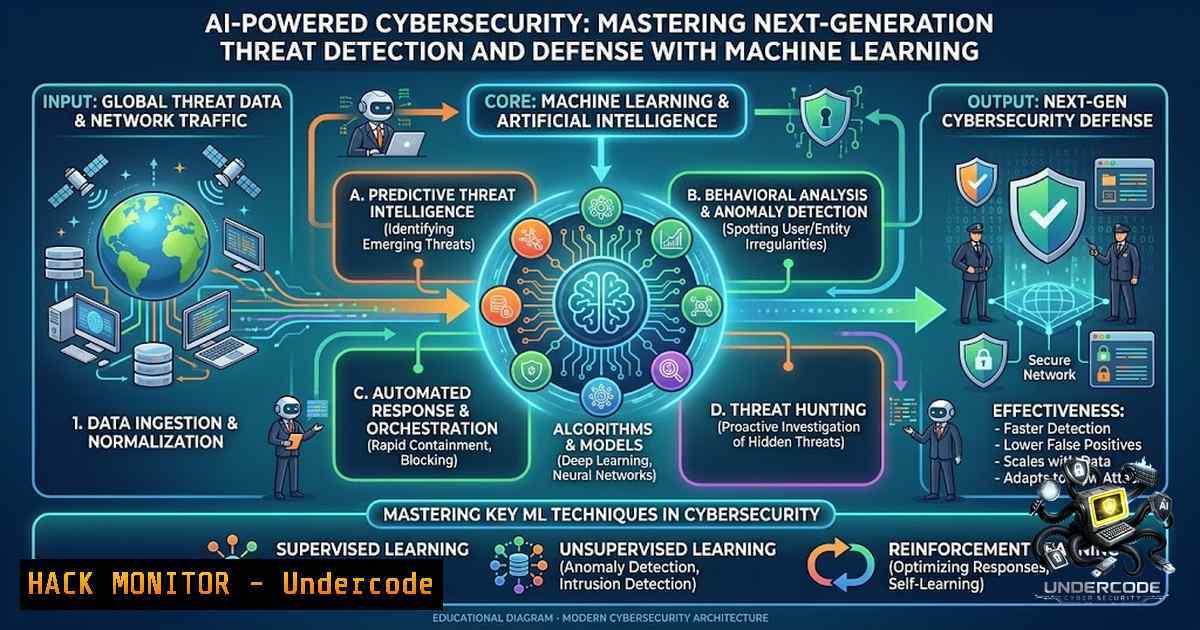
The convergence of artificial intelligence and cybersecurity is no longer a futuristic concept—it is the defining paradigm shift of modern defense operations. As threat actors increasingly leverage automation and machine learning to conduct attacks at machine speed, security professionals must equally adopt AI-augmented tooling to detect anomalies, respond to incidents, and harden infrastructures against evolving vulnerabilities. This article extracts actionable technical content from emerging cybersecurity curricula, providing verified commands, step‑by‑step guides, and configuration strategies for both Linux and Windows environments to fortify your IT ecosystem against next‑generation threats.
Learning Objectives:
- Implement AI-enhanced log analysis pipelines using machine learning models for anomaly detection in both Linux and Windows environments.
- Deploy and configure AI-driven penetration testing tools to automate reconnaissance and vulnerability discovery.
- Harden cloud and API security postures against AI‑specific attack vectors, including prompt injection and model poisoning.
- Apply practical command‑line techniques to secure AI coding agents and prevent destructive operations.
You Should Know:
1. Setting Up an AI‑Enhanced Log Analysis Pipeline
Modern security operations centers (SOCs) are overwhelmed by data volume. Integrating a lightweight machine learning model—such as Isolation Forest—into your log analysis workflow can dramatically reduce false positives and surface genuine threats that rule‑based systems miss.
Step‑by‑step guide (Linux):
1. Install Python dependencies:
sudo apt update && sudo apt install python3-pip -y
pip3 install scikit-learn pandas numpy
- Prepare your log data: Export system logs to a CSV format for processing.
sudo journalctl --since "2026-08-01" --output=json > /var/log/system_logs.json
3. Run a basic anomaly detection script:
import pandas as pd
from sklearn.ensemble import IsolationForest
 Load and preprocess your log data
df = pd.read_json('/var/log/system_logs.json', lines=True)
 Select numerical features for anomaly detection
features = df[['_PID', '_UID', '_BOOT_ID']].fillna(0)
model = IsolationForest(contamination=0.01)
df['anomaly'] = model.fit_predict(features)
 Output anomalous entries
print(df[df['anomaly'] == -1])
- Schedule the script using `cron` for continuous monitoring:
crontab -e
Add: 0     /usr/bin/python3 /opt/anomaly_detector.py >> /var/log/anomaly_alerts.log
For Windows (PowerShell with Python):
- Ensure Python is installed and added to PATH.
- Use the same Python script, but export logs via
Get-WinEvent:Get-WinEvent -LogName System -MaxEvents 1000 | Export-Csv -Path C:\logs\system_logs.csv
- Modify the Python script to read the CSV and run the Isolation Forest model.
This pipeline enables you to detect outliers in system behavior—such as unexpected process executions or privilege escalations—without investing in expensive commercial SIEM solutions.
2. Deploying AI‑Driven Penetration Testing Tools
The offensive security landscape is being reshaped by AI-1ative tools that can autonomously reason about vulnerabilities and generate domain‑aware payloads. One such tool is Specter, an AI‑powered penetration testing CLI that uses DeepSeek R1 for attack reasoning and GPU‑accelerated payload mutation.
Step‑by‑step guide (Kali Linux):
1. Install Specter:
git clone https://github.com/ItsSamarth/specter.git
cd specter
pip install -r requirements.txt
2. Configure your AI API key:
export SPECTER_AI_KEY="your-api-key-here"
3. Run a basic web application scan:
python specter.py --target https://test-vuln-app.com --ai-model deepseek --scan-depth 3
- For autonomous agent‑based testing, use the offsec-ai Python library, which probes live AI/LLM endpoints for the OWASP LLM Top 10 vulnerabilities:
pip install offsec-ai
offsec-ai scan --target https://api.ai-endpoint.com --llm-check
Important: Always obtain explicit written authorization before scanning any system. These tools are designed for authorized security testing and CTF environments only.
3. Hardening AI Coding Agents and Cloud Workloads
As organizations integrate AI coding agents (e.g., Claude Code, Cursor) into development workflows, the risk of destructive command execution and credential exfiltration increases exponentially. Implementing PreToolUse hooks can hard‑block dangerous commands before they ever reach a shell.
Step‑by‑step guide:
1. Clone the hardened security configuration repository:
git clone https://github.com/Droidzold/hardened-security-config.git
cd hardened-security-config
- Apply the `CLAUDE.md` security rules to your agent’s project root. The configuration enforces six numbered rules: trust boundaries, draft‑only defaults, file scoping, command safety, MCP vetting, and uncertainty handling.
-
Block risky patterns by adding the following hook to your agent’s settings:
{ "dangerous_commands": ["rm -rf", "git push --force", "git reset --hard", "chmod 777"], "block_patterns": ["|sh", "|bash", "curl.|sh"] } -
For cloud environments (AWS/GCP), implement Model Armor to prevent prompt injections and stop sensitive data leaks (PII) across agentic workflows. Use the automated setup script:
git clone https://github.com/iPablo26/The-AI-Agent-Security-ModelArmor.git
cd The-AI-Agent-Security-ModelArmor
python setup.py --project-id your-gcp-project --region us-central1
This approach shifts security left, embedding guardrails directly into the agent’s decision‑making loop rather than relying on reactive monitoring.
- Securing AI APIs Against Prompt Injection and Model Extraction
APIs are the primary interface for AI applications, making them a prime target for adversarial attacks. The OWASP LLM Top 10 highlights prompt injection, insecure output handling, and model theft as critical risks.
Step‑by‑step guide:
- Validate all user inputs using a whitelist approach. For a Python‑based API:
from flask import Flask, request, jsonify import re app = Flask(<strong>name</strong>) @app.route('/api/query', methods=['POST']) def query(): user_input = request.json.get('prompt', '') Block injection patterns if re.search(r'(system|ignore|override|role)', user_input, re.IGNORECASE): return jsonify({'error': 'Invalid input pattern detected'}), 400 Process safely return jsonify({'response': process_safely(user_input)}) -
Implement rate limiting and API key rotation to mitigate brute‑force extraction attempts:
Using iptables to limit connections per IP
sudo iptables -A INPUT -p tcp --dport 5000 -m connlimit --connlimit-above 10 -j REJECT
-
For cloud deployments, use Google Cloud’s Model Armor to enforce content safety policies and block prompt injection attempts in real time:
gcloud alpha ai endpoints deploy --region=us-central1 --model=your-model --security-config=model-armor.yaml
-
Regularly audit your API dependencies for known vulnerabilities using tools like `safety` or
pip-audit:pip install safety safety check --json > api_vuln_report.json
These measures collectively reduce the attack surface of your AI endpoints and protect against both automated and targeted adversarial campaigns.
5. Continuous Training and Certification Pathways
The skills gap in AI security is widening, but structured training programs are emerging to bridge it. The Certified AI Security Professional (CAISP) course offers an in‑depth exploration of AI supply chain risks, secure development techniques (differential privacy, federated learning), and robust model deployment. Similarly, the CompTIA SecAI+ (CY0‑001) certification prepares IT professionals to defend against AI‑enabled threats and apply governance controls.
Recommended learning path:
- Foundational: Enroll in “AI meets Cybersecurity: Fundamentals” to understand core AI/ML concepts and their cybersecurity applications.
- Intermediate: Take the “Artificial Intelligence (AI) for Cybersecurity” course, which covers building and evaluating AI‑powered security tools.
- Advanced: Pursue the CERT Leadership in AI for Cybersecurity program, which includes constructing machine learning models and a capstone workshop.
For hands‑on practice, the AI Security Bootcamp (AISB) repository provides seven days of intensive exercises covering prompt injection, model extraction, and defensive engineering.
What Undercode Say:
- Key Takeaway 1: AI is not a silver bullet—it is a force multiplier. Effective defense requires combining machine learning anomaly detection with rigorous command‑line hardening and continuous human oversight.
- Key Takeaway 2: The most dangerous threats are those that target the AI pipeline itself—prompt injection, model poisoning, and data exfiltration. Security must be embedded at every layer, from API design to agent hooks.
Analysis: The integration of AI into cybersecurity is accelerating faster than most organizations can adapt. While AI‑powered tools offer unprecedented efficiency in threat detection and response, they also introduce novel attack surfaces that traditional security measures cannot address. The shift from reactive to predictive defense is inevitable, but it demands a new breed of professional who understands both the mathematics of machine learning and the tactical realities of system hardening. Organizations that invest in AI security training today will be the ones that survive the next wave of automated, AI‑driven cyberattacks. Conversely, those that treat AI as a mere add‑on to existing workflows will find themselves outpaced by adversaries who weaponize the same technology.
Prediction:
- -1: The proliferation of open‑source AI penetration testing tools will lead to a surge in automated, low‑skill cyberattacks, overwhelming understaffed SOC teams and forcing a reactive, fire‑drill culture.
- +1: Concurrently, the maturation of AI security certifications and guardrail frameworks will create a new tier of highly specialized professionals, turning AI security into a distinct and lucrative career track.
- +1: By 2028, AI‑native defensive systems will become the default standard for enterprise security, rendering signature‑based detection obsolete and reducing mean time to detection (MTTD) by over 80%.
- -1: However, the race to deploy AI agents without proper hardening will result in high‑profile data breaches caused by prompt injection and model extraction, prompting regulatory crackdowns similar to GDPR for AI.
- +1: The emergence of federated learning and differential privacy will enable organizations to share threat intelligence without exposing sensitive data, creating a collaborative defense ecosystem that benefits the entire industry.
▶️ Related Video (86% Match):
🎯Let’s Practice For Free:
🎓 Live Courses & Certifications:
Join Undercode Academy for Verified Certifications
🚀 Request a Custom Project:
Secure, high-velocity infrastructure and disruptive technological engineering. Contact our engineering team for high-tier development and proprietary systems:
[email protected]
💎 Smart Architecture | 🛡️ Secure by Design | ⭐ Trusted by Thousands
IT/Security Reporter URL:
Reported By: Https: – Hackers Feeds
Extra Hub: Undercode MoN
Basic Verification: Pass ✅


