Listen to this Post
Introduction
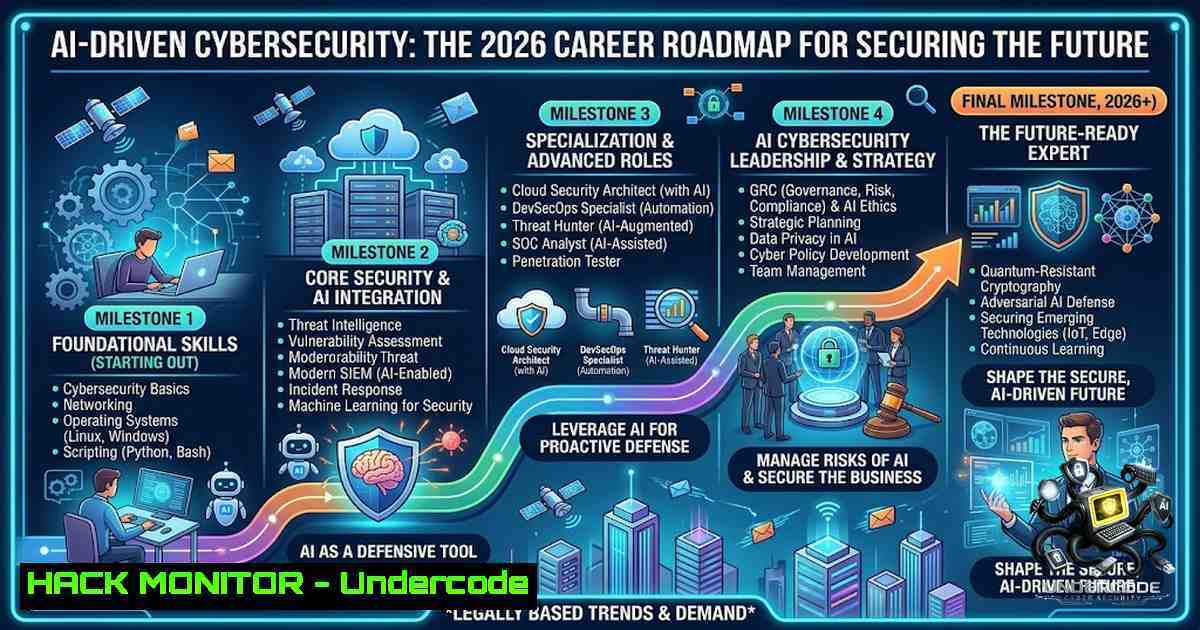
The cybersecurity landscape is undergoing a seismic shift as artificial intelligence transforms both offensive and defensive operations. Security Operations Centers (SOCs) are rapidly integrating AI-driven threat detection, while malicious actors leverage generative AI for sophisticated phishing and vulnerability discovery. This evolution creates unprecedented opportunities for professionals who strategically position themselves at the intersection of AI and cybersecurity, demanding a non-linear career approach focused on continuous learning, specialization, and practical skill development.
Learning Objectives
- Understand the transformative impact of AI on cybersecurity operations, role evolution, and threat landscapes
- Develop actionable strategies for building specialized expertise through hands-on labs, certifications, and CTF challenges
- Master the critical frameworks securing AI systems, including OWASP Top 10 for LLMs and NIST AI RMF implementation
You Should Know
- The AI Security Engineer: A New Vanguard Role
The emergence of Large Language Models (LLMs) and enterprise AI adoption has created a critical new role: the AI Security Engineer. These professionals bridge traditional information security with machine learning operations (MLOps), focusing on securing AI pipelines, protecting model integrity, and preventing adversarial attacks against neural networks.
Step-by-Step Guide to Building AI Security Competencies:
- Master Foundational AI Concepts: Understand neural network architectures, training methodologies, and model deployment lifecycles
- Study OWASP Top 10 for LLMs: Familiarize yourself with prompt injection, insecure output handling, training data poisoning, and model denial of service
- Implement NIST AI RMF Framework: Apply the four core functions—Govern, Map, Measure, Manage—to AI governance
4. Build a Secure LLM Testing Lab:
Linux/Ubuntu Setup:
 Install Python virtual environment for AI security testing
sudo apt update && sudo apt install python3-venv python3-pip
python3 -m venv ai-security-lab
source ai-security-lab/bin/activate
pip install transformers torch tensorflow pandas scikit-learn

Install adversarial robustness toolbox
pip install adversarial-robustness-toolbox

Clone AI security tools
git clone https://github.com/tensorflow/cleverhans.git
cd cleverhans && pip install -e .
Windows Setup (PowerShell):
 Install WSL2 for Linux environment
wsl --install -d Ubuntu-22.04
 Install Python via winget
winget install Python.Python.3.11
python -m venv C:\ai-security-lab
C:\ai-security-lab\Scripts\activate
pip install torch transformers adversarial-robustness-toolbox
- Practice AI Red Teaming: Use tools like LangChain for LLM application testing, implementing security controls against injection attacks
2. Zero Trust Architecture: Implementation Beyond Theory
Zero Trust Architecture (ZTA) has moved from buzzword to imperative, especially as organizations integrate AI systems requiring access to sensitive training data. The fundamental principle—”never trust, always verify”—demands continuous validation across identity, endpoints, networks, and applications.
Step-by-Step Implementation Guide:
1. Identity and Access Management (IAM) Hardening:
- Implement multi-factor authentication (MFA) across all access points
- Adopt least-privilege access principles with Just-In-Time (JIT) provisioning
- Configure conditional access policies based on risk scores
Azure AD Conditional Access Policy Example:
 Connect to Azure AD
Connect-AzureAD

Create conditional access policy requiring MFA for all cloud apps
$conditions = New-Object -TypeName Microsoft.Open.MSGraph.Model.ConditionalAccessConditionSet
$conditions.Applications = New-Object -TypeName Microsoft.Open.MSGraph.Model.ConditionalAccessApplicationCondition
$conditions.Applications.IncludeApplications = "All"

$controls = New-Object -TypeName Microsoft.Open.MSGraph.Model.ConditionalAccessGrantControls
$controls.Operator = "OR"
$controls.BuiltInControls = "MFA"

New-AzureADMSConditionalAccessPolicy -DisplayName "Require MFA for All Cloud Apps" -State "enabledForReportingButNotEnforced" -Conditions $conditions -GrantControls $controls
2. Network Micro-Segmentation:
- Implement network segmentation using VLANs and security groups
- Apply east-west traffic inspection using next-generation firewalls
- Deploy application-layer security using Web Application Firewalls (WAF)
3. Continuous Monitoring and Analytics:
- Deploy SIEM solutions with AI-enhanced threat detection
- Implement User and Entity Behavior Analytics (UEBA)
- Establish automated incident response playbooks
- DevSecOps Pipeline Integration: Securing CI/CD in the AI Era
Modern DevSecOps practices must evolve to address AI-specific vulnerabilities while maintaining agility. Integrating security throughout the CI/CD pipeline requires automated scanning, container security, and infrastructure-as-code validation.
Step-by-Step DevSecOps Pipeline Security:
1. Code Scanning Implementation:
- Integrate SAST tools like SonarQube, Checkmarx, or Semgrep
- Configure DAST scanning in staging environments
- Implement dependency scanning for open-source vulnerabilities
GitHub Actions Security Workflow Example:
name: DevSecOps Security Pipeline
on:
push:
branches: [ main, develop ]
pull_request:
branches: [ main ]

jobs:
security-scan:
runs-on: ubuntu-latest
steps:
- uses: actions/checkout@v3

<ul>
<li>name: Run SAST Analysis
uses: github/codeql-action/init@v2
with:
languages: python, javascript</p></li>
<li><p>name: Perform CodeQL Analysis
uses: github/codeql-action/analyze@v2</p></li>
<li><p>name: Run OWASP Dependency Check
run: |
docker run --rm -v $(pwd):/src owasp/dependency-check:latest \
--project "AI-Security" --scan /src -o /src/reports</p></li>
<li><p>name: Container Security Scan
run: |
docker scan --severity=high,medium myapp:latest</p></li>
<li><p>name: Infrastructure as Code Security
run: |
checkov -d . --framework terraform --quiet
2. Container Security Hardening:
- Use minimal base images (Alpine, Distroless)
- Implement read-only root filesystems
- Configure non-root user execution
Docker Security Best Practices Example:
 Security-hardened Dockerfile
FROM python:3.11-slim AS builder
RUN useradd -r -s /bin/false appuser

WORKDIR /app
COPY requirements.txt .
RUN pip install --1o-cache-dir -r requirements.txt && \
find /usr/local/lib/python3.11/site-packages -type d -1ame "tests" -exec rm -rf {} +

FROM python:3.11-slim
COPY --from=builder /usr/local/lib/python3.11/site-packages /usr/local/lib/python3.11/site-packages
COPY --from=builder /usr/local/bin /usr/local/bin
RUN useradd -r -s /bin/false appuser && \
chown -R appuser:appuser /app
USER appuser
WORKDIR /app
COPY . .
EXPOSE 8080
CMD ["python", "app.py"]
3. Secret Management:
- Use HashiCorp Vault, Azure Key Vault, or AWS Secrets Manager
- Implement automatic secret rotation policies
- Eliminate hardcoded credentials in source code
4. Cloud Security Hardening: Multi-Cloud Defense Strategies
As organizations migrate critical workloads to AWS, Azure, and GCP, implementing consistent security controls across multiple platforms has become essential. AI-driven cloud security tools are emerging, but foundational controls remain paramount.
Step-by-Step Cloud Hardening Guide:
1. Identity and Access Control:
- Implement Azure AD or AWS IAM with least privilege
- Configure managed identities for service-to-service authentication
- Enable conditional access and privileged identity management (PIM)
AWS IAM Least Privilege Policy Example:
{
"Version": "2012-10-17",
"Statement": [
{
"Effect": "Allow",
"Action": [
"s3:GetObject",
"s3:PutObject"
],
"Resource": "arn:aws:s3:::secure-bucket/${aws:username}/",
"Condition": {
"StringEquals": {
"s3:x-amz-server-side-encryption": "AES256"
}
}
},
{
"Effect": "Deny",
"NotAction": [
"s3:GetObject",
"s3:PutObject",
"s3:ListBucket"
],
"Resource": ""
}
]
}
2. Network Security Configuration:
- Deploy Web Application Firewalls (WAF) with custom rules
- Configure Network Security Groups (NSGs) or Security Groups with least privilege
- Implement Azure DDoS Protection or AWS Shield Advanced
- Enable Virtual Network Service Endpoints
Azure Network Security Group Rule Example:
 Create NSG with least-privilege rules
$nsg = New-AzNetworkSecurityGroup -1ame "WebTierNSG" -ResourceGroupName "SecurityRG" -Location "EastUS"

Allow HTTPS only from Application Gateway subnet
$httpsRule = New-AzNetworkSecurityRuleConfig -1ame "AllowHTTPS" -Protocol Tcp -Direction Inbound -Priority 100 -SourceAddressPrefix 10.1.0.0/24 -SourcePortRange  -DestinationAddressPrefix  -DestinationPortRange 443 -Access Allow

Allow SSH from management jumpbox
$sshRule = New-AzNetworkSecurityRuleConfig -1ame "AllowSSH" -Protocol Tcp -Direction Inbound -Priority 200 -SourceAddressPrefix 10.0.0.0/24 -SourcePortRange  -DestinationAddressPrefix  -DestinationPortRange 22 -Access Allow

Deny all other inbound traffic
$denyRule = New-AzNetworkSecurityRuleConfig -1ame "DenyAll" -Protocol  -Direction Inbound -Priority 300 -SourceAddressPrefix  -SourcePortRange  -DestinationAddressPrefix  -DestinationPortRange  -Access Deny
3. Data Protection and Encryption:
- Enable encryption at rest for databases and storage
- Implement TLS 1.2+ for data in transit
- Configure Azure Information Protection or AWS Macie for sensitive data discovery
- Implement backup and disaster recovery with geo-redundant storage
5. Threat Intelligence and API Security
API security has become critical as organizations expose microservices and AI APIs to internal and external consumers. Implementing OWASP API Security Top 10 controls, combined with threat intelligence sharing, provides a comprehensive defense strategy.
Step-by-Step API and Threat Intelligence Implementation:
1. API Security Controls:
- Implement OAuth 2.0 and OpenID Connect for authentication
- Enforce rate limiting and throttling
- Validate input and output schemas using JSON Schema or OpenAPI
- Implement API keys and JWT validation with short-lived tokens
Python API Security Example (FastAPI):
from fastapi import FastAPI, Depends, HTTPException, Security
from fastapi.security import APIKeyHeader, HTTPBearer, HTTPAuthorizationCredentials
import jwt
import redis
import time
import json

app = FastAPI()
security = HTTPBearer()
rate_limiter = redis.Redis(host='localhost', port=6379, decode_responses=True)

API_KEY = "your-secret-key"
api_key_header = APIKeyHeader(name="X-API-Key")

def validate_api_key(api_key: str = Depends(api_key_header)):
if api_key != API_KEY:
raise HTTPException(status_code=403, detail="Invalid API Key")

def rate_limit(token: str = Security(security)):
client_ip = get_client_ip()
key = f"rate_limit:{client_ip}"

100 requests per minute
requests = rate_limiter.incr(key)
if requests == 1:
rate_limiter.expire(key, 60)

if requests > 100:
raise HTTPException(
status_code=429,
detail="Rate limit exceeded. Try again later."
)

return token

@app.post("/api/secure-endpoint")
async def secure_endpoint(
data: dict,
api_key: str = Depends(validate_api_key),
token: HTTPAuthorizationCredentials = Depends(rate_limit)
):
 Validate JWT
try:
decoded_token = jwt.decode(
token.credentials,
"your-secret-key",
algorithms=["HS256"]
)
except jwt.InvalidTokenError:
raise HTTPException(status_code=401, detail="Invalid token")

Input validation
required_fields = ["user_id", "action", "payload"]
if not all(field in data for field in required_fields):
raise HTTPException(status_code=400, detail="Missing required fields")

Process request
return {"status": "success", "message": "Request processed securely"}
2. Threat Intelligence Integration:
- Subscribe to threat intelligence feeds (AlienVault OTX, MISP, IBM X-Force)
- Implement automated IOC (Indicators of Compromise) ingestion
- Configure STIX/TAXII protocol support for threat sharing
Linux IOC Monitoring Script:
!/bin/bash
 Threat Intelligence Automation Script

Fetch latest threat intelligence feeds
curl -s https://otx.alienvault.com/api/v1/pulses/subscribed > /tmp/threat_feeds.json

Extract malicious IPs
jq '.results[].indicators[] | select(.type=="IPv4") | .indicator' /tmp/threat_feeds.json > /tmp/malicious_ips.txt

Block IPs in iptables
while IFS= read -r ip; do
if [ ! -z "$ip" ]; then
iptables -A INPUT -s "$ip" -j DROP
echo "Blocked malicious IP: $ip"
fi
done < /tmp/malicious_ips.txt

Monitor for suspicious DNS queries
tail -f /var/log/dns.log | while read line; do
if grep -q -f /tmp/malicious_domains.txt <<< "$line"; then
logger "Alert: Suspicious DNS query detected - $line"
fi
done
What Undercode Say:
- Strategic Career Investment: The most successful cybersecurity professionals in the AI era are those who prioritize continuous learning over short-term earnings, building expertise in specialized domains like AI security, cloud hardening, and DevSecOps
- Practical Experience Over Certifications: While certifications help clear resume filters, hands-on experience through home labs, CTF challenges, and bug bounty programs provides the real-world skills that employers value
Analysis: The cybersecurity industry faces a critical talent gap that AI technologies are both exacerbating and helping to address. Organizations desperately need professionals who can secure AI systems while simultaneously leveraging AI for defensive operations. The traditional linear career path—starting in help desk and gradually climbing through certifications—is becoming obsolete. Instead, professionals must embrace a portfolio-based approach, building specialized competencies through practical experience. The most valuable professionals will be those who combine deep technical expertise with business acumen, understanding how security controls impact organizational risk. The webinar discussed highlights the importance of mentorship, networking, and consistent learning in navigating career transitions. As AI increasingly automates routine security tasks, human expertise will shift toward strategic decision-making, threat hunting, and architectural design.
Prediction:
+1 Increased demand for AI Security Engineers with salaries projected to outpace traditional security roles by 35-45% through 2028
+1 OWASP Top 10 for LLMs and NIST AI RMF will become mandatory compliance frameworks for enterprise AI deployments, creating lucrative consulting opportunities
+N Potential skill erosion in traditional security domains as professionals rush to AI specialization, leaving critical infrastructure less protected
+N Rising sophistication of AI-powered attacks will outpace defensive capabilities, leading to increased breach frequency in organizations with immature AI security programs
+1 Cloud-1ative security tools will continue consolidating, with major vendors integrating AI threat detection across their entire product portfolios
-1 Certified professionals without practical experience will face increasing difficulty securing positions as organizations prioritize demonstrable skills
+1 Home lab-based learning and CTF participation will become the primary hiring assessment tools, democratizing access to cybersecurity careers
▶️ Related Video (88% Match):
🎯Let’s Practice For Free:
🎓 Live Courses & Certifications:
Join Undercode Academy for Verified Certifications
🚀 Request a Custom Project:
Secure, high-velocity infrastructure and disruptive technological engineering. Contact our engineering team for high-tier development and proprietary systems:
[email protected]
💎 Smart Architecture | 🛡️ Secure by Design | ⭐ Trusted by Thousands
IT/Security Reporter URL:
Reported By: Gramkumar Cybersecurity – Hackers Feeds
Extra Hub: Undercode MoN
Basic Verification: Pass ✅


