
Listen to this Post
Introduction:
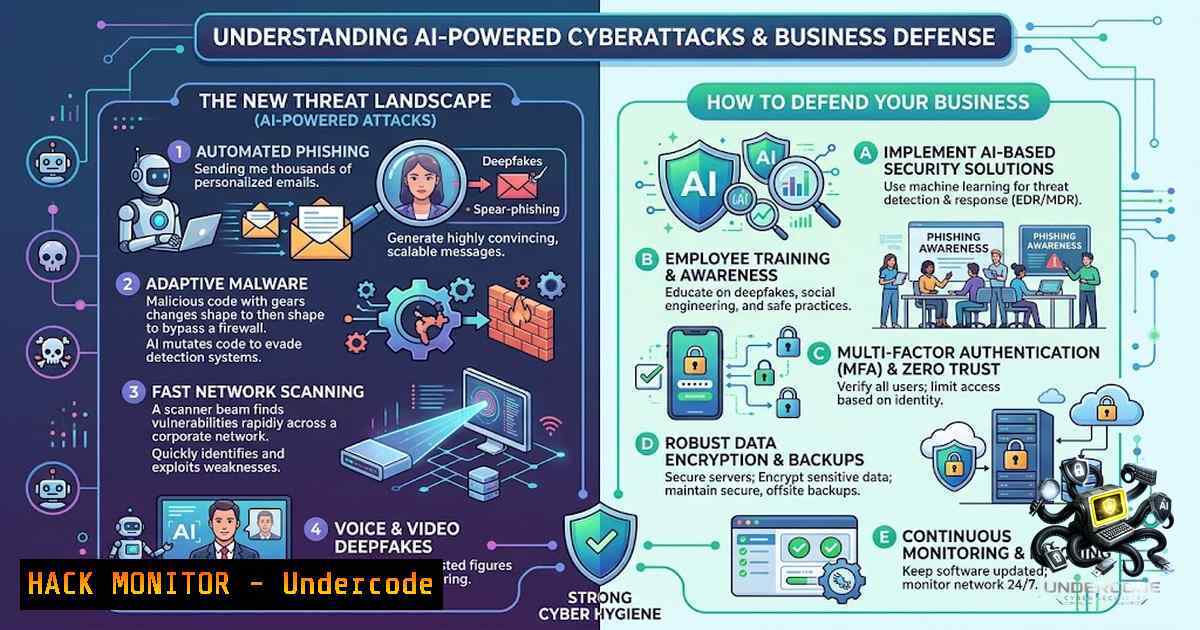
Artificial Intelligence is no longer just a tool for innovation; it has become a dual-use technology that is fundamentally altering the cybersecurity battlefield. Cybercriminals are leveraging AI to automate attacks, craft highly convincing phishing lures, and even clone voices, rendering traditional security perimeters obsolete. This evolution demands a paradigm shift from reactive to proactive defense strategies, where understanding the attacker’s new capabilities is the first step in building resilience.
Learning Objectives & Secrets:
- Objective 1: Update Your Threat Model. Understand that AI enables attackers to scale social engineering attacks with unprecedented precision, making it crucial to treat every digital interaction with skepticism.
- Objective 2 Secret Tip: Implement “Zero Trust” for Identity. Do not rely solely on MFA via SMS; use phishing-resistant authenticators like FIDO2 keys. The secret is that AI can now intercept or mimic one-time passwords (OTPs) through advanced phishing kits, making hardware-based authentication a necessity.
- Objective 3 Secret Tip: Deploy Behavioral Analytics. Use Endpoint Detection and Response (EDR) solutions with User and Entity Behavior Analytics (UEBA) to flag anomalies, such as an executive logging in from an unusual location or at an odd hour, which AI-generated attacks often exploit for lateral movement.
You Should Know:
- The AI-Enabled Attack Lifecycle and Your Defensive Countermeasures
The modern cyberattack, powered by AI, follows a sophisticated lifecycle that traditional antivirus cannot detect. It begins with reconnaissance, where AI scrapes public data (LinkedIn, company websites, social media) to profile key personnel and organizational hierarchy. This data is then used to generate “spear-phishing” emails that are grammatically perfect and contextually relevant. The next stage involves automation, where AI tools execute the attack, adapting to defenses in real-time. Finally, AI is used for “living off the land” (LotL) tactics, blending malicious activity with legitimate system processes.
To counter this, your security strategy must be layered and dynamic. A critical component is Privileged Access Management (PAM) and strict identity verification. For example, an Azure AD conditional access policy can be configured to block legacy authentication protocols and require compliant devices.
Step‑by‑step guide for Windows/Linux PAM hardening:
- Principle of Least Privilege: Regularly audit user permissions. On Windows, use PowerShell to export user group memberships:
Get-ADGroupMember -Identity "Domain Admins" | Export-Csv -Path "C:\security\domain_admins.csv"
- On Linux, review sudoers file for unnecessary privileges:
sudo grep -v -E "^|^$" /etc/sudoers | grep -E -v "NOPASSWD|ALL"
- Linux – Disable Root SSH Login: Edit `/etc/ssh/sshd_config` and set `PermitRootLogin no` and
PasswordAuthentication no, then restart SSH (sudo systemctl restart sshd). This prevents brute-force attacks that AI bots use to crack weak credentials.
2. How to Build an AI-Resistant Verification Culture
The post emphasizes a crucial rule: “Trust, but verify through a second channel.” This is not just a policy; it is a technical workflow that must be integrated into financial and data governance processes. The human factor remains the weakest link, and AI is exploiting it with deepfakes and voice cloning. For instance, attackers have used AI-generated audio to trick employees into transferring funds, mimicking the CEO’s voice during a phone call.
The solution is a “Out-of-Band Verification” protocol, especially for any request involving sensitive data, changes to payment details, or fund transfers. This involves using a separate communication channel to validate the request, such as using a pre-determined code word or using a dedicated secure messenger (like Signal or MS Teams) that is not the same as the channel used to receive the request.
Step‑by‑step guide for implementing this protocol:
- Step 1: Create a policy that requires dual approval for financial transactions exceeding a specific threshold.
- Step 2: Implement a “callback” procedure for vendor changes: If a vendor sends an email with new banking information, the finance department must call the vendor’s known, published number (not the number in the email) to verify.
- Step 3: To verify email integrity, check the email headers. On Windows/Linux, you can use `nslookup` to verify the email server’s SPF records:
nslookup -type=TXT example.com | grep "spf"
Look for a `spf` record to ensure the sending server is authorized to send emails on behalf of that domain.
- Step 4: Use Microsoft Defender for Office 365’s anti-phishing policies to “impersonate” known users (like your CEO) and flag emails that try to spoof them.
3. Securing Cloud Infrastructure Against AI-Driven Attacks
AI attacks are not limited to the user endpoint; they target APIs and cloud configurations. Microsoft and IBM reports show an increase in credential stuffing attacks targeting Azure and AWS environments, using AI to analyze leaked password databases and prioritize accounts. The key vulnerability is often misconfigured storage (like AWS S3 buckets with public access) or over-privileged IAM roles.
Step‑by‑step guide for cloud hardening:
- Azure: Enable Azure Security Center’s “Just-in-Time” (JIT) VM access. This prevents persistent open ports that attackers can scan. To manually audit open ports, use `nmap` from a Linux terminal:
nmap -sS -p- -T4 your-external-IP
- AWS: Regularly audit S3 bucket permissions using the CLI. List all buckets and check their public access block settings:
aws s3api list-buckets --query "Buckets[].Name"
aws s3api get-public-access-block --bucket your-bucket-1ame
- API Security: Implement API rate limiting and strict authentication. For a Linux NGINX server, you can enforce rate limiting to prevent brute-force on your API endpoints. Add to
/etc/nginx/nginx.conf:limit_req_zone $binary_remote_addr zone=mylimit:10m rate=10r/m; server { location /api/ { limit_req zone=mylimit burst=20 nodelay; proxy_pass http://your_backend/; } }
4. Endpoint Detection and Response (EDR) Configuration
Traditional antivirus is “reactive,” but EDR is “proactive,” using AI to detect patterns. Given that AI attacks are “polymorphic” (changing their signature to evade detection), EDR with behavioral detection is a must. These tools monitor processes, network connections, and file changes, creating a baseline of “normal” activity and alerting on deviations.
Step‑by‑step guide for Windows EDR optimization:
- Enable Attack Surface Reduction (ASR) rules in Windows Defender to block Office applications from creating child processes (a common vector for malware).
- On Windows, use PowerShell to set a PowerShell execution policy to restrict script execution:
Set-ExecutionPolicy -ExecutionPolicy Restricted -Scope LocalMachine
- On Linux, audit system logs for suspicious `cron` jobs (used by attackers to maintain persistence):
cat /var/spool/cron/crontabs/ | grep -v "^"
5. AI in Ransomware Mitigation
The post cites Anthropic documenting AI in ransomware/extortion operations. AI accelerates the encryption process and improves the “targeting” of valuable files (database backups, financial records). The defense is resilient, immutable backups.
Step‑by‑step guide for backup verification:
- 3-2-1 Backup Rule: 3 copies, 2 different media, 1 offsite. For Linux, use `rsync` to back up critical directories to a remote server, but ensure the remote server is not permanently connected (to prevent encryption propagation):
rsync -avz -e ssh /home/user/documents/ user@remote-server:/backup/documents/
- Windows: Use Windows Server Backup or third-party tools to create “shadow copies” (Volume Shadow Copy). To test the integrity of a shadow copy, use:
vssadmin list shadows
What Undercode Say:
- Key Takeaway 1: AI is a game-changer for attackers, making low-skill criminals highly effective. Your defenses must not assume “users are the weakest link” without equipping them with the tools and policies to fight back.
- Key Takeaway 2: Verification is a technical and operational process, not just a policy. Using a “second channel” and out-of-band authentication is the most effective defense against AI-driven impersonation and deepfakes.
- Analysis: The core vulnerability lies in “blind trust” of digital communication. As AI becomes ubiquitous, our “human intuition” becomes useless against AI-generated content. We are seeing a shift from “attack surface management” to “identity and trust management.” The business now must accept that both email and voice are no longer reliable forms of identity proof. The solution is a cultural and technical integration of “Zero Trust” architecture where every request is authenticated, authorized, and encrypted, regardless of its source. Businesses that adopt these practices will build a significant competitive advantage in terms of resilience and trust.
Prediction:
- +1: Companies that effectively implement out-of-band verification and EDR will be less susceptible to financial fraud, earning them lower cyber insurance premiums and stronger client trust in the next 18 months.
- -1: As AI tools become commoditized, ransomware-as-a-service (RaaS) models will become more prevalent and destructive, with attacks targeting not just data but also the integrity of backups, forcing businesses to pay or face permanent data loss.
- -1: The gap between large enterprises and SMBs will widen as AI-driven attacks disproportionately target smaller businesses with fewer resources to deploy advanced defenses, leading to a surge in SMB bankruptcies due to cyber incidents.
- +1: The demand for cybersecurity professionals trained in AI defense tactics will skyrocket, creating new career opportunities and driving the development of AI-vs-AI defensive tools to counter automated threats in real-time.
▶️ Related Video (84% Match):
🎯Let’s Practice For Free:
🎓 Live Courses & Certifications:
Join Undercode Academy for Verified Certifications
🚀 Request a Custom Project:
Secure, high-velocity infrastructure and disruptive technological engineering. Contact our engineering team for high-tier development and proprietary systems:
[email protected]
💎 Smart Architecture | 🛡️ Secure by Design | ⭐ Trusted by Thousands
IT/Security Reporter URL:
Reported By: https://lnkd.in/p/eT53sC4Z – Hackers Feeds
Extra Hub: Undercode MoN
Basic Verification: Pass ✅


