Listen to this Post
Introduction:
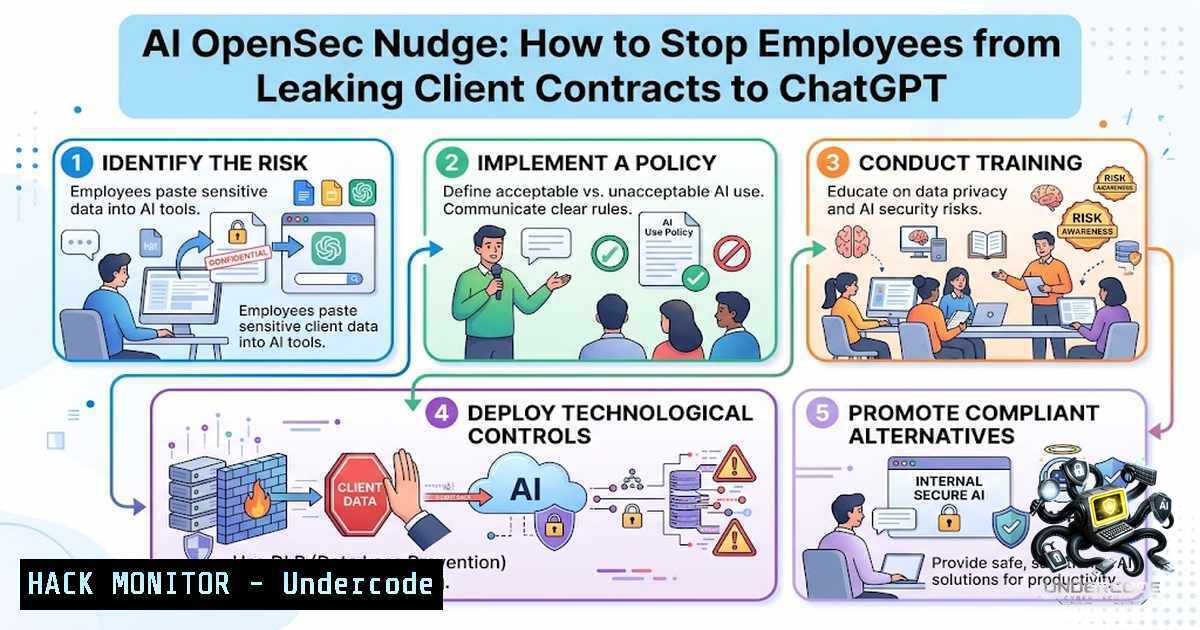
The rapid adoption of generative AI tools like ChatGPT and Claude in legal and accounting firms has created a perfect storm for data leakage. A single copy-paste of a client contract or sensitive financial report into a public AI model can violate GDPR, SOC2, and FCA compliance frameworks overnight【1†L5-L6】. AIOpenSec Labs Ltd addresses this with their “Nudge” feature—a real-time guardian that alerts employees the moment sensitive information is detected, enabling firms to embrace AI innovation while maintaining digital trust and regulatory compliance【1†L7-L9】. This article explores the technical architecture behind AI data loss prevention (DLP), provides hands-on commands for identifying unauthorized AI agents in your network, and offers a step-by-step guide to implementing AI security controls in your organization.
Learning Objectives:
- Understand the core architecture of AI-based data leakage prevention systems and how “Nudge” features operate in real-time.
- Learn to enumerate and identify unauthorized AI agents and shadow IT deployments within your network using both Linux and Windows commands.
- Master the configuration of API security policies, cloud hardening techniques, and vulnerability mitigation strategies specific to AI tool integration.
1. Understanding the AI Data Leakage Threat Surface
The modern enterprise faces a unique challenge: employees are adopting AI tools faster than security teams can vet them. When a user pastes a client contract into ChatGPT, that data is transmitted to external servers, often stored for model training, and potentially exposed in future responses to other users【1†L4-L6】. This is not theoretical—multiple high-profile incidents have occurred where proprietary source code or internal strategies were accidentally shared with public AI models.
AIOpenSec’s approach involves deploying a “Nudge” agent that uses pattern matching, regular expressions, and machine learning classifiers to detect sensitive data patterns (e.g., credit card numbers, passport IDs, legal case numbers) as they are being copied or pasted【1†L7-L8】. The system then intervenes with a real-time warning, effectively building a “layer of digital trust” that balances productivity with security【1†L9】.
Technical Deep-Dive:
- Data Classification Engine: Uses a combination of regex patterns (for PII/PHI) and NLP models (for contextual understanding of legal/financial documents).
- Policy Enforcement Point (PEP): Intercepts clipboard operations and HTTP/HTTPS outbound traffic to AI domains (e.g.,
api.openai.com,claude.ai). - Audit Logging: All alerts are logged to a SIEM (Security Information and Event Management) system for compliance reporting (SOC2, GDPR, FCA)【1†L9】.
Linux Command to Monitor Outbound AI Traffic:
Use `tcpdump` to monitor DNS queries and HTTP traffic to known AI endpoints.
sudo tcpdump -i eth0 -1 'dst host api.openai.com or dst host claude.ai or dst host anthropic.com' -v
Windows PowerShell Command to Check Active Network Connections to AI Domains:
Get-1etTCPConnection -RemotePort 443 | Where-Object { $_.RemoteAddress -match "openai|claude|anthropic" }
2. Identifying Shadow AI Agents in Your Network
If cybersecurity and infrastructure teams are unaware of which AI agents employees have deployed, ensuring those agents are deployed securely becomes almost impossible【1†L10-L11】. “Shadow AI” refers to any AI tool or service used within an organization without explicit IT approval. These can range from browser extensions that summarize emails to standalone desktop applications that generate code.
Step-by-Step Guide to Detecting Shadow AI:
- Network Traffic Analysis: Deploy a packet analyzer to inspect outbound traffic for patterns indicative of AI APIs.
– Linux: Use `ngrep` to search for API keys or typical JSON payloads sent to AI endpoints.
sudo ngrep -d eth0 -q 'api.openai.com' port 443
– Windows: Use `netsh` to capture network traces and then parse them with PowerShell.
netsh trace start capture=yes tracefile=C:\temp\ai_traffic.etl
 Stop after 5 minutes
netsh trace stop
 Use Microsoft Message Analyzer or pcap parsing tools to inspect.
- Browser Extension Audit: Many AI tools are deployed as browser extensions. On managed devices, use Group Policy or MDM (Mobile Device Management) to enforce a list of allowed extensions.
– Chrome GPO: Set `ExtensionInstallBlocklist` to “ and `ExtensionInstallAllowlist` to only approved extensions.
- Endpoint Detection and Response (EDR): Use EDR tools to hunt for processes associated with AI tools.
– Linux:
ps aux | grep -E 'chatgpt|claude|bard|copilot'
– Windows:
Get-Process | Where-Object { $_.ProcessName -match "chatgpt|claude|bard|copilot" }
- DNS Logging: Enable DNS debug logging on your domain controllers or use a tool like `dnscmd` to log all DNS queries.
dnscmd /config /loglevel 0xFFFFFFFF
3. Implementing a “Nudge” Architecture for Real-Time Protection
AIOpenSec’s “Nudge” feature is a proactive DLP mechanism【1†L7-L8】. Instead of blocking AI usage outright (which leads to shadow IT), it educates and alerts the user at the moment of risk. This behavioral approach is more effective for long-term security culture.
Step-by-Step Guide to Building a Nudge System:
- Deploy a Proxy or SSL Inspection Point: To inspect encrypted traffic (HTTPS), you need a man-in-the-middle (MITM) proxy like Squid or Zscaler. This allows you to decrypt, inspect, and re-encrypt traffic.
– Linux Squid Configuration:
 Install Squid
sudo apt-get install squid
 Configure squid.conf to intercept traffic on port 3128
http_port 3128 intercept
https_port 3130 intercept ssl-bump ...
- Integrate a DLP Engine: Use open-source tools like `ClamAV` with custom signatures or `Tesseract` for OCR on images to detect sensitive text.
– Custom Regex for Credit Cards:
\b(?:\d{4}[ -]?){3}\d{4}\b
- Develop a Response Module: When sensitive data is detected, the proxy should return a “Nudge” page instead of forwarding the request to the AI API. This page explains the risk and asks for confirmation.
– Python Flask Example (Mock Nudge Server):
from flask import Flask, request, render_template
app = Flask(<strong>name</strong>)
@app.route('/nudge')
def nudge():
return render_template('nudge.html', message="This contains PII. Are you sure?")
- Log and Alert: Send all nudge events to a central SIEM (e.g., Splunk, ELK) for compliance auditing【1†L9】.
4. Hardening Cloud Environments Against AI Data Exfiltration
With the rise of AI, cloud security postures must evolve. Attackers are now using AI-generated phishing emails or exploiting exposed API keys to access AI services and exfiltrate data.
Cloud Hardening Techniques:
1. API Key Rotation and Management:
- Use Azure Key Vault or AWS Secrets Manager to store AI API keys. Never hardcode keys in source code.
- AWS CLI Command to Rotate a Secret:
aws secretsmanager rotate-secret --secret-id MyAISecret --rotation-rules AutomaticallyAfterDays=30
2. Zero Trust Network Access (ZTNA):
- Implement ZTNA to ensure that only authenticated and authorized devices can access AI APIs. This prevents stolen credentials from being used outside the corporate network.
3. Data Loss Prevention (DLP) in the Cloud:
- Use cloud-1ative DLP tools like AWS Macie or Microsoft Purview to scan S3 buckets or SharePoint for sensitive data that might be fed into AI models.
- AWS Macie Command:
aws macie2 create-classification-job --1ame "AIDataScan" --s3-job-definition '{"BucketDefinitions":[{"AccountId":"123456789012","Buckets":["my-ai-data-bucket"]}]}'
4. Vulnerability Exploitation Mitigation:
- AI models themselves are vulnerable to prompt injection attacks. Sanitize all inputs to your AI models to prevent prompt leakage.
- Input Sanitization Regex (Python):
import re
def sanitize_input(text):
Remove potential injection patterns
text = re.sub(r'ignore previous instructions|system prompt|developer mode', '', text, flags=re.IGNORECASE)
return text
5. Compliance and Certification: The ISO 27001:2022 Standard
AIOpenSec is certified to ISO/IEC 27001:2022, covering platform development, operations, and customer data handling【1†L12-L13】. This certification is critical for legal and accounting firms that must demonstrate due diligence to their clients.
What ISO 27001:2022 Means for AI Security:
- Clause 5.1: Policies for information security must now explicitly address AI usage.
- Clause 8.2: Risk assessments must include AI-specific risks (e.g., model poisoning, data leakage).
- Clause 9.1: Monitoring and measurement must include AI system logs.
Steps to Achieve AI-Ready ISO 27001 Compliance:
- Inventory AI Assets: Create a register of all AI tools used within the organization.
– Linux Command to Inventory AI Packages:
pip list | grep -E 'openai|anthropic|transformers|tensorflow'
- Conduct a Risk Assessment: Use a framework like NIST AI RMF (Risk Management Framework) to identify risks.
3. Implement Controls:
- Access control (IAM) for AI platforms.
- Encryption of data at rest and in transit to AI APIs.
- Incident response plan for AI data breaches.
- Linux and Windows Commands for AI Security Auditing
Here is a comprehensive list of commands to audit your environment for AI-related security issues.
Linux:
- Find all AI-related configuration files:
sudo find / -1ame "openai" -o -1ame "claude" -o -1ame "anthropic" 2>/dev/null
- Check for running AI containers:
docker ps | grep -E 'openai|claude|llama|gpt'
- Audit sudo commands for AI tool installations:
sudo grep -i "pip install" /var/log/auth.log
Windows:
- Search the registry for AI software:
Get-ChildItem -Path HKLM:\Software\Microsoft\Windows\CurrentVersion\Uninstall | Get-ItemProperty | Where-Object {$_.DisplayName -match "AI|ChatGPT|Claude"} | Select-Object DisplayName, DisplayVersion - Find AI-related files on all drives:
Get-ChildItem -Path C:\ -Recurse -ErrorAction SilentlyContinue | Where-Object { $_.Name -match "openai|claude|anthropic" } - Check scheduled tasks for AI scripts:
Get-ScheduledTask | Where-Object { $_.TaskName -match "AI|ChatGPT" }
7. Future-Proofing Your AI Security Strategy
The landscape of AI security is evolving rapidly. Organizations must adopt a proactive stance.
Emerging Threats:
- Model Inversion Attacks: Attackers can reconstruct training data from model outputs.
- Membership Inference: Determining if specific data was used to train the model.
Mitigation Strategies:
- Differential Privacy: Add noise to training data to prevent inversion.
- Federated Learning: Train models locally without sharing raw data.
- AI-Specific Firewalls: Deploy next-gen firewalls with AI traffic inspection capabilities.
Script to Monitor AI Model Drift (Linux):
!/bin/bash
 Check if the model's response time or accuracy changes drastically
curl -X POST https://api.openai.com/v1/completions -H "Authorization: Bearer $API_KEY" -d '{"prompt":"Test","max_tokens":5}' | jq '.usage.total_tokens'
What Undercode Say:
- Key Takeaway 1: The “Nudge” approach is superior to blanket blocking because it fosters a security-conscious culture rather than driving users to shadow IT solutions.
- Key Takeaway 2: ISO 27001:2022 certification is not just a badge; it provides a tangible framework (clauses 5.1, 8.2, 9.1) for integrating AI governance into existing ISMS (Information Security Management Systems)【1†L12-L13】.
Analysis:
AIOpenSec addresses a critical gap in the market—the human factor in AI security. While most vendors focus on securing the AI model itself (e.g., preventing prompt injection), AIOpenSec focuses on securing the data that feeds into the model. Their solution is particularly well-suited for SMBs in regulated industries (legal, accounting) that lack large security teams. The “Nudge” feature effectively turns every employee into a security sensor, reducing the burden on the SOC (Security Operations Center). The self-service SOC aspect allows infrastructure teams to identify unknown AI agents, closing the visibility gap that plagues modern enterprises【1†L10-L11】.
Prediction:
- +1: By 2027, “AI DLP” will become a standard module in all major EDR and CASB (Cloud Access Security Broker) platforms, similar to how web filtering became standard in the early 2000s.
- +1: The “Nudge” paradigm will evolve into “AI Co-pilot Security,” where the AI itself warns the user in real-time, creating a symbiotic relationship between productivity and protection.
- -1: Organizations that fail to adopt AI-specific security measures (like those offered by AIOpenSec) will face significant regulatory fines (GDPR 83) and reputational damage, as AI data leakage incidents become as common as phishing attacks.
- +1: ISO 27001:2022 certification will become a minimum requirement for any vendor handling AI data, driving a wave of consolidation and standardization in the AI security market【1†L12-L13】.
▶️ Related Video (80% Match):
🎯Let’s Practice For Free:
🎓 Live Courses & Certifications:
Join Undercode Academy for Verified Certifications
🚀 Request a Custom Project:
Secure, high-velocity infrastructure and disruptive technological engineering. Contact our engineering team for high-tier development and proprietary systems:
[email protected]
💎 Smart Architecture | 🛡️ Secure by Design | ⭐ Trusted by Thousands
IT/Security Reporter URL:
Reported By: Welcome To – Hackers Feeds
Extra Hub: Undercode MoN
Basic Verification: Pass ✅


