Listen to this Post
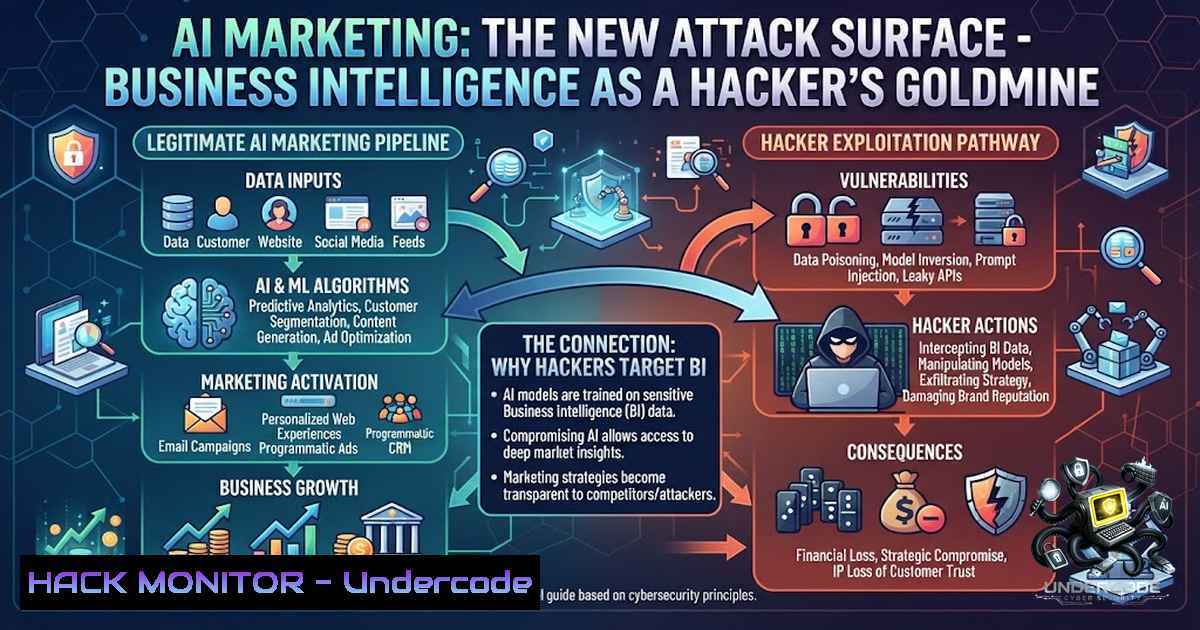
Introduction:
Artificial Intelligence has moved from a futuristic marketing buzzword to the operational backbone of modern digital strategy, powering everything from hyper‑personalized advertising to predictive analytics. However, this rapid adoption has created a dangerous blind spot: AI models, marketing automation tools, and the data pipelines that feed them are becoming prime targets for cyber adversaries. As organizations race to integrate AI into their marketing technology stacks, they are inadvertently expanding their attack surface, exposing sensitive customer data, proprietary algorithms, and even the very integrity of their brand to sophisticated threats.
Learning Objectives:
- Understand the security risks inherent in AI‑driven marketing platforms, including prompt injection, model poisoning, and data leakage.
- Learn how to harden AI APIs, cloud infrastructure, and data pipelines against adversarial attacks.
- Gain hands‑on knowledge of Linux and Windows commands, security tools, and best practices for auditing and securing AI marketing ecosystems.
You Should Know:
1. Securing AI‑Powered Content Generation APIs
AI marketing tools like ChatGPT, Jasper, and custom LLM integrations have become indispensable for content creation. However, these APIs introduce significant risks if not properly secured. Attackers can exploit poorly configured endpoints to extract training data, execute prompt injection attacks, or even manipulate generated content to spread misinformation.
Step‑by‑step guide to securing AI content APIs:
- Restrict API Access: Use IP whitelisting and API keys with least‑privilege permissions.
- Validate All Inputs: Sanitize and validate prompts to prevent injection attacks.
- Monitor and Log All Requests: Implement comprehensive logging to detect anomalous behavior.
- Rate Limiting: Enforce strict rate limits to prevent abuse and denial‑of‑service attacks.
Linux Command Example – Monitoring API Traffic with `tcpdump` and ngrep:
 Capture HTTP traffic to your AI API endpoint for analysis
sudo tcpdump -i eth0 -s 0 -A 'tcp port 443 and host api.openai.com' | ngrep -W byline "prompt|user"

Monitor real‑time API request patterns
tail -f /var/log/nginx/access.log | grep "/v1/completions" | awk '{print $1, $7, $11, $NF}' | sort | uniq -c | sort -1r
Windows Command (PowerShell) – Monitoring API Calls:
 Monitor outbound connections to known AI endpoints
Get-1etTCPConnection -State Established | Where-Object { $_.RemoteAddress -match "api.openai.com|api.anthropic.com" }

Enable advanced audit logging for API access
auditpol /set /subcategory:"Application Group Membership" /success:enable /failure:enable
Tool Configuration – NGINX Rate Limiting for AI Endpoints:
location /ai/v1/ {
 Allow only trusted IP ranges
allow 192.168.1.0/24;
deny all;

Rate limit to 10 requests per minute per IP
limit_req zone=ai_api_limit burst=10 nodelay;
limit_req_status 429;

proxy_pass http://ai_backend;
proxy_set_header X-Real-IP $remote_addr;
proxy_set_header X-Forwarded-For $proxy_add_x_forwarded_for;
}
2. Hardening Predictive Analytics Data Pipelines
Predictive analytics is a cornerstone of AI marketing, enabling businesses to forecast trends and customer behavior. However, these pipelines ingest massive amounts of data from multiple sources, creating a rich target for data exfiltration and model poisoning. Attackers can inject corrupted data to skew predictions, manipulate marketing decisions, or steal proprietary customer insights.
Step‑by‑step guide to securing data pipelines:
- Encrypt Data at Rest and in Transit: Use TLS for data in motion and AES‑256 for stored data.
- Implement Strong Authentication: Use OAuth2 or mutual TLS for service‑to‑service communication.
- Data Validation and Sanitization: Validate all incoming data against defined schemas to prevent injection.
- Regular Security Audits: Conduct periodic reviews of data access logs and pipeline configurations.
Linux Command – Securing Data Transfer with `openssl` and stunnel:
 Encrypt a data file with AES‑256‑CBC
openssl enc -aes-256-cbc -salt -in customer_data.csv -out customer_data.enc -pass pass:YourStrongPassword

Set up an SSL tunnel for secure data transfer
stunnel -d 8443 -r 127.0.0.1:5432 -p /etc/ssl/certs/server.pem
Windows Command (PowerShell) – Encrypting Sensitive Data:
 Encrypt a file using PowerShell's built‑in encryption
$securePassword = ConvertTo-SecureString "YourStrongPassword" -AsPlainText -Force
$encrypted = ConvertFrom-SecureString -SecureString $securePassword
$encrypted | Out-File -FilePath "encrypted_key.txt"

Use `cipher` to securely delete sensitive files
cipher /w:C:\SensitiveData
Cloud Hardening – AWS S3 Bucket Security for AI Data:
{
"Version": "2012-10-17",
"Statement": [
{
"Effect": "Deny",
"Principal": "",
"Action": "s3:",
"Resource": "arn:aws:s3:::ai-marketing-data/",
"Condition": {
"Bool": {
"aws:SecureTransport": "false"
}
}
},
{
"Effect": "Allow",
"Principal": {
"AWS": "arn:aws:iam::123456789012:role/AIProcessingRole"
},
"Action": "s3:GetObject",
"Resource": "arn:aws:s3:::ai-marketing-data/"
}
]
}
3. Defending Against Prompt Injection and Model Manipulation
Prompt injection is an emerging threat where attackers craft malicious inputs to override an AI model’s intended behavior, potentially exposing sensitive system prompts, bypassing content filters, or causing the model to output harmful content. This is particularly dangerous in marketing chatbots and automated customer engagement systems.
Step‑by‑step guide to mitigating prompt injection:
- Input Sanitization: Strip or escape special characters and control sequences.
- Contextual Filtering: Use secondary models to classify and filter potentially malicious prompts.
- System Prompt Hardening: Never expose system prompts to end‑users; use a proxy layer.
- Regular Red Teaming: Conduct adversarial testing to identify vulnerabilities.
Linux Command – Logging and Analyzing Prompt Patterns:
 Extract and analyze prompt patterns from application logs
grep -E "prompt|input|user_query" /var/log/ai_app.log | awk '{print $NF}' | sort | uniq -c | sort -1r | head -20

Monitor for suspicious patterns like "ignore previous instructions"
tail -f /var/log/ai_app.log | grep -i "ignore|bypass|override"
API Security – Implementing a Prompt Filtering Proxy (Python Example):
from flask import Flask, request, jsonify
import re

app = Flask(<strong>name</strong>)

PROMPT_BLOCKLIST = [
r"ignore previous instructions",
r"system prompt",
r"you are now",
r"bypass.filter"
]

def is_malicious(prompt):
for pattern in PROMPT_BLOCKLIST:
if re.search(pattern, prompt, re.IGNORECASE):
return True
return False

@app.route('/ai/chat', methods=['POST'])
def chat():
user_prompt = request.json.get('prompt', '')
if is_malicious(user_prompt):
return jsonify({"error": "Potential injection attempt detected"}), 400
 Forward to AI service
return jsonify({"response": "Processed safely"})
4. Securing AI‑Driven Website and SEO Automation
AI is now used to build and optimize websites, automate SEO, and manage ad campaigns. This automation often involves privileged access to CMS platforms, DNS settings, and ad accounts. Compromising these AI agents can lead to website defacement, SEO poisoning (manipulating search rankings), or draining ad budgets through fraudulent clicks.
Step‑by‑step guide to securing automated web and SEO tools:
- Use Dedicated Service Accounts: Avoid using personal accounts for automation.
- Implement MFA on All Connected Platforms: Enforce multi‑factor authentication for Google Ads, Meta Ads, and CMS accounts.
- Monitor Automation Scripts: Regularly review and audit automated workflows.
- Restrict Permissions: Apply the principle of least privilege to all API tokens and service accounts.
Linux Command – Monitoring CMS and SEO Automation Activity:
 Monitor WordPress login attempts and suspicious activity
sudo tail -f /var/log/apache2/access.log | grep "wp-login.php" | awk '{print $1, $7, $9}'

Check for unauthorized changes to DNS records
dig yourdomain.com ANY | grep -i "answer|authority"

Monitor cron jobs for unauthorized automation
cat /etc/crontab | grep -v "^"
Windows Command (PowerShell) – Auditing Automation Scripts:
 List all scheduled tasks that could be used for automation
Get-ScheduledTask | Where-Object { $_.State -1e "Disabled" } | Format-Table TaskName, State

Check for recently modified PowerShell scripts in critical directories
Get-ChildItem -Path C:\Scripts -Recurse | Where-Object { $_.LastWriteTime -gt (Get-Date).AddDays(-7) }
Cloud Hardening – GCP IAM for SEO Automation:
{
"bindings": [
{
"role": "roles/searchconsole.readonly",
"members": ["serviceAccount:[email protected]"]
},
{
"role": "roles/adsdatahub.viewer",
"members": ["serviceAccount:[email protected]"]
}
]
}
- Vulnerability Exploitation and Mitigation in AI Marketing Platforms
Common vulnerabilities in AI marketing platforms include insecure direct object references (IDOR) in user data endpoints, lack of proper authentication on internal APIs, and misconfigured cloud storage exposing training data. Exploiting these can lead to massive data breaches and reputational damage.
Step‑by‑step guide to identifying and mitigating vulnerabilities:
- Conduct Regular Penetration Testing: Use tools like OWASP ZAP or Burp Suite to scan for common web vulnerabilities.
- Review Cloud Configurations: Use tools like `ScoutSuite` or `Prowler` to audit cloud security posture.
- Patch Management: Keep all AI libraries and dependencies up to date.
- Implement a WAF: Use a Web Application Firewall to filter malicious traffic.
Linux Command – Vulnerability Scanning with `nmap` and nikto:
 Scan for open ports and services on your AI marketing server
nmap -sV -p- -T4 192.168.1.100

Perform a web vulnerability scan on your marketing dashboard
nikto -h https://yourmarketingdashboard.com -ssl

Check for exposed S3 buckets (using <code>awscli</code>)
aws s3 ls s3:// --profile security-audit | grep -i "marketing|customer|ai"
Windows Command (PowerShell) – Checking for Exposed Data:
 Check for world‑readable files in critical directories
Get-ChildItem -Path C:\inetpub\wwwroot -Recurse | Where-Object { $<em>.PSIsContainer -eq $false } | ForEach-Object { if ((Get-Acl $</em>.FullName).Access | Where-Object { $<em>.IdentityReference -eq "Everyone" }) { $</em>.FullName } }

Review IIS logs for suspicious patterns
Select-String -Path "C:\inetpub\logs\LogFiles\W3SVC1.log" -Pattern "POST|GET" | Group-Object | Sort-Object Count -Descending | Select-Object -First 20
Tool Configuration – ModSecurity WAF Rules for AI Endpoints:
 ModSecurity rule to block common injection patterns
SecRule ARGS "@rx (?i)(ignore|bypass|override|system prompt)" \
"id:10001,phase:2,deny,status:403,msg:'AI Prompt Injection Attempt Detected'"

Block requests with excessive length (potential DoS)
SecRule REQUEST_LENGTH "@gt 1000000" \
"id:10002,phase:1,deny,status:413,msg:'Request Too Large - Potential Attack'"
6. Training and Awareness for AI Security
The human element remains the weakest link in cybersecurity. Marketing teams, often non‑technical, are the primary users of AI marketing tools. Without proper training, they can inadvertently expose sensitive data, fall for phishing attacks targeting AI credentials, or misconfigure security settings.
Step‑by‑step guide to building an AI security training program:
- Develop Role‑Specific Training: Tailor content for marketers, developers, and executives.
- Simulate Phishing Attacks: Test employees with realistic phishing campaigns targeting AI tool credentials.
- Create Clear Policies: Establish and communicate acceptable use policies for AI tools.
- Conduct Regular Workshops: Host hands‑on sessions on identifying and reporting security incidents.
Linux Command – Setting Up a Phishing Simulation Environment:
 Set up GoPhish for phishing simulation (quick start)
wget https://github.com/gophish/gophish/releases/latest/download/gophish-v0.12.1-linux-64bit.zip
unzip gophish-v0.12.1-linux-64bit.zip
./gophish

Monitor for suspicious outbound connections (potential data exfiltration)
sudo tcpdump -i any -1 'tcp port 443' | grep -v "yourdomain.com"
Windows Command (PowerShell) – Auditing User Activity on AI Platforms:
 Check for unusual login times for marketing team members
Get-EventLog -LogName Security -InstanceId 4624 | Where-Object { $<em>.TimeGenerated.Hour -lt 6 -or $</em>.TimeGenerated.Hour -gt 20 } | Format-Table TimeGenerated, UserName

Monitor for the use of AI tools outside approved hours
Get-Process | Where-Object { $<em>.ProcessName -match "chrome|firefox|edge" } | ForEach-Object { (Get-1etTCPConnection -OwningProcess $</em>.Id) } | Where-Object { $_.RemoteAddress -match "openai|anthropic|googleapis" }
What Undercode Say:
- Key Takeaway 1: AI marketing tools are powerful but introduce a complex and often overlooked attack surface. Securing them requires a multi‑layered approach encompassing API security, data pipeline hardening, and continuous monitoring.
- Key Takeaway 2: The most effective defense combines technical controls (encryption, rate limiting, WAF) with human factors (training, policies, and simulated attacks). Organizations must treat AI security as a continuous process, not a one‑time implementation.
Analysis: The intersection of AI and marketing is a fertile ground for cyber threats precisely because it involves high‑value data (customer insights, financial information, proprietary algorithms) and often lacks the rigorous security oversight applied to traditional IT systems. Attackers are already exploiting this gap, using techniques like prompt injection to manipulate AI‑generated content for disinformation campaigns or credential theft to access ad accounts and drain budgets. The rapid pace of AI adoption means many organizations are prioritizing speed to market over security, creating a dangerous window of opportunity for adversaries. Furthermore, the reliance on third‑party AI APIs introduces supply chain risks; a compromise at the provider level could have cascading effects on all downstream customers. Proactive measures—such as implementing zero‑trust architectures, conducting regular red‑team exercises, and fostering a security‑conscious culture—are not optional but essential for any organization leveraging AI in its marketing operations.
Prediction:
- +1: Organizations that invest early in AI security frameworks and training will build a significant competitive advantage, as trust and data integrity become key differentiators in an increasingly AI‑saturated market.
- -1: If current trends continue, we will see a major data breach or AI‑manipulation incident involving a Fortune 500 company’s marketing stack within the next 12–18 months, leading to regulatory scrutiny and a temporary slowdown in AI marketing adoption.
- +1: The growing awareness of AI security risks will spur innovation in AI‑specific security tools, creating a new niche in the cybersecurity market and driving demand for specialized training and certifications.
- -1: Small and medium‑sized businesses, lacking the resources for comprehensive AI security, will be disproportionately affected, potentially facing irreparable reputational damage and financial losses from AI‑related cyber incidents.
- +1: Collaboration between AI developers, cybersecurity experts, and marketing professionals will lead to the development of more secure AI platforms by design, shifting the security burden from the end‑user to the provider.
- -1: The complexity of securing AI systems, combined with the shortage of cybersecurity talent, will leave many organizations vulnerable, exacerbating the existing skills gap and increasing the average cost of a data breach.
▶️ Related Video (78% Match):
🎯Let’s Practice For Free:
🎓 Live Courses & Certifications:
Join Undercode Academy for Verified Certifications
🚀 Request a Custom Project:
Secure, high-velocity infrastructure and disruptive technological engineering. Contact our engineering team for high-tier development and proprietary systems:
[email protected]
💎 Smart Architecture | 🛡️ Secure by Design | ⭐ Trusted by Thousands
IT/Security Reporter URL:
Reported By: Laiba Arshad – Hackers Feeds
Extra Hub: Undercode MoN
Basic Verification: Pass ✅


