
Listen to this Post
Introduction
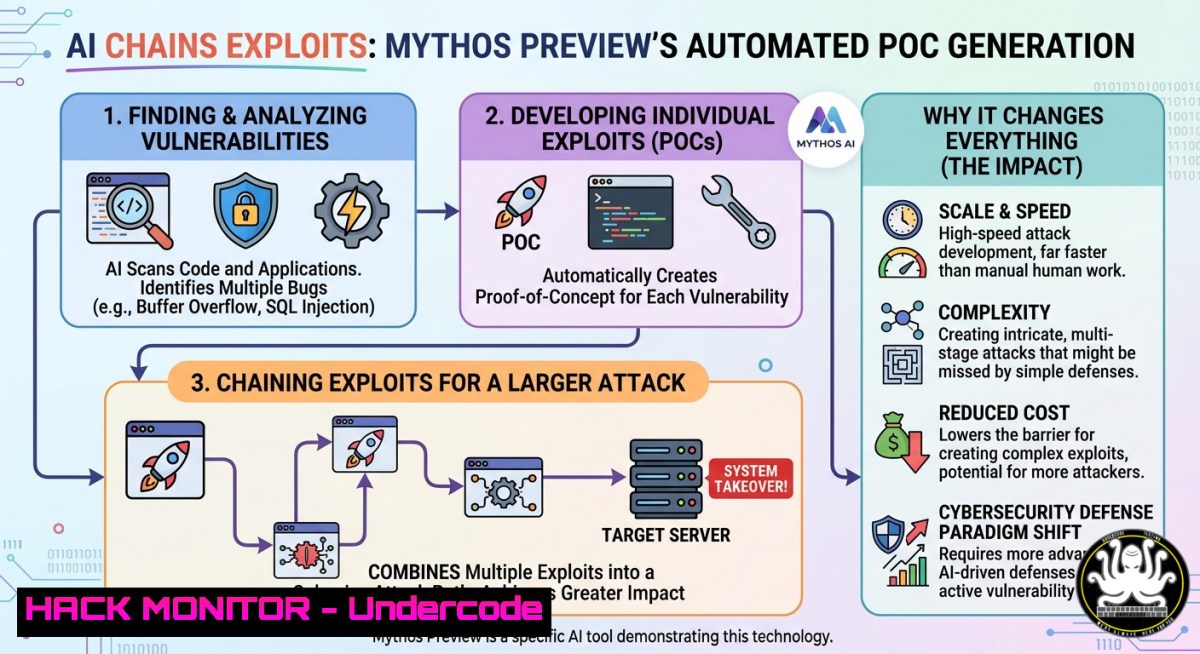
Anthropic’s Mythos Preview has crossed a critical threshold in automated vulnerability research—not merely identifying software flaws but autonomously chaining low-severity primitives (use-after-free bugs, arbitrary read/write, ROP gadgets) into fully weaponized proof-of-concept exploits. This shift from detection to autonomous offensive reasoning means that AI can now simulate real attacker logic at machine speed, transforming isolated vulnerabilities into systemic attack paths that traditional reactive security models cannot keep pace with.
Learning Objectives
- Understand how Mythos Preview’s exploit‑chaining pipeline (recon, hunt, validate, gapfill, dedupe, trace, feedback, report) constructs working exploits from multiple low‑severity primitives.
- Learn to implement architectural survivability controls—operational isolation, controlled trust environments, and zero‑trust segmentation—to withstand AI‑driven offensive reasoning.
- Acquire hands-on commands for Linux/Windows to detect memory corruption primitives, validate exploit paths, and harden systems against automated exploit generation.
You Should Know
- Deconstructing the Mythos Pipeline: From Recon to Trace
The pipeline’s eight stages automate what human reverse engineers spend weeks doing. The critical “trace” stage determines whether attacker‑controlled input can reach a confirmed bug from outside the system—validating exploitability before generating the PoC.
Step‑by‑step to emulate a simplified trace check on Linux:
 Monitor syscalls and memory access of a target binary
strace -e trace=read,write,openat -f ./vulnerable_binary 2>&1 | grep -E "read.from.socket|write.to.pipe"

Use GDB to trace user input propagation
gdb -q ./target_binary
(gdb) break 0x401234  break at suspected use-after-free site
(gdb) run < input_payload
(gdb) info registers rdi rsi rdx  check if attacker input reached registers
(gdb) x/s $rsi  examine memory content
Windows equivalent (PowerShell + WinDbg):
 Enable process creation tracing
logman start ProcessTrace -p "Microsoft-Windows-Kernel-Process" 0x10 -o C:\trace.etl
 Run target, then stop trace
logman stop ProcessTrace
 Convert ETL to text
tracerpt C:\trace.etl -o trace_analysis.xml
2. Identifying Use‑After‑Free (UAF) Primitives for Exploit Chaining
Mythos looks for dangling pointers where freed memory can be reallocated with attacker‑controlled data. This primitive is often chainable with an arbitrary read/write.
Linux: Detect UAF with AddressSanitizer & Core Dump Analysis
 Compile with sanitizers to catch UAF at runtime
gcc -fsanitize=address -g -o test_uaf vulnerable.c
./test_uaf
 ASAN will report: "heap-use-after-free" with allocation/free stack traces

Manual heap inspection using gdb + pwndbg
gdb -q ./test_uaf
(gdb) catch syscall exit_group
(gdb) r
(gdb) heap chunks  list all heap chunks and their state (freed/inuse)
(gdb) parseheap  show chunk boundaries and prev_size
Windows: Detect dangling pointers via PageHeap + WinDbg
 Enable full page heap for target executable
gflags /p /enable C:\path\to\target.exe /full
 Run target under WinDbg
windbg -g -o target.exe
 In WinDbg: break on heap free operations
bp ntdll!RtlFreeHeap ".echo Heap Free; kb; g"
3. Building ROP Gadget Chains Automatically
Mythos reasons about return‑oriented programming gadgets across executable sections. The model’s “gapfill” stage stitches short gadgets into longer chains to bypass NX/DEP.
Linux: Extract ROP gadgets from a binary using Ropper
 Install ropper
pip3 install ropper
ropper --file /bin/ls --search "pop rdi; ret"  find specific gadget
ropper --file target_binary --chain "execve"  automatically build execve chain
ropper --file target_binary --type rop --console  interactive ROP builder
Windows: Use rp++ (ROP++ for PE/ELF/Mach-O)
rp-win-x64.exe -f C:\target\app.exe -r 5 > rop_gadgets.txt
 Look for `pop rcx; ret` (x64 fastcall first argument) and `pop rax; ret`
Manual gadget chaining example (x64):
 Goal: call execve("/bin/sh", 0, 0)
 Gadget 1: pop rdi; ret (load "/bin/sh" pointer)
 Gadget 2: pop rsi; ret (load 0)
 Gadget 3: pop rdx; ret (load 0)
 Gadget 4: mov rax, 0x3b; syscall (execve syscall number 59)
4. Validating Arbitrary Read/Write Primitives
The “validate” stage confirms that discovered primitives actually work. For an arbitrary write, Mythos attempts to overwrite a saved return address or function pointer.
Python script to test arbitrary write on a Linux target (ptrace or /proc/pid/mem):
import ctypes, os, sys
pid = int(sys.argv[bash])
addr = int(sys.argv[bash], 16)  target memory address
value = b"A"8
 Write via process_vm_writev (requires same UID)
libc = ctypes.CDLL("libc.so.6")
libc.process_vm_writev(pid, ctypes.byref(ctypes.create_string_buffer(value)), 1, addr, 1, 0)
print(f"Wrote {value} to {hex(addr)}")
Windows: Validate arbitrary read via NtReadVirtualMemory (kernel32)
 PowerShell with P/Invoke
Add-Type @"
using System;
using System.Runtime.InteropServices;
public class Mem {
[DllImport("kernel32.dll")]
public static extern bool ReadProcessMemory(IntPtr hProcess, IntPtr lpBaseAddress, byte[] lpBuffer, int dwSize, out int lpNumberOfBytesRead);
}
"@
$proc = Get-Process -Name "target" | Select-Object -First 1
$buffer = New-Object byte[] 64
[bash]::ReadProcessMemory($proc.Handle, 0x7FFB12340000, $buffer, $buffer.Length, [bash]0)
5. Hardening Against AI‑Driven Exploit Chaining: Survivability Controls
Marius Barczak’s call for “architectural survivability” means designing systems that continue operating even when an AI has chained multiple exploits. Key controls: operational isolation and controlled trust environments.
Linux: Enforce seccomp-bpf to block exploit gadget stages
 Block execve syscall (prevents ROP chain from spawning shell)
echo '!/bin/bash' > block_execve.sh
cat << 'EOF' | sudo tee block_execve.sh
scmp_sys_resolver execve > /sys/kernel/seccomp/block_execve
 Or use seccomp-tools to generate filter
seccomp-tools dump ./vulnerable_binary
EOF
sudo chmod +x block_execve.sh

Apply strict seccomp to a service (systemd)
sudo systemctl edit my_service
 Add: [bash]
 MemoryDenyWriteExecute=yes
 SystemCallFilter=~execve execveat
 SystemCallArchitectures=native
Windows: Enable Control Flow Guard (CFG) and Arbitrary Code Guard (ACG)
 Enable CFG for a specific binary
Set-ProcessMitigation -Name "C:\app\vuln.exe" -Enable CFG
 Enable ACG (prevents dynamic code generation – blocks ROP chain injection)
Set-ProcessMitigation -Name "C:\app\vuln.exe" -Enable DynamicCode
 Enable Win32k System Call Disable (blocks user->kernel exploit transitions)
Set-ProcessMitigation -Name "C:\app\vuln.exe" -Enable DisableWin32kSystemCalls
6. Simulating AI‑Style Vulnerability Research Locally
You can replicate Mythos’s “recon → hunt → validate → gapfill” logic using open‑source tools.
Automated pipeline script (Linux):
!/bin/bash
 recon stage
cve_searchsploit -u  update local exploit db
nuclei -t cves/ -l targets.txt -o recon_results.json

hunt stage using AFL++ for fuzzing
afl-fuzz -i seed_corpus/ -o findings/ -m none -t 5000 -- ./target_binary @@

validate stage – check if crashes are controllable
for crash in findings/default/crashes/; do
gdb -q -batch -ex "run < $crash" -ex "bt" ./target_binary > validate_log.txt
if grep -q "use-after-free|heap-buffer-overflow" validate_log.txt; then
echo "Valid primitive in $crash"
fi
done

gapfill – attempt to build ROP chain using ROPgadget
ROPgadget --binary ./target_binary | grep -E "pop rdi; ret|int 0x80|syscall" > gadgets.txt
python3 -c "print('Chain: ' + '; '.join(open('gadgets.txt').read().splitlines()[:5]))"
- Cloud & API Security in the Age of AI Offensive Reasoning
Mythos’s ability to reason across trust layers means cloud misconfigurations and API logic flaws become prime chain components.
AWS: Detect and block exploit chaining via IAM privilege escalation
 Use Pacu to simulate AI-driven privilege escalation chain
pacu

<blockquote>
  import_iam_credentials --access_key AKIA... --secret_key ...
  run iam__privesc_scan
   Look for chains like: PutUserPolicy + AttachGroupPolicy
</blockquote>

Hardening: enforce permission boundaries
aws iam put-user-permissions-boundary --user-name myuser --permissions-boundary arn:aws:iam::aws:policy/DenyPrivilegeEscalation
API security: Validate input propagation to prevent reachable bugs
 Send malformed JWT to test for reachable memory corruption (example)
curl -X POST https://api.example.com/auth \
-H "Authorization: Bearer eyJhbGciOiJub25lIn0.$(echo -n '{"user":"A"1000}' | base64)." \
--max-time 5
 Monitor backend for segfaults (use journalctl -u api-service -f)
Kubernetes: Prevent container breakout chains
 PodSecurityPolicy to block shared PID namespace and CAP_SYS_ADMIN
apiVersion: policy/v1beta1
kind: PodSecurityPolicy
metadata:
name: restrict-escapes
spec:
allowPrivilegeEscalation: false
requiredDropCapabilities: [bash]
allowedCapabilities: []
runAsUser:
rule: MustRunAsNonRoot
seLinux:
rule: RunAsAny
supplementalGroups:
rule: MustRunAs
ranges:
- min: 1000
max: 65535
fsGroup:
rule: MustRunAs
ranges:
- min: 1000
max: 65535
What Undercode Say
Extracted from Marius Barczak & Adeoye David Abodunrin’s commentary:
- Key Takeaway 1: “We are moving beyond AI systems that merely detect vulnerabilities into an era where AI can autonomously reason about exploit chains, combine low‑severity primitives into high‑impact attack paths, and simulate real offensive logic at machine speed.” – The real danger is no longer isolated CVEs but AI’s ability to understand relationships between systems, trust layers, and memory corruption paths simultaneously.
-
Key Takeaway 2: “The greatest mistake civilization could make is to blindly hand over trust, infrastructure and autonomous power without preserving human oversight.” – Humanity must never surrender strategic control or operational authority entirely to AI; survivability requires architectural isolation, controlled trust environments, and human‑in‑the‑loop decision‑making.
Analysis (10 lines):
Mythos Preview demonstrates that AI can now perform the most cognitively demanding phase of offensive security—chaining primitives into working exploits. This renders traditional patch‑and‑pray cycles obsolete because AI reasons at machine speed across entire software stacks. Defenders must pivot from reactive detection to proactive survivability: assume that any vulnerability can be chained within seconds. The eight‑stage pipeline (recon to report) provides a blueprint for both attackers and defenders—blue teams can adopt the same “trace” validation to prioritize real exploitable paths. Organizations still relying on perimeter firewalls will be overwhelmed by AI that systematically maps internal trust relationships. The only sustainable countermeasure is zero‑trust segmentation combined with runtime exploit mitigations (seccomp, CFG, ACG). Crucially, Marius’s warning about retaining human sovereignty is not philosophical—when AI generates exploit chains faster than humans can approve responses, we risk automating our own compromise. The future battlefield will be defined not by who has the most zero‑days, but whose infrastructure can survive AI‑driven offensive reasoning.
Prediction
By 2027, nation‑state adversaries will deploy Mythos‑class models to automate entire intrusion campaigns, from initial reconnaissance to privilege escalation and lateral movement, reducing exploit development time from weeks to minutes. This will force a fundamental re‑architecture of critical infrastructure: air‑gapped operational technology will be replaced by “dynamic isolation” where every service assumes it is compromised. Security operations centers will shift from SIEM alert triage to AI‑versus‑AI containment battles, with defensive AI models generating decoy exploit chains to waste attacker resources. The most immediate impact will be on software liability—when AI can trivially chain low‑severity bugs into RCE, developers will no longer be able to argue that individual vulnerabilities are “low risk.” Regulatory frameworks (e.g., EU Cyber Resilience Act) will mandate survivability testing against automated exploit generators. Ultimately, the cyber arms race will accelerate into a permanent offensive‑defensive asymmetry, where the only sustainable advantage is architectural simplicity and ruthless reduction of attack surface—because no AI can chain a primitive that doesn’t exist.
▶️ Related Video (82% Match):
🎯Let’s Practice For Free:
IT/Security Reporter URL:
Reported By: Cybersecuritynews Share – Hackers Feeds
Extra Hub: Undercode MoN
Basic Verification: Pass ✅


