Listen to this Post
Introduction:
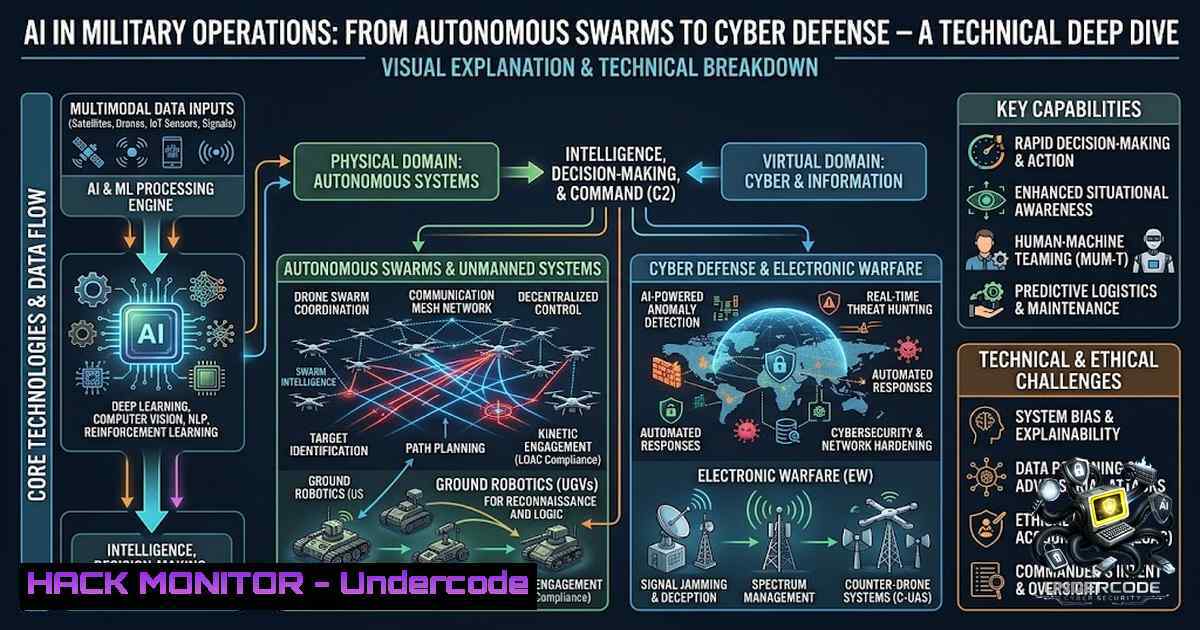
Artificial Intelligence (AI) is fundamentally reshaping modern military operations, enabling real-time threat detection, autonomous decision-making, and adaptive mission execution across surveillance, logistics, cyber defense, and combat domains. As AI models evolve from narrow task-specific systems toward general-purpose architectures, defense organizations worldwide are integrating deep learning, reinforcement learning, and generative AI into mission-critical infrastructure. This article provides a comprehensive technical examination of AI military applications, covering computer vision for surveillance, reinforcement learning for autonomous systems, generative AI for synthetic training data, and AI-powered cyber defense — complete with practical implementation guides and verified commands.
Learning Objectives:
- Understand the core AI paradigms deployed in military contexts (Narrow AI, General AI, Supervised/Unsupervised/Reinforcement Learning, Generative AI)
- Implement computer vision pipelines for military object detection using YOLOv11 on Ubuntu/Linux systems
- Deploy autonomous drone simulation environments with ROS, MAVROS, and PX4 for swarm coordination
- Apply reinforcement learning techniques for UAV formation control and tactical decision-making
- Leverage generative AI for synthetic data generation to overcome military training data scarcity
- Configure AI-driven cybersecurity threat detection frameworks for military network defense
You Should Know:
- Computer Vision for Military Surveillance: YOLO-Based Object Detection
Real-time object detection forms the backbone of modern military surveillance, from satellite imagery analysis to drone-based reconnaissance. The YOLO (You Only Look Once) family of models has emerged as the industry standard, with YOLOv11 achieving 92.3% accuracy at 30ms inference speed for military vehicle detection. Research demonstrates YOLO11n achieves the highest [email protected] with fastest inference speed, excelling in real-time applications, while YOLO11m offers superior accuracy for detailed reconnaissance.
Step-by-Step Guide: Installing and Running YOLOv11 for Military Object Detection
 1. Verify Ubuntu version
lsb_release -a

<ol>
<li>Create project directory and Python virtual environment
cd ~
mkdir military_yolo && cd military_yolo
sudo apt install python3.10-venv
python3 -m venv yolo_env
source yolo_env/bin/activate</p></li>
<li><p>Install required libraries
pip install setuptools
pip install ultralytics
pip install torch torchvision torchaudio --index-url https://download.pytorch.org/whl/cu118</p></li>
<li><p>Verify installation
yolo version</p></li>
<li><p>Run detection on sample imagery
yolo predict model=yolo11n.pt source='path/to/military_imagery/' conf=0.25</p></li>
<li><p>For oriented object detection (OBB) - critical for aerial surveillance
yolo predict model=yolo11n-obb.pt source='path/to/aerial_images/'
For military-grade deployment, models should be fine-tuned on custom datasets annotated using CVAT (Computer Vision Annotation Tool) with NVIDIA GPU acceleration. The hybrid YOLO-Transformer architecture has shown enhanced performance in challenging aerial situations with partial obscuration and variable lighting.
- Autonomous Drone Swarms: ROS, MAVROS, and PX4 Integration
AI-enabled swarm drones combined with blockchain-backed IoT networks represent the frontier of military surveillance. Each drone in the swarm makes real-time decisions using deep reinforcement learning to find, follow, and evaluate threats autonomously. The integration of 6G-powered communication networks enables secure, ultra-fast encrypted transmissions, while Edge AI computing provides onboard threat detection without cloud dependency.
Step-by-Step Guide: Setting Up Autonomous Drone Simulation Environment
 1. Install ROS Noetic on Ubuntu 20.04
sudo apt update
sudo apt install ros-1oetic-desktop-full

<ol>
<li>Install MAVROS
sudo apt install ros-1oetic-mavros ros-1oetic-mavros-extras
sudo apt install geographiclib-tools
sudo geographiclib-get-geoids egm96-5</p></li>
<li><p>Clone and build PX4 Autopilot
git clone https://github.com/PX4/PX4-Autopilot.git --recursive
cd PX4-Autopilot
bash ./Tools/setup/ubuntu.sh --1o-1uttx</p></li>
<li><p>Setup ROS workspace with drone control packages
mkdir -p ~/catkin_ws/src
cd ~/catkin_ws
catkin_make
source devel/setup.bash</p></li>
<li><p>Launch PX4 SITL with Gazebo simulation
cd ~/PX4-Autopilot
DONT_RUN=1 make px4_sitl_default gazebo-classic_iris
source Tools/simulation/gazebo-classic/setup_gazebo.bash $(pwd) $(pwd)/build/px4_sitl_default
export ROS_PACKAGE_PATH=$ROS_PACKAGE_PATH:$(pwd)
roslaunch px4 posix_sitl.launch</p></li>
<li><p>Launch MAVROS in separate terminal
source ~/catkin_ws/devel/setup.bash
roslaunch mavros px4.launch fcu_url:=udp://:[email protected]:14557
For natural language drone mission control, frameworks like Agentic Aerial Swarms integrate LLMs (LLaMA, Mistral, Falcon) to convert plain English commands into structured mission plans with adaptive formation switching.
3. Reinforcement Learning for Autonomous Combat Systems
Deep reinforcement learning enables unmanned combat aerial vehicles (UCAVs) to execute tactical decision-making in autonomous within-visual-range air combat (WVRAC). Hierarchical reinforcement learning frameworks with automatic curriculum generation based on Wasserstein Generative Adversarial Networks (WGANs) enhance training efficiency and adaptability to diverse combat conditions. For multi-UAV formation control, the Offline Sample Correction Actor-Critic (OSCAC) algorithm optimizes historical data utilization, achieving efficient collaborative formation policies.
Implementation Example: Reinforcement Learning for UAV Formation Control (Python Pseudocode)
import torch
import torch.nn as nn
import numpy as np
from stable_baselines3 import PPO
from gymnasium import Env

Define UAV formation environment
class UAVFormationEnv(Env):
def <strong>init</strong>(self, num_uavs=5):
self.num_uavs = num_uavs
self.state_dim = num_uavs  6  position + velocity for each UAV
self.action_dim = num_uavs  3  acceleration commands

def step(self, action):
 Apply formation control with collision avoidance
 Reward: formation maintenance + obstacle avoidance
pass

Initialize PPO agent for formation control
model = PPO("MlpPolicy", UAVFormationEnv(), verbose=1)
model.learn(total_timesteps=1000000)
model.save("uav_formation_policy")
4. Generative AI for Synthetic Military Training Data
The development of AI models for automated scene understanding is constrained by limited access to relevant military training data due to its restricted nature, high acquisition costs, and evolving threat signatures. Generative AI methods address this through three key strategies: (1) full-image generation by fine-tuning with application-specific data; (2) inpainting, where objects of interest are placed in existing image data; and (3) image-to-image translation for augmenting image conditions or translating between modalities.
Generative AI Implementation for Synthetic Data Generation
 Using Stable Diffusion for military scene generation
from diffusers import StableDiffusionPipeline
import torch

model_id = "runwayml/stable-diffusion-v1-5"
pipe = StableDiffusionPipeline.from_pretrained(model_id, torch_dtype=torch.float16)
pipe = pipe.to("cuda")

Generate military scene with specific assets
prompt = "Military convoy of armored vehicles moving through desert terrain, aerial view, photorealistic"
image = pipe(prompt, num_inference_steps=50).images[bash]
image.save("synthetic_military_scene.png")

For GAN-based SAR image generation
 EMS-GAN: Electromagnetically Simulated Generative Adversarial Networks
 Generates realistic synthetic SAR scene data where each image carries unique challenges
DataForge, a cutting-edge synthetic data generation tool, leverages Generative Adversarial Networks (GANs) to produce large-scale, realistic synthetic datasets in visual, textual, geospatial, and sensor formats for defense applications.
5. AI-Powered Cybersecurity for Military Networks
Military networks face AI-aided cyberworms capable of adaptive, stealthy intrusions. Autonomous Cyber Defence (ACD) agents integrate Multi-Agent Reinforcement Learning (MARL), Large Language Models (LLMs), and rule-based systems into blue and red agent teams distributed across network devices. The CONQUEST framework, a context-aware quantum-inspired system, achieved a 97.5% detection rate with 0.8% false positives against AI-driven cyber threats.
Linux Security Hardening Commands for Military-Grade Systems
 1. Harden SSH configuration
sudo nano /etc/ssh/sshd_config
 Set: PermitRootLogin no, PasswordAuthentication no, Protocol 2

<ol>
<li>Configure UFW firewall with strict rules
sudo ufw default deny incoming
sudo ufw default allow outgoing
sudo ufw allow 22/tcp  Only from trusted IPs
sudo ufw enable</p></li>
<li><p>Install and configure fail2ban for intrusion prevention
sudo apt install fail2ban
sudo systemctl enable fail2ban
sudo systemctl start fail2ban</p></li>
<li><p>Implement auditd for security monitoring
sudo apt install auditd
sudo auditctl -e 1
sudo auditctl -w /etc/passwd -p wa -k identity
sudo auditctl -w /etc/shadow -p wa -k identity</p></li>
<li><p>Disable unnecessary services
sudo systemctl list-unit-files --state=enabled
sudo systemctl disable [unnecessary-service]</p></li>
<li><p>Apply DISA STIG compliance (for DoD environments)
Install OpenSCAP
sudo apt install openscap-scanner
sudo oscap xccdf eval --profile xccdf_org.ssgproject.content_profile_stig --results stig_results.xml /usr/share/xml/scap/ssg/content/ssg-ubuntu2004-ds.xml
For AWS military cloud environments, hardening requires STIG-hardened AMIs with over 160 required security settings, alignment with DISA STIG and Impact Level 6 requirements, and compliance with NIST SP 800-53 Rev.5 security controls.
6. Cloud Hardening for Defense Workloads
The Pentagon has partnered with NVIDIA, Microsoft, and AWS to secure classified networks, with NVIDIA providing computational muscle while Microsoft and AWS handle cloud infrastructure for Impact Level 6 and 7 networks. AWS GovCloud provides FedRAMP High–certified isolated environments for defense workloads.
AWS Security Hardening Commands (AWS CLI)
 1. Enable AWS Config for compliance monitoring
aws configservice put-configuration-recorder --configuration-recorder name=default,roleARN=arn:aws:iam::account-id:role/config-role

<ol>
<li>Enable CloudTrail for audit logging
aws cloudtrail create-trail --1ame military-trail --s3-bucket-1ame military-logs-bucket
aws cloudtrail start-logging --1ame military-trail</p></li>
<li><p>Apply security group restrictions
aws ec2 authorize-security-group-ingress --group-id sg-12345678 --protocol tcp --port 22 --cidr 192.168.1.0/24</p></li>
<li><p>Enable VPC Flow Logs for network monitoring
aws ec2 create-flow-logs --resource-type VPC --resource-id vpc-12345678 --traffic-type ALL --log-group-1ame military-vpc-logs</p></li>
<li><p>Implement AWS WAF for API protection
aws wafv2 create-web-acl --1ame military-api-acl --scope REGIONAL --default-action Block={}
What Undercode Say:
-
Key Takeaway 1: The convergence of AI, autonomous systems, and cybersecurity is creating a new paradigm of warfare where machine-speed decision-making and real-time threat response are operational necessities, not optional enhancements.
-
Key Takeaway 2: The military AI market is projected to grow from USD 14.3 billion in 2025 to USD 38.7 billion by 2034 at an 11.5% CAGR, with key players including NVIDIA, Intel, Google, Microsoft, AWS, and emerging startups like Graphcore and Mythic driving innovation.
Analysis: The integration of AI into military operations represents both unprecedented opportunity and significant risk. On the operational side, AI-enabled systems dramatically enhance surveillance coverage, reduce human exposure to danger, and enable rapid threat response that would be impossible with manual decision-making. However, the deployment of autonomous weapons systems raises profound ethical and legal questions. The RAND Corporation warns that AI-driven military systems may increase the risk of accidental conflict, as autonomous weapons lack human judgment in crisis situations. The emergence of Military-AI Cyber Agents (MAICAs) creates a credible pathway to catastrophic risk, necessitating defensive-AI and analogue-resilience measures. The industry must balance technological acceleration with robust governance frameworks, including NIST’s AI Risk Management Framework and emerging DoD AI/ML security frameworks.
Prediction:
- +1 AI-powered autonomous systems will reduce military casualty rates by 40-60% over the next decade through enhanced situational awareness and precision targeting.
-
+1 Generative AI will revolutionize military training by 2028, reducing the cost of simulation environments by 70% while increasing scenario variety and realism.
-
-1 The proliferation of AI-enabled cyber weapons will trigger a new arms race, with AI-driven cyberworms capable of autonomous propagation and adaptation becoming the primary threat vector by 2027.
-
-1 Without robust international governance, the deployment of autonomous lethal systems increases the risk of inadvertent escalation by 35%, as machine-speed responses outpace human diplomatic channels.
-
+1 Edge AI and 6G integration will enable truly decentralized military communications by 2029, eliminating single points of failure and enhancing operational resilience in contested environments.
▶️ Related Video (78% Match):
https://www.youtube.com/watch?v=7tIcK4-ngXU
🎯Let’s Practice For Free:
🎓 Live Courses & Certifications:
Join Undercode Academy for Verified Certifications
🚀 Request a Custom Project:
Secure, high-velocity infrastructure and disruptive technological engineering. Contact our engineering team for high-tier development and proprietary systems:
[email protected]
💎 Smart Architecture | 🛡️ Secure by Design | ⭐ Trusted by Thousands
IT/Security Reporter URL:
Reported By: Https: – Hackers Feeds
Extra Hub: Undercode MoN
Basic Verification: Pass ✅


