Listen to this Post
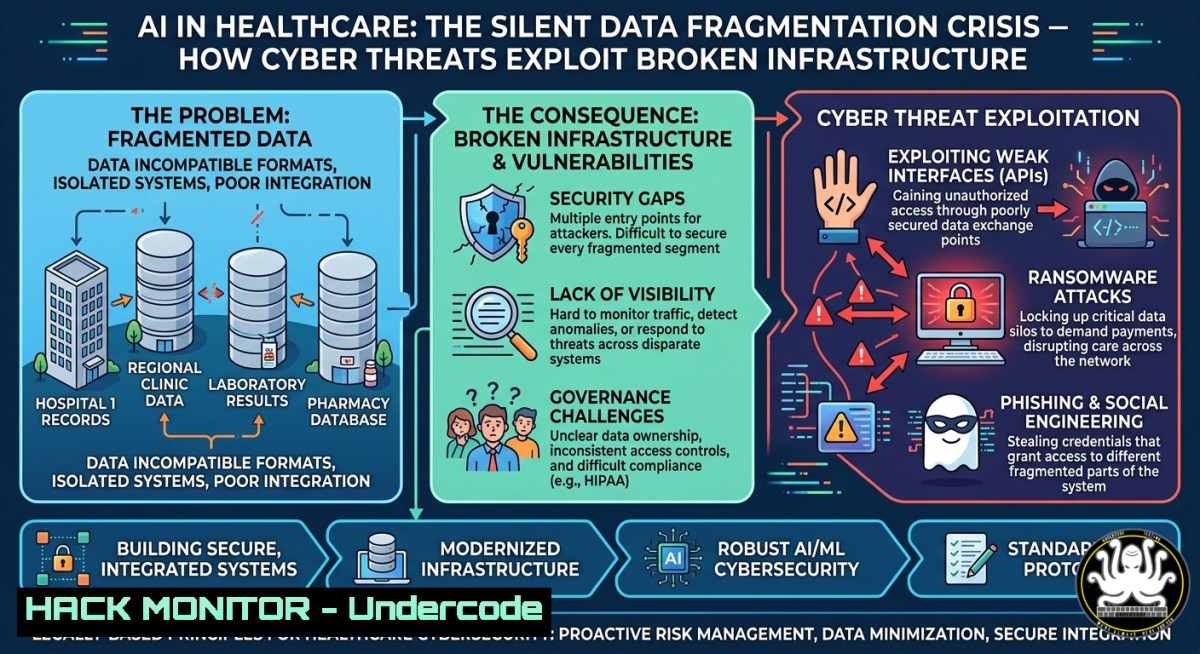
Introduction:
Artificial intelligence promises to revolutionize healthcare through predictive analytics and personalized treatment, but the underlying infrastructure in most health systems remains fractured, insecure, and incompatible. Attackers are increasingly targeting these data silos and broken APIs, turning fragmented medical data ecosystems into prime vectors for ransomware, data poisoning, and adversarial ML attacks. Understanding how to secure cross-departmental data pipelines, harden prediction engines, and implement zero-trust for healthcare AI is now a critical cybersecurity discipline.
Learning Objectives:
- Identify vulnerabilities introduced by fragmented health data infrastructure and map them to AI-specific attack surfaces.
- Implement secure data integration pipelines using encrypted ETL processes and verifiable lineage controls.
- Apply adversarial machine learning defenses and API security hardening techniques for healthcare prediction systems.
You Should Know:
- Mapping Fragmented Data to Attack Vectors – A Step-by-Step Reconnaissance Guide
The core issue raised by Toby J Daniel is that health systems cannot share data between departments, leading to fragmented predictions. From a red-team perspective, each silo represents a distinct attack surface. Attackers exploit inconsistent authentication, legacy APIs, and unencrypted internal transfers.
Step-by-step: How to enumerate and assess data fragmentation risks in a healthcare AI environment
1. Discover exposed data endpoints
Use Nmap to scan for common healthcare data protocols (HL7, FHIR, DICOM):
nmap -p 2575,6661,8080,8443 --open -T4 10.x.x.0/24 -oG fhir_servers.txt
2. Test for inconsistent FHIR API authentication
Many fragmented systems deploy custom API gateways with misconfigured OAuth2 scopes. Use a Python script to probe anonymous access:
import requests
endpoints = ["/Patient", "/Observation", "/Condition"]
for ep in endpoints:
r = requests.get(f"https://target.fhir.com{ep}")
if r.status_code == 200 and "entry" in r.json():
print(f"[!] Anonymous access to {ep}")
3. Identify broken data lineage
Fragmented predictions rely on aggregated data without proper provenance. Use `truffleHog` to find hardcoded credentials in data pipeline scripts:
trufflehog filesystem --directory /mnt/health_pipelines/ --entropy=True
4. Map inter-departmental data flows
Run Zeek on a mirrored switch port to detect unencrypted HL7 traffic:
zeek -C -r health_traffic.pcap scripts/dpd.zeek
grep "hl7" conn.log | awk '{print $3,$5,$7}'
Windows alternative – Use PowerShell with Get-NetTCPConnection to identify listening ports on health integration engines (e.g., Mirth, Rhapsody):
Get-NetTCPConnection -State Listen | Where-Object {$_.LocalPort -in (2575,6661,8080)} | Format-Table LocalAddress,LocalPort
2. Securing AI Data Pipelines Against Fragmentation Exploits
When health systems attempt to integrate fragmented data, they often create temporary ETL jobs that bypass security controls. Attackers inject poisoned data into these pipelines to corrupt prediction engines.
Step-by-step: Hardening cross-departmental data ingestion for healthcare AI
- Implement cryptographic data signing for each data source
Generate per-department GPG keys and require signed payloads before ingestion:gpg --full-generate-key --batch --passphrase '' --quick-gen-key "Radiology Dept" rsa4096 gpg --export --armor Radiology > radiology_pub.asc
2. Validate against schema drift
Use `great_expectations` to enforce data contracts across fragmented sources:
import great_expectations as ge
suite = ge.ExpectationSuite("fhir_patient_expectations")
suite.add_expectation(ge.expectations.ExpectColumnValuesToBeInSet("department", ["radiology","labs","pharmacy"]))
suite.add_expectation(ge.expectations.ExpectColumnValuesToNotBeNull("patient_id"))
3. Deploy a zero-trust data mesh sidecar
Use OPA (Open Policy Agent) to enforce data access per pipeline stage. Example rego policy:
package data.auth
default allow = false
allow if {
input.method == "POST"
input.path == "/api/v1/ingest"
input.headers["x-dept-token"] == valid_tokens[bash]
input.data.fhir_version == "R4"
}
4. Monitor for poisoning attempts
Deploy an anomaly detection sidecar on each ingestion node. Use `auditd` on Linux to log all writes to ML feature stores:
auditctl -w /opt/ml_features/ -p wa -k ml_ingestion
ausearch -k ml_ingestion --format raw | grep "comm=\"python\""
- Adversarial Defenses for Prediction Engines in Broken Health Infrastructures
Fragmented data leads to inconsistent model inputs – a perfect condition for adversarial examples where attackers craft inputs to force misdiagnosis predictions.
Step-by-step: Implementing adversarial robustness for healthcare AI
1. Add input sanitization layer before any prediction
Use a library like `adversarial-robustness-toolbox` (ART) to filter out-of-distribution samples:
from art.defences.preprocessor import FeatureSqueezing
squeeze = FeatureSqueezing(clip_values=(0,1), bit_depth=8)
clean_input = squeeze(attacker_input)[bash]
2. Ensemble with a rule-based guardrail
For each prediction, cross-check with a simple rule engine that encodes known medical constraints. Example using durable_rules:
rule "Blood pressure inconsistency"
when
Patient(systolic < 70) and Patient(heartRate > 120)
then
HoldPrediction("Possible adversarial input - physiological mismatch");
end
3. Deploy model signing and verification
Prevent model replacement attacks via corrupted CI/CD. Use `cosign` to sign model artifacts:
cosign generate-key-pair
cosign sign --key cosign.key models/oncology_predictor_v2.h5
cosign verify --key cosign.pub models/oncology_predictor_v2.h5
4. Set up real-time prediction monitoring
Use `Prometheus` to track input distribution divergence. Alert when JS distance exceeds threshold:
groups:
- name: ai_security
rules:
- alert: PredictionInputDrift
expr: histogram_quantile(0.95, rate(model_input_bins[bash])) > 0.3
annotations:
summary: "Likely adversarial input injection detected"
- API Security Hardening for Fragmented Healthcare Data Sharing
Most health systems use RESTful FHIR APIs to bridge departmental silos – these are often rate-limit unprotected, lack proper audit logs, and expose internal patient IDs.
Step-by-step: Pentesting and hardening FHIR APIs
1. Test for IDOR vulnerabilities
Using Burp Suite, send sequential patient IDs and observe if access control is enforced at API level:
curl -X GET "https://fhir.hospital.com/Patient/1001" -H "Authorization: Bearer $TOKEN"
curl -X GET "https://fhir.hospital.com/Patient/1002" -H "Authorization: Bearer $TOKEN"
2. Enforce OAuth2 with granular scopes
Configure Keycloak to issue scoped tokens per department:
{
"scopes": ["radiology.read", "labs.write"],
"authorization_details": {
"resource": "fhir-api",
"permissions": [{"type": "Observation", "actions": ["read"]}]
}
}
3. Deploy API gateway with request validation
Use Kong Gateway to enforce FHIR resource schemas and reject malformed payloads:
curl -X POST http://kong:8001/plugins \
-d "name=fhir-validation" \
-d "config.schema_url=https://hl7.org/fhir/R4/patient.schema.json"
4. Implement audit logging for all prediction queries
Use Elasticsearch to index each API call with `X-Request-ID` tied to model input:
logstash -e 'input { http { port => 8080 } }
filter { json { source => "message" }
mutate { add_field => { "prediction_audit" => "%{[bash][X-Request-ID]}" } } }
output { elasticsearch { hosts => ["localhost:9200"] } }'
5. Cloud Hardening for Distributed Healthcare AI Training
To overcome fragmentation, health systems move to cloud-based data lakes. Misconfigured S3 buckets and unsecured MLflow instances become entry points.
Step-by-step: Securing cloud-native healthcare AI workloads
1. Block public access to data lakes
AWS CLI command to enforce bucket policies:
aws s3api put-public-access-block --bucket healthcare-models \
--public-access-block-configuration BlockPublicAcls=true,IgnorePublicAcls=true
- Encrypt data at rest and in transit with customer-managed keys
Azure example using Key Vault:
az storage account update --name healthdatalake --encryption-key-name ai-key --encryption-key-vault https://kv-health.vault.azure.net/
3. Restrict MLflow model registry access
Deploy MLflow behind an authenticating proxy and disable default artifact store:
mlflow server --host 0.0.0.0 --port 5000 --backend-store-uri postgresql://mlflow:secure@localhost/mlflow \
--default-artifact-root s3://secure-models/ --no-serve-artifacts
4. Monitor for cryptojacking on training instances
Use Falco runtime security to detect unexpected miners:
- rule: Launch miner process
desc: Detect cryptominer based on known process names
condition: spawned_process and proc.name in ("xmrig", "minerd", "cgminer")
output: "Cryptominer started in training cluster (user=%user.name)"
priority: CRITICAL
What Undercode Say:
- Key Takeaway 1: Fragmented healthcare data isn’t just an operational inefficiency – it’s a structural attack surface. Each silo introduces inconsistent security postures, making cross-silo predictions inherently vulnerable to data poisoning and adversarial manipulation.
- Key Takeaway 2: Fixing AI prediction security requires solving the data integration problem first. Without verifiable lineage, cryptographic signing, and zero-trust APIs, even the most advanced AI model is a house built on sand.
Analysis: The tension between Steven Chen’s vision of AI-driven precision healthcare and Toby J Daniel’s reality check exposes a hard truth: cybersecurity cannot be an afterthought in medical AI. Attackers are already probing fragmented systems – from hospital ransomware that corrupts ETL pipelines to adversarial examples that fool diagnostic models. The path forward demands a shift from siloed security (departmental firewalls) to pipeline-native defenses (signed data, OPA-enforced contracts, and anomaly detection on every ingestion). Training courses must now cover not just ML security, but also healthcare integration standards (FHIR, HL7) and legacy system hardening. The next wave of healthcare breaches won’t come through a firewall; it will come through a broken API between the radiology and oncology departments.
Prediction:
By 2028, we will see the first large-scale class-action lawsuit against a healthcare provider where fragmented data integration led to an AI prediction failure that caused patient harm. This will trigger regulatory mandates requiring continuous security validation of cross-departmental AI pipelines, similar to FDA’s software validation rules for medical devices. Startups offering “data lineage firewalls” and “adversarial input detection as a service” will emerge as the new cybersecurity unicorns. Meanwhile, open-source tools for fuzzing FHIR APIs and poisoning detection will become standard in every health system’s DevSecOps toolchain. The winners will be organizations that treat data fragmentation not as an IT headache, but as a core risk domain – and invest in security training that bridges clinical engineering, data science, and red-team operations.
▶️ Related Video (78% Match):
🎯Let’s Practice For Free:
IT/Security Reporter URL:
Reported By: Steven Chen – Hackers Feeds
Extra Hub: Undercode MoN
Basic Verification: Pass ✅
🎓 Live Courses & Certifications:
Join Undercode Academy for Verified Certifications
🚀 Request a Custom Project:
Secure, high-velocity infrastructure and disruptive technological engineering. Contact our engineering team for high-tier development and proprietary systems:
[email protected]


