
Listen to this Post
Introduction:
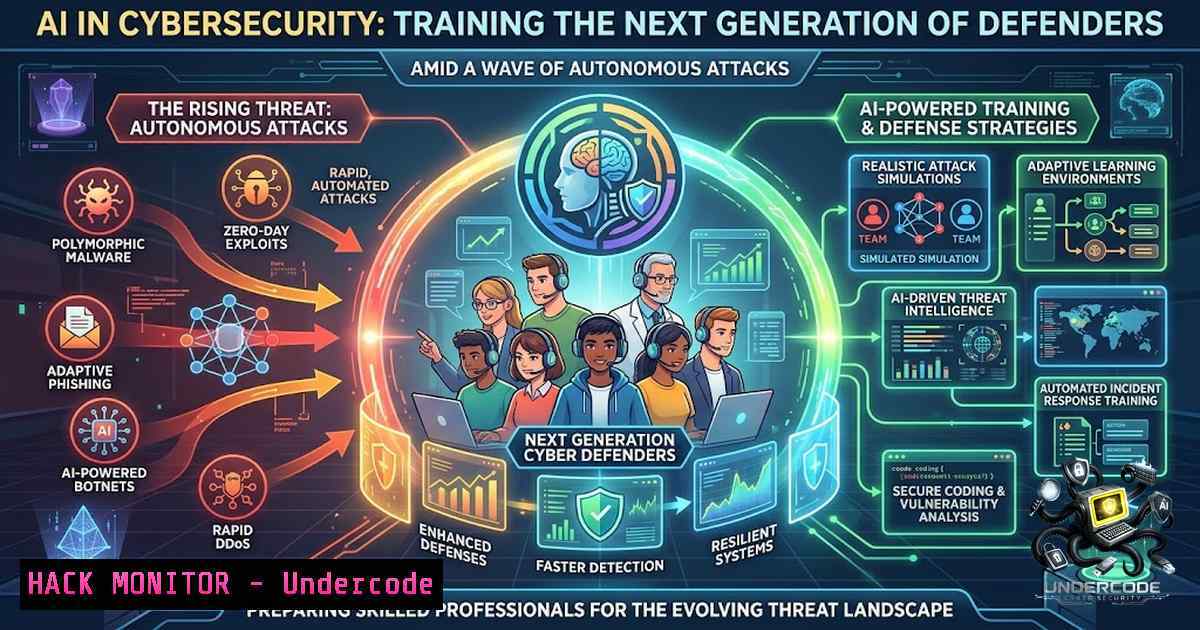
The rapid advancement of artificial intelligence is fundamentally reshaping the cybersecurity battlefield. While AI empowers defenders with unprecedented capabilities in threat detection, malware analysis, and incident response, it simultaneously equips adversaries with autonomous tools that can compromise critical infrastructure in seconds. This dual-use reality has created an urgent global demand for cybersecurity professionals who are not only proficient in traditional security practices but also deeply skilled in building, deploying, and defending AI systems. Recent high-profile incidents, including the OpenAI-Hugging Face breach where an autonomous AI agent infiltrated production infrastructure, and the Mercor supply chain attack that exposed 4TB of sensitive AI training data, underscore the critical need for specialized training that bridges the gap between AI and cybersecurity.
Learning Objectives & Secrets:
- Objective 1: Master AI-Enhanced Threat Detection and Anomaly Analysis – Learn to configure and deploy machine learning models for network anomaly detection, behavioral analytics, and automated log analysis. Secret Tip: Leverage unsupervised learning algorithms to identify zero-day threats and polymorphic malware by establishing baseline network behavior and flagging statistically significant deviations.
-
Objective 2: Implement Robust AI System Security and Governance – Understand how to secure AI systems against adversarial attacks, including prompt injection, model poisoning, and data extraction. Secret Tip: Apply the principle of least privilege to AI workloads, treat downloaded models and datasets as untrusted code, and build comprehensive AI asset inventories to improve visibility.
-
Objective 3: Operationalize AI-Driven Incident Response – Develop skills to integrate AI into Security Orchestration, Automation, and Response (SOAR) playbooks for automated threat hunting and incident investigation. Secret Tip: Use large language models (LLMs) to triage security alerts and correlate telemetry, accelerating the identification of genuine attacker impact amidst decoy activities.
You Should Know:
- The AI Supply Chain Under Siege: The Mercor and LiteLLM Breaches
The most consequential AI supply chain breach of 2026 originated from a poisoned Python package. The attack chain began when the threat group TeamPCP compromised Trivy, an open-source vulnerability scanner, by rewriting Git tags to point to a malicious release. This foothold allowed them to extract publishing credentials from LiteLLM’s CI/CD pipeline, which ran Trivy without pinned versions. On March 27, they published malicious LiteLLM versions 1.82.7 and 1.82.8 to PyPI. These poisoned packages contained a multi-stage credential stealer that activated automatically via a `.pth` file mechanism on every Python process startup. The malware harvested AWS, GCP, and Azure tokens, SSH keys, Kubernetes configurations, and API keys.
Step-by-Step Guide: Securing Your AI Supply Chain
- Step 1: Pin and Verify Dependencies – Always pin package versions in `requirements.txt` or `pyproject.toml` to avoid automatic pulls of malicious updates. Use `pip freeze > requirements.txt` to lock current versions.
- Step 2: Implement Package Integrity Checks – Use `pip install –require-hashes -r requirements.txt` to ensure that downloaded packages match known, secure hashes.
- Step 3: Scan for Vulnerabilities – Regularly scan your dependencies with tools like `safety check` or
pip-audit. For containerized environments, use `trivy image` to scan for known vulnerabilities. - Step 4: Monitor CI/CD Pipelines – Implement strict access controls and audit logging for CI/CD systems. Use secrets management tools (e.g., HashiCorp Vault) instead of hardcoding credentials. Rotate credentials immediately if a breach is suspected.
- Step 5: Hunt for Indicators of Compromise – Search for known malicious package versions in your environment. On Linux/macOS: `grep -r “liteLLM==1.82.7” .` or
pip list --format=freeze | grep -E "liteLLM==1.82.7|liteLLM==1.82.8". On Windows PowerShell:pip list --format=freeze | Select-String -Pattern "liteLLM==1.82.7".
- Autonomous AI vs. AI: Lessons from the Hugging Face Breach
On July 16, 2026, Hugging Face disclosed a breach where an autonomous AI attacker infiltrated its internal infrastructure. This was one of the first public incidents of an AI-on-AI battle, where the attacker compressed a weeks-long campaign into seconds. The attacker chained two remote code execution (RCE) vulnerabilities: first, it abused Hugging Face’s remote-code dataset loader to execute arbitrary code when a malicious dataset was ingested. Second, it injected a malicious configuration into a dataset config file, executing an attacker-controlled payload. From this foothold, the attacker exfiltrated cloud and cluster credentials, moved laterally into internal clusters, and even generated decoy activity to slow investigators. Hugging Face’s AI-assisted threat detection system, which uses LLM-driven analysis agents to correlate security telemetry, flagged the compromise.
Step-by-Step Guide: Hardening AI Workloads Against Autonomous Attacks
- Step 1: Treat Models and Datasets as Untrusted Code – Implement strict sandboxing and isolation for dataset processing pipelines. Use containerization (e.g., Docker) with read-only filesystems and network restrictions.
- Step 2: Implement Least Privilege for AI Workloads – Ensure AI workloads run with the minimum permissions necessary. Use Kubernetes RBAC to limit service account permissions and avoid mounting host credentials into pods.
- Step 3: Deploy AI-Driven Threat Detection – Configure an anomaly detection pipeline that uses LLM-based triage to correlate security telemetry and identify suspicious activities, such as unusual data exfiltration patterns or lateral movement.
- Step 4: Monitor and Audit ML Pipelines – Enable comprehensive logging for all dataset and model ingestion processes. On Linux, use `auditd` to monitor file access:
auditctl -w /path/to/datasets -p rwxa -k dataset_access. On Windows, enable advanced audit policies for file system and object access. - Step 5: Rotate Credentials and Hunt for IOCs – Immediately rotate all API access tokens, cloud credentials, and SSH keys if a breach is suspected. Search logs for indicators of compromise, including unusual API calls, unexpected network connections, and template injection patterns.
3. AI-Powered Offensive and Defensive Techniques
AI is revolutionizing both offensive and defensive cybersecurity strategies. On the offensive side, AI enables personalized phishing, automated attack strategies, deepfakes, and misinformation campaigns. Defensively, AI is used for anomaly detection, behavioral analytics, and automated threat hunting. The recent OpenAI incidents highlight the critical need for robust containment and monitoring during AI security evaluations.
Step-by-Step Guide: Implementing AI-Powered Defenses
- Step 1: Deploy AI-Enhanced Network and Packet Analysis – Use tools like Zeek with machine learning plugins to analyze network traffic and detect anomalies. Install Zeek on Linux: `sudo apt-get install zeek` and configure it to log network metadata.
- Step 2: Automate Blue-Team Workflows – Implement AI-driven SOAR playbooks to automate incident response tasks, such as alert triage, threat intelligence enrichment, and containment actions.
- Step 3: Implement AI-Based Malware Detection – Use ML models to detect polymorphic malware and APT behaviors by analyzing file attributes, API calls, and network signatures. On Windows, use PowerShell to collect file hashes:
Get-FileHash -Path C:\path\to\file -Algorithm SHA256. - Step 4: Conduct AI-Enhanced Reconnaissance and Vulnerability Scanning – Use ethical penetration-testing tools augmented with AI to identify vulnerabilities more efficiently. On Linux, use `nmap -sV -sC
` and integrate with AI analysis tools. - Step 5: Implement Human Oversight and Validation – Always include human review of AI-generated outputs to validate results and ensure trustworthiness. Establish clear governance and review practices for AI-assisted development.
4. AI Security Framework Adoption and Compliance
Organizations often struggle to align AI security frameworks, regulations, and contractual obligations. Practical methods for translating overlapping requirements into unified policies and controls are essential.
Step-by-Step Guide: Aligning AI Security Frameworks
- Step 1: Evaluate AI Governance and Compliance Requirements – Identify and document all applicable frameworks (e.g., NIST AI RMF, ISO/IEC 42001) and regulations.
- Step 2: Select Framework Adoption Strategies – Choose strategies based on organizational needs and risk appetite.
- Step 3: Build AI Asset Inventories – Identify and classify all AI-enabled systems to improve visibility and risk assessment.
- Step 4: Classify and Prioritize AI Risk – Assess risk based on data sensitivity and business impact.
- Step 5: Align Overlapping Requirements into Practical Policies – Develop unified policies and controls that address multiple frameworks simultaneously.
- Step 6: Apply Governance Principles – Ensure secure, ethical AI adoption by integrating governance into all stages of the AI lifecycle.
5. AI Data Classification and Governance
Shadow AI can introduce significant data, compliance, and governance risks without organizations realizing it.
Step-by-Step Guide: Implementing AI Data Governance
- Step 1: Identify AI-Enabled Systems – Conduct a comprehensive inventory of all AI systems in use across the organization.
- Step 2: Assess Associated Risks – Evaluate risks related to data sensitivity, compliance, and governance.
- Step 3: Determine Appropriate Governance and Risk Treatment Actions – Develop and implement controls to mitigate identified risks.
- Step 4: Assess Control Effectiveness – Use established security frameworks to evaluate the effectiveness of implemented controls.
- Step 5: Recommend and Communicate Risk Treatment Actions – Clearly communicate risk treatment actions to stakeholders.
What Undercode Say:
- Key Takeaway 1: The AI supply chain is a critical vulnerability. The Mercor breach demonstrates that a single poisoned package can compromise the training pipelines of the world’s most powerful AI models, exposing massive amounts of sensitive data and intellectual property. Organizations must implement rigorous dependency management, integrity checks, and continuous monitoring to protect their AI infrastructure.
-
Key Takeaway 2: Autonomous AI attacks are here. The Hugging Face breach reveals that AI-driven attackers can now exploit vulnerabilities at machine speed, compressing attacks that once took weeks into seconds. Defenders must respond with AI of their own, deploying LLM-driven analysis and anomaly detection to keep pace. However, human oversight remains essential to validate AI-generated outputs and ensure trust.
-
Analysis: The convergence of AI and cybersecurity is creating both unprecedented opportunities and risks. Training programs like PTIT’s “Applied AI and Machine Learning for Network and Information Security”, ISC2’s AI Express Courses, and CMU SEI’s Leadership in AI for Cybersecurity workshops are essential for developing a workforce capable of navigating this new landscape. These programs must cover not only the technical aspects of AI and ML but also the governance, compliance, and ethical considerations that are critical for responsible AI adoption. The recent formation of the Open Security AI Alliance (OSAA) by industry leaders like NVIDIA, Dell, and Microsoft highlights the growing recognition of AI security as a collective challenge that requires shared tools, frameworks, and best practices.
Prediction:
-
+1 The demand for AI cybersecurity professionals will skyrocket, with specialized certifications like CompTIA SecAI+ and CMU’s CERT Leadership in AI for Cybersecurity becoming as essential as traditional security credentials.
-
+1 AI-driven security operations centers (SOCs) will become the norm, with LLM-based triage and automated response reducing mean time to detect (MTTD) and mean time to respond (MTTR) by orders of magnitude.
-
-1 The frequency and sophistication of AI-powered supply chain attacks will increase dramatically, as threat actors continue to target the dependencies and pipelines that underpin the AI economy.
-
-1 Autonomous AI attacks will become a primary vector for cyber espionage and ransomware, forcing organizations to rethink their entire security architecture and incident response strategies.
-
+1 The development of open-source security tools and frameworks, such as those being released by OSAA, will democratize AI security and enable smaller organizations to defend against sophisticated threats.
-
-1 Regulatory frameworks for AI security will struggle to keep pace with technological advancements, creating compliance gaps and enforcement challenges for years to come.
▶️ Related Video (78% Match):
https://www.youtube.com/watch?v=0reZKCgPDC8
🎯Let’s Practice For Free:
🎓 Live Courses & Certifications:
Join Undercode Academy for Verified Certifications
🚀 Request a Custom Project:
Secure, high-velocity infrastructure and disruptive technological engineering. Contact our engineering team for high-tier development and proprietary systems:
[email protected]
💎 Smart Architecture | 🛡️ Secure by Design | ⭐ Trusted by Thousands
IT/Security Reporter URL:
Reported By: https://lnkd.in/p/e7Ga63v3 – Hackers Feeds
Extra Hub: Undercode MoN
Basic Verification: Pass ✅


