
Listen to this Post
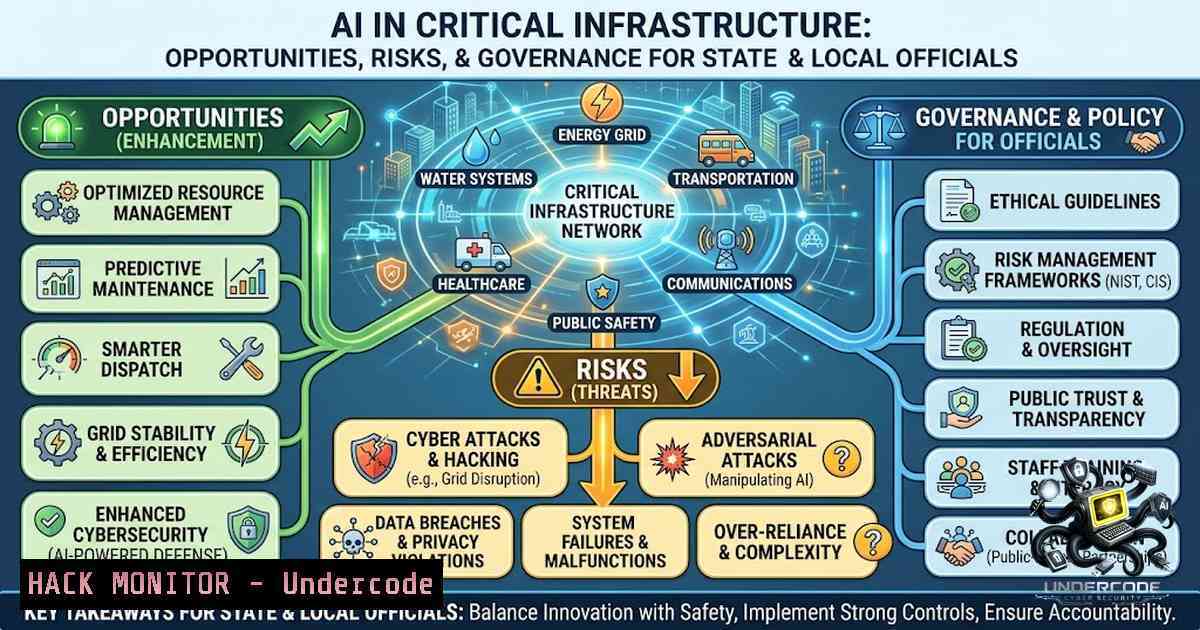
Introduction:
As artificial intelligence rapidly integrates into energy grids, water treatment facilities, healthcare systems, and emergency response networks, state and local governments face a dual-edged sword: unprecedented operational efficiency alongside novel vulnerabilities. The deployment of LLM-powered analytics, autonomous agents, and predictive algorithms promises real-time disaster prevention and optimized resource allocation, but it also introduces attack surfaces that malicious actors are already exploiting—from prompt injection attacks on public-facing chatbots to adversarial data poisoning that skews severe weather forecasts. This article synthesizes technical insights from Bear Afkhami’s workshop on AI governance in critical infrastructure, providing actionable cybersecurity frameworks, configuration guides, and risk mitigation strategies for officials navigating this transformative yet precarious landscape.
Learning Objectives & Secrets:
- Objective 1: Identify the top three AI-specific attack vectors in critical infrastructure (prompt injection, model theft, and data poisoning) and implement detection mechanisms using open-source tools like MLflow and Adversarial Robustness Toolbox.
- Objective 2 (Secret Tip): Leverage Windows Event Viewer and Linux auditd to monitor unauthorized API calls to AI models—look for anomalous `POST /v1/completions` requests with payloads containing system prompt override sequences (e.g.,
"ignore previous instructions"). - Objective 3 (Secret Tip): Establish a red-team rotation for AI models every 90 days using open-source frameworks like Counterfit (Microsoft) or TextAttack to simulate jailbreak attempts and data extraction, ensuring your jurisdiction’s AI remains resilient against evolving threat actors.
You Should Know:
1. AI Prompt Injection Defense and Logging
The post highlights concerns about LLM chats leaking onto search engines and AI agents hacking websites—both symptoms of inadequate input sanitization and output filtering. Prompt injection, where an attacker crafts a user input that overrides the model’s system instructions, can lead to data exposure or unauthorized actions. To defend against this, implement a three-layer filter: regex-based pattern matching, semantic anomaly detection using a secondary small language model, and output encoding to neutralize executable scripts.
Step‑by‑step guide for Linux (Ubuntu 22.04):
 Install ModSecurity with CRS for API gateway
sudo apt update && sudo apt install libapache2-mod-security2
sudo a2enmod security2
sudo systemctl restart apache2

Add custom rule to block prompt injection patterns in /etc/modsecurity/crs/custom-rules.conf
SecRule REQUEST_BODY "@rx (?i)(ignore previous|system prompt|override|jailbreak)" \
"id:10001,phase:2,deny,status:403,msg:'Prompt Injection Detected'"

Set up real-time logging with rsyslog to forward to SIEM
echo "local7. /var/log/ai-api.log" >> /etc/rsyslog.conf
sudo systemctl restart rsyslog
For Windows Server with IIS:
- Install URL Rewrite Module and create an inbound rule that blocks requests containing “ignore previous instructions” or “system prompt override” in query strings or form data.
- Enable Advanced Logging to capture full POST payloads for forensic analysis, stored in
C:\inetpub\logs\LogFiles\.
2. Securing AI Model Repositories and Supply Chains
Afkhami’s call for governance echoes the NIST AI RMF and CISA’s guidelines on secure AI development. Many jurisdictions deploy pre-trained models from Hugging Face or OpenAI without verifying their provenance, risking backdoors or biased outputs. Implement cryptographic signing of model weights and enforce strict access controls using OAuth 2.0 with PKCE for API endpoints.
Step‑by‑step guide for model verification:
 Generate SHA-256 checksum of your model file on Linux
sha256sum model.pt > model.checksum

Verify checksum before each deployment
if ! sha256sum -c model.checksum; then
echo "Model integrity compromised!" | mail -s "Alert" [email protected]
exit 1
fi

Use Hugging Face's huggingface_hub to pin specific versions
pip install huggingface_hub
huggingface-cli download meta-llama/Llama-2-7b-chat-hf --revision 2773f9f --local-dir ./verified-model
For Windows (PowerShell):
 Compute and verify file hash
Get-FileHash .\model.pt -Algorithm SHA256 | Out-File .\model.checksum
if ((Get-FileHash .\model.pt -Algorithm SHA256).Hash -1e (Get-Content .\model.checksum)) {
Send-MailMessage -To "[email protected]" -Subject "Model Tampered" -SmtpServer localhost
}
3. Monitoring AI API Access and Anomaly Detection
Given the post’s mention of AI agents autonomously hacking sites, it’s imperative to monitor API consumption patterns for signs of credential abuse or privilege escalation. Use Elastic Stack or Splunk to ingest logs and apply machine learning for behavioral baselining—e.g., sudden spikes in token usage from a single API key or out-of-hours requests.
Step‑by‑step guide to set up API monitoring with Prometheus and Grafana:
 Deploy Prometheus exporter for your AI gateway
docker run -d -p 9090:9090 --1ame prometheus \
-v /path/to/prometheus.yml:/etc/prometheus/prometheus.yml \
prom/prometheus

Configure alert for >1000 requests/minute per API key in prometheus.yml
groups:
- name: ai_api_alerts
rules:
- alert: HighAPITraffic
expr: rate(api_requests_total[bash]) > 1000
for: 2m
labels:
severity: critical
annotations:
summary: "Unusual API traffic from {{ $labels.api_key }}"
On Windows, use PowerShell to parse IIS logs and flag anomalies:
$logPath = "C:\inetpub\logs\LogFiles\W3SVC1.log"
$threshold = 1000
Get-ChildItem $logPath | ForEach-Object {
$requests = (Get-Content $_ | Select-String "POST /v1/completions").Count
if ($requests -gt $threshold) {
Write-Warning "High request count: $requests from $_"
 Trigger alert via Microsoft Graph API
}
}
4. Hardening Cloud Infrastructure for AI Workloads
The workshop emphasizes resource allocation and real-time decision-making, often reliant on AWS, Azure, or GCP. Misconfigured S3 buckets or Azure Blob Storage containing training data are prime targets. Enforce bucket-level encryption, versioning, and access logging. Additionally, use AWS IAM or Azure AD conditional access policies to restrict model invocation to designated networks (e.g., government VPN IP ranges).
Step‑by‑step for AWS:
 Create S3 bucket with default encryption and block public access
aws s3api create-bucket --bucket ai-model-data --region us-east-1 --create-bucket-configuration LocationConstraint=us-east-1
aws s3api put-bucket-encryption --bucket ai-model-data --server-side-encryption-configuration '{"Rules":[{"ApplyServerSideEncryptionByDefault":{"SSEAlgorithm":"AES256"}}]}'
aws s3api put-public-access-block --bucket ai-model-data --public-access-block-configuration BlockPublicAcls=true,IgnorePublicAcls=true,BlockPublicPolicy=true,RestrictPublicBuckets=true

Set bucket policy to allow only VPC endpoint access
aws s3api put-bucket-policy --bucket ai-model-data --policy file://policy.json
Where `policy.json` contains:
{
"Version": "2012-10-17",
"Statement": [{
"Effect": "Deny",
"Principal": "",
"Action": "s3:",
"Resource": "arn:aws:s3:::ai-model-data/",
"Condition": {
"StringNotEquals": {"aws:SourceVpc": "vpc-12345678"}
}
}]
}
For Azure (PowerShell):
 Create storage account with blob encryption and firewall rules
$storageAccount = New-AzStorageAccount -ResourceGroupName "ai-rg" -1ame "aimodeldata" -Location "EastUS" -SkuName Standard_LRS -EnableHttpsTrafficOnly $true
Set-AzStorageAccount -ResourceGroupName "ai-rg" -1ame "aimodeldata" -EnableBlobVersioning $true
Add-AzStorageAccountNetworkRule -ResourceGroupName "ai-rg" -1ame "aimodeldata" -IPAddressOrRange "10.0.0.0/24"
5. Vulnerability Exploitation and Mitigation in AI Pipelines
Afkhami’s mention of AI solving biomedical puzzles and processing massive datasets implies reliance on third-party libraries (e.g., PyTorch, TensorFlow, Scikit-learn). These libraries have had CVEs like CVE-2023-25662 (TensorFlow’s denial-of-service) and CVE-2024-27318 (PyTorch’s arbitrary code execution). Regularly scan dependencies with Trivy or Snyk and maintain a software bill of materials (SBOM).
Step‑by‑step vulnerability scanning on Linux:
 Install Trivy
sudo apt install wget
wget https://github.com/aquasecurity/trivy/releases/download/v0.51.2/trivy_0.51.2_Linux-64bit.deb
sudo dpkg -i trivy_0.51.2_Linux-64bit.deb

Scan your Python environment
trivy filesystem --scanners vuln --severity HIGH,CRITICAL /path/to/your/ai-project

Generate SBOM in SPDX format
trivy sbom /path/to/your/ai-project --format spdx-json > sbom.json
On Windows using Chocolatey and Snyk:
choco install snyk
snyk auth
snyk test --file=requirements.txt --package-manager=pip
6. Implementing AI Governance and Incident Response
As per the workshop’s white paper recommendation, develop a playbook specifically for AI-related incidents: model drift, adversarial attacks, and privacy breaches (e.g., membership inference). Incorporate regular tabletop exercises that simulate a prompt injection attack leading to unauthorized access to SCADA systems.
Step‑by‑step to create an AI incident response playbook (Linux/Mac):
 Clone a template from CISA's GitHub
git clone https://github.com/cisagov/playbooks.git
cp playbooks/ai_incident_template.md /path/to/your/jurisdiction/
 Customize with your AI asset inventory
sed -i 's/{{MODEL_NAME}}/your-model/g' /path/to/your/jurisdiction/ai_incident_template.md
Windows command to automate backup of critical configurations before an exercise:
Copy-Item -Path "C:\AI\configs" -Destination "C:\AI\backup_$(Get-Date -Format 'yyyyMMdd')" -Recurse
What Undercode Say:
- Key Takeaway 1: The integration of AI into critical infrastructure is inevitable, but it demands a shift from reactive cybersecurity to proactive, AI-1ative defense strategies—this means treating your model’s training data, API endpoints, and output logs as crown jewels requiring equal protection to physical assets.
- Key Takeaway 2: State and local officials must prioritize workforce upskilling; traditional IT security teams need cross-training in adversarial ML, while emergency managers should understand AI’s probabilistic nature to avoid over-reliance on automated decisions during crises.
Analysis: Afkhami’s workshop bridges a critical gap—technical AI deployment and governance awareness. The no-cost, 1.5‑hour format is a smart approach to democratize knowledge, but the real challenge lies in translating high-level ethics into enforceable technical controls. The accompanying white paper likely offers a maturity model that jurisdictions can adopt incrementally, starting with inventorying AI use cases and risk-ranking them based on impact (e.g., water treatment > traffic management). The emphasis on “balanced view” is refreshing, avoiding either techno-utopianism or fearmongering, which is essential for public sector buy-in. From a security lens, the most overlooked aspect is supply chain—AI models are not static; they evolve, and so must security postures. The workshop’s decision to leave questions for attendees is a brilliant nudging technique to encourage local ownership of AI risk.
Prediction:
- +1 Within 18 months, we will see the first mandatory AI security standards for critical infrastructure from CISA and NIST, mirroring the cybersecurity framework (CSF) but with appendices for ML-specific controls.
- +1 Adoption of AI red-team-as-a-service will surge, with vendors offering continuous adversarial testing, reducing the barrier for small municipalities.
- -1 However, the skills gap will widen, leaving rural jurisdictions disproportionately vulnerable to AI-driven attacks unless federal grants explicitly fund training and tooling.
- +1 The convergence of AI and IoT in smart cities will accelerate, but so will ransomware gangs leveraging AI to automate phishing and vulnerability discovery, requiring law enforcement to adopt AI defensive tools asymmetrically.
- -1 If not addressed promptly, a single high-profile AI failure (e.g., manipulated weather model causing delayed evacuation) could trigger a regulatory overreaction that stifles innovation for years.
▶️ Related Video (82% Match):
🎯Let’s Practice For Free:
🎓 Live Courses & Certifications:
Join Undercode Academy for Verified Certifications
🚀 Request a Custom Project:
Secure, high-velocity infrastructure and disruptive technological engineering. Contact our engineering team for high-tier development and proprietary systems:
[email protected]
💎 Smart Architecture | 🛡️ Secure by Design | ⭐ Trusted by Thousands
IT/Security Reporter URL:
Reported By: https://lnkd.in/p/eHdfzpUb – Hackers Feeds
Extra Hub: Undercode MoN
Basic Verification: Pass ✅


