Listen to this Post
Introduction:
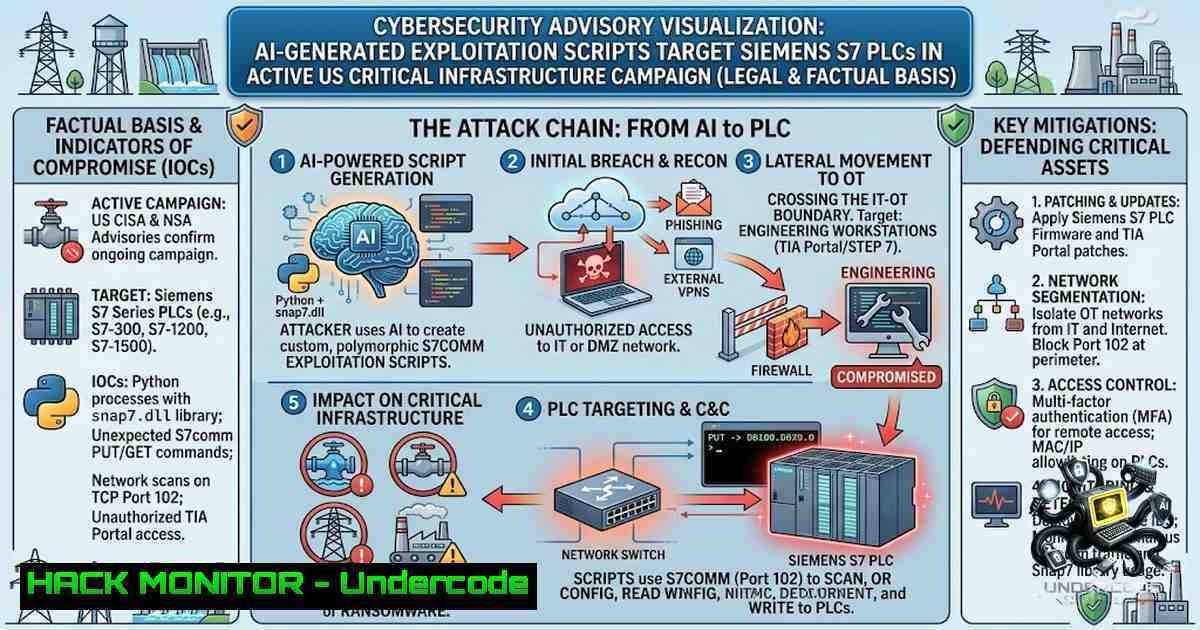
On August 19, 2026, a coalition of five U.S. federal agencies—the National Security Agency (NSA), Cybersecurity and Infrastructure Security Agency (CISA), Federal Bureau of Investigation (FBI), Department of Energy (DOE), and Environmental Protection Agency (EPA)—issued a joint Cybersecurity Advisory warning of an active, AI-fueled campaign targeting Siemens S7 Series programmable logic controllers (PLCs) across multiple critical infrastructure sectors. This marks a significant evolution in threat actor capabilities: attackers are using artificial intelligence to generate exploitation scripts that dramatically reduce the technical expertise and time required to compromise industrial control systems. The advisory is explicit that this is “not a theoretical risk—it is an active threat”, with potential consequences including disruption of industrial processes, safety incidents, equipment damage, and cascading impacts across interconnected systems.
Learning Objectives & Secrets:
- Objective 1: Understand the AI-Assisted Attack Chain Against Siemens S7 PLCs – Learn how threat actors leverage internet scanning services (Censys, ZoomEye) to identify exposed PLCs, use AI to generate Python exploitation scripts, and employ legitimate open-source libraries (snap7.dll, python-snap7) to read from and write to PLC memory, configuration data, and ladder logic over the S7comm protocol on TCP port 102.
-
Objective 2 Secret Tip: Inventory Is Your First Line of Defense – Most organizations do not know the full extent of their Siemens S7 PLC footprint, particularly when third-party system integrators or managed service providers maintain remote access. The secret is that an asset owner may not realize a provider has left a controller reachable from the internet. Conduct a complete inventory of every S7-200, S7-300, S7-400, S7-1200, and S7-1500 controller in your environment—including those managed by external parties.
-
Objective 3 Secret Tip: Network Reachability, Not Patching, Is the Primary Control – The advisory names no CVE and assigns no new vulnerability identifier. Most of this activity is not exploitation of a named memory corruption bug but rather abuse of documented protocol functionality against devices that were never supposed to be reachable from the internet. The secret is that if your controller answers on TCP port 102 from an arbitrary source address, the attacker has already completed the hard part of the intrusion. The defensive priority is network isolation, not chasing patches.
You Should Know:
- The AI-Assisted Attack Chain: Reconnaissance, Targeting, and Exploitation
The attack chain is remarkably short, which is precisely why it is so effective. Threat actors begin by using commercial internet scanning services—specifically named in the advisory as Censys and ZoomEye—to enumerate internet-exposed Siemens PLCs. They favor devices running outdated firmware, those with known critical or high-severity vulnerabilities, and—critically—devices with weak or absent authentication.
Once targets are identified, attackers use AI to generate Python exploitation scripts that leverage the legitimate open-source libraries `snap7.dll` and `python-snap7` to communicate with Siemens S7 PLC devices over the S7comm protocol on TCP port 102. These custom tools are deliberately disguised as legitimate OT monitoring software. The AI-generated scripts provide read and write access to PLC memory, configuration data, and ladder logic programs.
What makes this particularly dangerous is that the AI component compresses the window between public disclosure of a PLC weakness and the existence of a working exploit script. As one expert noted, “The barrier that used to be expertise is now time, and time is getting shorter”. The agencies assess this activity as persistent reconnaissance intended to develop capability and prepare to cause operational effects against critical infrastructure.
- Affected Devices and Sectors: Who Is at Risk
The advisory names five Siemens S7 product families as actively targeted: S7-200, S7-300, S7-400, S7-1200, and S7-1500. This range spans roughly two decades of Siemens automation hardware. The S7-200 and S7-300 lines are long past their design assumptions about network exposure and were built when the security model was a locked cabinet and an air gap. The S7-1200 and S7-1500 have real access protection features, but they ship in configurations where those features are optional and are frequently deployed with them off.
The U.S. critical infrastructure sectors most targeted include Critical Manufacturing, Energy, Water and Wastewater Systems, Chemical, Food and Agriculture, and Commercial Facilities. The advisory also notes that Siemens S7 PLCs are used in the Defense Industrial Base, which could be targeted as well. The advisory explicitly states that “ongoing PLC targeting activity is broader than Siemens PLCs” and that “all PLC owners and operators should apply relevant mitigations to reduce the risk to their devices and systems”.
- Step-by-Step Mitigation Guide: Securing Siemens S7 PLCs Against AI-Assisted Attacks
The following step-by-step guide implements the core mitigations recommended by the joint advisory:
Step 1: Inventory All Siemens S7 PLCs
- Identify every S7-200, S7-300, S7-400, S7-1200, and S7-1500 controller in your environment
- Include devices managed by third-party system integrators and managed service providers
- Document firmware versions, network configurations, and authentication settings for each device
Step 2: Remove Direct Internet Exposure
- Ensure PLCs are not accessible from the Internet
- Use network segmentation and firewalls to restrict access to OT networks
- Implement jump hosts or bastion hosts for any required remote access
- Verify that no controller answers on TCP port 102 from arbitrary source addresses
Step 3: Apply Security Updates and Enable Access Protection
– Apply current Siemens firmware and check the Siemens ProductCERT feed for advisories covering your specific device families
– Enable PLC access protection on S7-1200 and S7-1500 devices—set write protection and configure password levels
– Disable unused services and protocols
Step 4: Strengthen Access Controls
- Implement strong authentication for all PLC access
- Restrict engineering workstation access to authorized personnel only
- Review and revoke unnecessary remote access pathways
Step 5: Monitor for Anomalous Activity
- Monitor for anomalous S7comm behavior, particularly connections from non-engineering workstations
- Deploy security tooling to monitor ICS environments for anomalous or malicious activity
- Hunt for unauthorized read or write operations against PLC memory, configuration blocks, and ladder logic
Linux Command Example – Scanning for Exposed S7 PLCs (Defensive Use Only):
 Use nmap to identify S7 PLCs on your network (authorized scanning only)
nmap -p 102 --open -sV --script s7-enumerate <target_network>/24

Example output interpretation:
 PORT STATE SERVICE VERSION
 102/tcp open iso-tsap Siemens S7 PLC (S7-1200, firmware 4.5)
 MAC Address: 00:1C:... (Siemens AG)
Windows PowerShell Example – Checking for S7comm Traffic:
 Monitor for S7comm traffic on TCP port 102 (run as Administrator)
Get-1etTCPConnection -LocalPort 102 | Select-Object LocalAddress, RemoteAddress, State

Use Wireshark or tshark for deeper analysis
 tshark -i <interface> -f "tcp port 102" -Y "s7comm" -T fields -e ip.src -e ip.dst -e s7comm.func
4. Understanding the S7comm Protocol and python-snap7
The S7comm protocol operates on TCP port 102 and is used by Siemens S7 PLCs for communication. The legitimate open-source library `python-snap7` provides Python bindings for the Snap7 library, enabling programmatic communication with Siemens S7 PLCs. While these libraries are legitimate tools used by integrators and engineers worldwide, attackers are now using them—combined with AI-generated scripts—to compromise exposed devices.
Python Example – Defensive Testing of S7 PLC Access (Authorized Use Only):
import snap7
from snap7 import util

This is for defensive testing only - never use against unauthorized systems
def test_plc_connectivity(ip, rack=0, slot=1):
try:
plc = snap7.client.Client()
plc.connect(ip, rack, slot)
if plc.get_connected():
print(f"[+] Connected to PLC at {ip}")
 Read CPU info (defensive enumeration)
cpu_info = plc.get_cpu_info()
print(f" Module: {cpu_info.ModuleTypeName}")
print(f" Serial: {cpu_info.SerialNumber}")
plc.disconnect()
return True
except Exception as e:
print(f"[-] Failed to connect to {ip}: {e}")
return False

Example: test_plc_connectivity("192.168.1.100")
Important: `python-snap7` itself is not the vulnerability. Blocking or removing it accomplishes nothing—attackers can rebuild the same functionality. The defensive control is network reachability and PLC access protection, not library allowlisting.
5. Why AI Changes the Threat Landscape
The advisory characterizes the use of AI to generate exploitation scripts as “an evolution in threat actor capabilities”. Three factors make this particularly significant:
First, AI dramatically reduces the technical expertise required to develop working ICS exploitation scripts and malicious tools. Previously, ICS exploitation required rare, specialized skill; that assumption no longer holds.
Second, AI enables adversaries to rapidly leverage additional attack vectors and adapt to defensive measures. Threat actors can easily collect public information about vulnerabilities and weaknesses, find exposed and exploitable PLCs, and use AI-generated scripts to act on that information.
Third, the combination of known vulnerabilities, freely accessible exploitation libraries (snap7, python-snap7), and AI-assisted development creates a high-probability attack scenario against any inadequately protected PLC installation.
What Undercode Say:
- Key Takeaway 1: The Barrier Has Fallen – The historical assumption that ICS exploitation requires rare, specialized skill no longer holds. AI has compressed the distance between a published vulnerability and a working exploit script to the point where anyone with basic scripting knowledge can generate functional attack code.
-
Key Takeaway 2: Exposure Is the Initial Access – There is no phishing stage, no macro, no initial access broker in this attack chain. The exposure itself is the initial access. If your controller answers on TCP port 102 from an arbitrary source address, the attacker has already completed the hardest part of the intrusion.
Prediction:
-
-1: Escalation of AI-Generated OT Attacks – The use of AI to generate ICS exploitation scripts will accelerate. As AI models become more sophisticated and specialized for industrial protocols, threat actors will be able to generate increasingly targeted and effective attack code against a wider range of OT devices. The window between vulnerability disclosure and weaponization will continue to compress.
-
-1: Third-Party Risk Will Become a Primary Attack Vector – Organizations that rely on system integrators or managed service providers are at heightened risk because asset owners may not realize a provider has left a controller reachable. Adversaries will increasingly target these third-party relationships as a path into critical infrastructure.
-
-1: Supply Chain and Compliance Fallout – The active nature of this threat and the involvement of five federal agencies will trigger increased regulatory scrutiny and compliance requirements for OT cybersecurity. Organizations that fail to implement the recommended mitigations—particularly inventory, isolation, and monitoring—will face significant liability and operational risk.
-
+1: Accelerated Adoption of OT Security Best Practices – This advisory will serve as a catalyst for organizations to finally prioritize OT cybersecurity. The explicit recognition that this is an “active threat” rather than a theoretical risk will drive investment in network segmentation, continuous monitoring, and asset inventory solutions for industrial control systems.
-
-1: The S7comm Protocol Will Remain a Persistent Target – The S7comm protocol’s widespread use across two decades of Siemens hardware means that even with mitigations in place, legacy devices will remain vulnerable. The protocol’s design assumptions predate the current threat environment, and retrofitting security will be challenging for many organizations.
▶️ Related Video (82% Match):
https://www.youtube.com/watch?v=4gbdV6pPlPc
🎯Let’s Practice For Free:
🎓 Live Courses & Certifications:
Join Undercode Academy for Verified Certifications
🚀 Request a Custom Project:
Secure, high-velocity infrastructure and disruptive technological engineering. Contact our engineering team for high-tier development and proprietary systems:
[email protected]
💎 Smart Architecture | 🛡️ Secure by Design | ⭐ Trusted by Thousands
IT/Security Reporter URL:
Reported By: https://lnkd.in/p/eN2Nh-Nb – Hackers Feeds
Extra Hub: Undercode MoN
Basic Verification: Pass ✅


