Listen to this Post
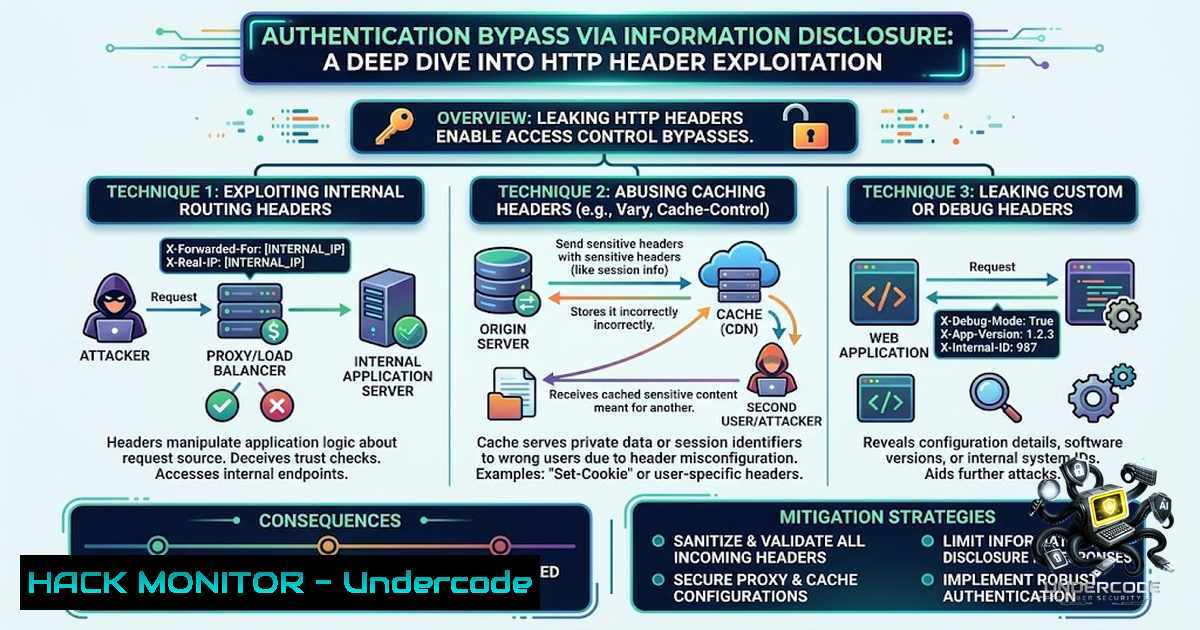
Introduction:
Authentication bypass through information disclosure represents one of the most insidious vulnerabilities in modern web applications, where seemingly innocuous data leaks—error messages, exposed headers, or debug information—can be chained into a full authentication bypass. When applications implicitly trust client-supplied headers like `X-Forwarded-For` or custom IP authorization headers without proper server-side validation, attackers can manipulate these values to impersonate trusted internal systems and gain unauthorized access. This vulnerability class has been responsible for numerous critical CVEs in 2025–2026, including authentication bypasses in WSO2 products (CVE-2025-5605), Fortinet FortiCloud SSO (CVE-2025-59718), and various proxy and middleware systems.
Learning Objectives & Secrets:
- Objective 1: Master HTTP Header Analysis for Information Disclosure — Learn to systematically enumerate and analyze HTTP headers, responses, and error messages to identify hidden clues that reveal authentication mechanisms. Use tools like Burp Suite to intercept and study every request-response cycle, paying special attention to custom headers and TRACE method responses.
-
Objective 2 Secret Tip: The TRACE Method as an Intelligence-Gathering Weapon — The TRACE HTTP method, when enabled, echoes back the exact request received by the server, often revealing proxy-added headers like `X-Custom-IP-Authorization` or
X-Forwarded-For. Send `TRACE /admin` instead of `GET /admin` to expose the header names the server uses for authentication decisions—this is the reconnaissance key most penetration testers overlook. -
Objective 3 Secret Tip: Header Spoofing via Match and Replace — Once you identify the custom header (e.g.,
X-Custom-IP-Authorization: 127.0.0.1), configure Burp Proxy’s match and replace rules to automatically inject this header into every request. This transforms your external IP into a “localhost” identity, bypassing IP-based authentication restrictions without writing a single line of code.
You Should Know:
- Understanding the Authentication Bypass via Information Disclosure Attack Chain
This attack typically follows a four-phase sequence: Reconnaissance → Header Discovery → Header Injection → Privileged Access. The attacker first identifies that an admin panel restricts access to local users only. By sending a `TRACE /admin` request, the server reveals that a proxy automatically appends an `X-Custom-IP-Authorization` header containing the client’s IP address. The attacker then crafts requests with this header set to 127.0.0.1, effectively impersonating the localhost. The server, trusting this client-supplied header without proper verification, grants administrative access.
This pattern extends beyond simple IP spoofing. Recent CVEs demonstrate sophisticated variants:
- CVE-2025-9485 (Authentication Bypass via Unsigned JWT): Attackers forge JWTs with `alg: none` and empty signatures, exploiting servers that fail to verify cryptographic signatures:
TOKEN=$(node -e 'function b64u(s){ return Buffer.from(s).toString("base64").replace(/+/g,"-").replace(/\//g,"_").replace(/=+$/,"")}const header = b64u(JSON.stringify({ alg: "none", typ: "JWT" }));const now = Math.floor(Date.now()/1000);const payload = b64u(JSON.stringify({ iss: "https://evil.example", aud: "abc", sub: "admin-hijack", email: "[email protected]", email_verified: "1", iat: now, exp: now + 3600}));console.log(header + "." + payload + ".");') -
CVE-2025-59718 (Fortinet FortiCloud SSO Bypass): Attackers craft unsigned SAML responses that Fortinet products fail to verify properly, enabling unauthenticated administrative access. Mitigation requires upgrading to patched versions or disabling FortiCloud SSO via CLI:
config system global
set admin-forticloud-sso-login disable
end
-
CVE-2026-15075 (Vert.x Header Forwarding): Critical headers including
Authorization,Cookie, and `Proxy-Authorization` are forwarded across cross-origin redirects without the caller’s knowledge, enabling unauthorized information disclosure. -
CVE-2026-74880 (OpenSSL Encrypt Token Extraction): Attackers can extract tokens from server logs, proxy logs, browser history, and HTTP Referer headers to gain unauthorized access.
- Practical Exploitation: Burp Suite Configuration for Header Injection
The most direct exploitation method for this vulnerability class involves configuring Burp Suite’s match and replace functionality to automatically inject spoofed headers into every request.
Step-by-Step Guide:
- Intercept the Target Request: Open Burp Suite’s browser and navigate to the vulnerable application. Attempt to access the restricted admin panel at
/admin. -
Identify the Authentication Mechanism: Send a `TRACE` request to the same endpoint:
TRACE /admin HTTP/1.1
Host: target.com
Study the response—it will echo back the request headers, including any proxy-added custom headers like
X-Custom-IP-Authorization: 192.168.1.100.
3. Configure Match and Replace Rule:
- Navigate to Proxy → Match and replace.
- Click Add to create a new rule.
- Under Type, select Request header.
- Leave the Match field empty (this appends a new header rather than replacing an existing one).
- In the Replace field, enter:
X-Custom-IP-Authorization: 127.0.0.1. - Click Test to verify the header is added correctly.
- Verify Successful Bypass: Browse to the home page. The application now treats your requests as originating from localhost, granting administrative access.
Alternative Command-Line Approach (cURL) :
For scenarios where Burp Suite is unavailable, use cURL with custom headers:
curl -X GET https://target.com/admin -H "X-Custom-IP-Authorization: 127.0.0.1" -H "X-Forwarded-For: 127.0.0.1"
For brute-forcing internal IP ranges when the exact trusted IP is unknown:
for ip in {1..255}; do curl https://target.com/admin -H "X-Forwarded-For: 192.168.0.$ip" -o $ip.out; done
- Advanced Exploitation: Header Manipulation and Proxy Bypass Techniques
Modern applications often employ multiple layers of proxy and header-based authentication, creating complex attack surfaces. Recent research has uncovered several sophisticated bypass techniques:
- Header Shadowing: When a client injects a duplicate header (e.g., two `X-Forwarded-For` headers), different components in the request chain may prioritize different values, enabling attackers to override trusted proxy-added headers.
-
Case Normalization Bypass: Some web servers accept uppercase/lowercase header variations inconsistently. An attacker might send `x-forwarded-for: 127.0.0.1` while the application expects
X-Forwarded-For, leading to the trusted value being ignored or overwritten. -
FastCGI Header Normalization: When requests pass through Caddy to PHP-FastCGI, headers are normalized by replacing hyphens with underscores. Attackers can exploit this to inject or override identity headers trusted by PHP applications.
-
CRLF Injection via Custom Headers: Applications that pass user-influenced data into `CURLOPT_HTTPHEADER` without sanitizing `\r\n` characters are vulnerable to header injection, request splitting, and authentication bypass.
Detection and Prevention Commands (Linux/Windows) :
Linux – Identify Exposed Headers:
 Check for TRACE method support
curl -X TRACE https://target.com -v

Enumerate all headers sent by proxy
curl -X GET https://target.com -H "X-Forwarded-For: 127.0.0.1" -v

Test for header injection
curl -X GET https://target.com -H "X-Custom-Header: test\r\nX-Injected: true" -v
Windows PowerShell – Header Enumeration:
 Test TRACE method
Invoke-WebRequest -Uri https://target.com -Method TRACE -UseBasicParsing

Send custom headers
$headers = @{"X-Forwarded-For"="127.0.0.1"; "X-Custom-IP-Authorization"="127.0.0.1"}
Invoke-WebRequest -Uri https://target.com/admin -Headers $headers
4. Mitigation Strategies and Secure Coding Practices
Preventing authentication bypass through information disclosure requires a defense-in-depth approach:
- Never Trust Client-Supplied Headers for Authentication: Headers like
X-Forwarded-For,X-Real-IP, or custom IP headers should never be used as the sole basis for authentication or authorization decisions. Always validate these values against trusted proxy configurations. -
Disable TRACE and TRACK Methods: These methods should be disabled in production environments to prevent header reflection attacks:
– Apache: `TraceEnable Off`
– Nginx: `add_header X-Content-Type-Options nosniff;` and ensure `TRACE` is not in `Allow` methods
– IIS: Remove TRACE from allowed verbs in request filtering
- Implement Proper JWT Validation: Always verify JWT signatures using strong algorithms (HS256, RS256). Reject tokens with
alg: none:import jwt try: decoded = jwt.decode(token, secret, algorithms=['HS256']) except jwt.InvalidSignatureError: Reject token
-
Strict Header Validation and Whitelisting: Implement a header allowlist on your reverse proxy or application firewall, rejecting unexpected or malformed headers.
-
Redact Sensitive Information in Error Messages: Ensure error responses do not expose internal headers, stack traces, or debug information. CVE-2025-62168 demonstrates how failure to redact HTTP authentication credentials in error handling can lead to credential disclosure.
5. Real-World Impact: Recent CVEs and Active Exploitation
The authentication bypass via information disclosure vulnerability class has seen widespread exploitation in 2025–2026:
- CVE-2025-5605 (WSO2): Authentication bypass via URI manipulation in multiple WSO2 products’ management consoles, enabling partial information disclosure. Attackers manipulate the request URI to bypass authentication and access restricted resources.
-
CVE-2025-66570 (cpp-httplib): Attacker-controlled HTTP headers flow into server metadata and logging, enabling IP spoofing, log poisoning, and authorization bypass via header shadowing.
-
CVE-2025-62168 (Squid): Failure to redact HTTP authentication credentials in error handling allows scripts to bypass browser security protections and learn trusted client credentials. Fixed in Squid version 7.2.
-
CVE-2026-34518 (AIOHTTP): When following cross-origin redirects, AIOHTTP drops the `Authorization` header but retains `Cookie` and `Proxy-Authorization` headers, leading to credential leakage. Patched in version 3.13.4.
What Undercode Say:
-
Key Takeaway 1: Authentication bypass through information disclosure is not a theoretical vulnerability—it’s actively exploited in the wild, with critical CVEs affecting major enterprise products including Fortinet, WSO2, Squid, and AIOHTTP. The common thread across all these vulnerabilities is implicit trust—trusting client-supplied headers without verification, trusting JWT signatures without validation, or trusting error messages without redaction.
-
Key Takeaway 2: The “Attempt → Research → Learn → Try Again” methodology is the cornerstone of mastering offensive security. As demonstrated by the PortSwigger lab, failing to solve a lab on the first attempt is not a failure—it’s an opportunity to deepen your understanding of HTTP headers, proxy behavior, and server-side trust models. The TRACE method discovery, match and replace configuration, and header injection sequence represent a repeatable methodology applicable across thousands of real-world applications.
Analysis: The cybersecurity industry is witnessing a paradigm shift where information disclosure is increasingly recognized as a primary attack vector rather than a secondary vulnerability. Attackers are no longer relying solely on brute force or credential stuffing—they’re exploiting the fundamental trust relationships built into HTTP infrastructure. Proxies, load balancers, and CDNs introduce headers that applications implicitly trust, creating a massive attack surface. The most effective defense is a zero-trust approach to HTTP headers: validate everything, trust nothing, and assume that any client-supplied value can be manipulated. Organizations must disable unnecessary HTTP methods like TRACE, implement strict header validation, and ensure authentication decisions are based on server-side state rather than client-supplied metadata. As the AIOHTTP and Vert.x CVEs demonstrate, even well-maintained libraries are susceptible to header forwarding vulnerabilities, emphasizing the need for continuous security review throughout the software development lifecycle.
Prediction:
- -1 The proliferation of microservices and API gateways will exponentially increase the attack surface for header-based authentication bypasses, as each intermediary introduces new headers that applications may implicitly trust. Organizations that fail to implement strict header validation will face a surge in account takeover incidents.
-
-1 AI-powered code assistants and automated code generation tools will inadvertently introduce header trust vulnerabilities at scale, as developers rely on AI-generated code without understanding the security implications of client-supplied headers.
-
+1 The security community will develop standardized header validation frameworks and middleware that automatically sanitize and validate all incoming HTTP headers, reducing the cognitive burden on developers.
-
+1 Burp Suite’s match and replace functionality will evolve with AI-powered header discovery, automatically identifying and testing potential authentication bypass vectors without manual reconnaissance.
-
-1 Attackers will increasingly target the header normalization differences between reverse proxies and backend applications, exploiting inconsistencies in how different components parse and validate headers.
-
-1 The rise of serverless architectures and edge computing will introduce new header forwarding vectors, as requests traverse multiple trust boundaries before reaching the application logic.
-
+1 Regulatory frameworks will begin mandating specific header validation requirements, forcing organizations to adopt secure-by-default configurations for HTTP header handling.
-
-1 Legacy applications that cannot be easily patched will remain vulnerable to TRACE method exploitation and header spoofing for years, creating persistent backdoors in enterprise environments.
-
+1 The cybersecurity training industry will develop specialized labs and certifications focused specifically on HTTP header exploitation and mitigation, addressing the current skills gap in this critical area.
-
-1 As AI-powered reconnaissance tools become more sophisticated, attackers will automate the discovery of custom headers and authentication mechanisms, scaling information disclosure attacks from manual to fully automated operations.
▶️ Related Video (84% Match):
https://www.youtube.com/watch?v=0rL37nccNwc
🎯Let’s Practice For Free:
🎓 Live Courses & Certifications:
Join Undercode Academy for Verified Certifications
🚀 Request a Custom Project:
Secure, high-velocity infrastructure and disruptive technological engineering. Contact our engineering team for high-tier development and proprietary systems:
[email protected]
💎 Smart Architecture | 🛡️ Secure by Design | ⭐ Trusted by Thousands
IT/Security Reporter URL:
Reported By: https://lnkd.in/p/e6n9ZPcU – Hackers Feeds
Extra Hub: Undercode MoN
Basic Verification: Pass ✅


