Listen to this Post
Introduction
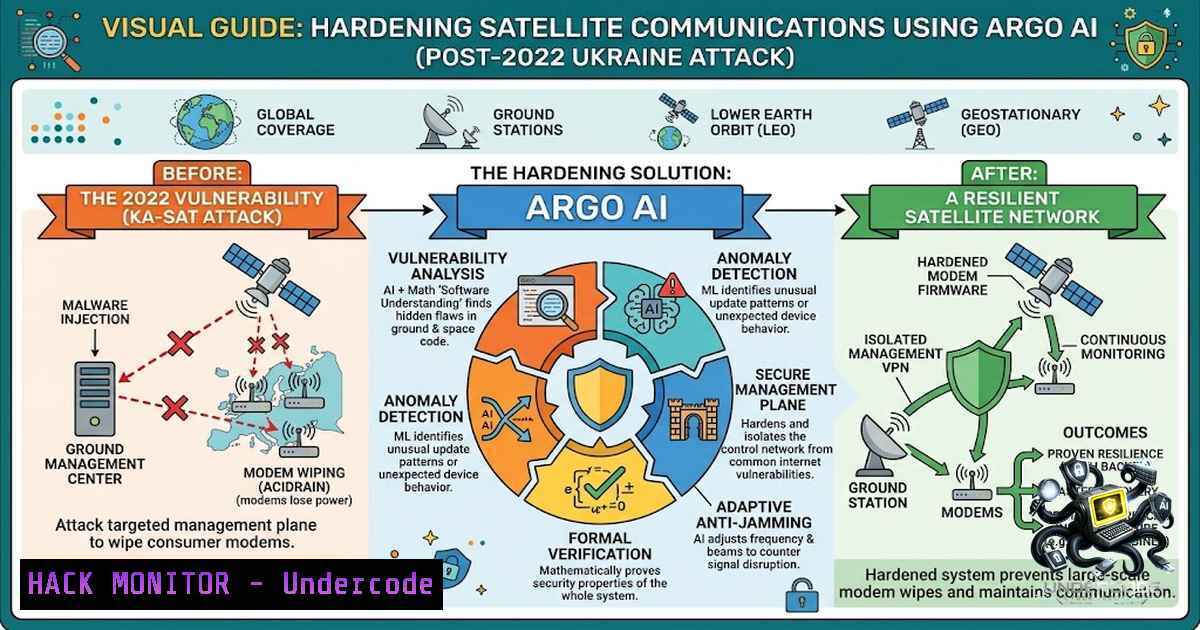
On February 24, 2022—the same day Russia launched its full-scale invasion of Ukraine—a destructive cyberattack crippled thousands of satellite modems across Europe, targeting Viasat’s KA-SAT network used by the Ukrainian Armed Forces. The attack left tens of thousands without internet and even affected thousands of wind turbines in Central Europe. In response, cybersecurity company Atalanta has released “Argo,” an AI-assisted tool that combines complex mathematics with artificial intelligence to analyze software and internet-connected systems for vulnerabilities in a more comprehensive manner. This technology, already instrumental in securing Viasat’s network post-attack, represents a paradigm shift in how critical infrastructure can be defended against state-sponsored cyber threats.
Learning Objectives & Secrets
- Objective 1: Understand the KA-SAT Attack Vector – Learn how Russian military cyber operators (GRU) deployed destructive wiper malware against satellite modems, disrupting command and control communications hours before the invasion.
-
Objective 2 Secret Tip: Leverage “Software Understanding” for Zero-Day Detection – Argo doesn’t just scan for known signatures; it uses formal mathematics and AI to mathematically prove system resilience, uncovering vulnerabilities that traditional scanners miss.
-
Objective 3 Secret Tip: Automate Compliance and Hardening Validation – The tool produces verifiable mathematical proofs of system security, enabling organizations to demonstrate compliance and resilience against future attacks with quantifiable data.
You Should Know
- Understanding the KA-SAT Cyberattack: A Case Study in Modern Cyber Warfare
The Viasat KA-SAT attack was executed via a malicious software command that immediately crippled tens of thousands of modems across Europe. The attack occurred between 5 am and 9 am EEST on February 24, 2022, targeting satellite equipment connected to the KA-SAT network. The primary objective was to disrupt communication channels of the Ukrainian armed forces, preventing them from using satellite communications to respond to the invasion.
Key Technical Details:
- Attack Type: Destructive wiper malware (similar to HermeticWiper)
- Target: Viasat’s KA-SAT satellite network modems
- Impact: Tens of thousands of modems offline across Ukraine and Europe; up to 5,800 wind turbines affected in Central Europe
- Attribution: Russian military intelligence (GRU), confirmed by Denmark, the EU, and the United States
Linux Command to Check for Suspicious Modem Activity:
 Check for unusual outbound connections from network devices
sudo netstat -tunap | grep ESTABLISHED | awk '{print $5}' | sort | uniq -c | sort -1r

Monitor system logs for unauthorized access attempts
sudo journalctl -f -u systemd-1etworkd --since "2022-02-24 05:00:00"

Scan for modified binaries (potential wiper malware indicators)
sudo find / -type f -mtime -1 -exec ls -la {} \; 2>/dev/null | grep -E "(modem|satellite|network)"
Windows Command (PowerShell) to Audit Network Devices:
 Check for unexpected outbound connections
Get-1etTCPConnection | Where-Object {$_.State -eq "Established"} | Select-Object LocalAddress, LocalPort, RemoteAddress, RemotePort

Review security event logs for anomalies
Get-WinEvent -LogName Security -MaxEvents 100 | Where-Object {$_.Id -in (4624,4625,4672)} | Format-Table TimeCreated, Id, Message -AutoSize
2. How Argo Works: The “Software Understanding” Approach
Atalanta’s Argo represents a fundamental departure from traditional vulnerability scanning. Instead of relying on signature databases or heuristic pattern matching, Argo uses “software understanding”—a combination of complex mathematics and artificial intelligence to analyze software and internet-connected systems comprehensively. The technology mathematically proves system resilience, producing verifiable evidence that a system is hardened against attacks.
Step-by-Step Guide to Implementing an AI-Assisted Vulnerability Analysis Workflow:
- Asset Discovery and Inventory: Identify all internet-connected systems and software components within your infrastructure.
Linux: Discover all listening services
sudo ss -tuln | grep LISTEN
sudo lsof -i -P -1 | grep LISTEN
-
Software Composition Analysis: Map all software dependencies and their versions.
Linux: List installed packages
dpkg -l | grep -E "^(ii|hi)"  Debian/Ubuntu
rpm -qa  RHEL/CentOS

Scan for known vulnerabilities in dependencies
sudo apt-get install lynis && sudo lynis audit system
-
Behavioral Analysis with AI: Deploy AI-driven behavioral monitoring to establish baselines and detect anomalies.
Monitor file integrity
sudo aideinit && sudo aide -c /etc/aide/aide.conf --check

Real-time process monitoring
sudo ps aux --sort=-%mem | head -20
-
Formal Verification: Use mathematical proofs to validate system configurations against security policies (Argo’s core capability).
-
Continuous Hardening: Automate patch management and configuration updates based on AI-generated recommendations.
Automated security updates
sudo apt-get update && sudo apt-get upgrade -y
sudo unattended-upgrades --dry-run --debug
3. Securing Satellite Communication Systems: Practical Hardening Measures
The Viasat attack highlighted the vulnerability of commercial satellite networks that serve both civilian and military purposes. Here are practical steps to harden SATCOM infrastructure:
Network Segmentation:
- Isolate satellite modem management interfaces from public networks
- Implement VLAN segmentation for different traffic types
- Use firewall rules to restrict management access to trusted IP ranges
Linux Firewall Configuration (iptables/nftables):
 Block all incoming connections except established
sudo iptables -P INPUT DROP
sudo iptables -A INPUT -m conntrack --ctstate ESTABLISHED,RELATED -j ACCEPT

Allow only SSH from trusted management subnet
sudo iptables -A INPUT -p tcp --dport 22 -s 192.168.1.0/24 -j ACCEPT

Log and drop all other traffic
sudo iptables -A INPUT -j LOG --log-prefix "FIREWALL: " --log-level 4
sudo iptables -A INPUT -j DROP
Windows Firewall Configuration (PowerShell):
 Block all inbound traffic by default
Set-1etFirewallProfile -Profile Domain,Public,Private -DefaultInboundAction Block

Allow RDP only from specific IPs
New-1etFirewallRule -DisplayName "RDP from Trusted" -Direction Inbound -Protocol TCP -LocalPort 3389 -RemoteAddress 192.168.1.0/24 -Action Allow

Enable logging
Set-1etFirewallProfile -Profile Domain,Public,Private -LogFileName "C:\Windows\System32\LogFiles\Firewall\pfirewall.log"
Set-1etFirewallProfile -Profile Domain,Public,Private -LogAllowed True -LogBlocked True
- AI in Cybersecurity: The DARPA Investment and Future Standards
The technology behind Argo has been decades in the making. DARPA has invested well over $2 billion over the past two decades in programs advancing formal methods for cybersecurity. Greg Shannon, chief cybersecurity scientist at Idaho National Laboratory, predicts that such AI-assisted tools will become standard in development toolkits within a decade or two. The Pentagon’s chief technology officer, Emil Michael, has stated he wants the mathematics underpinning Atalanta’s technology to “become the DoD’s gold standard” for cybersecurity.
Key AI Security Commands and Tools:
 Install and use an AI-powered vulnerability scanner (example with OWASP Dependency-Check)
sudo apt-get install owasp-dependency-check
dependency-check --scan /path/to/your/application --format HTML --out report.html

Use AI-assisted log analysis (Elasticsearch with Machine Learning)
 Enable anomaly detection in Elastic Stack:
 PUT _ml/anomaly_detectors/security_anomalies
 {
 "analysis_config": {
 "bucket_span": "15m",
 "detectors": [
 {"function": "rare", "field": "source.ip"}
 ]
 }
 }
- Emerging Threats: Iranian Cyber Threats to Critical Infrastructure
The AP report notes that Iranian hackers have been targeting water and wastewater systems and other critical infrastructure. This underscores the need for AI-assisted defenses that can scale across diverse sectors.
Critical Infrastructure Hardening Checklist:
- Implement multi-factor authentication (MFA) for all remote access
- Conduct regular penetration testing and vulnerability assessments
- Deploy AI-powered anomaly detection for ICS/SCADA environments
- Maintain offline backups and disaster recovery plans
- Establish threat intelligence sharing with sector-specific ISACs
Linux Command for ICS/SCADA Network Monitoring:
 Monitor Modbus traffic (common in SCADA)
sudo tcpdump -i eth0 port 502 -1n -v

Monitor DNP3 traffic
sudo tcpdump -i eth0 port 20000 -1n -v

Log all network connections to /var/log/connections.log
sudo tcpdump -i any -1n -l | tee -a /var/log/connections.log
6. Implementing a Zero-Trust Architecture for Satellite Communications
The Viasat attack demonstrated that perimeter-based security is insufficient for satellite networks. A zero-trust approach—continuous verification of every access request—is essential.
Zero-Trust Implementation Steps:
1. Identity and Access Management (IAM):
 Linux: Implement certificate-based authentication for SSH
 Generate a certificate authority
ssh-keygen -t rsa -b 4096 -f ~/.ssh/ca_key
2. Micro-segmentation:
 Use network namespaces to isolate satellite modem interfaces
sudo ip netns add satcom_ns
sudo ip link set eth1 netns satcom_ns
sudo ip netns exec satcom_ns ip addr add 10.0.1.1/24 dev eth1
3. Continuous Monitoring and Analytics:
 Deploy Auditd for comprehensive system auditing
sudo auditctl -w /etc/passwd -p wa -k identity_changes
sudo auditctl -w /etc/shadow -p wa -k identity_changes
sudo auditctl -e 1
- Automated Response: Implement SOAR (Security Orchestration, Automation, and Response) playbooks triggered by AI-detected anomalies.
-
The Future of AI-Assisted Cybersecurity: Genesis Mission and Beyond
Atalanta’s technology has also been deployed on the Genesis Mission—the Department of Energy’s effort to create autonomous nuclear reactors. This demonstrates the versatility of AI-assisted formal verification for protecting the most critical infrastructure.
Recommended Security Tools for Critical Infrastructure:
- Vulnerability Management: Qualys, Tenable, or open-source alternatives like OpenVAS
- SIEM: Splunk, Elastic Stack, or Wazuh
- AI Security: Darktrace, Vectra AI, or Atalanta Argo
- Compliance Automation: Chef InSpec, OpenSCAP
Linux Command for Compliance Scanning:
 Install and run OpenSCAP for security compliance
sudo apt-get install openscap-scanner scap-security-guide
sudo oscap xccdf eval --profile xccdf_org.ssgproject.content_profile_cis --results results.xml /usr/share/xml/scap/ssg/content/ssg-ubuntu2004-ds.xml
What Undercode Say:
- Key Takeaway 1: AI-Powered Formal Verification Is the Next Frontier – Traditional vulnerability scanning is no longer sufficient against state-sponsored attacks. Argo’s “software understanding” approach, combining mathematics and AI, represents a paradigm shift from reactive to proactive defense. The $2 billion DARPA investment finally reaching commercial availability is a game-changer for critical infrastructure protection.
-
Key Takeaway 2: Satellite Communication Security Is National Security – The KA-SAT attack was not just a cyber incident; it was a military operation designed to cripple command and control capabilities. As commercial satellite networks increasingly support military and civilian infrastructure, securing them against state-sponsored threats becomes a matter of national security. The spillover effects—thousands of wind turbines offline across Europe—demonstrate that cyberattacks on space assets have real-world kinetic consequences.
The Viasat attack serves as a wake-up call for the cybersecurity community. The integration of AI and formal mathematics into security tooling, as demonstrated by Argo, offers a path forward. However, organizations must also implement practical hardening measures, adopt zero-trust architectures, and invest in continuous monitoring. The threats are evolving, and so must our defenses.
Prediction:
- +1 AI-assisted formal verification tools like Argo will become standard in all critical infrastructure sectors within 5–7 years, driven by regulatory mandates and insurance requirements. Organizations that adopt early will have a significant competitive advantage in security posture and compliance.
-
+1 The success of Argo in securing Viasat’s network will accelerate DARPA and DoD investment in AI-driven cybersecurity, leading to a new generation of autonomous defense systems that can detect and mitigate zero-day exploits in real-time.
-
-1 As AI-powered defenses become more prevalent, adversaries will increasingly use AI to develop more sophisticated attack vectors, creating an AI arms race in cybersecurity that will strain resources for smaller organizations and developing nations.
-
-1 The reliance on AI for critical infrastructure security introduces new risks: adversarial machine learning attacks could poison training data or manipulate AI models, potentially creating false senses of security or enabling targeted exploits of AI-assisted systems.
-
+1 The commercial availability of Argo and similar tools will democratize advanced cybersecurity capabilities, allowing mid-sized enterprises to access defense technologies previously available only to government agencies and large defense contractors.
-
-1 The Viasat attack and subsequent developments highlight the growing weaponization of commercial space assets. Without stronger international norms and treaties governing cyber operations in space, we can expect more frequent and destructive attacks on satellite infrastructure, with cascading effects on global communications, navigation, and military systems.
▶️ Related Video (82% Match):
https://www.youtube.com/watch?v=2R5wViTjk-M
🎯Let’s Practice For Free:
🎓 Live Courses & Certifications:
Join Undercode Academy for Verified Certifications
🚀 Request a Custom Project:
Secure, high-velocity infrastructure and disruptive technological engineering. Contact our engineering team for high-tier development and proprietary systems:
[email protected]
💎 Smart Architecture | 🛡️ Secure by Design | ⭐ Trusted by Thousands
IT/Security Reporter URL:
Reported By: https://lnkd.in/p/es5gey3e – Hackers Feeds
Extra Hub: Undercode MoN
Basic Verification: Pass ✅


