Listen to this Post
Introduction
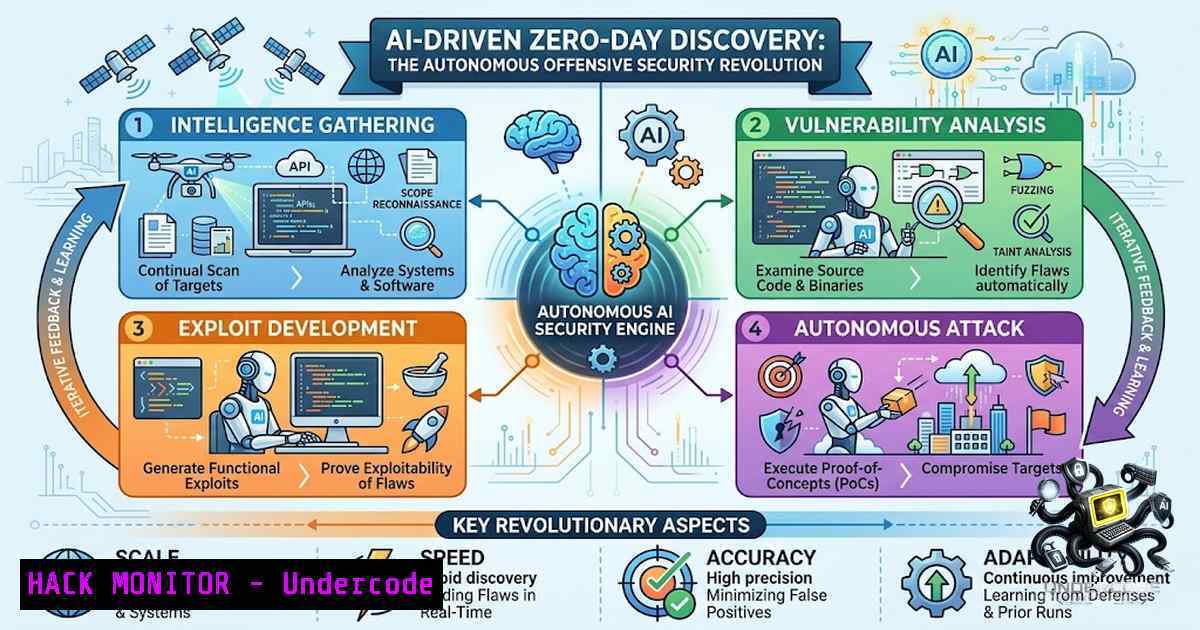
The cybersecurity industry has reached an inflection point. What was theoretical just two years ago—artificial intelligence autonomously discovering and proving zero-day vulnerabilities—is now a documented reality. XBOW, a purpose-built autonomous offensive security system, has identified and responsibly disclosed more than 14,000 zero-day vulnerabilities across real-world production systems, executed exploit chains spanning up to 48 steps, and broken complex cryptographic implementations in under 18 minutes. More remarkably, XBOW reached the number-one position on HackerOne’s global leaderboard, competing against thousands of human security researchers. This is not AI pointing at suspicious code—it is AI completing the full vulnerability research loop: exploring applications, understanding attack surfaces, forming hypotheses, testing them, chaining behaviours, and validating whether exploitation actually works.
Learning Objectives & Secrets
- Objective 1: Understand the Architecture of Autonomous Offensive Security – Learn how systems like XBOW use thousands of short-lived agents with narrow objectives, orchestrated by a persistent coordinator and validated by deterministic logic. Unlike general-purpose AI, these purpose-built systems are designed specifically for offensive security tasks.
-
Objective 2 Secret Tip: Master the Art of Attack Surface Exploration – The most successful autonomous systems don’t just scan for known patterns. They explore, reason, adapt, and validate. XBOW’s approach includes a unique “validator” mechanism that provides deterministic verification of findings—a critical safeguard against the hallucinations that plague LLM-based vulnerability detection.
-
Objective 3 Secret Tip: Think Beyond the Vulnerability Scanner – Traditional scanners look for known patterns. Autonomous security systems can explore, reason, adapt their approach, and validate what they find. The key insight: AI doesn’t replace security researchers—it massively increases the number of attempts a researcher can make, amplifying human capability rather than eliminating it.
You Should Know
1. Autonomous Network Reconnaissance and Attack Surface Mapping
Autonomous offensive security begins with comprehensive reconnaissance. Modern AI-driven penetration testing agents orchestrate network discovery using tools like Nmap, Masscan, and custom enumeration scripts. The following commands illustrate the reconnaissance phase of an autonomous security assessment:
Linux Reconnaissance Commands:
 Comprehensive network scan with service detection
nmap -sV -sC -O -p- -T4 192.168.1.0/24 -oA network_recon

Aggressive scan with script execution
nmap -A -T4 --script=vuln,exploit 192.168.1.100

Masscan for high-speed port scanning across large ranges
masscan -p1-65535 --rate=10000 192.168.1.0/24 -oJ masscan_results.json

Subdomain enumeration and DNS reconnaissance
dnsrecon -d example.com -t axfr,ns,soa
Windows PowerShell Reconnaissance:
 Network discovery and port scanning (Test-1etConnection)
1..1024 | ForEach-Object { Test-1etConnection -ComputerName 192.168.1.100 -Port $_ -WarningAction SilentlyContinue }

Active Directory reconnaissance
Get-ADDomainController | ForEach-Object { nslookup $_.HostName }

DNS enumeration
Resolve-DnsName -1ame example.com -Type A | Format-Table
What This Does: Autonomous systems use these commands to build a comprehensive map of the target environment, identifying live hosts, open ports, running services, and potential attack vectors. The AI coordinates multiple reconnaissance agents simultaneously, covering more ground than any human team could.
2. Vulnerability Discovery and Automated Exploitation
Once the attack surface is mapped, autonomous systems proceed to vulnerability discovery and exploitation. Modern frameworks like Metasploit can be orchestrated by AI agents to identify and validate vulnerabilities:
Linux Vulnerability Assessment:
 Launch Metasploit console with resource script
msfconsole -q -r automated_exploit.rc

Example resource script (automated_exploit.rc):
use auxiliary/scanner/portscan/tcp
set RHOSTS 192.168.1.0/24
set PORTS 1-1024
run

Search for known exploits
searchsploit -w --json apache 2.4

Automated SQL injection testing
sqlmap -u "http://target.com/page?id=1" --batch --random-agent --level=3 --risk=2

Web application fuzzing with ffuf
ffuf -u http://target.com/FUZZ -w /usr/share/wordlists/dirb/common.txt -ac
Windows Exploitation Commands:
 PowerShell for vulnerability assessment
Invoke-WebRequest -Uri "http://target.com/page?id=1" -Method GET

Using PowerSploit for reconnaissance
Import-Module .\PowerSploit.psm1
Get-1etComputer -OperatingSystem "Windows Server"
Invoke-UserHunter -CheckAccess

BloodHound for Active Directory attack path analysis
Invoke-BloodHound -CollectionMethod All -OutputDirectory C:\BHData
What This Does: Autonomous systems use these tools to identify potential vulnerabilities, test them for exploitability, and chain multiple weaknesses together. XBOW has demonstrated the ability to execute exploit chains spanning up to 48 steps, autonomously navigating complex attack paths.
3. Web Application and API Security Testing
Web applications and APIs represent prime targets for autonomous offensive security. AI-driven systems can perform sophisticated testing that goes far beyond traditional scanners:
API Security Testing with cURL:
 Test for Broken Object Level Authorization (BOLA/IDOR)
curl -X GET "https://api.example.com/users/1001/profile" -H "Authorization: Bearer $TOKEN"
curl -X GET "https://api.example.com/users/1002/profile" -H "Authorization: Bearer $TOKEN"

Authentication bypass testing
curl -X POST https://api.example.com/auth/login \
-H "Content-Type: application/json" \
-d '{"username":"admin","password":"'"$(echo -1 'or 1=1--' | base64)"'"}'

JWT token manipulation
python3 -c "import jwt; print(jwt.encode({'user':'admin','exp':9999999999}, 'secret', algorithm='HS256'))"

GraphQL introspection and injection
curl -X POST https://api.example.com/graphql \
-H "Content-Type: application/json" \
-d '{"query":"query { __schema { types { name fields { name } } } }"}'
OWASP ZAP Automated Scanning:
 Start ZAP in daemon mode
zap.sh -daemon -port 8080 -host 127.0.0.1 -config api.key=changeme

Start spider scan
curl -s "http://127.0.0.1:8080/JSON/spider/action/scan/?apikey=changeme&url=http://target.com&recurse=true"

Start active scan
curl -s "http://127.0.0.1:8080/JSON/ascan/action/scan/?apikey=changeme&url=http://target.com"

Retrieve scan results
curl -s "http://127.0.0.1:8080/JSON/core/view/alerts/" | python3 -m json.tool
What This Does: These commands enable autonomous systems to probe APIs for common vulnerabilities including broken object-level authorization, authentication bypasses, injection flaws, and misconfigurations. XBOW’s success in bug bounty programs demonstrates that AI can effectively identify complex vulnerabilities in production APIs.
4. Cloud Infrastructure Hardening and Security Validation
With 67.2% of exploited CVEs in 2026 being zero-day vulnerabilities—up from just 16.1% in 2018—cloud security requires continuous validation. Autonomous systems can audit and harden cloud infrastructure:
AWS Security Auditing:
 Check CIS benchmark compliance
aws configservice get-compliance-details-by-config-rule \
--config-rule-1ame cis-benchmark-1.4 \
--compliance-types NON_COMPLIANT

Audit S3 bucket public access
aws s3api get-public-access-block --bucket your-bucket-1ame

Enforce public access block
aws s3api put-public-access-block --bucket your-bucket-1ame \
--public-access-block-configuration BlockPublicAcls=true,IgnorePublicAcls=true,BlockPublicPolicy=true,RestrictPublicBuckets=true

Check IAM password policy
aws iam get-account-password-policy

Enable CloudTrail for all regions
aws cloudtrail create-trail --1ame security-trail --s3-bucket-1ame cloudtrail-logs --is-multi-region-trail
aws cloudtrail start-logging --1ame security-trail
Azure Security Commands:
 Check CIS benchmark compliance
az security assessment metadata list --query "[?name=='cis-azure-1.4.0']"

Audit network security groups
az network nsg list --query "[].{name:name, rules:securityRules}"

Enable Azure Defender
az security pricing create -t VirtualMachines --1ame VirtualMachines

Check for open RDP/SSH ports
az network nsg rule list --1sg-1ame your-1sg --resource-group your-rg \
--query "[?destinationPortRange=='3389' || destinationPortRange=='22']"
What This Does: These commands allow autonomous systems to continuously audit cloud configurations against CIS benchmarks, identify misconfigurations, and automatically remediate security gaps. Given that attackers now operate at machine speed and scale,organizations must adopt similar automation for defense.
5. Zero-Day Vulnerability Mitigation and Emergency Response
When autonomous systems discover zero-day vulnerabilities, rapid mitigation is essential. The following commands illustrate emergency response procedures:
Linux Zero-Day Mitigation:
 Blacklist vulnerable kernel modules
echo "install algif_aead /bin/false" > /etc/modprobe.d/disable-algif.conf
rmmod algif_aead 2>/dev/null || true

Apply kernel command line mitigations
sudo grubby --update-kernel=ALL --args="initcall_blacklist=algif_aead_init"

Enable kernel kill switch for specific subsystems
echo "engage af_alg_sendmsg -1" > /sys/kernel/security/killswitch/control

Apply emergency AppArmor profiles
sudo aa-enforce /etc/apparmor.d/usr.sbin.apache2

Update and reboot with patched kernel
sudo apt update && sudo apt upgrade linux-image-generic && sudo reboot
Windows Emergency Response:
 Check for suspicious processes and services
Get-Process | Where-Object { $<em>.StartTime -gt (Get-Date).AddHours(-24) } | Format-Table
Get-Service | Where-Object { $</em>.Status -eq 'Running' } | Format-Table

Audit Windows Event Logs for suspicious activity
Get-WinEvent -LogName Security -MaxEvents 100 | Where-Object { $_.Id -in 4624,4625,4672,4688 }

Enable advanced audit policies
auditpol /set /subcategory:"Process Creation" /success:enable /failure:enable
auditpol /set /subcategory:"Detailed File Share" /success:enable /failure:enable

Block suspicious executables via Windows Defender
Add-MpPreference -ExclusionPath "C:\Suspicious\Path" -ErrorAction SilentlyContinue

Enable Windows Defender real-time protection
Set-MpPreference -DisableRealtimeMonitoring $false

Configure Windows Firewall to block all inbound connections
New-1etFirewallRule -DisplayName "Block All Inbound" -Direction Inbound -Action Block
What This Does: These mitigation commands enable security teams to rapidly respond to newly discovered zero-day vulnerabilities. With the mean time from vulnerability disclosure to confirmed exploitation having fallen below one day in 2026, speed of response is critical.
What Undercode Say
- Key Takeaway 1: Autonomous Offensive Security is No Longer Theoretical – XBOW’s discovery of 14,000+ zero-day vulnerabilities, its 1 ranking on HackerOne, and its recognition by the Microsoft Security Response Center demonstrate that AI-driven vulnerability research has moved from proof-of-concept to production reality. The question is no longer whether AI can help find vulnerabilities—it clearly can. The real question is how much of vulnerability research can become autonomous.
-
Key Takeaway 2: Purpose-Built Systems Outperform General-Purpose AI – The International AI Safety Report 2026 concluded that fully autonomous attacks aren’t possible yet. However, this conclusion was calibrated to general-purpose AI. XBOW’s architecture—using thousands of short-lived agents with narrow objectives, orchestrated by a persistent coordinator and validated by deterministic logic—achieves what general-purpose AI cannot. The architecture matters as much as the model.
The implications are profound. We are witnessing the emergence of AI systems that can think like attackers, exploring applications, understanding attack surfaces, forming hypotheses, testing them, chaining behaviours together, and validating whether exploitation actually works. This doesn’t make security researchers irrelevant—it completely changes what one security researcher is capable of doing. AI may not replace the security researcher, but it could massively increase the number of attempts a security researcher can make. The defenders who embrace this technology will have a significant advantage over those who don’t.
Prediction
- +1 The democratization of autonomous offensive security will level the playing field, enabling smaller organizations to access enterprise-grade security testing capabilities that were previously only available to large corporations with substantial security budgets.
-
+1 AI-driven vulnerability discovery will accelerate the pace of software security improvements, as autonomous systems continuously discover and report vulnerabilities before attackers can exploit them.
-
-1 The same technology that enables defensive autonomous security can be weaponized by malicious actors, leading to an AI-driven arms race where attackers use autonomous systems to discover and exploit vulnerabilities at machine speed.
-
-1 Traditional security approaches that rely on point-in-time penetration tests and signature-based scanning will become obsolete, forcing organizations to adopt continuous validation and autonomous security monitoring.
-
+1 Security researchers will evolve from manual vulnerability hunters to AI orchestrators and validators, focusing on high-level strategy, complex logic flaws that AI struggles with, and the validation of AI-discovered findings—making their work more strategic and impactful.
-
-1 The speed of vulnerability discovery and exploitation will outpace many organizations’ ability to patch, with the mean time from disclosure to exploitation already below one day. This will require fundamental changes in how organizations approach vulnerability management.
▶️ Related Video (92% Match):
https://www.youtube.com/watch?v=93p_gNIFyoo
🎯Let’s Practice For Free:
🎓 Live Courses & Certifications:
Join Undercode Academy for Verified Certifications
🚀 Request a Custom Project:
Secure, high-velocity infrastructure and disruptive technological engineering. Contact our engineering team for high-tier development and proprietary systems:
[email protected]
💎 Smart Architecture | 🛡️ Secure by Design | ⭐ Trusted by Thousands
IT/Security Reporter URL:
Reported By: https://lnkd.in/p/eztJwwbZ – Hackers Feeds
Extra Hub: Undercode MoN
Basic Verification: Pass ✅


