Listen to this Post
Introduction:
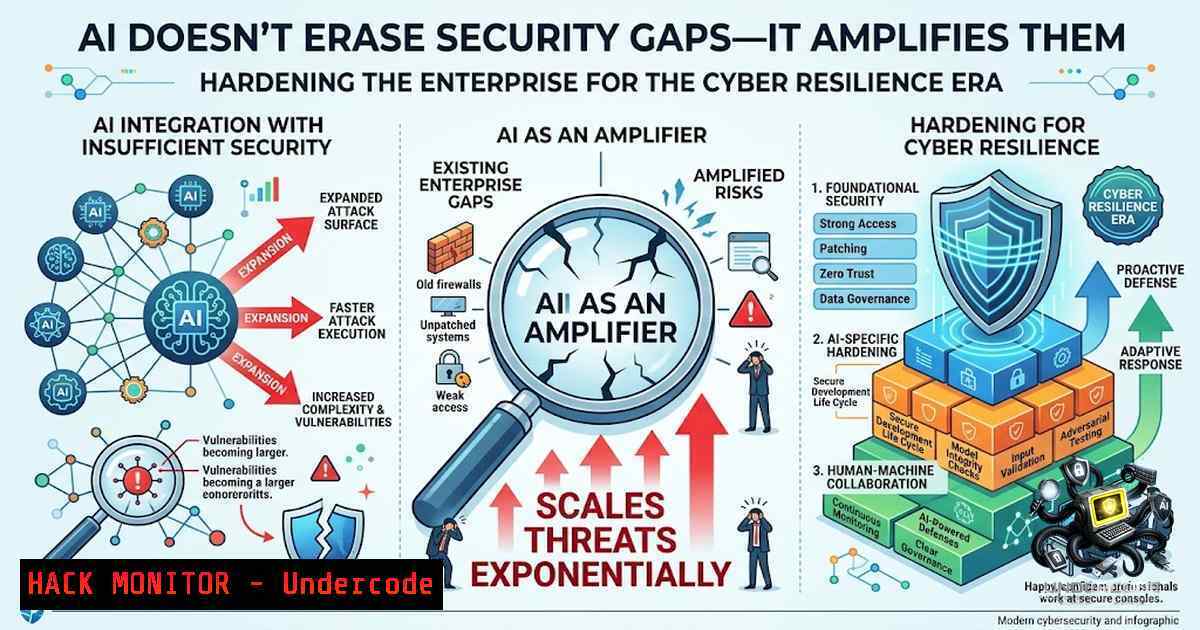
The rapid integration of artificial intelligence into enterprise operations has created a paradox: organizations are deploying AI at unprecedented scale while leaving the foundational security and governance frameworks that should protect these systems critically underdeveloped. As highlighted during the TAG Cybersecurity & Risk Management Society and TAG Data Science & AI Society’s “Cyber Resilience in the AI Era” event, AI does not erase existing security gaps—it amplifies them, turning minor vulnerabilities into catastrophic exposure points. With 83% of organizations already using AI in daily operations but only 13% possessing strong visibility into how these systems handle sensitive data, the cybersecurity community faces an urgent mandate to embed resilience into every stage of AI adoption.
Learning Objectives:
- Understand how AI amplifies existing governance and security gaps within enterprise environments
- Master practical command-line techniques for hardening AI infrastructure across Linux and Windows platforms
- Implement AI-specific supply chain security measures to prevent data poisoning, model tampering, and adversarial attacks
- Apply NIST Cybersecurity Framework AI Profile and AI TRiSM principles to build resilient AI systems
- Develop audience-specific cyber risk communication strategies that translate technical threats into business impact
You Should Know:
- The Governance Gap: Why AI Adoption Outpaces Security Maturity
The disconnect between AI innovation and security governance is stark. According to IBM’s AI at the Core 2025 research, nearly 74% of surveyed organizations report only moderate or limited coverage in their AI risk and governance frameworks for technology, third-party, and model risks. Only 7% of organizations have a dedicated AI governance team, and just 11% feel prepared to meet emerging regulatory requirements. This governance gap manifests in tangible risks: 97% of organizations experiencing AI-related security incidents lacked proper AI access controls, while 63% of breached organizations had no governance policies for managing AI or detecting unauthorized use.
The challenge extends to the AI supply chain. Data poisoning, training framework vulnerabilities, and model tampering represent significant threats that have been documented since early AI development. Malicious AI models appearing safe but containing dangerous code can steal data and install backdoors when downloaded by unsuspecting users. Organizations must treat AI systems as distinct identities—non-human users that read faster, access more, and operate continuously—requiring identity models designed for machine speed rather than human-centric access controls.
Step-by-Step Guide: Auditing Your AI Governance Posture
Step 1: Inventory AI Assets
 Linux: Discover AI-related services and containers
sudo docker ps -a --filter "name=ai" --filter "name=llm" --filter "name=model"
sudo systemctl list-units --type=service | grep -i "ai|ml|tensor|pytorch"

Windows PowerShell: Find AI workloads
Get-Service | Where-Object {$<em>.DisplayName -match "AI|ML|Tensor|Python|Jupyter"}
Get-Process | Where-Object {$</em>.ProcessName -match "python|jupyter|tensor"}
Step 2: Assess Access Controls
 Linux: Check model repository permissions
find /opt/ai-models -type f -exec ls -la {} \; | grep -v "^d"
 Identify world-writable model files (security risk)
find /opt/ai-models -type f -perm -o+w -ls

Windows: Review NTFS permissions on AI directories
icacls "C:\AI-Models" /T
 Check for excessive permissions
icacls "C:\AI-Models" /T | findstr "Everyone (OI)(CI)(F)"
Step 3: Validate Governance Documentation
 Check for existence of AI governance policies
 Linux
test -f /etc/security/ai-governance-policy.yaml && echo "Policy found" || echo "MISSING AI GOVERNANCE POLICY"

Verify model versioning and provenance
 Install sigstore/cosign for supply chain verification
cosign verify-blob --key cosign.pub ./model.bin
- Securing the AI Supply Chain: From Model Repositories to Production
AI supply chains are more intricate and opaque than traditional software supply chains, introducing unique vulnerabilities that demand specialized defenses. The opacity of large language models—where behavior is heavily influenced by weights in binary format that are difficult to analyze—poses a unique challenge for security leaders who can more easily inspect traditional software.
Organizations must adapt established security frameworks to the AI context. Google’s Secure AI Framework (SAIF) emphasizes that AI development parallels traditional software development, meaning existing security measures should readily adapt to AI. However, a new class of dependencies emerges: datasets used to train models, which require tamper-proof provenance to verify model producer identity and authenticity.
Step-by-Step Guide: AI Supply Chain Hardening
Step 1: Implement Model Provenance Verification
 Install SLSA verification tools
 Linux
pip install slsa-verifier
 Verify model provenance
slsa-verifier verify-artifact --provenance-path model.provenance --source-uri github.com/org/ai-model

Windows (using WSL or Python)
python -m slsa_verifier verify --artifact model.bin --provenance provenance.json
Step 2: Scan for Vulnerable Dependencies in AI Pipelines
 Linux: Scan Python AI dependencies for known vulnerabilities
pip-audit --requirement requirements.txt
safety check -r requirements.txt

Scan container images for AI frameworks
trivy image --severity HIGH,CRITICAL tensorflow/tensorflow:latest
grype docker.io/pytorch/pytorch:latest

Windows: Using pip-audit in PowerShell
pip-audit --requirement requirements.txt --format json
Step 3: Implement Model Integrity Monitoring
 Calculate and store model hash for integrity verification
 Linux
sha256sum /opt/ai-models/production-model.bin > model-checksum.txt
 Schedule integrity check via cron
echo "0 /6    /usr/bin/sha256sum -c /opt/ai-models/model-checksum.txt" >> /etc/crontab

Windows PowerShell
Get-FileHash -Path "C:\AI-Models\production-model.bin" -Algorithm SHA256 | Out-File model-checksum.txt
 Schedule with Task Scheduler
$Action = New-ScheduledTaskAction -Execute "powershell.exe" -Argument "-Command Get-FileHash -Path C:\AI-Models\production-model.bin -Algorithm SHA256 -Expected (Get-Content model-checksum.txt)"
$Trigger = New-ScheduledTaskTrigger -Daily -At 6am
Register-ScheduledTask -TaskName "AI-Model-Integrity-Check" -Action $Action -Trigger $Trigger
- Hardening AI Infrastructure: Zero Trust for Machine Identities
AI agents and models operate as machine identities that require Zero Trust principles applied at every layer. With 76% of respondents identifying autonomous AI agents as the hardest systems to secure, and 57% lacking the ability to block risky AI actions in real time, organizations must implement robust identity and access management controls.
NIST’s recently released Cybersecurity Framework Profile for Artificial Intelligence (Cyber AI Profile) provides guidelines for managing cybersecurity risk related to AI systems across three core focus areas: Secure (addressing cybersecurity challenges within AI systems themselves), Defend (leveraging AI to enhance cyber defense), and Thwart (blocking AI-powered cyberattacks). This framework builds upon the AI Risk Management Framework’s four core functions—Govern, Map, Measure, Manage—to support trustworthy AI and risk-based decision-making.
Step-by-Step Guide: AI Infrastructure Hardening
Step 1: Restrict AI Model Endpoint Access
 Linux: Configure firewall rules for AI API endpoints
 Allow only specific IP ranges to access model inference endpoints
sudo iptables -A INPUT -p tcp --dport 5000 -s 10.0.0.0/8 -j ACCEPT
sudo iptables -A INPUT -p tcp --dport 5000 -s 192.168.0.0/16 -j ACCEPT
sudo iptables -A INPUT -p tcp --dport 5000 -j DROP

Implement rate limiting with nginx for AI endpoints
 In /etc/nginx/nginx.conf
limit_req_zone $binary_remote_addr zone=ai_api:10m rate=10r/s;
location /api/v1/predict {
limit_req zone=ai_api burst=20 nodelay;
proxy_pass http://ai_backend;
}
Step 2: Implement Agent Command Safety
 Install command safety layer for AI agents (Linux/WSL)
git clone https://github.com/agentify-sh/safeexec.git
cd safeexec
sudo make install

Configure safeexec to block destructive commands
echo "rm -rf" >> /etc/safeexec/blacklist.conf
echo "dd if=" >> /etc/safeexec/blacklist.conf
echo "chmod 777" >> /etc/safeexec/blacklist.conf

Test safety layer
safeexec --check "rm -rf /"  Should block with warning
Step 3: Enforce Least-Privilege for AI Service Accounts
 Linux: Create dedicated AI service account with minimal permissions
sudo useradd -r -s /bin/false -m -d /opt/ai-service ai_runner
sudo chown -R ai_runner:ai_runner /opt/ai-models
sudo chmod 750 /opt/ai-models

Restrict sudo capabilities
echo "ai_runner ALL=(ALL) NOPASSWD: /usr/bin/systemctl restart ai-service" >> /etc/sudoers.d/ai-runner

Windows: Create managed service account for AI
New-ADServiceAccount -1ame "AIServiceAccount" -DNSHostName "ai.domain.local"
 Assign minimum required permissions
Grant-ADServiceAccount -Identity "AIServiceAccount" -PrincipalsAllowedToRetrieveManagedPassword "AI-Servers"
4. AI-Specific Threat Detection and Response
AI-enabled cyberattacks are faster, more adaptive, and increasingly difficult to detect. Organizations must deploy AI-specific monitoring that goes beyond traditional security information and event management (SIEM) to detect prompt injection, model inversion, and adversarial attacks.
Step-by-Step Guide: AI Threat Monitoring
Step 1: Deploy AI-Specific Logging
 Linux: Configure detailed logging for AI model interactions
 Enable auditd for AI model access
auditctl -w /opt/ai-models -p wa -k ai_model_access
auditctl -w /var/log/ai-inference.log -p wa -k ai_inference

Monitor for anomalous prompt patterns
tail -f /var/log/ai-inference.log | grep -E "DROP TABLE|exec(|system(|os."
Step 2: Implement Real-Time Anomaly Detection
 Python script for monitoring inference request patterns
import time
from collections import deque

request_timestamps = deque(maxlen=100)
def monitor_request_rate():
now = time.time()
request_timestamps.append(now)
if len(request_timestamps) >= 90:  Threshold for anomaly
rate = 60 / (now - request_timestamps[bash])  len(request_timestamps)
if rate > 50:  50 requests per minute threshold
alert("Potential DoS attack on AI endpoint")
Step 3: Block Adversarial Inputs
 Linux: Use ModSecurity with OWASP rules for AI APIs
 Install ModSecurity for nginx
sudo apt-get install libmodsecurity3 nginx-modsecurity

Enable AI-specific rules in /etc/nginx/modsecurity.conf
SecRule ARGS "@rx (\bDROP\b|\bDELETE\b|\bUNION\b|\bEXEC\b|\bSYSTEM\b)" \
"id:1001,phase:2,deny,status:403,msg:'SQL Injection in AI Prompt'"

Windows: Implement WAF rules in IIS
 Using URL Rewrite module with outbound rules for AI endpoints
5. Translating Cyber Risk to Business Impact
One of the key takeaways from the TAG event was the importance of tailoring cyber conversations to the audience. A CFO wants financial impact and risk in dollars; a manufacturing leader wants to know about production loss, downtime, and operational disruption. Business outcomes drive business decisions.
Step-by-Step Guide: Cyber Risk Quantification
Step 1: Calculate Financial Exposure of AI Breach
 Estimate potential breach cost based on IBM Cost of Data Breach Report 2025
 Average breach cost: $4.88M globally
 AI-specific breach cost multiplier: 1.3x due to complexity

Python calculation
avg_breach_cost = 4880000
ai_multiplier = 1.3
estimated_cost = avg_breach_cost  ai_multiplier
print(f"Estimated AI breach cost: ${estimated_cost:,.2f}")
Step 2: Map AI Risks to Business Metrics
 Create risk register with business impact scoring
 Format: [Risk ID] | [bash] | [bash] | [Impact ($)] | [Mitigation Cost]

cat << EOF > ai-risk-register.csv
R001,Data Poisoning,Medium,\$2,500,000,\$350,000
R002,Model Theft,High,\$5,000,000,\$800,000
R003,Prompt Injection,High,\$1,200,000,\$200,000
R004,Training Data Exposure,Critical,\$8,000,000,\$1,200,000
EOF
What Undercode Say:
- Key Takeaway 1: AI does not erase foundational security and governance gaps—it amplifies them. Organizations rushing to deploy AI without proper governance frameworks are creating new vulnerabilities even as they attempt to defend against existing ones. With only 23.8% of organizations having comprehensive AI risk frameworks, the majority remain exposed to unmanaged AI risks.
-
Key Takeaway 2: Cyber resilience in the AI era requires embedding security into every stage of AI development, not treating it as an afterthought. Organizations that adopt secure-by-design principles and implement frameworks like NIST’s Cyber AI Profile or AI TRiSM achieve significantly stronger security postures and faster, safer innovation.
The convergence of AI and cybersecurity demands a fundamental shift in how organizations approach risk management. AI is no longer just another tool—it operates as a new identity inside the enterprise, one that never sleeps and often ignores boundaries. The 2025 State of AI Data Security Report makes this clear: “You cannot secure an AI agent you do not identify, and you cannot govern what you cannot see”.
Organizations must move beyond treating AI security as a compliance checkbox and instead embrace it as a strategic imperative. This means implementing continuous discovery of AI use, real-time monitoring of prompts and outputs, and identity policies that treat AI as a distinct actor with narrowly scoped access driven by data sensitivity. The path forward requires cross-functional collaboration between cybersecurity, data science, and business leadership to balance innovation with resilience. Those who fail to close the governance gap risk becoming the next headline in IBM’s breach report, where 63% of organizations that suffered breaches had no formal AI governance framework.
Prediction:
- -1: The governance gap between AI adoption and security maturity will widen further in 2026, with organizations continuing to prioritize innovation velocity over security controls. IBM’s finding that only 23.8% of organizations have comprehensive AI risk coverage suggests that the majority will experience AI-related security incidents within the next 12-18 months.
-
+1: NIST’s Cybersecurity Framework Profile for Artificial Intelligence, released in draft form in December 2025, will become the de facto standard for AI security governance, enabling organizations to align AI risks with existing risk management processes rather than reinventing security programs from scratch.
-
-1: The complexity of AI supply chains will lead to a major supply chain attack targeting popular model repositories like Hugging Face, exploiting the opacity of LLM weights and the immaturity of dataset provenance systems. Organizations without robust model verification will be disproportionately affected.
-
+1: AI TRiSM adoption will accelerate, with Gartner projecting 50% higher AI adoption and acceptance among organizations that implement trust, risk, and security management frameworks. This will create a competitive advantage for security-mature organizations.
-
+1: The cybersecurity industry will develop standardized AI agent identity and access management solutions, treating AI agents as distinct machine identities with lifecycle governance, reducing the 76% of organizations currently struggling to secure autonomous AI agents.
▶️ Related Video (78% Match):
https://www.youtube.com/watch?v=3bR_FyLuiU0
🎯Let’s Practice For Free:
🎓 Live Courses & Certifications:
Join Undercode Academy for Verified Certifications
🚀 Request a Custom Project:
Secure, high-velocity infrastructure and disruptive technological engineering. Contact our engineering team for high-tier development and proprietary systems:
[email protected]
💎 Smart Architecture | 🛡️ Secure by Design | ⭐ Trusted by Thousands
IT/Security Reporter URL:
Reported By: Drbeverlywright Thebeverlyorbit – Hackers Feeds
Extra Hub: Undercode MoN
Basic Verification: Pass ✅


