Listen to this Post
Introduction
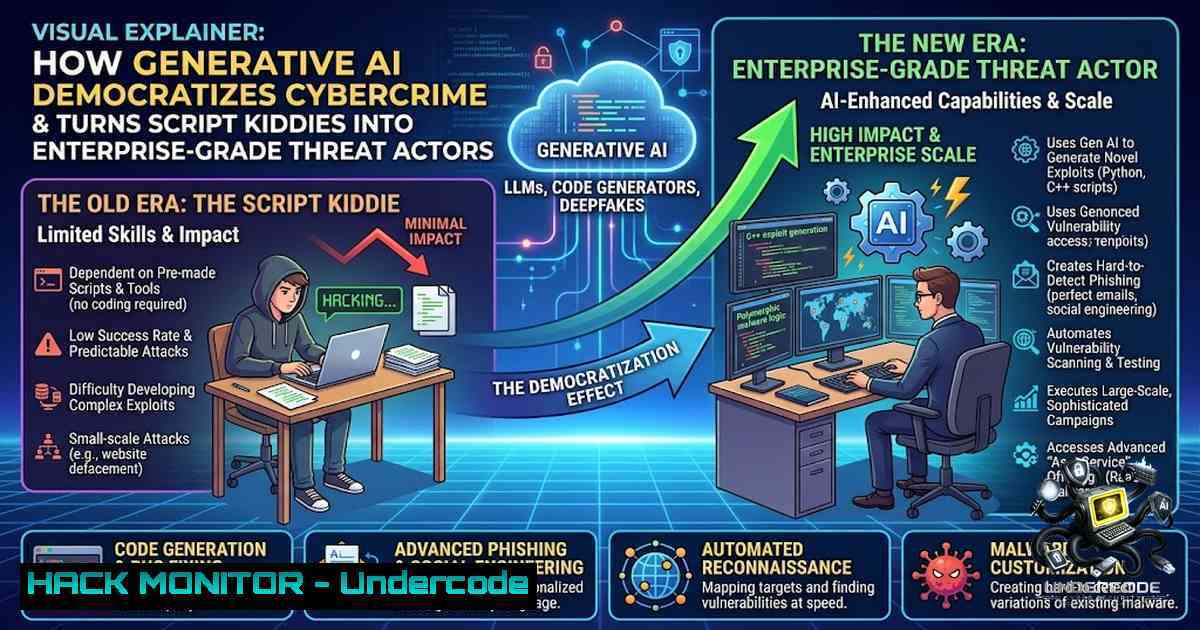
The democratization of artificial intelligence has fundamentally altered the cybercrime landscape, eliminating the technical barriers that once separated amateur scammers from sophisticated cybercriminal syndicates. According to INTERPOL’s African Cyberthreat Assessment Report 2026, artificial intelligence is now enabling 55% of reported cybercrimes across Africa, with financial losses more than doubling from USD 192 million in 2024 to USD 484 million in 2025. What makes this shift particularly alarming is not that sophisticated criminals are becoming more dangerous—it is that AI now empowers the most basic operator to execute surprisingly sophisticated attacks, effectively “leveling the playing field” between the technically illiterate scammer and the seasoned cybercriminal.
Learning Objectives
- Understand how generative AI lowers the technical barrier to entry for cybercrime and enables non-technical actors to execute sophisticated attacks
- Identify AI-powered social engineering techniques including deepfake voice synthesis, AI-generated phishing, and synthetic identity creation
- Learn practical defense strategies and command-line tools for detecting and mitigating AI-enabled threats across Linux and Windows environments
- Master verification protocols and incident response procedures specific to AI-generated impersonation attacks
You Should Know
- The AI-Powered Attack Chain: From Reconnaissance to Extortion
INTERPOL’s Neal Jetton, Director of the Cybercrime unit, warns that “AI is automating every stage of a cyberattack from reconnaissance and phishing to extortion and evasion”. This automation transforms what was once a multi-step process requiring diverse technical skills into a streamlined, AI-orchestrated operation.
Step-by-step guide to understanding the AI attack chain:
Step 1: Reconnaissance Automation – Attackers deploy AI-powered OSINT (Open Source Intelligence) tools to scrape social media, corporate websites, and public databases. Unlike manual reconnaissance that might take weeks, AI can profile a target organization’s executive team, communication patterns, and internal workflows in hours.
Step 2: Phishing Campaign Generation – Large Language Models (LLMs) generate hyper-personalized phishing emails that mimic executive tone, internal jargon, and signature styles with near-perfect fidelity. According to SoSafe’s 2025 survey, AI-generated phishing emails increased from 35% to 79% of all phishing attempts in just one year.
Step 3: Voice and Visual Synthesis – Deepfake voice cloning tools enable real-time impersonation in vishing campaigns, with attacks exceeding USD 25 million in a single incident. Attackers can now replicate a CEO’s voice or create synthetic video calls with minimal technical expertise.
Step 4: Synthetic Identity Creation – Criminals combine real personal data with fabricated elements to create AI-generated digital personas that bypass advanced biometric verification systems. These synthetic identities have been used to open bank accounts, secure mobile loans, and register SIM cards under false names.
Step 5: Evasion and Persistence – AI adapts attack patterns in real-time, automatically modifying tactics based on victim responses. 46% of targeted individuals in 2025 received follow-up emails, with 30% experiencing continual, deliberately sequenced multi-chain tactics.
- Business Email Compromise 3.0: AI-Powered Impersonation at Scale
Business Email Compromise (BEC) has evolved dramatically with AI integration. The INTERPOL report reveals that 70% of BEC detections originated in South Africa and 29% from Nigeria in 2025, with West Africa emerging as the most active region for BEC operations.
How AI enhances BEC attacks:
Command-Line Email Header Analysis (Linux/macOS):
 Extract and analyze email headers for BEC indicators
cat suspicious.eml | grep -E "Received:|From:|Return-Path:|Authentication-Results:"

Check SPF, DKIM, and DMARC records
dig TXT _spf.example.com
dig TXL _domainkey.example.com
dig TXT _dmarc.example.com

Analyze email routing path
grep "Received:" suspicious.eml | tail -5
Windows PowerShell Email Forensics:
 Parse email headers for BEC detection
Get-Content suspicious.eml | Select-String "Authentication-Results"
Get-Content suspicious.eml | Select-String "X-Originating-IP"

Extract and validate sender domain
$headers = Get-Content suspicious.eml
$headers -match "From:.@([^>]+)" | Out-1ull
$domain = $matches[bash]
Resolve-DnsName -1ame $domain -Type TXT
Practical BEC defense steps:
- Implement Multi-Factor Authentication (MFA) for all financial transaction approvals
- Establish verification protocols requiring out-of-band confirmation (phone call to known number) for any wire transfer requests
- Deploy AI-powered email filtering that analyzes linguistic patterns and detects anomalies in writing style
- Conduct regular BEC simulation exercises using AI-generated phishing templates to test employee awareness
- Monitor for email forwarding rules that may indicate compromised accounts: `Get-InboxRule -Mailbox [email protected] | Where-Object {$_.ForwardTo -1e $null}`
- Deepfake and Voice Cloning: When Seeing and Hearing Are No Longer Believing
The sophistication of AI-generated synthetic media has reached the point where traditional identity verification methods are no longer reliable. The Yahoo Boys, notorious West African scammers, have been documented using face-swapping and deepfakes to enhance their grifts, including posting fake CNN broadcasts with AI-generated newscasters to blackmail victims.
Detecting deepfake manipulation:
Linux command-line deepfake detection tools:
 Install deepfake detection libraries
pip install deepface facenet-pytorch

Analyze video for manipulation artifacts
python -c "
import cv2
import numpy as np
video = cv2.VideoCapture('suspicious_video.mp4')
 Check for inconsistent facial landmarks
 Analyze eye blink patterns (deepfakes often have irregular blinking)
 Detect color inconsistency between face and background
"

Use FFmpeg to extract frames for analysis
ffmpeg -i suspicious_video.mp4 -vf "fps=1" frames/frame_%04d.png

Use image forensic tools
apt-get install imagemagick
identify -verbose suspicious_frame.png | grep -E "Quality|Depth|Colors"
Windows PowerShell for media verification:
 Extract metadata from video files
Get-ChildItem -Path "C:\suspicious\" -Filter .mp4 | ForEach-Object {
$shell = New-Object -ComObject Shell.Application
$folder = $shell.Namespace($<em>.DirectoryName)
$file = $folder.ParseName($</em>.Name)
0..287 | ForEach-Object {
$prop = $folder.GetDetailsOf($file, $<em>)
if ($prop) { Write-Host "$($</em>) : $prop" }
}
}

Check for common deepfake artifacts using Python
python -c "
import cv2
import numpy as np
 Check for inconsistent reflections, unnatural eye movements
 Verify lip-sync accuracy by comparing audio and visual patterns
"
Key indicators of deepfake manipulation:
- Lip-sync mismatches between audio and video
- Unnatural eye movements or inconsistent blinking patterns
- Unusual speech cadence or robotic intonation
- Responses that don’t adapt to unexpected questions
- Inconsistent lighting or reflections on the face versus the background
- Synthetic Identity Fraud: The New Frontier of AI-Enabled Financial Crime
INTERPOL’s report highlights a disturbing trend: criminals have “moved beyond simply stealing existing credentials to creating entirely synthetic identities”. These AI-generated digital personas combine real personal data with fabricated elements, making them extraordinarily difficult to detect.
How synthetic identities are created and used:
- Data Harvesting: AI scrapes legitimate personal information from data breaches, social media, and public records
- Identity Generation: Machine learning models combine real and fabricated data to create plausible identities
- Verification Bypass: Synthetic identities are used to open bank accounts, secure mobile loans, and register SIM cards
- Money Laundering: Ill-gotten proceeds are routed through crypto exchanges, shell companies, and mobile payment platforms
Technical defense against synthetic identities:
Implementing identity verification checks:
 Check for identity inconsistencies using OSINT tools
theHarvester -d example.com -b all

Verify address and phone number consistency
 Cross-reference identity claims across multiple data sources
Windows Active Directory monitoring for synthetic identities:
 Monitor for unusual account creation patterns
Get-ADUser -Filter  -Properties Created | Where-Object {$_.Created -gt (Get-Date).AddDays(-30)}

Check for accounts with incomplete or suspicious attributes
Get-ADUser -Filter  -Properties  | Where-Object {
($_. -eq $null) -or
($<em>.Department -eq $null) -or
($</em>.Manager -eq $null)
}

Audit failed login attempts that may indicate synthetic identity testing
Get-EventLog -LogName Security -InstanceId 4625 | Select-Object -First 50
5. Defensive AI: Building Resilience Against Machine-Speed Attacks
While AI empowers attackers, it also provides defenders with powerful tools. The key is implementing a layered defense strategy that combines technical controls, process changes, and awareness training.
Implementing an AI defense framework:
Step 1: Deploy AI-Powered Email Filtering
 Configure SpamAssassin with AI-enhanced rules
vi /etc/spamassassin/local.cf
 Add custom rules for AI-generated content detection
 Enable Bayesian filtering
bayes_path /var/lib/spamassassin/bayes
use_bayes 1
bayes_auto_learn 1

Restart and test
systemctl restart spamassassin
spamassassin -D < test_email.eml
Step 2: Implement Zero-Trust Verification Protocols
- Require out-of-band verification for all sensitive transactions
- Implement multi-factor authentication with hardware tokens
- Establish “break-glass” procedures for emergency requests
Step 3: Deploy Continuous Monitoring
 Monitor for unusual network patterns
iftop -i eth0
nethogs

Windows: Monitor for unusual process execution
Get-Process | Sort-Object CPU -Descending | Select-Object -First 20
Step 4: Conduct Regular AI-Enhanced Security Training
- Run simulation exercises that include deepfake scenarios
- Train employees to recognize deepfake indicators
- Establish verification protocols for voice and video communications
Step 5: Implement Identity Verification Best Practices
- Use multiple verification factors for identity confirmation
- Implement real-time, inter-agency data sharing between banks, telecoms, and law enforcement
- Deploy AI-powered anomaly detection systems
- The Human Element: Why Awareness Training Is Your First Line of Defense
Despite the sophistication of AI-powered attacks, the human element remains the critical vulnerability. Kaspersky detected and blocked over 142 million phishing link clicks in Q2 2025 alone. The key to defense is combining security awareness training with strong identity verification processes and layered cybersecurity controls.
Security awareness protocols:
Verify through secondary channels: “Employees should be trained to verify unusual requests through secondary channels such as direct phone calls or internal communication platforms”
Regular drill execution: Conduct regular drills for executives and staff using real examples of deepfake calls and AI-generated messages
Media literacy training: Provide ongoing media literacy training to help all employees recognize synthetic media cues
Crisis simulation: Include deepfake scenarios in crisis simulation exercises to train incident response teams
What Undercode Say
- Key Takeaway 1: AI democratizes cybercrime – The most significant threat is not that sophisticated criminals will become more dangerous, but that AI enables the most basic operators to execute sophisticated attacks. This “leveling of the playing field” represents a fundamental shift in the cybercrime landscape.
-
Key Takeaway 2: Traditional verification is obsolete – With AI-generated deepfakes and synthetic identities, traditional verification methods are no longer sufficient. Organizations must adopt zero-trust principles and multi-factor verification protocols that go beyond “seeing is believing.”
Analysis: The INTERPOL data paints a stark picture: AI-enabled cybercrime in Africa has grown from USD 192 million to USD 484 million in a single year, with 55% of all reported cybercrimes now involving AI. This acceleration is driven by the same forces that drive legitimate AI adoption—increased accessibility, reduced costs, and improved capabilities. The Yahoo Boys’ adoption of AI tools demonstrates how quickly these technologies diffuse through criminal networks. What’s particularly concerning is the creation of “scamfluencers” like Format Boy who actively teach AI-powered scamming techniques, creating a self-reinforcing cycle of criminal innovation. The response must be equally adaptive: organizations need to deploy AI-powered defenses, implement verification protocols that don’t rely on visual or auditory trust, and invest in continuous security awareness training that evolves with the threat landscape.
Prediction
- +1 AI-powered defense systems will become as ubiquitous as traditional antivirus, with organizations deploying AI security tools that can detect and respond to AI-generated threats in real-time. This arms race will drive innovation in both attack and defense technologies.
-
-1 Synthetic identity fraud will become the primary vehicle for financial crime, with AI-generated personas capable of bypassing even advanced biometric verification systems. The financial sector will face unprecedented challenges in verifying customer identities.
-
-1 The proliferation of AI-powered scamming tools will lead to a surge in sextortion and blackmail cases, with AI-generated content making it increasingly difficult for victims to distinguish between real and fabricated threats.
-
+1 Regulatory frameworks will evolve rapidly, with 17 African countries already having enacted or amended cybercrime legislation in 2025. This regulatory momentum will drive international cooperation and information sharing.
-
-1 The criminal-industrial complex will continue to professionalize, with AI-powered cybercrime becoming an organized, borderless ecosystem generating hundreds of millions in illicit revenue annually. The economic damage will disproportionately affect developing nations with fragmented cybercrime legislation.
▶️ Related Video (82% Match):
https://www.youtube.com/watch?v=-D2f7wxjOCU
🎯Let’s Practice For Free:
🎓 Live Courses & Certifications:
Join Undercode Academy for Verified Certifications
🚀 Request a Custom Project:
Secure, high-velocity infrastructure and disruptive technological engineering. Contact our engineering team for high-tier development and proprietary systems:
[email protected]
💎 Smart Architecture | 🛡️ Secure by Design | ⭐ Trusted by Thousands
IT/Security Reporter URL:
Reported By: Oludamilare Adesola – Hackers Feeds
Extra Hub: Undercode MoN
Basic Verification: Pass ✅


