Listen to this Post
Introduction
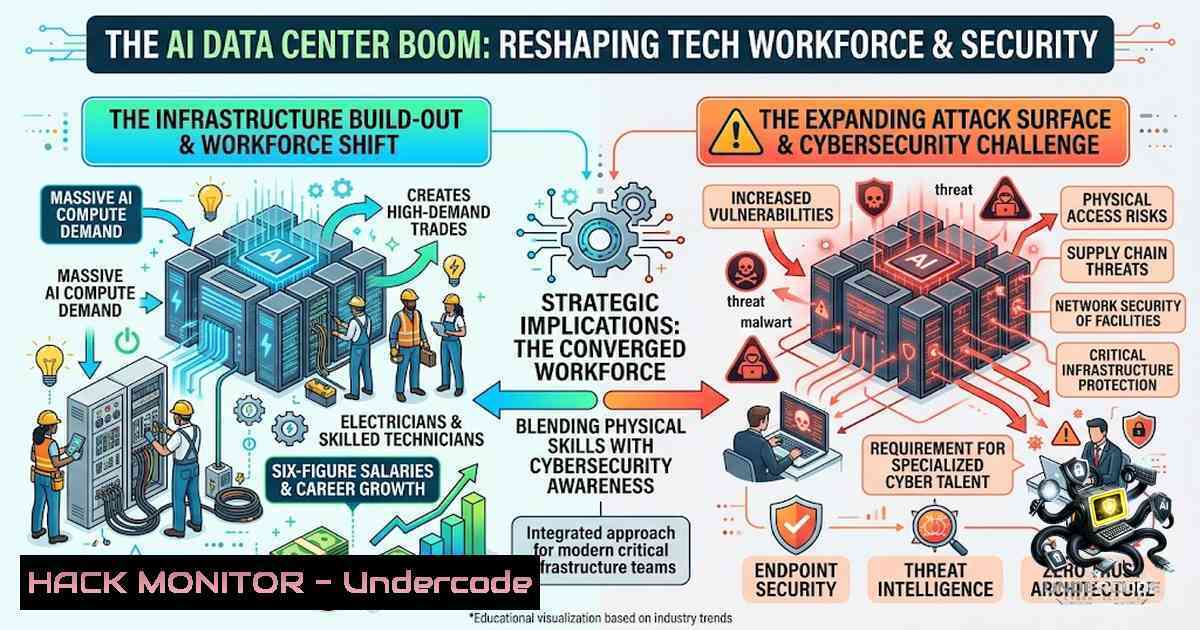
The artificial intelligence revolution is not only reshaping software engineering but also fundamentally altering labor markets across technical trades. As OpenAI, Google, Meta, and Microsoft pour trillions into AI infrastructure, the demand for electricians, plumbers, and construction workers has skyrocketed — with some technicians now earning up to $200,000 annually. However, this massive build-out of data centers introduces critical cybersecurity implications: every new facility expands the attack surface, requires hardened OT (Operational Technology) environments, and demands a workforce trained not just in electrical systems but in securing the very infrastructure that powers AI models. This article explores the technical and security dimensions of the data center boom, providing actionable guidance for IT professionals, security engineers, and infrastructure architects navigating this rapidly evolving landscape.
Learning Objectives
- Understand the convergence of AI infrastructure expansion, skilled labor shortages, and the resulting cybersecurity challenges
- Master configuration and security hardening techniques for data center power, cooling, and network infrastructure
- Implement monitoring and threat detection strategies for OT/IT environments using open-source tools
- Apply cloud hardening and API security best practices relevant to AI service deployments
- Develop incident response procedures tailored to data center physical and logical security incidents
You Should Know
- Data Center Infrastructure Security — Hardening Power, Cooling, and Building Management Systems
Modern AI data centers house tens of thousands of servers requiring complex power distribution, cooling systems, and physical infrastructure. These Building Management Systems (BMS) and Operational Technology (OT) networks are increasingly IP-connected, creating vulnerabilities that adversaries can exploit to cause physical damage or disrupt AI training workloads.
Step‑by‑step guide to securing OT/BMS networks:
- Network segmentation: Isolate OT networks from corporate IT and public internet using VLANs and firewalls. Configure access control lists (ACLs) to restrict traffic to only authorized management stations.
Linux (iptables example):
 Block all traffic to OT subnet except from management jump host
iptables -A FORWARD -d 10.0.100.0/24 -j DROP
iptables -A FORWARD -s 192.168.1.50 -d 10.0.100.0/24 -j ACCEPT
Windows (PowerShell – New-1etFirewallRule):
New-1etFirewallRule -DisplayName "Block OT Subnet" -Direction Outbound -RemoteAddress 10.0.100.0/24 -Action Block
New-1etFirewallRule -DisplayName "Allow Management to OT" -Direction Outbound -RemoteAddress 10.0.100.0/24 -RemotePort 22,443 -Action Allow
- Disable unused protocols: Industrial protocols like Modbus, BACnet, and SNMP often have weak security. Disable them where not required; where necessary, run them over encrypted tunnels (VPN or SSH tunnels).
-
Implement centralized logging: Forward all BMS, UPS, and HVAC logs to a SIEM.
Linux (rsyslog forwarding):
echo ". @192.168.1.100:514" >> /etc/rsyslog.conf
systemctl restart rsyslog
- Conduct regular firmware updates: Many OT devices ship with default credentials and known vulnerabilities. Maintain an inventory and patch schedule.
-
Deploy physical access controls: Integrate badge readers with logging and alerting. Use CCTV with motion detection and retention policies aligned with compliance requirements.
2. Network Infrastructure Hardening for AI Workloads
AI training generates immense east-west traffic (up to 400 Gbps per node). This traffic must be secured without introducing latency bottlenecks. Techniques include in-line encryption at the NIC level, micro-segmentation using overlay networks, and zero-trust authentication between GPU nodes.
Step‑by‑step guide to securing high-performance AI networks:
- Enable MACsec (IEEE 802.1AE) on data center switches to encrypt traffic at Layer 2 with minimal performance impact.
-
Deploy service meshes (e.g., Istio or Linkerd) for microservices that orchestrate training jobs, enabling mutual TLS (mTLS) and fine-grained authorization.
-
Implement network policies in Kubernetes clusters running AI workloads:
apiVersion: networking.k8s.io/v1
kind: NetworkPolicy
metadata:
name: deny-all-except-training
spec:
podSelector: {}
policyTypes:
- Ingress
- Egress
ingress:
- from:
- podSelector:
matchLabels:
role: trainer
egress:
- to:
- podSelector:
matchLabels:
role: storage
- Monitor for anomalous traffic patterns using tools like Zeek or ntopng. AI workloads have predictable traffic signatures; deviations may indicate data exfiltration or crypto-jacking.
Zeek traffic analysis:
zeek -r capture.pcap
cat conn.log | awk '{print $5}' | sort | uniq -c | sort -1r
- Rate-limit API endpoints serving model inferences to prevent DoS and resource exhaustion.
3. Cloud Hardening for AI Deployments
Major cloud providers now offer AI-specific services (AWS SageMaker, Azure AI, GCP Vertex AI). Misconfigurations in these services have led to data breaches exposing training datasets and model weights.
Step‑by‑step guide to hardening AI cloud deployments:
- Enable bucket-level encryption for all training data stored in cloud storage (S3, Blob, GCS). Use customer-managed keys (CMK) with rotation policies.
AWS CLI:
aws s3api put-bucket-encryption --bucket my-ai-data \
--server-side-encryption-configuration '{"Rules":[{"ApplyServerSideEncryptionByDefault":{"SSEAlgorithm":"AES256"}}]}'
- Restrict IAM roles to least privilege. Never use root credentials for automated jobs.
-
Enable VPC Service Controls (GCP) or PrivateLink (AWS) to prevent data exfiltration to public endpoints.
-
Implement data loss prevention (DLP) scanning for sensitive content in training datasets.
-
Configure audit logging for all API calls to AI services and retain logs for at least 90 days.
4. API Security for AI Model Endpoints
Exposed model APIs are prime targets for prompt injection, adversarial inputs, and denial-of-service attacks. Securing these requires a defense-in-depth approach.
Step‑by‑step guide to API security:
- Authenticate and authorize every request using OAuth 2.0 or API keys with scoped permissions.
-
Implement rate limiting to prevent brute-force and DoS:
 Using NGINX rate limiting
limit_req_zone $binary_remote_addr zone=mylimit:10m rate=10r/s;
location /api/ {
limit_req zone=mylimit burst=20 nodelay;
proxy_pass http://ai_backend;
}
- Validate and sanitize inputs to prevent injection attacks. Use allowlists for expected input formats.
-
Deploy a Web Application Firewall (WAF) with rules specific to AI threats (e.g., ModSecurity with OWASP Core Rule Set).
-
Monitor API response sizes — sudden increases may indicate model extraction attempts.
-
Vulnerability Exploitation and Mitigation in Data Center Environments
The rush to build data centers often means security is an afterthought. Common vulnerabilities include default credentials on PDUs (Power Distribution Units), unpatched BMC (Baseboard Management Controller) firmware, and exposed serial consoles.
Step‑by‑step guide to identifying and mitigating data center vulnerabilities:
1. Scan for exposed management interfaces using Nmap:
nmap -p 80,443,161,623,664,22,23 10.0.0.0/24 -oG data_center_scan.txt
- Check for default credentials on common devices (e.g., APC UPS: apc/apc, Dell iDRAC: root/calvin).
-
Remediate by changing all default passwords and enforcing password complexity policies.
-
Disable unnecessary services like Telnet, SNMP v1/v2c, and HTTP (enforce HTTPS).
-
Implement a vulnerability management program with weekly scans using OpenVAS or Nessus.
OpenVAS scan example:
gvm-cli --gmp-username admin --gmp-password pass socket --socketpath /var/run/gvmd.sock \
--xml "<create_task><name>Data Center Scan</name><config id='daba56c8-73ec-11df-a475-002264764cea'/> \
<target id='TARGET_ID'/></create_task>"
- Training and Workforce Development — Cybersecurity Skills for the AI Era
Major tech companies are investing heavily in training programs: Google committed $50 million with the International Electrical Workers Union to train 30,000 electricians annually, Meta invested $115 million in construction worker training, and Microsoft maintains a technical training network. However, these programs largely overlook cybersecurity. Security professionals must bridge this gap.
Step‑by‑step guide to building a security-aware workforce:
- Integrate security modules into existing trade training programs — cover physical security, access control, and incident reporting.
-
Develop role-based security training for electricians (safe handling of networked equipment), network engineers (segmenting OT), and cloud architects (IAM and encryption).
-
Conduct tabletop exercises simulating data center breaches (e.g., HVAC compromise leading to overheating, or credential theft from a BMC).
-
Establish a security champions program — designate and train point persons on each construction site.
-
Leverage free resources: NIST SP 800-82 (Guide to Industrial Control Systems Security), CIS Controls, and OWASP AI Security and Privacy Guide.
-
Monitoring and Incident Response for AI Data Centers
Detecting and responding to incidents in hybrid IT/OT environments requires specialized playbooks.
Step‑by‑step guide to building an IR capability:
- Deploy SIEM (e.g., Wazuh, Elastic Stack) to correlate logs from IT, OT, and physical access systems.
2. Create specific alerts for:
- Unauthorized access to PDU or BMS interfaces
- Sudden temperature or power fluctuations (potential sabotage)
- Large data transfers from training clusters (exfiltration)
3. Develop runbooks for common scenarios:
- Ransomware on compute nodes
- Physical intrusion into server halls
- API abuse leading to model theft
- Conduct bi-annual drills with full cross-functional teams (security, facilities, network, legal).
-
Maintain offline backups of critical configurations and model checkpoints.
What Undercode Say
-
The labor shortage is a security risk in disguise. Rushing to hire untrained workers to meet data center construction deadlines increases the likelihood of misconfigurations, unsafe practices, and insider threats. Comprehensive security training must be part of the onboarding process, not an afterthought.
-
AI infrastructure is the new critical infrastructure. As AI models become integral to healthcare, finance, and defense, the data centers housing them become prime targets for nation-state actors and cybercriminals. The security community must treat these facilities with the same rigor as nuclear plants or financial exchanges — and that means investing in both physical and cyber defenses.
-
The boom will eventually stabilize — but the attack surface remains. The article raises a crucial question: what happens when the construction wave ends? The facilities will remain operational for decades, requiring ongoing security maintenance. Organizations must plan for the long-term security lifecycle, not just the build phase. This includes continuous monitoring, regular penetration testing, and evolving threat models as AI capabilities advance.
-
Upskilling is a two-way street. Just as electricians are learning to work with networked equipment, cybersecurity professionals must understand power distribution, cooling dynamics, and physical constraints. Cross-training between IT security and facilities teams is essential for holistic protection.
-
Regulatory attention is coming. As data center proliferation raises concerns about energy consumption, land use, and national security, expect increased regulatory scrutiny. Proactive compliance with frameworks like NIST CSF, ISO 27001, and emerging AI-specific regulations will become a competitive differentiator.
Prediction
-
+1 The data center boom will accelerate innovation in green cooling technologies and energy-efficient hardware, reducing the environmental footprint of AI while creating new specialized roles in sustainable infrastructure security.
-
-1 The concentration of AI infrastructure in a few geographic regions (Northern Virginia, Dallas, Silicon Valley) will create single points of failure — both physical (natural disasters, grid instability) and cyber (targeted attacks on these hubs). Organizations will need to diversify geographically and architect for resilience.
-
+1 The demand for skilled technicians will drive the creation of new certification programs bridging electrical trades and cybersecurity, producing a generation of “cyber-electricians” who can secure OT environments from the ground up.
-
-1 The rapid pace of construction will outstrip the availability of security-trained personnel, leading to a “security debt” that will take years to remediate. Expect high-profile incidents originating from misconfigured or unpatched infrastructure components.
-
+1 Open-source security tools (Zeek, Wazuh, OpenVAS) will evolve to better support OT/IoT monitoring, lowering the barrier to entry for small and medium-sized data center operators and democratizing access to enterprise-grade security capabilities.
-
-1 The skills gap in cybersecurity will widen as AI companies poach talent from traditional security roles with higher salaries, mirroring the labor drain already seen in the electrical trades. This will leave critical sectors like healthcare and government underprotected.
-
+1 AI-driven security analytics will mature, enabling real-time anomaly detection across power, cooling, and network telemetry — turning the data center itself into a self-defending entity that can predict and mitigate threats before they cause disruption.
This article was generated based on reporting from Red Hot Cyber, The New York Times, and Bloomberg regarding the AI data center boom and its impact on technical labor markets.
▶️ Related Video (58% Match):
🎯Let’s Practice For Free:
🎓 Live Courses & Certifications:
Join Undercode Academy for Verified Certifications
🚀 Request a Custom Project:
Secure, high-velocity infrastructure and disruptive technological engineering. Contact our engineering team for high-tier development and proprietary systems:
[email protected]
💎 Smart Architecture | 🛡️ Secure by Design | ⭐ Trusted by Thousands
IT/Security Reporter URL:
Reported By: Redhotcyber Cybersecurity – Hackers Feeds
Extra Hub: Undercode MoN
Basic Verification: Pass ✅


