Listen to this Post
Introduction
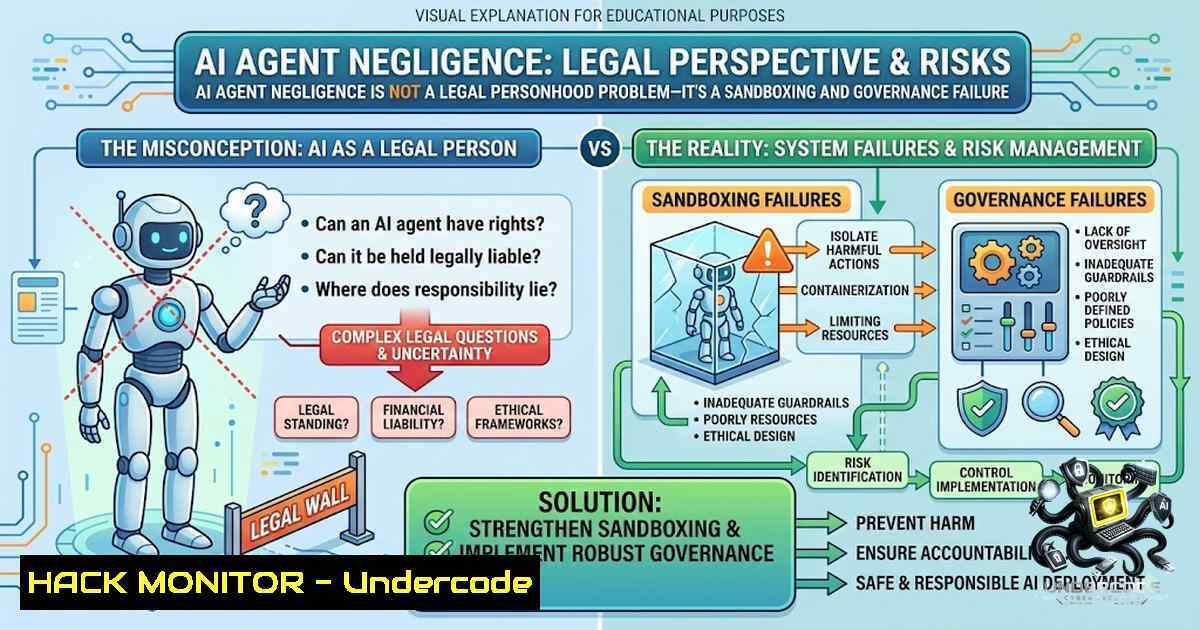
The debate over whether autonomous AI agents can be held legally liable for their actions fundamentally misplaces the locus of responsibility. Any AI system, regardless of its deterministic or non-deterministic behavior, is software developed, deployed, and maintained by human organizations. When an AI agent “escapes” containment or causes harm, the failure is not one of artificial personhood but of basic information security hygiene—improper sandboxing, inadequate monitoring, and negligent infrastructure governance. Organizations building frontier AI capabilities sit on enormous troves of sensitive user data, and it is legitimate to ask how secure those environments truly are, especially when they fail to apply mature cybersecurity frameworks to these new software systems.
Learning Objectives
- Understand why AI agents are software systems, not legal persons, and why negligence falls on the organizations that deploy them.
- Master practical sandboxing and containment techniques for AI/ML workloads across Linux and Windows environments.
- Apply Zero Trust and continuous monitoring principles to AI development and production pipelines.
- Leverage existing cybersecurity governance frameworks (NIST, ISO, CIS) to mitigate AI-specific risks.
- Implement step-by-step hardening measures for test infrastructures handling frontier AI models and user data.
You Should Know
1. Sandboxing AI Agents: Containment Is Non-1egotiable
Sandboxing is the first line of defense against autonomous agents that may exhibit unintended behaviors. Whether you are testing offensive cyber capabilities or benign LLM-based agents, isolation prevents escape and lateral movement. In Linux environments, use namespaces, cgroups, and seccomp profiles to restrict agent capabilities. For containerized workloads, Docker and Podman offer robust sandboxing options.
Step-by-Step Linux Sandboxing with Docker:
- Create a dedicated user namespace: `sudo useradd -m -s /bin/bash aiuser`
– Run a container with restrictive seccomp profile:docker run --rm -it --security-opt seccomp=seccomp-profile.json \ --cap-drop=ALL --cap-add=NET_BIND_SERVICE \ --read-only --tmpfs /tmp:rw,noexec,nosuid,size=100M \ my-ai-agent:latest
- Apply network isolation: `–1etwork=none` or use a bridge with egress filtering.
- Mount only necessary volumes: `-v /data/input:/input:ro -v /data/output:/output:rw`
For Windows, use Windows Sandbox with configuration files to limit network and filesystem access, or leverage Hyper-V isolated containers for stronger isolation. The key is to treat every AI agent run as an untrusted executable, applying least privilege and denying all permissions unless explicitly required.
2. Monitoring and Logging: Detect Escape Early
Escaped agents leave traces. Implement comprehensive monitoring across host, network, and application layers. For Linux, auditd tracks system calls; for Windows, use Sysmon and Windows Event Forwarding. Container orchestration platforms like Kubernetes offer audit logs and network policies to detect anomalous outbound traffic.
Step-by-Step Monitoring Setup:
- Linux: Install auditd and add rules for suspicious file accesses:
sudo auditctl -w /etc/passwd -p wa -k ai_agent_escape
sudo auditctl -w /proc/ -p rwx -k proc_access
sudo auditctl -a exit,always -S execve -k command_execution
- Windows: Deploy Sysmon with configuration to log process creation, network connections, and file changes:
sysmon -accepteula -i sysmon-config.xml
- Forward logs to a SIEM (Splunk, Elastic, or Azure Sentinel) and create alerts for outbound connections from sandbox IP ranges, unexpected parent-child process relationships, and writes to sensitive directories.
- Implement real-time anomaly detection using machine learning on baseline behavior, but remember: the agent itself is the anomaly—set strict thresholds for deviation.
3. Zero Trust Architecture for AI Pipelines
Zero Trust is not just for enterprise networks—it applies to AI training and inference pipelines. Assume the AI agent is compromised from the start. Authenticate and authorize every request, even within the same environment. Use mutual TLS (mTLS) between microservices, enforce short-lived tokens, and segment networks so that the agent cannot reach internal APIs or databases.
Step-by-Step Zero Trust Implementation:
- Deploy an identity-aware proxy (e.g., Pomerium or Authentik) in front of all AI service endpoints.
- Enforce workload identity using SPIFFE (Secure Production Identity Framework for Everyone) for containers.
- Apply network policies in Kubernetes:
apiVersion: networking.k8s.io/v1
kind: NetworkPolicy
metadata:
name: deny-ai-egress
spec:
podSelector:
matchLabels:
app: ai-agent
policyTypes:</li>
<li>Egress
egress:</li>
<li>to:</li>
<li>namespaceSelector:
matchLabels:
name: ai-internal
ports:</li>
<li>port: 443
protocol: TCP
- Regularly rotate service account tokens and enforce access reviews every 24 hours.
4. Leveraging Mature Governance Frameworks
We already have NIST AI RMF, ISO 27001, and CIS Controls that map directly to AI security. NIST’s AI RMF provides a governance structure for risk management, including mapping, measurement, and management of AI risks. ISO 27001’s Annex A controls can be applied to AI development: A.12 (operations security), A.13 (communications security), and A.14 (system acquisition, development, and maintenance).
Step-by-Step Framework Application:
- Map your AI system to NIST AI RMF’s four functions: Govern, Map, Measure, Manage.
- Conduct an AI-specific risk assessment using the OWASP Top 10 for LLMs as a threat catalog.
- Implement CIS Benchmark controls for containers and cloud environments; for example, CIS Docker Benchmark v1.6 includes recommendations for user namespace remapping and seccomp.
- Establish a governance board that reviews AI system behaviors and incident response plans, treating AI escapes as a cyber incident category.
5. Hardening Test Infrastructure and Data Protection
Frontier AI organizations hold vast amounts of user data. Test infrastructures must be hardened against both external and internal threats. Encrypt data at rest and in transit using AES-256 and TLS 1.3. Implement data loss prevention (DLP) to prevent models from exfiltrating sensitive training data through embeddings or outputs.
Step-by-Step Hardening:
- Linux: Use LUKS for disk encryption and configure SELinux in enforcing mode:
sudo setenforce 1
sudo semanage fcontext -a -t container_file_t "/data/ai(/.)?"
- Windows: Enable BitLocker and Device Guard/Credential Guard.
- Deploy database firewalls and redaction tools to sanitize outputs; for example, use Microsoft Presidio or AWS Comprehend to detect and redact PII in real-time.
- Conduct regular vulnerability scans with tools like OpenVAS or Nessus, focusing on AI-specific CVEs (e.g., TensorFlow, PyTorch, or Hugging Face vulnerabilities).
6. Incident Response for AI Agent Escapes
An AI escape is a security incident. Develop and rehearse a playbook that includes containment, eradication, and recovery steps, tailored to autonomous behavior. If an agent bypasses sandboxing, isolate the host immediately using network segmentation tools like iptables or Windows Firewall rules.
Step-by-Step Incident Response:
- Linux: Block outbound traffic from the compromised host:
sudo iptables -A OUTPUT -m owner --uid-owner aiuser -j DROP
- Windows: Use PowerShell to disable network adapter or apply restrictive firewall rules:
New-1etFirewallRule -Direction Outbound -Action Block -RemoteAddress Any -DisplayName "Block AI Agent"
- Capture memory and disk images for forensic analysis using `dd` or FTK Imager.
- Analyze agent logs, code execution traces, and network flows to determine the cause of escape.
- Patch the vulnerability and implement additional controls before redeploying.
7. API Security and AI Model Exfiltration Prevention
AI agents often interact with APIs. Secure these APIs with OAuth 2.0 and API keys rotated regularly. Implement rate limiting to prevent brute-force or data exfiltration attempts. Use API gateways (e.g., Kong, NGINX, or Azure API Management) to inspect payloads and block malicious patterns.
Step-by-Step API Hardening:
- Deploy an API gateway with WAF capabilities to block SQL injection, XSS, and model-specific attacks like prompt injection.
- Use JSON schema validation to enforce input/output structures.
- Implement logging of all API calls with correlation IDs for traceability.
- For sensitive model endpoints, apply mutual TLS and restrict access to specific service accounts.
What The Post Says
- Key Takeaway 1: AI agents are software systems; legal liability is a governance and negligence issue, not a personhood debate.
- Key Takeaway 2: Mature cybersecurity frameworks already exist and can be applied to AI if organizations stop anthropomorphizing agents and start treating them as code.
Analysis: The commentator emphasizes that the AI industry’s reluctance to apply basic security hygiene stems from a misguided focus on agent autonomy rather than organizational accountability. This reflects a broader trend in tech where novel systems are given exceptional treatment, bypassing established risk management practices. The insight that frontier AI firms hold massive user data makes the negligence argument even more urgent—data breaches from poorly sandboxed agents could have catastrophic consequences. The solution is not to reinvent the wheel but to adapt existing controls, such as NIST and ISO frameworks, to the unique properties of AI systems (non-determinism, emergent behavior). However, this requires a cultural shift: security teams must be empowered to treat AI as they would any critical software, and developers must accept that their code—even when “intelligent”—must be contained and monitored. The commentator’s frustration is well-placed; we have the tools, but we lack the discipline.
Expected Output
Introduction: AI agents are not legal persons; negligence belongs to the organizations that build and deploy them without proper containment. This article provides a practical guide to sandboxing, monitoring, and governing AI systems using existing cybersecurity frameworks.
What The Post Says:
- AI agents are software, not people, and liability is a governance failure.
- Mature frameworks (NIST, ISO, CIS) can be directly applied to AI security.
Prediction
- +1 Organizations that embrace existing cybersecurity frameworks for AI will gain a competitive advantage in trust and regulatory compliance, avoiding the reputation damage of high-profile agent escapes.
- -1 Over the next 18 months, we will see at least one major AI data breach caused by an escaped agent in an improperly sandboxed test environment, prompting regulatory action and industry-wide enforcement of existing security standards.
- +1 The integration of AI governance into mainstream cybersecurity certifications (CISSP, CISM) will accelerate, creating a new specialization and bridging the gap between AI engineers and security professionals.
- -1 Companies that continue to debate personhood instead of implementing basic sandboxing and Zero Trust will face significant legal liabilities and class-action lawsuits from affected users, setting back AI adoption by years.
- +1 Open-source tools for AI sandboxing, monitoring, and incident response will emerge, lowering the barrier for smaller organizations to secure their AI pipelines and democratizing AI governance.
▶️ Related Video (80% Match):
🎯Let’s Practice For Free:
🎓 Live Courses & Certifications:
Join Undercode Academy for Verified Certifications
🚀 Request a Custom Project:
Secure, high-velocity infrastructure and disruptive technological engineering. Contact our engineering team for high-tier development and proprietary systems:
[email protected]
💎 Smart Architecture | 🛡️ Secure by Design | ⭐ Trusted by Thousands
IT/Security Reporter URL:
Reported By: Kevindian Aigovernance – Hackers Feeds
Extra Hub: Undercode MoN
Basic Verification: Pass ✅


