Listen to this Post
Introduction:
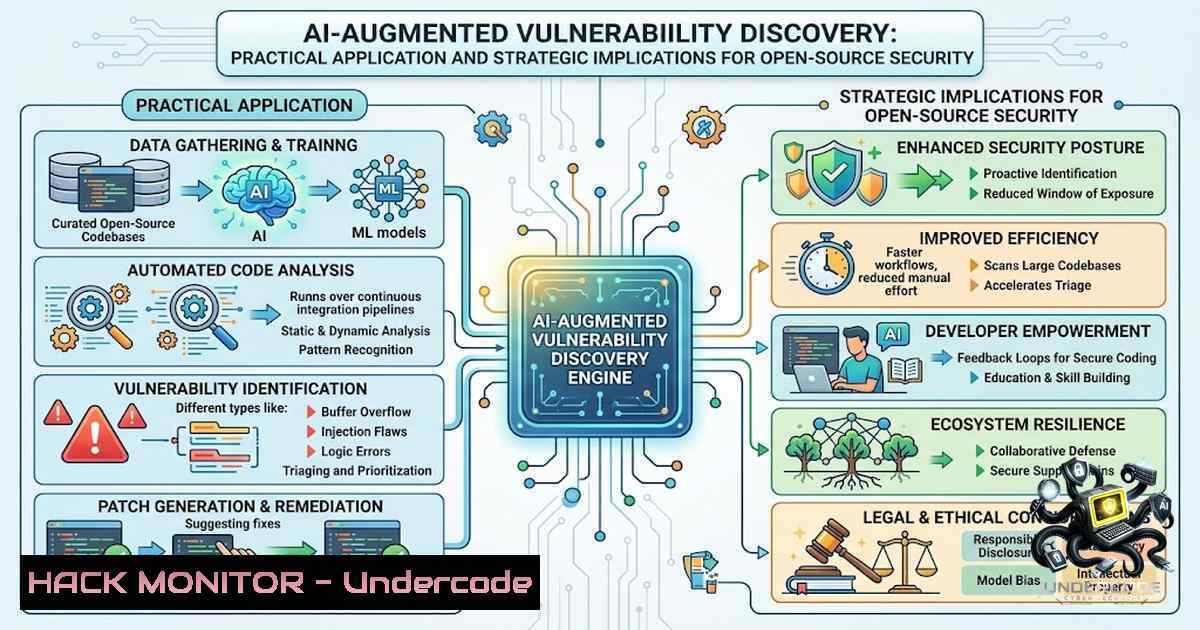
The integration of artificial intelligence into the cybersecurity workflow is no longer a theoretical concept but a practical reality for security engineers and researchers. Recent experiments leveraging AI code generation models to audit open-source applications for security flaws demonstrate a significant paradigm shift, where large language models (LLMs) capable of reasoning about code can identify complex vulnerabilities with a high degree of efficacy. This operational shift transforms vulnerability research from a purely manual, time-intensive process into a semi-automated effort that can scale, uncovering a range of issues from stored cross-site scripting (XSS) to privilege escalation and command injection. By systematically applying these tools, researchers not only build their professional portfolios but also make substantial, high-impact contributions to the security posture of widely used software.
Learning Objectives & Secrets:
- Objective 1: AI-Assisted Attack Surface Mapping. Learn to use AI tools like Codex not merely as code generators but as static analysis engines to map out an application’s attack surface. The secret is to provide the AI with context about potential vulnerability classes (e.g., OWASP Top 10) and request an audit of specific functions responsible for file uploads, authentication, and API endpoints.
-
Objective 2: Effective Prompt Engineering for Bug Hunting. The quality of vulnerabilities found directly correlates with the specificity of the prompts given to the AI. A key secret tip is to instruct the AI to “trace user-controllable data flow from input to sink” to effectively identify injection points. Another effective prompt is to ask for a “threat model” of a specific module, such as the user registration or password reset functionality, to uncover broken authorization logic.
-
Objective 3: From Identification to Remediation. Simply finding a bug is only half the battle. The secret to a robust portfolio contribution is to understand the root cause and, where possible, develop or suggest a patch. Leverage the AI to generate proof-of-concept (PoC) exploits to confirm the vulnerability and then use it to draft initial mitigation strategies, such as input validation functions or authorization checks, which can be refined for submission.
You Should Know:
- How to Automate SVG Upload XSS Discovery and Mitigation
File upload functionalities, particularly those allowing vector graphics, remain a critical entry point for stored cross-site scripting. An AI tool can quickly audit the server-side validation logic for file types, content, and processing. For instance, a vulnerability in XBackBone allowed for stored XSS via malicious SVG files. The AI can highlight areas where the server fails to sanitize XML payloads or strips dangerous tags like <script>.
Step‑by‑step guide to test and fix this:
- Linux Command to Create a Malicious SVG Payload: `echo ‘‘ > xss.svg`
– Windows Command to Create a Malicious SVG Payload: `echo ^ -
Mitigation Strategy (Server-Side Validation): Implement a whitelist approach for allowed SVG tags and attributes. Configure a library like `htmlsanitizer` in Python or `DOMPurify` in JavaScript to clean the SVG content upon upload. Additionally, ensure the `Content-Type` header and file extension are strictly validated and the file is stored in a domain separate from the main application to prevent same-origin policy exploitation.
2. Exploiting and Hardening Broken API Authentication
Modern applications often feature complex APIs that handle user authentication and data updates. A key vulnerability discovered involved broken authentication leading to Denial of Service and privilege escalation. This occurs when the API fails to properly validate session tokens or when authorization checks are skipped on particular endpoints. An AI can identify inconsistencies in how authentication is enforced across different API routes by comparing implementations.
Step‑by‑step guide to test and fix this:
- Linux Command for Testing API Authentication Bypass (cURL): `curl -X GET “https://target.com/api/v1/admin/users” -H “Authorization: Bearer invalid_token” -w “%{http_code}”`
– Windows Command for Testing API Authentication (PowerShell): `Invoke-WebRequest -Uri “https://target.com/api/v1/admin/users” -Headers @{“Authorization”=”Bearer invalid_token”}`
– If a request with an invalid or missing token returns a `200 OK` or `403 Forbidden` instead of a401 Unauthorized, it indicates a potential flaw. For privilege escalation, compare the response of an API call with a low-privilege token to the expected response for an admin-only function. -
Mitigation Strategy: Enforce strict, centralized authentication and authorization middleware that intercepts all API requests. For instance, in a Node.js/Express application, use middleware like `express-jwt` to verify JSON Web Tokens (JWT) on every authenticated route. For role-based access control, explicitly define roles in the JWT payload and check permissions at the endpoint level before processing the request. Regularly audit API routes to ensure no new endpoints are inadvertently left unprotected.
3. Mitigating Command Injection via Environment Variables
Command injection occurs when an application passes unsanitized user input to a system shell. In the Kroki vulnerability, this allowed attackers to execute arbitrary commands on the server. AI can detect dangerous patterns where functions like exec(), system(), or `popen()` are used with dynamic strings that incorporate external data.
Step‑by‑step guide to test and fix this:
- PoC Testing: If a parameter is used to construct a command, inject a command separator. For example, if a GET parameter `input=1` is used in
ping -c 4 {input}, modify it toinput=1; whoami. - Linux/Mac OS X Exploitation Test: `curl “http://target.com/process?input=1; whoami”`
– Windows Exploitation Test: `curl “http://target.com/process?input=1 & whoami”`
– Mitigation Strategy: The most effective mitigation is to avoid calling system shells entirely. Use native programming language libraries instead. If a shell call is absolutely necessary, implement strict input sanitization and use escaping functions specific to the shell. For example, in Python, use `shlex.quote()` to escape dangerous characters before passing tosubprocess.Popen. Prefer using `execve` instead of `system` and ensure a safe environment variable list is provided to the child process, eliminating the risk of `LD_PRELOAD` or `PATH` injection attacks.
4. Securing User Update APIs against Privilege Escalation
Broken object-level authorization is a frequent flaw in APIs that handle user profiles. A vulnerability in LaravelEcomm allowed a user to update their own profile and escalate privileges to that of a “super admin” by manipulating the request payload to include a `role` parameter. AI can identify that the server-side logic fails to filter sensitive fields from the user-provided data.
Step‑by‑step guide to test and fix this:
- Capture a legitimate user update request using a browser’s developer tools or a proxy like Burp Suite.
- Modify the request to include fields like
role=admin,is_admin=1, orpermissions:. - Send the request and then check if the user’s permissions have been elevated.
- Mitigation Strategy: Implement a strict “allowlist” approach for all user-updatable fields. The backend should define explicitly which attributes can be updated (e.g.,
first_name,last_name,email) and ignore all other fields passed in the request. Alternatively, map the incoming data to a dedicated Data Transfer Object (DTO) that does not contain sensitive fields. Use attribute-based authorization to verify that the authenticated user has the right to modify the specific resource being accessed.
5. Exploiting and Preventing Server-Side Request Forgery (SSRF)
SSRF is a vulnerability that allows an attacker to induce the server to make requests to arbitrary internal or external resources. AI can detect this by identifying code that uses user-supplied input to construct URLs for `curl` or `fetch` requests without proper validation. This vulnerability can lead to internal port scanning, reading internal metadata services, or even compromising internal networks.
Step‑by‑step guide to test and fix this:
- Initial Test: Supply the vulnerable parameter with a URL pointing to an external server you control (e.g., `http://your-server.com`). Check your server logs to see if a connection is established.
– Internal IP Testing: Attempt to access internal resources by providing `http://127.0.0.1:80`,http://169.254.169.254/latest/meta-data/` (for AWS), orhttp://192.168.1.1`. - Mitigation Strategy: The most secure solution is to implement a strict allowlist of allowed destinations. If a user must provide a URL, use a function like `urlparse` in Python to extract the hostname and validate it against an internal list of permitted domains or IP addresses. Implement a robust network-level denial list to block access to private IP address spaces (RFC 1918), localhost, and metadata services. Where possible, use an outbound proxy to restrict and log outgoing HTTP requests.
6. AI-Driven Remediation: Patching Vulnerabilities
After discovering a flaw like the stored XSS in NotrinosERP or broken authorization in SveltyCMS, the next step is to create a fix. AI is not just a vulnerability discovery tool but also a powerful assistant for writing the necessary code to fix the issue. This capability allows for rapid response and contribution to the project.
Step‑by‑step guide to patch an XSS vulnerability:
- Locate the vulnerable code. The AI can help trace the data flow to the exact line where the output is rendered.
- Generate a sanitization function. Prompt the AI: “Write a PHP function to sanitize user input to prevent stored XSS, allowing only basic HTML tags.” The AI will generate a function using `htmlspecialchars` or a library like
HTML Purifier. - Integrate the function. Manually or with AI assistance, apply this sanitization function to the vulnerable output points in the application’s codebase.
- Test the patch. Re-run the same exploit payloads to confirm the vulnerability is resolved and no functionality is broken. Submit the patch to the maintainers, as was done for the NotrinosERP project.
What Undercode Say:
- Key Takeaway 1: Leveraging AI for vulnerability research is a high-leverage strategy. Security engineers must embrace AI not as a replacement for human expertise, but as a force multiplier that drastically speeds up the reconnaissance and initial discovery phases.
- Key Takeaway 2: The move from discovering bugs to writing effective patches, as exemplified by the NotrinosERP contribution, distinguishes a skilled security engineer from a casual bug hunter. Demonstrating the ability to both identify and fix a vulnerability is a powerful portfolio builder and adds immense value to the open-source community.
Analysis: The convergence of AI and offensive security represents a paradigm shift. The ability to use Large Language Models to deeply analyze codebases reduces the barrier to entry for new researchers while simultaneously enabling experienced professionals to cover more ground. This democratization of security tooling is generally positive, as it leads to more open-source projects being audited and hardened. However, it also implies that attackers will equally leverage these tools to find vulnerabilities faster, increasing the pressure on developers to adopt AI in their own secure coding practices. The real-world impact is already tangible, with multiple CVEs and patches originating from these efforts, showcasing a practical, community-driven model for improving software security.
Prediction:
- -1 The accessibility of advanced AI tools for vulnerability discovery will inevitably lead to a short-term surge in the volume of reported vulnerabilities, potentially overwhelming open-source maintainers who lack the resources to triage and fix them quickly.
- +1 AI-augmented patching and debugging will mature, leading to semi-automated workflows where the AI not only finds the bug but also generates the patch and initiates the pull request, dramatically reducing the mean time to remediation.
- +1 Codex and similar tools will be increasingly integrated into CI/CD pipelines as pre-commit hooks that run security-specific “linters,” pushing security earlier in the development lifecycle and fostering a culture of “shift-left” security.
- -1 The cybersecurity community will likely see a rise in “AI-assisted” bug bounty farming, where the quality of submissions decreases as less-skilled researchers flood projects with low-impact or false positive findings, causing fatigue among maintainers.
- +1 The role of the human security engineer will evolve to focus on high-level strategic threat modeling, analyzing the AI’s findings for business logic flaws, and crafting complex, multi-step exploits that remain beyond the current reasoning capabilities of AI models.
▶️ Related Video (86% Match):
🎯Let’s Practice For Free:
🎓 Live Courses & Certifications:
Join Undercode Academy for Verified Certifications
🚀 Request a Custom Project:
Secure, high-velocity infrastructure and disruptive technological engineering. Contact our engineering team for high-tier development and proprietary systems:
[email protected]
💎 Smart Architecture | 🛡️ Secure by Design | ⭐ Trusted by Thousands
IT/Security Reporter URL:
Reported By: https://lnkd.in/p/eJQ5ynkG – Hackers Feeds
Extra Hub: Undercode MoN
Basic Verification: Pass ✅


