
Listen to this Post
Introduction
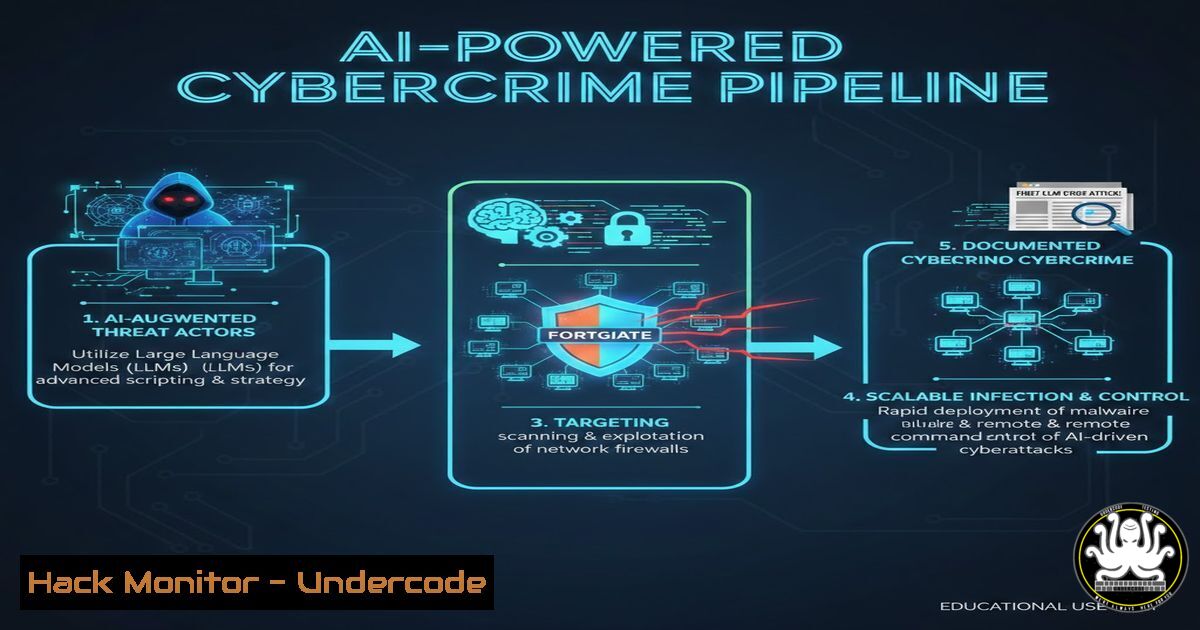
In a groundbreaking revelation published by Amazon Threat Intelligence on February 20, security researchers have documented the first large-scale cyberattack campaign where commercial Large Language Models (LLMs) were woven into every phase of the kill chain. A Russian-speaking threat actor with only “low-to-medium baseline technical capability” successfully leveraged AI services—specifically DeepSeek and —to orchestrate attacks against FortiGate devices across continental infrastructure. This marks a paradigm shift where AI democratizes sophisticated cyber operations, enabling previously unskilled attackers to execute complex campaigns that traditionally required years of specialized expertise.
Learning Objectives
- Understand how AI services are being integrated into the complete cyber kill chain from reconnaissance to reporting
- Analyze the technical architecture of the ARXON MCP server and its role in orchestrating AI-powered attacks
- Master detection and mitigation techniques for AI-augmented attacks against FortiGate and similar network infrastructure
You Should Know
1. The AI-Augmented Kill Chain Architecture
The threat actor, identified by Amazon Threat Intelligence, constructed an attack pipeline that integrated at least two commercial LLM services into every operational phase. This represents a fundamental evolution in cybercrime methodology.
Reconnaissance Phase: The attacker used DeepSeek and to analyze publicly exposed FortiGate interfaces, parsing SSL certificates, version banners, and configuration leaks to identify vulnerable targets. The AI models processed thousands of Shodan and Censys results, generating prioritized target lists based on exploitability scoring.
Attack Planning: The LLMs were prompted to generate attack trees specific to FortiGate vulnerabilities, including CVE-2018-13379 (path traversal), CVE-2020-12812 (SSL VPN authentication bypass), and CVE-2022-40684 (authentication bypass). The AI cross-referenced exploit databases and generated custom exploitation strategies.
Tool Development: Using the ARXON MCP (Master Control Program) server—a custom Python-based orchestration layer—the attacker automated the generation of polymorphic exploit code. The system would request the LLMs to rewrite existing exploits with different evasion techniques, creating unique payloads for each target to bypass signature-based detection.
Linux Commands for Detection:
 Check FortiGate logs for suspicious AI-augmented scanning patterns
diagnose log filter category 0
diagnose log filter severity warning
diagnose log display | grep -E "scan|probe|bruteforce"

Monitor for unusual API calls to LLM services from internal networks
tcpdump -i any -n host api.deepseek.com or host api.anthropic.com

Analyze process lists for Python-based MCP servers
ps aux | grep -E "python.mcp|arxon|llm-orch"
Windows Commands (if FortiGate management from Windows):
 Check for ARXON related processes
Get-Process | Where-Object {$<em>.ProcessName -like "python" -and $</em>.CommandLine -like "mcp"}

Monitor outbound connections to LLM APIs
netstat -ano | findstr :443 | findstr "deepseek anthropic"
2. ARXON MCP Server Deep Dive
The ARXON server represents a new class of threat orchestration tools. Built on Python with asyncio for concurrent operations, it functions as a middleware layer between the attacker and multiple LLM providers.
Core Components:
- LLM Router: Distributes prompts across DeepSeek and based on task type (code generation, reconnaissance analysis, reporting)
- Exploit Generator: Takes vulnerability signatures and requests AI to produce working exploit code with random variable names and code structure mutations
- Target Orchestrator: Manages concurrent attacks against multiple FortiGate devices with adaptive timing to avoid rate limiting
Python Code Example (Detecting ARXON Traffic):
import scapy.all as scapy
import re

def detect_arxon_packets(packet):
if packet.haslayer(scapy.TCP) and packet[scapy.TCP].dport == 443:
payload = str(packet[scapy.Raw].load) if packet.haslayer(scapy.Raw) else ""

ARXON indicators: JSON-RPC over HTTPS with specific patterns
if re.search(r'jsonrpc.2.0.method.(generate_exploit|analyze_target)', payload, re.I):
print(f"[!] Potential ARXON MCP traffic from {packet[scapy.IP].src}")

LLM API indicators
if 'api.deepseek.com' in payload or 'api.anthropic.com' in payload:
print(f"[!] LLM API call detected from {packet[scapy.IP].src}")

scapy.sniff(prn=detect_arxon_packets, store=0)
3. FortiGate Vulnerability Exploitation Techniques
The AI-augmented attacker exploited multiple FortiGate vulnerabilities with unprecedented efficiency. The LLMs were prompted to generate variations of exploits that could bypass Web Application Firewalls and IPS systems.
CVE-2022-40684 Exploitation:
The attacker used AI-generated HTTP requests that mutated headers and User-Agent strings while maintaining the core exploitation logic. The ARXON system would generate 100+ variants of the exploit, testing each against target firewalls until successful.
Mitigation Commands:
 FortiOS CLI commands to harden against AI-augmented scanning
config system global
set admin-sport 10443  Change default admin port
set admin-access-via-https enable
set admin-access-via-http disable
end

config system interface
edit <port>
set https-redirect enable
set https-client-renegotiation disable
next
end

Implement strict rate limiting
config firewall schedule rate-limit
edit "ai-attack-prevention"
set type per-ip
set limit 30
set window 60
next
end
4. API Security and LLM Infrastructure Hardening
The attack chain relied heavily on commercial LLM APIs. Organizations must now consider these services as potential attack surfaces and implement controls to prevent their infrastructure from being used as part of such campaigns.
AWS WAF Rules for LLM API Protection:
{
"Name": "LLM-API-Abuse-Prevention",
"Priority": 1,
"Action": "Block",
"VisibilityConfig": {
"SampledRequestsEnabled": true,
"CloudWatchMetricsEnabled": true,
"MetricName": "LLMAPIAbuse"
},
"Statement": {
"RateBasedStatement": {
"Limit": 100,
"AggregateKeyType": "IP",
"ScopeDownStatement": {
"ByteMatchStatement": {
"SearchString": "api.deepseek.com",
"FieldToMatch": {
"UriPath": {}
},
"TextTransformations": [
{
"Type": "NONE",
"Priority": 0
}
]
}
}
}
}
}
Linux Hardening Against ARXON Installations:
 Monitor for unauthorized Python package installations
grep -r "pip install" /var/log/auth.log
find /home -name "requirements.txt" -exec cat {} \;

Detect ARXON configuration files
find / -name "arxon.conf" -o -name "mcp.json" 2>/dev/null

Network isolation for LLM endpoints
iptables -A OUTPUT -d api.deepseek.com,api.anthropic.com -m owner --uid-owner www-data -j ACCEPT
iptables -A OUTPUT -d api.deepseek.com,api.anthropic.com -j DROP
5. Cloud Infrastructure Exploitation
The threat actor used cloud infrastructure to host their ARXON command servers and distribute attacks. AWS environments were specifically targeted through compromised credentials, which were then used to launch attacks against FortiGate devices.
AWS CloudTrail Detection Queries:
-- Athena query to detect ARXON-like behavior
SELECT useridentity.arn, eventname, sourceipaddress, useragent, eventtime
FROM cloudtrail_logs
WHERE eventsource = 'ec2.amazonaws.com'
AND eventname IN ('RunInstances', 'CreateSecurityGroup', 'AuthorizeSecurityGroupIngress')
AND useragent LIKE '%python%'
AND json_extract_scalar(requestparameters, '$.instanceType') LIKE '%large'
AND eventtime > '2024-02-01T00:00:00Z'
ORDER BY eventtime DESC;
6. Exploitation and Mitigation Workflow
Step-by-Step Attack Simulation and Defense:
1. Attacker Reconnaissance Phase:
 AI-assisted target discovery (simplified)
import requests
from langchain.llms import Anthropic

llm = Anthropic(model="-3")
shodan_results = requests.get("https://api.shodan.io/search?query=product:fortigate")

target_analysis = llm.predict(f"Analyze these FortiGate IPs for vulnerability patterns: {shodan_results.text[:5000]}")
print(f"AI Recommendations: {target_analysis}")
2. Defender Detection:
 FortiGate: Detect abnormal scanning patterns
diagnose ips packet sniffer any "host <suspicious-ip>" 4
diagnose debug flow filter proto 17  UDP scans
diagnose debug flow show function-name enable

Check for MCP server indicators in traffic
grep -r "arxon" /var/log/httpd/access.log
grep -r "deepseek" /var/log/messages
7. Future-Proofing Against AI-Augmented Attacks
The convergence of AI and cybercrime demands new defensive strategies. Organizations must implement AI-aware security controls that can detect LLM-generated patterns and automated exploitation chains.
YARA Rules for ARXON Detection:
rule ARXON_MCP_Server {
meta:
description = "Detects ARXON MCP server components"
author = "Undercode Security"
date = "2024-02-24"
strings:
$python_marker = "!/usr/bin/env python3"
$arxon_import = "import arxon.mcp"
$llm_router = "LLMRouter("
$exploit_gen = "generate_exploit("
$deepseek_api = "api.deepseek.com"
$anthropic_api = "api.anthropic.com"
condition:
all of ($python_marker, $arxon_import, $llm_router) or
2 of ($exploit_gen, $deepseek_api, $anthropic_api)
}
What Undercode Say
- Key Takeaway 1: AI is no longer just an attacker’s tool—it’s now the orchestrator. The ARXON case demonstrates that LLMs can replace entire teams of penetration testers, allowing low-skilled actors to execute nation-state level campaigns. Organizations must treat AI service usage as a critical security control point, implementing strict access policies and monitoring for unauthorized LLM API calls.
-
Key Takeaway 2: Traditional signature-based detection is obsolete against AI-augmented attacks. The polymorphic nature of LLM-generated exploits means defenders must shift to behavioral analysis and anomaly detection. Focus on identifying the orchestration patterns (like JSON-RPC over HTTPS to multiple LLM providers) rather than the exploits themselves.
-
Key Takeaway 3: The fusion of commercial AI with criminal infrastructure creates new attack surfaces. Security teams must extend monitoring to include outbound connections to LLM providers, unusual Python process execution, and cloud credential abuse patterns. This attack demonstrates that the weakest link may now be the AI services we freely provide to the public.
The democratization of sophisticated cyber operations through AI represents an existential threat to current security paradigms. As LLMs become more capable and accessible, the barrier to entry for advanced persistent threats collapses entirely. The ARXON case is not an anomaly—it’s the blueprint for the future of cybercrime. Organizations that fail to adapt their defenses to detect AI-augmented attack chains will find themselves increasingly vulnerable to adversaries who can now think, plan, and execute at machine speed.
Prediction
Within the next 12 months, we will see the emergence of fully autonomous AI crime syndicates operating without human intervention. These systems will manage their own infrastructure, generate zero-day exploits through LLM-powered fuzzing, and conduct simultaneous campaigns across thousands of targets. The ARXON architecture will evolve into open-source frameworks available on criminal forums, leading to an explosion of AI-augmented attacks against edge devices, cloud infrastructure, and critical systems. Regulatory bodies will be forced to classify commercial LLM services as critical infrastructure, requiring mandatory security controls and abuse reporting. The cybersecurity industry will pivot toward AI-versus-AI defense, deploying defensive LLMs that can detect and counter autonomous attack pipelines in real-time.
▶️ Related Video (80% Match):
🎯Let’s Practice For Free:
IT/Security Reporter URL:
Reported By: Huzeyfe Ai – Hackers Feeds
Extra Hub: Undercode MoN
Basic Verification: Pass ✅


