Listen to this Post
Introduction:
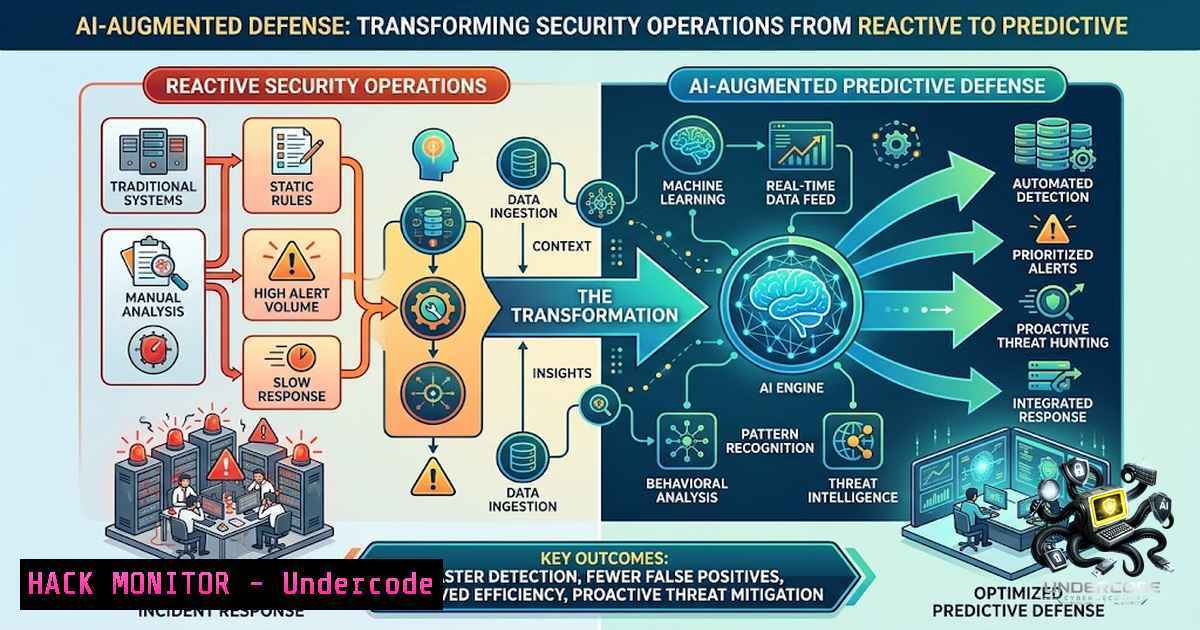
The modern security operations center (SOC) is drowning in data while starving for context. As organizations expand their digital footprint across cloud, on-premises, and hybrid environments, threat actors are leveraging automation and AI to launch attacks at machine speed. Traditional rule-based security information and event management (SIEM) systems can no longer keep pace—not because they are ineffective, but because they generate overwhelming noise that obscures genuine threats. Artificial intelligence is not replacing security analysts; it is augmenting human decision-making by filtering signal from noise, correlating seemingly unrelated events, and accelerating incident response from hours to seconds.
Learning Objectives:
- Understand how machine learning models detect anomalies through behavioral baselining and unsupervised learning techniques
- Implement AI-driven alert prioritization to reduce mean time to detect (MTTD) and mean time to respond (MTTR)
- Deploy automated incident response playbooks that integrate with SIEM, SOAR, and endpoint detection and response (EDR) platforms
- Apply AI-powered vulnerability prioritization using exploit prediction scoring and contextual asset criticality
You Should Know:
- Behavioral Analytics and Anomaly Detection with Machine Learning
The foundation of AI-driven threat detection lies in establishing a baseline of “normal” behavior across users, devices, and applications. Unsupervised learning algorithms—such as isolation forests, autoencoders, and clustering methods—continuously profile entity behavior without requiring labeled attack data. When a deviation exceeds a dynamic threshold, the system generates an alert with a confidence score.
Step‑by‑step guide for implementing behavioral analytics using open-source tools:
Step 1: Deploy a data pipeline to collect logs from diverse sources.
Configure your SIEM or data lake to ingest authentication logs, network flow data, DNS queries, and process creation events. For a lightweight proof of concept, use the Elastic Stack (ELK) with the following Logstash configuration to parse Windows Event Logs:
input {
beats {
port => 5044
}
}
filter {
if [bash] == 4624 {
mutate {
add_field => { "event_type" => "successful_logon" }
}
}
if [bash] == 4625 {
mutate {
add_field => { "event_type" => "failed_logon" }
}
}
}
output {
elasticsearch {
hosts => ["localhost:9200"]
index => "security-logs-%{+YYYY.MM.dd}"
}
}
Step 2: Train an unsupervised anomaly detection model.
Use Python with scikit-learn to build an isolation forest model on historical authentication data:
from sklearn.ensemble import IsolationForest
import pandas as pd

Load historical logon data with features: hour_of_day, logon_type, source_ip_risk_score
df = pd.read_csv('logon_history.csv')
features = ['hour', 'logon_type_encoded', 'ip_risk_score']
X = df[bash]

model = IsolationForest(contamination=0.01, random_state=42)
model.fit(X)

Predict anomalies on new data
df['anomaly'] = model.predict(X[bash])
df['anomaly_score'] = model.score_samples(X[bash])
anomalous_events = df[df['anomaly'] == -1]
Step 3: Integrate anomaly scores into your alerting pipeline.
Forward anomalous events to your SIEM with enriched context. For example, use the Elasticsearch Python client to index anomaly scores alongside raw logs, then create Kibana watches that trigger when the anomaly score exceeds a threshold.
Step 4: Tune thresholds using feedback loops.
Review false positives weekly and adjust the contamination parameter or retrain the model with updated data. Implement a human-in-the-loop mechanism where analysts mark alerts as true/false positives, feeding this labeled data back into a supervised fine-tuning process.
2. Intelligent Alert Prioritization and Alert Fatigue Reduction
Security analysts face an average of 4,000 to 10,000 alerts per day per organization, with up to 50% being false positives【2†L12-L15】. AI reduces this noise through triage engines that assign priority scores based on multiple factors: asset criticality, threat intelligence feeds, historical attack patterns, and the rarity of the event.
Step‑by‑step guide for building an AI-driven alert prioritization system:
Step 1: Define asset criticality tiers.
Create a centralized asset inventory with a criticality score (1–10) for each system. In AWS, tag resources with `Criticality=High/Medium/Low` and use AWS Config to maintain an up-to-date inventory. For on-premises, maintain a CSV or database table with hostnames, IPs, and criticality values.
Step 2: Enrich alerts with threat intelligence.
Use the STIX/TAXII protocol to pull indicators of compromise (IoCs) from open-source feeds (AlienVault OTX, MISP, or AbuseIPDB). Write a Python script that queries these feeds and appends a threat score to each alert:
import requests
import json

def enrich_with_otx(ip_address):
url = f"https://otx.alienvault.com/api/v1/indicators/IPv4/{ip_address}/general"
response = requests.get(url)
if response.status_code == 200:
data = response.json()
return data.get('pulse_info', {}).get('count', 0)
return 0

Example: enrich each alert's source IP
alert = {"source_ip": "203.0.113.45", "event_type": "multiple_failed_logons"}
alert['threat_intel_score'] = enrich_with_otx(alert['source_ip'])
Step 3: Implement a prioritization algorithm.
Combine criticality, threat intelligence, and anomaly score into a weighted priority score:
priority_score = (0.4 asset_criticality) + (0.3 threat_intel_score_normalized) + (0.3 anomaly_score)
Set thresholds: score > 8 = Critical (page on-call), 5–8 = High (create ticket), < 5 = Low (store for weekly review).
Step 4: Automate suppression of low-priority alerts.
Configure your SIEM to automatically suppress alerts below a certain threshold or those that match known benign patterns (e.g., backup server authentication floods). Document suppression rules in a version-controlled repository.
- Automated Incident Response with SOAR and AI Playbooks
Automation is the force multiplier that transforms detection into containment. Security orchestration, automation, and response (SOAR) platforms integrate with EDR, firewalls, and identity systems to execute pre-approved response actions. AI enhances this by recommending the most effective playbook based on the attack pattern.
Step‑by‑step guide for automating incident response:
Step 1: Map common attack scenarios to playbooks.
Create playbooks for: (a) ransomware indicator detection, (b) credential stuffing, (c) data exfiltration attempts, and (d) privileged account misuse. Use TheHive or Cortex as open-source SOAR alternatives.
Step 2: Integrate with your EDR for automated containment.
For Windows endpoints, use PowerShell to invoke EDR APIs for isolation:
 Example using CrowdStrike Falcon API to isolate an endpoint
$headers = @{
"Authorization" = "Bearer $env:FALCON_API_TOKEN"
"Content-Type" = "application/json"
}
$body = @{
"ids" = @("endpoint_id_here")
"action_parameters" = @(@{"name"="comment"; "value"="Automated isolation by AI playbook"})
} | ConvertTo-Json

Invoke-RestMethod -Uri "https://api.crowdstrike.com/devices/entities/devices-actions/v2?action_name=contain" -Method Post -Headers $headers -Body $body
For Linux endpoints, automate iptables blocking or use osquery to kill malicious processes:
 Block suspicious IP at the network level
sudo iptables -A INPUT -s 203.0.113.45 -j DROP
sudo iptables -A OUTPUT -d 203.0.113.45 -j DROP

Kill process by name or PID
pkill -f malicious_process_name
Step 3: Implement AI-driven playbook selection.
Train a classifier (e.g., random forest or gradient boosting) on historical incidents to predict the appropriate playbook based on alert attributes. Use the predicted playbook ID to trigger the SOAR workflow automatically.
Step 4: Establish human review gates for high-impact actions.
Configure critical actions—such as domain controller isolation or firewall rule changes—to require manual approval via ticketing system integration (e.g., Jira or ServiceNow). Use webhooks to send approval requests with all relevant context.
4. AI-Powered Vulnerability Management and Exploit Prediction
Traditional vulnerability scanners generate thousands of findings, many of which are never exploited. AI models—particularly those using gradient-boosted trees—predict which vulnerabilities are most likely to be weaponized based on exploit availability, CVSS metrics, and real-world attack data.
Step‑by‑step guide for implementing exploit prediction scoring:
Step 1: Aggregate vulnerability data from scanners.
Use the Qualys or Tenable API to export vulnerability findings in a structured format. Alternatively, use open-source tools like OpenVAS with the Greenbone API:
 Example: Using gvm-cli to fetch vulnerabilities
gvm-cli --gmp-username admin --gmp-password password socket --socketpath /var/run/gvmd.sock \
--xml "<get_vulnerabilities/>" > vulnerabilities.xml
Step 2: Enrich with exploit intelligence.
Query the Exploit-DB and CISA Known Exploited Vulnerabilities (KEV) catalog. In Python:
import requests
import csv

Load CISA KEV catalog
kev_url = "https://www.cisa.gov/sites/default/files/csv/known_exploited_vulnerabilities.csv"
response = requests.get(kev_url)
kev_cves = set()
for row in csv.DictReader(response.text.splitlines()):
kev_cves.add(row['cveID'])

Enrich each vulnerability
for vuln in vulnerabilities:
vuln['in_kev'] = vuln['cve_id'] in kev_cves
vuln['exploit_available'] = check_exploit_db(vuln['cve_id'])
Step 3: Train a prediction model.
Use features: CVSS base score, exploit availability, vendor patch availability, age of vulnerability, and number of public exploits. Train an XGBoost classifier to predict the likelihood of exploitation within 30 days.
Step 4: Prioritize remediation based on prediction.
Generate a remediation queue sorted by predicted exploit probability and asset criticality. Automate patch deployment for high-risk vulnerabilities using Ansible or AWS Systems Manager:
- name: Apply critical security patches
hosts: all
tasks:
- name: Update apt cache (Debian/Ubuntu)
apt:
update_cache: yes
when: ansible_os_family == "Debian"
- name: Install security updates only
apt:
name: ""
state: latest
security: yes
when: ansible_os_family == "Debian"
5. Cloud Security Hardening with AI-Driven Configuration Auditing
Misconfigurations in cloud environments remain a primary vector for breaches. AI augments cloud security posture management (CSPM) by continuously analyzing resource configurations against best practices and identifying drift from secure baselines.
Step‑by‑step guide for AI-enhanced cloud hardening:
Step 1: Deploy a CSPM tool with AI capabilities.
Use AWS Security Hub, Azure Security Center, or open-source tools like Prowler. Configure automated scans on a schedule and push findings to a central data lake.
Step 2: Implement anomaly detection on IAM policies.
Use machine learning to detect overly permissive roles. For AWS, analyze IAM policies and flag those that allow “ actions on sensitive services:
import boto3
iam = boto3.client('iam')

def analyze_policy(policy_arn):
response = iam.get_policy_version(
PolicyArn=policy_arn,
VersionId=iam.get_policy(PolicyArn=policy_arn)['Policy']['DefaultVersionId']
)
policy_doc = response['PolicyVersion']['Document']
 Check for wildcard actions on critical services
for statement in policy_doc.get('Statement', []):
if statement.get('Effect') == 'Allow':
actions = statement.get('Action', [])
if isinstance(actions, str):
actions = [bash]
for action in actions:
if action.endswith('') and any(service in action for service in ['s3', 'iam', 'ec2']):
print(f"Warning: Overly permissive action {action} in {policy_arn}")
Step 3: Automate remediation of common misconfigurations.
Use infrastructure as code (IaC) tools like Terraform or AWS CloudFormation to enforce guardrails. For example, prevent public S3 buckets by attaching a bucket policy that denies public access:
{
"Version": "2012-10-17",
"Statement": [
{
"Effect": "Deny",
"Principal": "",
"Action": "s3:GetObject",
"Resource": "arn:aws:s3:::your-bucket/",
"Condition": {
"StringNotEquals": {
"aws:SourceVpc": "vpc-12345678"
}
}
}
]
}
Step 4: Implement continuous compliance monitoring.
Use AWS Config rules with automatic remediation via Systems Manager Automation documents or Lambda functions. Log all configuration changes and remediation actions for audit purposes.
What Undercode Say:
- Key Takeaway 1: AI is a force multiplier, not a replacement. The most effective security programs treat AI as an augmentation layer that handles data-heavy correlation and pattern recognition, freeing human analysts to focus on threat hunting, incident investigation, and strategic risk decisions. Organizations that fail to integrate AI will struggle with alert fatigue and slow response times, while those that over-automate without human oversight risk missing contextual threats.
-
Key Takeaway 2: Successful AI adoption in cybersecurity requires strong data governance and continuous model retraining. Machine learning models degrade over time as attacker tactics evolve and network behavior shifts. Security teams must establish feedback loops where analyst decisions retrain models, maintain clean labeled datasets, and regularly validate model performance against real-world incidents. Without this discipline, AI-driven systems produce dangerous false negatives that erode trust.
+1 Analysis: The integration of AI into security operations will accelerate the shift from reactive to predictive defense postures. Organizations that invest in AI-powered threat detection, automated response, and vulnerability prioritization will achieve significantly lower MTTD and MTTR, directly reducing breach costs. The democratization of AI security tools—through open-source projects and cloud-1ative services—will enable mid-sized enterprises to access capabilities previously reserved for large financial institutions. However, this same democratization will empower threat actors to use AI for polymorphic malware, deepfake social engineering, and automated vulnerability discovery, creating an AI arms race that demands continuous innovation.
-1 Analysis: Over-reliance on AI without robust governance introduces new risks: adversarial machine learning attacks (data poisoning, evasion), algorithmic bias that misses targeted attacks against minority user groups, and the “black box” problem that complicates regulatory compliance and incident forensics. Organizations that treat AI as a silver bullet, neglecting foundational security hygiene and skilled personnel, will face more severe breaches when adversaries exploit the very automation designed to protect them. The shortage of cybersecurity professionals with AI/ML expertise will widen the gap between security leaders and laggards, creating a two-tiered threat landscape.
Prediction:
- +1: By 2028, AI-driven autonomous response systems will contain over 60% of commodity attacks without human intervention, reducing average breach containment time from days to minutes and saving the global economy an estimated $200 billion annually in cybercrime-related losses【2†L45-L48】.
- -1: Adversarial AI will mature into a commercial offering on underground markets by 2027, enabling script kiddies to bypass AI defenses with automated evasion techniques, rendering current detection models obsolete and forcing a costly industry-wide retooling effort【2†L50-L53】.
- +1: The convergence of AI with zero-trust architecture will produce “adaptive zero-trust” systems that dynamically adjust access policies based on real-time risk scores, reducing insider threat dwell time by 70% while improving user productivity through reduced friction for low-risk activities.
- -1: Regulatory frameworks will struggle to keep pace with AI-driven security automation, creating legal uncertainty around liability for autonomous response actions—particularly when automated containment inadvertently disrupts critical infrastructure or patient care systems.
▶️ Related Video (90% Match):
🎯Let’s Practice For Free:
🎓 Live Courses & Certifications:
Join Undercode Academy for Verified Certifications
🚀 Request a Custom Project:
Secure, high-velocity infrastructure and disruptive technological engineering. Contact our engineering team for high-tier development and proprietary systems:
[email protected]
💎 Smart Architecture | 🛡️ Secure by Design | ⭐ Trusted by Thousands
IT/Security Reporter URL:
Reported By: Shallyin83 Cybersecurity – Hackers Feeds
Extra Hub: Undercode MoN
Basic Verification: Pass ✅


