
Listen to this Post
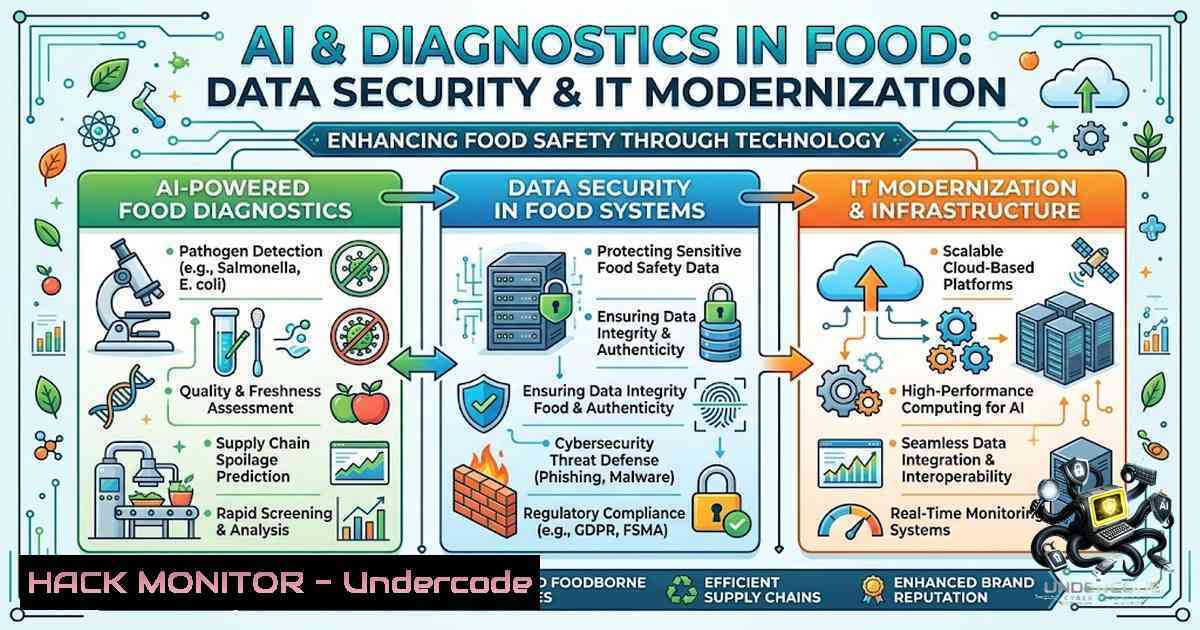
Introduction:
The convergence of appetite-suppressing drugs, artificial intelligence, and bio-diagnostic tools is not merely reshaping consumer behavior but is fundamentally altering the data infrastructure of the food industry. This technological shift introduces critical cybersecurity and IT challenges, as companies scramble to secure sensitive health data, AI recommendation engines, and cloud-based diagnostic platforms. Understanding the technical backbone of these disruptions is essential for IT professionals tasked with hardening new digital ecosystems against emerging threats.
Learning Objectives & Secrets:
- Objective 1: Understand the data privacy implications of AI-driven dietary recommendations and diagnostic tools.
- Objective 2: Implement secure API gateways for third-party integrations between food tech, pharma, and AI firms (secret tip: always enforce mutual TLS).
- Objective 3: Harden cloud environments hosting biometric and dietary data against unauthorized access (secret tip: use zero-trust architecture with micro-segmentation).
You Should Know:
1. The Data Pipeline of Tomorrow’s Appetite
The integration of AI and diagnostic tools creates a complex data pipeline involving wearable devices, food ordering platforms, and health records. This pipeline collects Personally Identifiable Information (PII), dietary habits, and biometric data, making it a prime target for cyberattacks. To secure this ecosystem, IT teams must implement end-to-end encryption and robust access controls. A typical architecture involves data ingestion via APIs, processing through machine learning models, and storage in secure data lakes.
Step‑by‑Step Guide for Securing Data Ingestion:
- Encrypt Data at Rest: Use AES-256 encryption for databases and storage buckets.
– Linux command: `sudo cryptsetup luksFormat /dev/sda1` (for disk encryption).
– Windows command: `manage-bde -on C: -RecoveryPassword` (BitLocker).
2. Implement API Security: Deploy an API gateway with OAuth 2.0 and OpenID Connect.
– Example (NGINX): Configure rate limiting and JWT validation.
3. Enable Audit Logging: Track all data access attempts.
– Linux command: auditctl -w /var/log/data_pipeline/ -p rwxa -k data_access.
2. Securing AI Recommendation Engines
AI algorithms that predict and suggest dietary choices are prone to adversarial attacks, where malicious actors manipulate input data to produce harmful recommendations. To mitigate this, model robustness must be tested using adversarial training and input sanitization. Additionally, the integrity of training data must be verified to prevent data poisoning.
Step‑by‑Step Guide for AI Model Security:
- Validate Input Data: Use schema validation to filter out malicious payloads.
– Python (Linux):
import jsonschema
schema = {"type": "object", "properties": {"user_id": {"type": "string"}}}
jsonschema.validate(instance=data, schema=schema)
2. Implement Adversarial Testing: Use tools like CleverHans or Foolbox to simulate attacks.
– Installation: pip install cleverhans.
3. Monitor Model Drift: Regularly evaluate model performance to detect anomalies.
– Linux script: Schedule cron jobs to compare daily predictions against a baseline.
3. Cloud Hardening for Diagnostic Data
Diagnostic tools produce massive amounts of sensitive health data stored in cloud environments. A breach could expose millions of users’ health profiles. Cloud hardening involves strict identity management, network segmentation, and continuous compliance monitoring. Using Infrastructure as Code (IaC) ensures security controls are consistently applied across all environments.
Step‑by‑Step Guide for Cloud Security:
- Enforce Multi-Factor Authentication (MFA): Require MFA for all cloud console and API access.
- Set Up Virtual Private Cloud (VPC): Isolate resources using subnets and security groups.
– AWS CLI: aws ec2 create-vpc --cidr-block 10.0.0.0/16.
3. Scan for Misconfigurations: Use tools like Scout Suite or Prowler.
– Linux command: python3 scout.py aws --report-dir ./reports.
4. Vulnerability Exploitation and Mitigation in IoT Diagnostics
The proliferation of IoT-enabled diagnostic devices introduces vulnerabilities such as default credentials and unpatched firmware. Attackers can exploit these to gain network access or intercept data. Mitigation requires regular firmware updates, credential rotation, and network segmentation.
Step‑by‑Step Guide for IoT Security:
- Change Default Credentials: Immediately update default usernames/passwords upon deployment.
– Linux command (SSH): `passwd` to change device password.
2. Enable Firmware Signing: Ensure only authorized firmware can be installed.
3. Isolate IoT Networks: Use VLANs to separate IoT devices from critical infrastructure.
– Switch config: `vlan 10` and assign ports.
5. API Security in a Multi-Industry Ecosystem
Drug companies, AI firms, and food corporations are all vying for control over dietary data, leading to a complex web of API integrations. Securing these APIs against injection attacks, broken authentication, and excessive data exposure is critical. Implementing a Web Application Firewall (WAF) and strict input validation can prevent common OWASP Top 10 vulnerabilities.
Step‑by‑Step Guide for API Hardening:
1. Deploy a WAF: Use ModSecurity with NGINX.
- Linux command:
apt-get install libapache2-mod-security2.
- Validate All Inputs: Use regex to sanitize user inputs.
– Python: import re; pattern = re.compile(r'^[a-zA-Z0-9_]+$').
3. Rate Limit Requests: Prevent brute-force and DDoS attacks.
– NGINX config: limit_req_zone $binary_remote_addr zone=one:10m rate=10r/s;.
What Undercode Say:
- Key Takeaway 1: The integration of AI and diagnostics in food production creates a new attack surface that demands proactive security measures.
- Key Takeaway 2: IT professionals must bridge the gap between culinary technology and cybersecurity to protect consumer data and corporate assets.
Analysis:
The food industry’s digital transformation is not just about innovation; it’s a cybersecurity battleground. As companies collect more intimate health data, the value of that information skyrockets, attracting sophisticated attackers. Organizations that fail to secure their data pipelines risk regulatory fines, loss of consumer trust, and strategic disadvantage. The convergence of food, pharma, and AI necessitates a unified security strategy that includes encryption, zero-trust principles, and continuous monitoring. Professionals who master these technical skills will be pivotal in shaping a safe and sustainable digital food ecosystem. The race for data supremacy in this new frontier will reward those who prioritize security from the ground up.
Prediction:
- +1: The demand for cybersecurity professionals specializing in health-tech and AI will see a significant rise, creating new career opportunities.
- -1: If left unchecked, data breaches in this sector could lead to widespread identity theft and health fraud, undermining public confidence.
- +1: Advancements in homomorphic encryption will enable safer data sharing between competing firms, fostering innovation.
- -1: Regulatory fragmentation across borders will complicate compliance, increasing operational costs for global food-tech firms.
▶️ Related Video (88% Match):
🎯Let’s Practice For Free:
🎓 Live Courses & Certifications:
Join Undercode Academy for Verified Certifications
🚀 Request a Custom Project:
Secure, high-velocity infrastructure and disruptive technological engineering. Contact our engineering team for high-tier development and proprietary systems:
[email protected]
💎 Smart Architecture | 🛡️ Secure by Design | ⭐ Trusted by Thousands
IT/Security Reporter URL:
Reported By: https://lnkd.in/p/e8vdiqUA – Hackers Feeds
Extra Hub: Undercode MoN
Basic Verification: Pass ✅


