Listen to this Post
Introduction
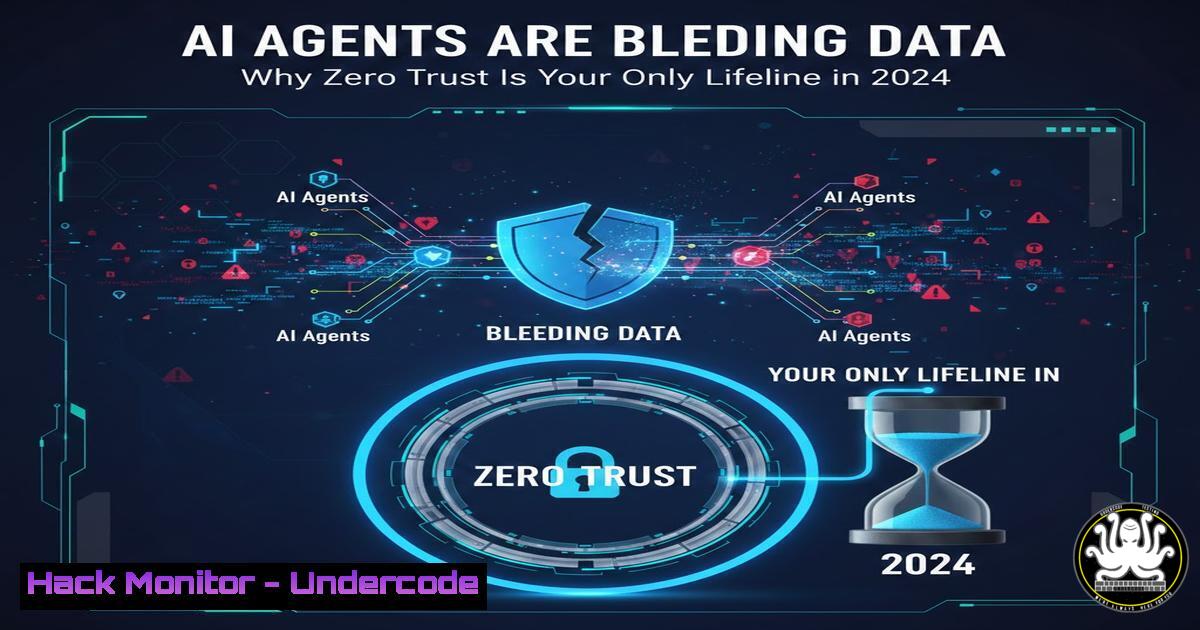
The rapid proliferation of autonomous AI agents has created a dangerous security blind spot for organizations. Unlike traditional software that follows deterministic rules, AI agents operate probabilistically—making real-time decisions, chaining API calls, and executing actions without human intervention. This fundamental shift renders conventional security stacks (firewalls, SIEM, endpoint protection) dangerously obsolete. When an AI agent gets compromised, it doesn’t just leak a database; it executes malicious workflows using legitimate credentials, leaving defenders to clean up damage they couldn’t see coming.
Learning Objectives
- Understand the architectural differences between AI agents and traditional software that break conventional security models
- Implement Zero-Trust principles specifically adapted for autonomous agent workflows
- Deploy runtime execution controls that prevent unauthorized data encryption and exfiltration
You Should Know
1. Identity Isolation: Never Let Agents Touch Secrets
The most common critical vulnerability in AI deployments is hardcoded or environment‑variable credentials. Agents scrape memory, logs, and context windows—if a secret exists in plaintext, it will eventually leak.
What to do: Implement a token exchange mechanism where the agent requests a time‑limited, scope‑restricted token from a secure vault at runtime.
Step‑by‑step guide (HashiCorp Vault + Python agent example):
- Install Vault and enable the AppRole auth method.
- Create a role with a CIDR restriction and TTL of 5 minutes.
vault auth enable approle
vault write auth/approle/role/ai-agent \
secret_id_ttl=10m \
token_ttl=5m \
token_max_ttl=10m \
bound_cidr_list="10.0.0.0/24"
- Inside your agent code, fetch a token only when needed:
import requests
import hvac</li>
</ol>

client = hvac.Client(url='https://vault.internal:8200')
 Agent only gets role_id; secret_id is retrieved securely at boot
response = client.auth.approle.login(
role_id=os.environ['ROLE_ID'],
secret_id=client.get_role_secret_id()  ephemeral
)
db_creds = client.secrets.database.get_creds('my-db-role')
 Use db_creds for this task, then discard
This ensures the agent never stores long‑lived credentials—if the memory is dumped, nothing valuable remains.
2. Policy‑Based Access Control: Default Deny for Everything
Human engineers often give agents broad permissions because they don’t know exactly what APIs the agent will call during reasoning. This is a fatal mistake.
Step‑by‑step guide (OPA + Envoy for API gateways):
Use Open Policy Agent (OPA) as a sidecar to intercept every outbound agent request.
- Deploy OPA as a sidecar container alongside your agent.
- Define a policy that denies all actions except those explicitly allowed:
package envoy.authz</li>
</ol>

default allow = false

Allow read access only to specific endpoints
allow {
input.attributes.request.http.method == "GET"
input.attributes.request.http.path =~ "^/api/v1/customers/[0-9]+/profile"
token_valid(input.attributes.request.http.headers.authorization)
}

Block any write/modify operations by default
allow {
false  intentional block for writes
}
3. In your agent’s orchestration layer, enforce that every API call passes through this policy engine. If the agent tries to call an endpoint not pre‑authorized, the request is dropped with a 403, and an alert fires.
- Immutable Audit Logs: Cryptographic Proof of Agent Actions
Standard logging is mutable—an attacker who compromises the logging server can delete traces of the agent’s malicious activity.
Step‑by‑step guide (Syslog‑ng + Signing):
Configure logs to be signed and forwarded to an immutable store (like AWS S3 with Object Lock).
1. Install `syslog-ng` on the agent host.
- Configure it to sign each log line using a hardware security module (HSM) or a local private key:
destination d_s3 {
s3(
bucket("agent-audit-logs")
object("{YEAR}-{MONTH}-{DAY}/agent-${HOST}.log")
log-fifo-size(1000)
template("${ISODATE} ${HOST} ${MSGHDR}${MSG}\n")
flush-lines(10000)
);
};</li>
</ol>

log {
source(s_agent);
destination(d_s3);
flags(final);
};
3. Enable S3 Object Lock with retention mode `COMPLIANCE` so logs cannot be modified or deleted by anyone—even root—for a defined period.
4. Runtime Execution Control: Block Unauthorized Encryption
As highlighted by Jack Fitzpatrick, logging alone is reactive. We need deterministic blocking of dangerous operations like mass file encryption or large‑scale data export.
Step‑by‑step guide (Linux `seccomp` + AppArmor):
Constrain the agent process at the kernel level.
- Write an AppArmor profile that denies access to encryption‑related binaries and libraries:
profile ai-agent /usr/bin/python3.10 {
Include base abstractions
include <abstractions/base>
include <abstractions/python>

Deny access to common encryption tools
deny /usr/bin/openssl ix,
deny /usr/bin/gpg ix,
deny /usr/bin/gpgsm ix,
deny /usr/bin/age ix,

Deny writing to common ransomware target directories
deny /home//.{doc,docx,xls,xlsx,pdf,jpg,jpeg} w,
deny /mnt// w,
deny /media// w,
}
2. Enforce the profile:
sudo apparmor_parser -r -W /etc/apparmor.d/ai-agent
sudo aa-enforce ai-agent
3. For Windows agents, use Windows Defender Application Control (WDAC) to block execution of crypto miners or ransomware binaries.
5. Real‑Time Anomaly Detection in Agent Behavior
Agents generate telemetry that differs from human users—they might call 100 APIs in 10 seconds. Traditional UEBA tools flag this as suspicious, but with agents, it’s normal. You need an agent‑specific baseline.
Step‑by‑step guide (Elastic Stack + custom ML job):
- Ingest agent logs into Elasticsearch with fields like
agent_id,api_endpoint,response_time,bytes_sent. - Create a machine learning job that detects when an agent deviates from its own behavioral pattern:
– Sudden increase in call volume to a sensitive endpoint
– Calls to endpoints never before seen
– Unusual time‑of‑day activity
3. Set up a watcher that triggers an automatic response: if anomaly_score > 80, revoke the agent’s token via Vault API and page the SOC.- Execution Control via eBPF (Prevention, Not Just Detection)
For deep visibility and control at the system call level, eBPF can intercept and block malicious actions before they happen.
Step‑by‑step guide (Tracee + custom signatures):
Use Tracee to detect and block file encryption patterns.
- Deploy Tracee as a DaemonSet in Kubernetes or as a systemd service on Linux hosts.
- Write a custom signature that looks for mass file operations with specific extensions:
pseudocode for Tracee signature def on_event(event): if event.syscall == "openat" and "O_WRONLY" in event.flags: if any(event.pathname.endswith(ext) for ext in [".encrypted", ".locked"]): if event.pid == AGENT_PID: log_alert("Agent attempting to write encrypted file") kill_process(event.pid) terminate the agent - This stops ransomware‑style encryption in its tracks, even if the agent itself is compromised.
7. Prompt Injection Defense at the Input Layer
Agents are vulnerable to prompt injection—malicious instructions hidden in data they process. This can trick the agent into performing unauthorized actions.
Step‑by‑step guide (Input sanitization with guardrails):
Implement a validation layer before the agent’s prompt is passed to the LLM.
- Use a tool like NeMo Guardrails or Lakera to scan user inputs and retrieved context.
- Define rules that strip out instructions disguised as data:
from lakera import LakeraClient
client = LakeraClient(api_key="...")</li>
</ol>

def validate_prompt(user_input, retrieved_context):
combined = user_input + "\n" + retrieved_context
result = client.detect(combined, dataset="prompt_injection")
if result['score'] > 0.8:
raise Exception("Prompt injection detected, blocking request")
return combined
3. If injection is detected, do not pass the prompt to the LLM; instead, return an error and alert the security team.
What Undercode Say:
- Key Takeaway 1: AI agents are not just software; they are autonomous decision‑makers that require identity‑ and behavior‑based controls, not just perimeter defenses. Treating them as users with limited, audited permissions is the only viable model.
- Key Takeaway 2: Detection is too slow. You must implement deterministic prevention at the kernel, API, and execution layers. If an agent can still encrypt files or exfiltrate data while being monitored, your security has already failed.
Analysis: The convergence of AI and security is forcing a paradigm shift. Traditional SOCs are built for human adversaries who operate slowly; AI agents move at machine speed, chaining exploits and API calls in seconds. Organizations that retrofit old tools onto new agents will suffer breaches. The winning approach is to embed security into the agent’s runtime environment—making it literally incapable of performing harmful actions, regardless of its intent or compromise state.
Prediction:
Within 18 months, we will see the first major breach attributed to an AI agent being manipulated into performing a ransomware attack. This incident will trigger regulatory changes, forcing companies to implement deterministic execution controls for any agent with access to sensitive data. The cybersecurity industry will pivot from “monitoring” to “prevention by design,” with eBPF and hardware‑enforced isolation becoming standard for AI workloads.
▶️ Related Video (80% Match):
🎯Let’s Practice For Free:
IT/Security Reporter URL:
Reported By: Peyo0907 Cybersecurity – Hackers Feeds
Extra Hub: Undercode MoN
Basic Verification: Pass ✅🔐JOIN OUR CYBER WORLD [ CVE News • HackMonitor • UndercodeNews ]
📢 Follow UndercodeTesting & Stay Tuned:
- Write an AppArmor profile that denies access to encryption‑related binaries and libraries:
- Immutable Audit Logs: Cryptographic Proof of Agent Actions


