Listen to this Post
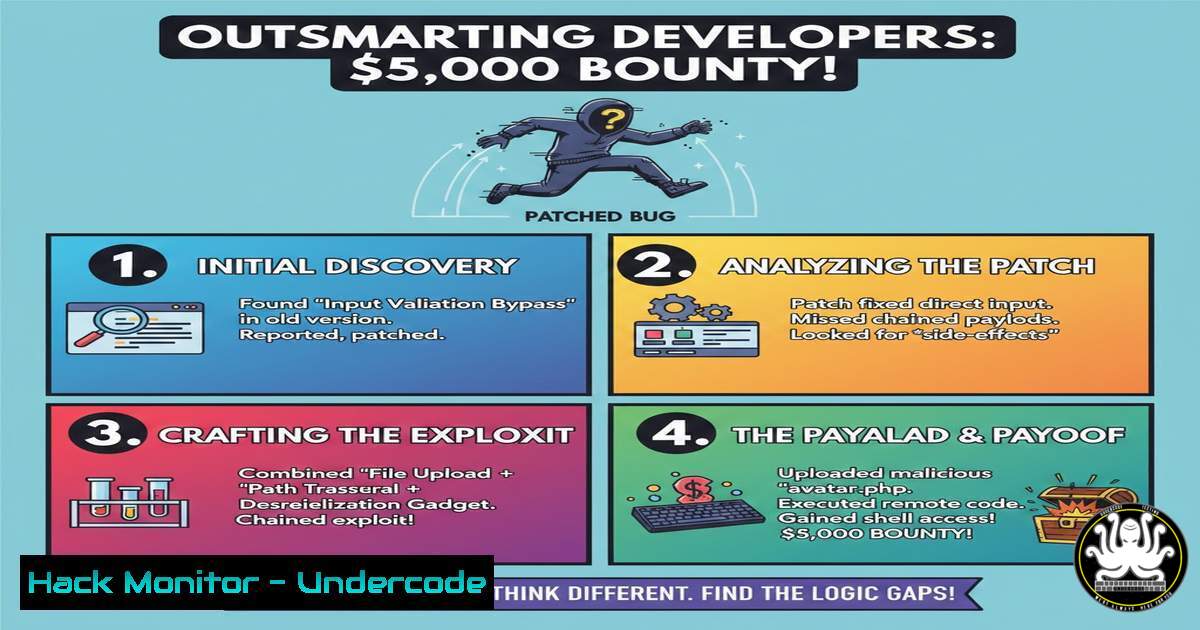
Introduction:
In the high-stakes world of bug bounty hunting, a “fixed” vulnerability is often just the beginning of a new challenge. When developers release a patch, they address a specific attack vector, but seasoned penetration testers know that the underlying logic might still be flawed. This article dissects the mindset behind bypassing security fixes, transforming a simple patch into an opportunity for a critical find. By understanding how to probe the boundaries of a fix, you can uncover deeper issues that others miss.
Learning Objectives:
- Objective 1: Analyze security patches to identify potential bypass vectors.
- Objective 2: Master hands-on techniques and tools for testing patched vulnerabilities.
- Objective 3: Develop a methodological approach to finding and exploiting logic flaws in web applications.
You Should Know:
1. Deconstructing the Patch: Understanding the Original Vulnerability
Before attempting a bypass, you must comprehend what was broken and how it was fixed. Start by obtaining as much information as possible about the original bug. If it’s a public disclosure, study the report. If it’s from a private program, analyze the communication from the vendor.
Step‑by‑step guide:
- Use Burp Suite to compare HTTP requests and responses before and after the patch. If you have historical data, import it into the Burp Comparer tool.
- Identify the specific input validation or sanitization that was added. For example, if the patch was for an SQL injection, look for new filters like `mysqli_real_escape_string()` or parameterized queries in the code (if accessible).
- Simulate the original exploit to confirm it’s indeed blocked. This sets a baseline for your bypass attempts.
2. Reconnaissance on the Patched Endpoint
With the patch identified, perform targeted reconnaissance to understand the application’s structure and potential weak points.
Step‑by‑step guide:
- Use directory brute-forcing tools to discover hidden endpoints related to the patched functionality. For example, if the bug was in a user profile update feature, look for admin panels or debug interfaces.
Linux command: `gobuster dir -u https://target.com/profile -w /usr/share/wordlists/dirb/common.txt -x php,asp,aspx,jsp,do`
– Analyze JavaScript files for client-side validation that might hint at server-side logic. Use tools like `LinkFinder` or manually inspect with browser dev tools. - For Windows environments, consider using `dir /s /b` on mirrored sites or `Invoke-WebRequest` in PowerShell for similar enumeration.
3. Fuzzing Input Fields with Custom Payloads
Once you have a list of input vectors, fuzzing helps identify what the patch actually blocks and what slips through.
Step‑by‑step guide:
- Create a wordlist of payloads specifically designed to test the patched vulnerability. Include variations like case changes, encoding, and alternative syntax. For SQLi, use payloads like `‘ OR ‘1’=’1` and its URL-encoded form
%27%20OR%20%271%27%3D%271. - Use `ffuf` for high-speed fuzzing. Run a command to test a parameter that was previously vulnerable.
Linux command: `ffuf -u https://target.com/page?param=FUZZ -w sqli_payloads.txt -fc 200,302` (filter out successful responses to see anomalies) - Analyze the responses. A 500 error might indicate that the payload caused an unhandled exception, while a 200 OK with different content could suggest a successful injection.
4. Exploiting Logic Flaws in the Patch
Patches often focus on blocking specific characters or patterns but neglect the business logic. This is where bypasses thrive.
Step‑by‑step guide:
- If the patch blocks the single quote (
‘), try using double quotes (“) if the database is configured to accept them, or use backslash escaping if the input isn’t properly handled. - For authentication bypasses, test if the patch added a check for a specific cookie but forgot to validate it on all endpoints. Use Burp Repeater to tamper with cookies and headers.
- Example: If a patch fixes a privilege escalation by checking a role parameter, try manipulating the request to include both the old and new role parameters. HTTP Parameter Pollution (HPP) can sometimes cause the server to process the malicious one.
5. Leveraging Encoding and Unicode Tricks
Many patches implement simple string matching that can be evaded with encoding tricks. This is especially effective against WAFs (Web Application Firewalls) and basic input filters.
Step‑by‑step guide:
- Use URL encoding to represent characters. For example, `` but encoded.
- Then, navigate to a page where this data is displayed, such as an admin panel or user profile. If the patch only filtered on input but not output, the payload will execute.
- Use tools like Burp Scanner or manual inspection to trace how data flows through the application.
What Undercode Say:
- Key Takeaway 1: A patch is not a silver bullet; always test for bypasses by thinking like an attacker who has read the same fix notes.
- Key Takeaway 2: Automation and creativity are your greatest assets—combine fuzzing with manual logic analysis to uncover hidden flaws.
In the cybersecurity landscape, the difference between a good hunter and a great one is the ability to see beyond the obvious. While developers focus on the trees, you must see the forest. The bug El Sayed Mohammed highlighted reminds us that "fixed" often means "patched in one place, vulnerable in another." By systematically probing patches with encoding, logic twists, and second-order attacks, we not only validate the fix but also raise the bar for secure coding. This persistence is what turns a simple report into a critical vulnerability disclosure, ultimately making the digital world safer—one bypass at a time.
Prediction:
As AI-driven development tools become mainstream, patches will be generated faster, but they will also inherit the biases and blind spots of their training data. Future bypasses may involve adversarial machine learning attacks, where input is crafted to confuse AI-based security filters. Meanwhile, automated bypass frameworks will evolve, leveraging large language models to generate sophisticated evasion techniques. The cat-and-mouse game will intensify, demanding that both defenders and attackers master AI to stay ahead.
▶️ Related Video (74% Match):
🎯Let’s Practice For Free:
IT/Security Reporter URL:
Reported By: Shari7a0x %D8%A7%D9%84%D8%AD%D9%85%D8%AF - Hackers Feeds
Extra Hub: Undercode MoN
Basic Verification: Pass ✅


