
Listen to this Post
Introduction:
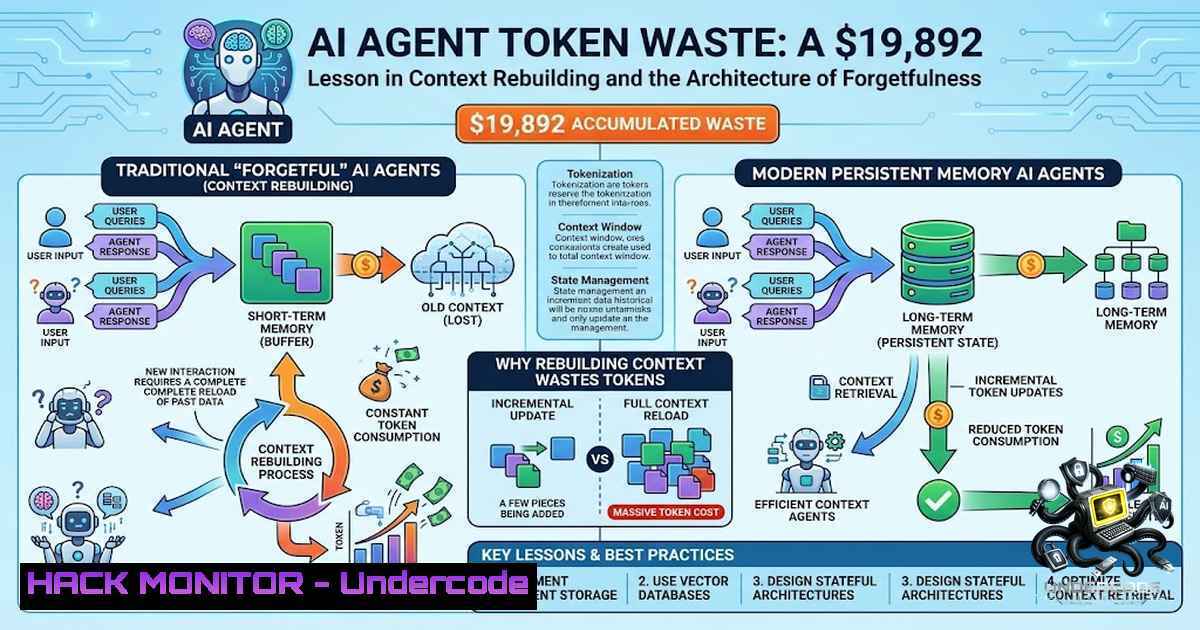
The proliferation of Large Language Model (LLM) agents in software development has introduced a hidden operational cost: semantic amnesia. Recent log analyses reveal that AI agents can spend over 96% of processing tokens not on novel reasoning, but on re-reading their own context windows and previously established project rules. This inefficiency, exemplified by a case where 25.59 billion tokens were consumed with a 47% repetition rate on identical queries, highlights a critical security and economic vulnerability in the AI supply chain, where excessive API calls increase the attack surface and operational expenditure without proportional gains in productivity.
Learning Objectives & Secrets:
- Objective 1: Understand Token Economics. Learn how to audit your AI agent’s token usage to identify “wasted” spending on redundant context reloading rather than productive code generation.
- Objective 2: Secrets of Context Management. Discover the 24KB load limit pitfall; learn to architect your agent’s memory to ensure persistent rules and project knowledge are actively loaded rather than passively stored in oversized markdown files.
- Objective 3: Secrets of Query Caching. Implement a “one-command” survival strategy to archive duplicate queries and force the agent to query a local cache first, preventing the creation of 44 duplicate scripts for a single, repeated question.
You Should Know:
- Understanding the Log Audit: The 96.9% Context Tax
The foundational problem identified was not a flaw in the AI model itself, but in the workflow integration. The agent was spending 96.9% of its tokens (approximately 24.8 billion tokens) re-reading prior interactions and context that were technically “known” but inaccessible due to architectural limitations. This results in a “Context Tax,” where users pay for inference on data that is already stored but not effectively loaded into the active memory.
Step‑by‑step guide for Auditing your Agent Logs (Linux/macOS):
- Extract Logs: Locate your agent’s session logs (e.g., `~/.cursor/logs/` or custom output).
- Count Tokens: Use a tokenizer library like `tiktoken` to count tokens per session.
pip install tiktoken
Run a script to parse JSON logs and sum the `input_tokens` field across sessions.
- Identify Repetition: Use `grep` to find repeated prompts.
grep -r "Which open-source repos do I own" ./logs/ | wc -l
- Calculate Waste: Determine the percentage of total input tokens that are identical to previous inputs. For Windows, use PowerShell’s `Select-String` and `Measure-Object` to count patterns.
-
The Rule File Bottleneck: 127KB vs. 24KB Limit
The agent’s operational guidelines were stored in a 127KB markdown file, far exceeding the effective load limit of roughly 24KB. This meant that 80% of the project’s established logic was “sitting on disk, never read back.” The agent operated in a state of partial amnesia, ignoring the foundational rules that were supposed to guide its behavior.
Step‑by‑step guide to implement a “Reflect Layer” (Mechanism over Prose):
1. Split the Rules: Separate the rules file into `core-rules.md` (always loaded, < 24KB) and `archive-rules.md` (for reference).
2. Implement a Load Script: Create a Python script to pre-process the rules before the agent session begins.
 load_rules.py
import os
with open("core-rules.md", "r") as f:
core = f.read()
 Inject core rules into the system prompt
print(f"System Context: {core[:24000]}")  Truncate to safety
3. Automate Injection: Configure your agent’s startup script to run `load_rules.py` first, ensuring the agent starts with the correct, compacted context every time.
- Query Caching and De-Duplication: The “One Command” Rule
The logs showed that a single question—”Which open-source repos do I own”—was asked 122 times out of 261 sessions, resulting in 44 unique scripts being written to answer it. The solution was implementing a command cache: if the answer exists, query the cache; do not rebuild.
Step‑by‑step guide to implement a Query Cache (Linux/Windows Universal):
1. Create a Cache Directory: `mkdir ~/.agent_cache`
- Cache Script: Write a wrapper script that checks for a cached response before executing the agent.
!/bin/bash
agent_query.sh
QUERY_HASH=$(echo "$1" | md5sum | cut -d' ' -f1)  Linux
For Windows PowerShell: $hash = [System.BitConverter]::ToString((New-Object -TypeName System.Security.Cryptography.MD5CryptoServiceProvider).ComputeHash([System.Text.Encoding]::UTF8.GetBytes($args[bash])))
if [ -f "~/.agent_cache/$QUERY_HASH.txt" ]; then
cat "~/.agent_cache/$QUERY_HASH.txt"
else
Run agent and save output
agent-cli "$1" | tee "~/.agent_cache/$QUERY_HASH.txt"
fi
- Ensure Archiving: The second rule demands that “the other 43 get archived.” Implement a cleanup job that archives duplicate scripts to a `./archive/` folder and deletes them from the active directory.
4. The Ledger Protocol: Tracking “Done, Open, Missed”
To prevent tasks from vanishing due to context flooding, the developer introduced a mandatory ledger at the start of every reply. This is a structured output format that provides a status report for all pending and completed objectives.
Step‑by‑step guide to implement a Session Ledger:
- Define the Format: Instruct the agent to output the status report first.
[bash]
DONE: [Task ID] - [Brief Description]
OPEN: [Task ID] - [Brief Description]
MISSED: [Task ID] - [Brief Description]
- Parse the Ledger: Write a parser to validate the ledger.
import re
def parse_ledger(text):
done = re.findall(r"DONE:\s(.)", text)
return done
- Action on “MISSED”: Implement a loop that automatically re-queues “MISSED” tasks to the top of the priority queue to ensure they are not forgotten.
5. Security Implications of “Re-reading”
The excessive re-reading of context is not just a cost issue; it is a security vulnerability. If the agent re-reads a 127KB file containing secrets or API keys due to context overflow, it increases the likelihood of accidental exposure in debug logs or error messages. Implementing strict context pruning reduces the data footprint and the risk of credential leakage.
Step‑by‑step guide to secure context handling:
- Static Analysis: Run `grep -r -E “(API_KEY|SECRET|PASSWORD)” ./rules/` to identify sensitive data in the rules file.
- Environment Variables: Replace hardcoded secrets with environment variables in the core rules.
- Log Sanitization: Configure your agent to scrub logs of sensitive patterns before writing to disk.
What Undercode Say:
- Key Takeaway 1: The Productivity Mirage. An AI agent that types fast but reads slowly is not productive. The raw speed of generation is irrelevant if 47% of the logic is being regenerated weekly. The key performance indicator (KPI) is “Cache Hit Rate” for previous solutions, not “Tokens Per Second.”
- Key Takeaway 2: The “Mechanism over Prose” Paradigm. Human-readable markdown is insufficient for large-scale agent automation. Rules must be engineered with load limits and priority tiers. The failure to load an 80% portion of the project’s memory renders the agent effectively an intern with goldfish memory.
Analysis:
The analysis reveals a systemic flaw in current agentic workflows: the assumption that context is infinite. In reality, memory is constrained and fragile. The solution proposed—a “Reflect Layer,” query caching, and a ledger—represents a shift from passive prompting to active state management. This is analogous to moving from a monolithic codebase to a microservices architecture, where memory is managed explicitly. The 47% repetition rate is a symptom of poor orchestration, not AI intelligence. By treating the agent’s memory as a finite resource and implementing error-handling mechanisms for context overflow, developers can reduce token costs by an estimated 80-90%, turning a $19,892 bill into a more palatable ~$2,000 operational cost.
Prediction:
- +1 The industry will move toward “Tiered Memory Architectures” for agents, where rules and past interactions are automatically summarized and vectored for retrieval-augmented generation (RAG), ensuring that only the most relevant 24KB is loaded.
- -1 Organizations that do not implement such caching mechanisms will continue to bleed capital on API costs, with “Token Waste” becoming the next major shadow IT expense, potentially eclipsing cloud compute costs in AI-first companies.
- +1 The creation of standardized audit tools for AI logs will emerge as a new sub-sector in the observability market, helping teams visualize and optimize their agent’s “memory utilization.”
- -1 The reliance on natural language rules (prose) will result in catastrophic misalignments if those files exceed load limits, leading to AI agents making decisions based on incomplete or outdated project philosophies.
- +1 The “Ledger Protocol” is likely to evolve into a standard output format for AI agents, ensuring deterministic tracking of tasks and preventing the “newer one showed up” problem that caused tasks to vanish.
▶️ Related Video (78% Match):
🎯Let’s Practice For Free:
🎓 Live Courses & Certifications:
Join Undercode Academy for Verified Certifications
🚀 Request a Custom Project:
Secure, high-velocity infrastructure and disruptive technological engineering. Contact our engineering team for high-tier development and proprietary systems:
[email protected]
💎 Smart Architecture | 🛡️ Secure by Design | ⭐ Trusted by Thousands
IT/Security Reporter URL:
Reported By: https://lnkd.in/p/eMkXfCat – Hackers Feeds
Extra Hub: Undercode MoN
Basic Verification: Pass ✅


