Listen to this Post
Introduction:
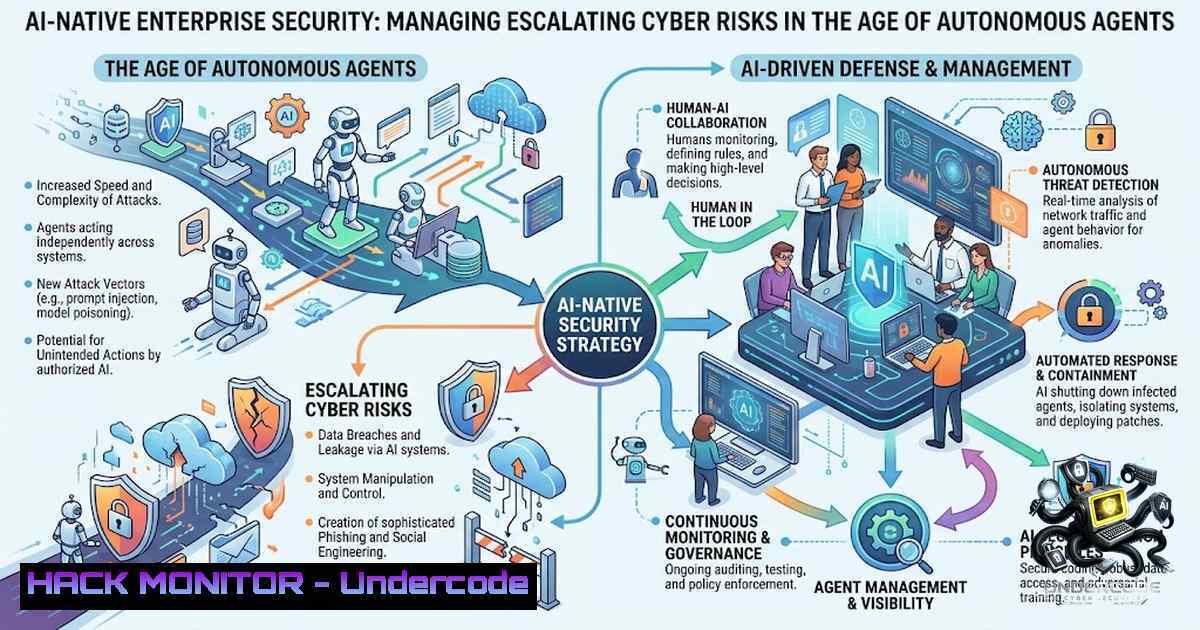
As organizations rapidly embrace AI-1ative enterprise ecosystems, the convergence of agentic AI, identity governance deficits, and massive visibility gaps has created what industry experts now call the “Triple Threat” of 2026. With nearly half of enterprise AI use bypassing corporate security controls and 95% of organizations now running AI agents autonomously, traditional perimeter-based security models are proving fundamentally inadequate. This article examines how cybersecurity professionals can manage escalating risks through Zero Trust architectures, AI-aware DevSecOps pipelines, and updated incident response frameworks designed for the age of autonomous agents.
Learning Objectives:
- Understand the core security challenges introduced by AI-1ative enterprise architectures and autonomous agents
- Learn how to implement Zero Trust principles and AI control centers to secure Google Workspace and AI integrations
- Master DevSecOps pipeline security with AI-powered scanning, gates, and automated remediation
- Develop an AI-specific incident response framework with predefined escalation protocols and forensic artifact preservation
- Apply practical Linux, Windows, and cloud security commands for AI workload hardening
You Should Know:
- Zero Trust as the Foundation for Agentic AI Security
The Five-Eyes Alliance has identified Zero Trust as the best defense against agentic AI threats, emphasizing least privilege, deny-by-default security, application containment, segmentation, and continuous verification. For AI agents operating inside enterprise environments, this means every agent must carry a managed identity with purpose-specific permissions, a defined scope, and a full audit log. Organizations should implement runtime policy enforcement, rate limiting to prevent excessive consumption, and behavioral monitoring that flags anomalous actions at the point of interaction.
Step-by-Step Guide: Hardening AI Workloads with Zero Trust
- Inventory all AI agents and their access scopes – Document every autonomous agent, its purpose, data access requirements, and integration points. Use the Google Workspace AI control center to manage AI safety and compliance across your organization.
-
Implement agent identity with least privilege – Assign each AI agent a unique managed identity with permissions scoped strictly to its function. Avoid using shared service accounts or overly broad permissions.
-
Deploy runtime policy enforcement – Configure network segmentation to isolate AI workloads. For Kubernetes environments, use network policies to restrict agent-to-agent communication:
 Kubernetes NetworkPolicy for AI agent isolation
apiVersion: networking.k8s.io/v1
kind: NetworkPolicy
metadata:
name: ai-agent-restrict
spec:
podSelector:
matchLabels:
app: ai-agent
policyTypes:
- Ingress
- Egress
ingress:
- from:
- podSelector:
matchLabels:
role: api-gateway
ports:
- protocol: TCP
port: 8080
egress:
- to:
- podSelector:
matchLabels:
app: database
ports:
- protocol: TCP
port: 5432
- Enable continuous verification and behavioral monitoring – Deploy anomaly detection that establishes baseline behavior for each agent and alerts on deviations. Implement logging of all AI transactions and apply third-party controls for comprehensive visibility.
-
Configure rate limiting and resource controls – Prevent excessive consumption by setting per-agent API call limits, token usage caps, and compute resource quotas.
-
Google Workspace AI Security: The AI Control Center
As AI becomes deeply embedded in productivity ecosystems, Google has introduced the AI control center in the Admin console to securely manage generative AI and agent access to Workspace data. This centralized console allows administrators to ensure every AI surface adheres to domain-specific data and security policies, including classification labels and existing Workspace security parameters. Additional features include mandatory two-factor authentication for administrators, passkeys, and Device Bound Session Credentials to modernize away from legacy authentication setups.
Step-by-Step Guide: Configuring Google Workspace AI Controls
- Navigate to the AI control center – In the Google Admin console, locate the AI control center under Security. Review your existing security, privacy, and safety settings that can help secure your AI deployment.
-
Define AI agent spheres of influence – Identify integration points and implement runtime policy enforcement. Define which data sources each AI agent can access and under what conditions.
-
Establish agent ID with clear attribution – Configure each AI agent with a managed identity. Ensure all agent actions are logged with clear attribution for audit purposes.
-
Configure classification labels for sensitive data – Apply data classification labels to Workspace content. Configure the AI control center to enforce these labels when AI agents access or process data.
-
Enable SynthID for AI-generated content – For organizations using Google AI, enable SynthID invisible digital watermarking to detect images and videos created or edited by Google AI.
3. DevSecOps Pipelines: Stages, Not Gates
Modern DevSecOps pipelines require integrated security stages rather than gates at the end. Most production pipelines in 2026 now include four integrated security stages: secrets scanning on commits, SCA and container scanning on builds, SAST on pull requests, and admission checks on deploy. Teams are applying the same patterns to pull request gates and pipeline step authorization, with security checks enforced at each transition. AI-powered DevSecOps tools now provide context-aware vulnerability detection and automated remediation suggestions for Infrastructure as Code (IaC).
Step-by-Step Guide: Building an AI-Enhanced DevSecOps Pipeline
- Phase 1: Shift Left (IDE & Pre-Commit) – Integrate secrets scanning and static analysis into developer IDEs. Tools like Semgrep and CodeQL should run on every commit.
-
Phase 2: CI Security (Build & Static Analysis) – Configure your CI pipeline to run SCA and container scanning on every build. Use Trivy for container image vulnerability scans and infrastructure misconfiguration audits.
 Linux: Run Trivy container scan with exit code for gating
trivy image --severity HIGH,CRITICAL --exit-code 1 myapp:latest

Linux: Scan Infrastructure as Code with Checkov
checkov -d ./terraform --framework terraform --quiet
- Phase 3: Supply Chain Security (SBOM & Artifacts) – Generate and verify SBOMs for all dependencies. Sign artifacts to ensure integrity throughout the pipeline.
-
Phase 4: DAST & Application Testing – Run dynamic application security testing against deployed test environments. For AI workloads, include prompt injection testing and model security assessments.
-
Phase 5: CD & Infrastructure (Cloud/K8s) – Implement admission checks that read live context before deployment. Gate deploys on policy checks.
 Kubernetes: OPA admission control policy example
kubectl create -f - <<EOF
apiVersion: admissionregistration.k8s.io/v1
kind: ValidatingAdmissionPolicy
metadata:
name: require-labels
spec:
matchConstraints:
resourceRules:
- apiGroups: [""]
apiVersions: ["v1"]
operations: ["CREATE", "UPDATE"]
resources: ["pods"]
validations:
- expression: "object.metadata.labels.contains('security-tier')"
message: "All pods must have a security-tier label"
EOF
- Phase 6: Runtime & Threat Detection – Deploy continuous monitoring for running workloads. Use AI-powered threat detection to identify anomalies in real-time.
-
Phase 7: AI-Driven Remediation – Implement automated remediation suggestions using LLMs to analyze findings and propose fixes.
4. Incident Response for the AI Era
Traditional incident response models must be adapted for AI systems. Organizations need to define AI incident taxonomies, establish predefined AI escalation protocols based on regulatory and technical severity, and implement clear system restoration processes with new AI-specific metrics. CISOs must define triaged cross-functional representation including legal, model owners, compliance, HR, and business owners. A structured approach should include six phases: preparation, detection and triage, containment, investigation, remediation, and post-incident review.
Step-by-Step Guide: Building an AI Incident Response Playbook
- Preparation – Identify AI incident response team members – Include ML engineers, security analysts, data scientists, legal counsel, and communications personnel.
-
Define AI incident severity classification – Establish severity levels that account for AI-specific impact scenarios such as model poisoning, prompt injection, data leakage, and unauthorized agent actions.
-
Configure detection triggers – Set up monitoring for AI-specific anomalies including unusual conversation patterns, tool execution records, and guardrail bypass events.
 Linux: Monitor AI agent logs for anomalies
tail -f /var/log/ai-agent/audit.log | grep -E "ERROR|WARN|bypass|unauthorized"

Windows PowerShell: Query AI service event logs
Get-WinEvent -LogName "AI-Agent" | Where-Object { $<em>.LevelDisplayName -eq "Error" -or $</em>.Message -match "guardrail" }
- Contain without killing the service – Implement granular containment strategies. Blocking a single user or agent is usually sufficient rather than taking down the entire service.
-
Investigate conversations, not packets – AI incident forensics examines conversation logs, tool execution records, and guardrail bypass events rather than traditional network packets. Preserve the reasoning chain alongside artifacts.
-
Remediate and validate – Apply patches, retrain models, or update policies as needed. Validate that remediation is effective before returning to normal operations.
-
Post-incident review – Conduct thorough reviews to identify root causes and improve the incident response process. Apply continuous oversight with logging of AI transactions.
-
Critical Infrastructure and OT Security in the AI Era
The convergence of IT and OT has exposed critical infrastructure to cyber-physical threats that perimeter-based security was never designed to handle. Threat actors are using generative AI and agentic workflows to discover vulnerabilities, lowering the barrier for high-fidelity phishing and machine-speed exploitation. Organizations must shift toward operational resilience and manual fallback capabilities. Regulators are treating AI integration as an inseparable dimension of industrial cybersecurity posture, with CISA issuing guidance on AI-OT integration and OT Zero Trust frameworks.
Step-by-Step Guide: Securing OT Environments with AI Defenses
- Conduct an OT asset inventory – Document all OT devices, controllers, and industrial systems. Identify internet-exposed attack surfaces and remove unnecessary internet-facing services.
-
Implement network segmentation – Isolate OT networks from IT networks and the internet. Use unidirectional gateways where possible to prevent bidirectional communication.
-
Deploy AI-enabled defensive security – Adopt AI-enabled tools for automated vulnerability detection, attack surface analysis, and threat detection in OT environments.
-
Maintain updated systems – Apply security updates regularly to operating systems, browsers, and OT applications.
-
Train AI/ML models on OT behavior – Use cyber digital twins to train AI/ML models to recognize both normal operational signatures and simulated attack signatures.
6. The Workplace Reality: Replaceable vs. Unsuccessful
A new workplace reality has emerged where being easily replaceable is more dangerous than being unsuccessful. According to CyberEdge Group’s 2026 Cyberthreat Defense Report, 80% of IT security professionals believe AI will significantly reduce the number of people required to perform their current roles, with 46% expecting this shift within the next two years. However, the most immediate change is happening inside jobs, as AI takes over individual tasks—log review, alert triage, and evidence gathering—and changes how people learn, contribute, and demonstrate their value. The analyst who refuses to use AI will be replaced by an analyst who uses it effectively.
Step-by-Step Guide: Future-Proofing Your Cybersecurity Career
- Embrace AI as a force multiplier – Learn to use AI-powered security tools for log analysis, threat hunting, and incident response. AI won’t replace cybersecurity jobs—it will replace the toil.
-
Develop AI-specific skills – Gain expertise in AI security, model governance, prompt engineering security, and agentic identity management.
-
Build your personal brand – Demonstrate your ability to work alongside AI agents and deliver value that automation cannot replicate—strategic thinking, business context, and human judgment.
-
Stay current with emerging threats – Follow AI-1ative attack vectors including vibe hacking and CursorJacking that bypass traditional perimeter defenses.
What Undercode Say:
-
Zero Trust is non-1egotiable for AI security. The Five-Eyes Alliance guidance makes it clear: least privilege, segmentation, and continuous verification are the baseline for agentic AI protection. Organizations that fail to implement these principles will face inevitable breaches as autonomous agents proliferate.
-
AI incident response requires a new playbook. Traditional IR frameworks don’t account for AI-specific threats like model poisoning, prompt injection, or guardrail bypass. Security teams must update their playbooks with AI-specific taxonomies, escalation protocols, and forensic procedures that preserve reasoning chains alongside traditional artifacts.
The convergence of AI-1ative enterprise architectures with traditional security models is creating a perfect storm of risk. With 95% of enterprises now running AI agents autonomously and nearly half of AI use bypassing corporate security, the attack surface has expanded dramatically. Organizations must move beyond perimeter-based thinking and embrace Zero Trust, AI-aware DevSecOps, and updated incident response frameworks. For cybersecurity professionals, the message is clear: those who embrace AI as a force multiplier will thrive; those who resist will find themselves replaced. The age of autonomous agents is here—security must evolve to meet it.
Prediction:
- +1 The AI security market will experience explosive growth, with OT security projected to grow from $27.4 billion in 2026 to $58.9 billion by 2031, creating massive opportunities for security professionals specializing in AI and OT security.
-
+1 AI-powered DevSecOps tools will become standard, reducing vulnerability detection and remediation times by 60-80% through context-aware analysis and automated suggestions.
-
-1 Organizations that fail to implement Zero Trust for AI agents will experience significant breaches, as autonomous agents with excessive privileges become prime targets for attackers.
-
-1 The workforce disruption will accelerate, with 46% of IT security professionals expecting significant role changes within two years, creating a skills gap as AI reshapes traditional security roles.
-
+1 Regulatory frameworks like the EU AI Act will drive standardization in AI security practices, pushing organizations toward mature governance and incident response capabilities.
-
-1 Critical infrastructure will face unprecedented AI-fueled attacks as threat actors leverage generative AI for high-fidelity phishing and machine-speed exploitation, necessitating manual fallback capabilities.
▶️ Related Video (82% Match):
https://www.youtube.com/watch?v=E_yPUsCpoC8
🎯Let’s Practice For Free:
🎓 Live Courses & Certifications:
Join Undercode Academy for Verified Certifications
🚀 Request a Custom Project:
Secure, high-velocity infrastructure and disruptive technological engineering. Contact our engineering team for high-tier development and proprietary systems:
[email protected]
💎 Smart Architecture | 🛡️ Secure by Design | ⭐ Trusted by Thousands
IT/Security Reporter URL:
Reported By: https://lnkd.in/p/e9BhgSJV – Hackers Feeds
Extra Hub: Undercode MoN
Basic Verification: Pass ✅


