Listen to this Post
Introduction:
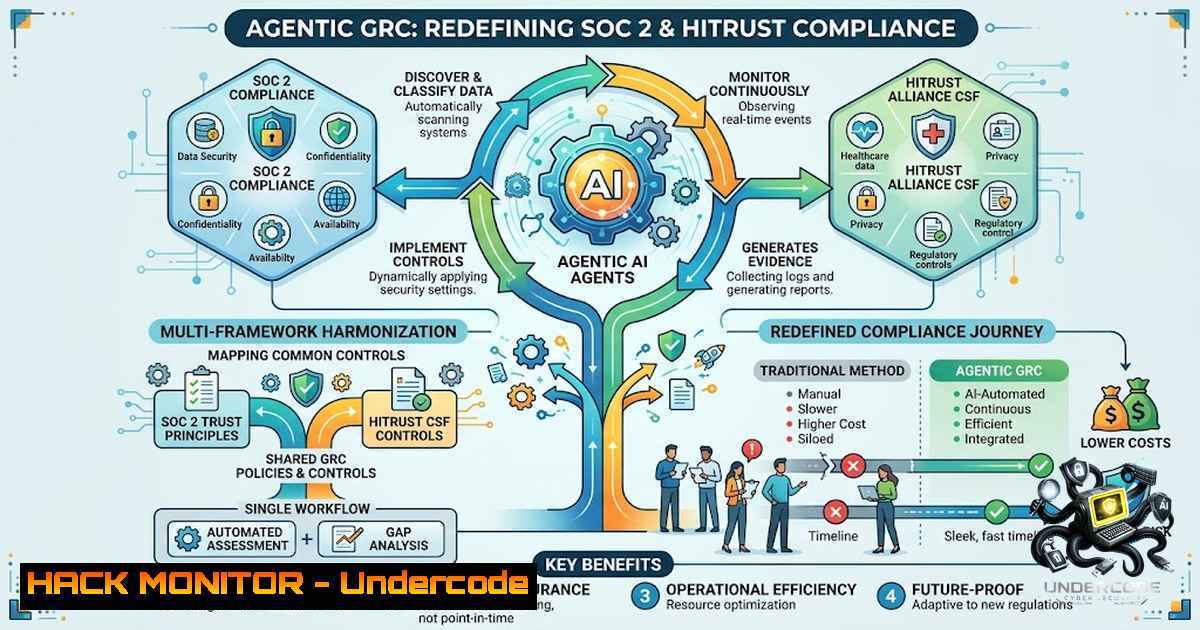
The governance, risk, and compliance (GRC) landscape is undergoing a fundamental shift. As organizations grapple with an increasingly complex web of regulatory requirements—from SOC 2’s Trust Services Criteria to HITRUST’s 1,900+ control specifications—traditional manual approaches to compliance are no longer sustainable. The emergence of agentic AI is transforming how security professionals conduct assessments, manage evidence, and harmonize multiple frameworks, moving compliance from an annual scramble to a continuous, intelligence-driven operation.
Learning Objectives:
- Master the technical controls and evidence requirements for SOC 2 Type II and HITRUST CSF v11.8 certifications
- Implement AI agents to automate evidence collection, control monitoring, and audit preparation
- Architect multi-framework harmonization strategies that reduce audit fatigue and operational overhead
- Deploy and configure GRC platforms for continuous compliance and real-time risk management
You Should Know:
- SOC 2 and HITRUST: Technical Control Deep Dive
SOC 2, developed by the American Institute of CPAs, is an attestation framework that evaluates service organizations’ controls across five Trust Services Criteria: Security, Availability, Processing Integrity, Confidentiality, and Privacy. The Security criterion alone comprises nine Common Criteria (CC1-CC9) encompassing approximately 64 underlying control points. SOC 2 Type II reports evaluate operating effectiveness over a minimum six-month observation window, requiring consistent control performance.
HITRUST CSF, by contrast, is a certifiable framework that consolidates requirements from HIPAA, NIST, ISO, and other standards into a layered structure of 14 control categories, 49 control objectives, 156 control specifications, and more than 1,900 requirement statements. The HITRUST i1 certification path requires 182 core requirements and mandates that implemented controls operate for at least 90 consecutive days before fieldwork. The latest CSF v11.8.0 release introduces updates affecting fifteen i1 and r2 assessment requirements, with particular attention to threats enabled by frontier AI models.
The technical overlap between these frameworks is substantial. Organizations can leverage SOC 2 foundational controls to streamline HITRUST certification, as both frameworks share requirements around access control (SOC 2 CC6.1, HITRUST 01.a), configuration management (SOC 2 CC7.1, HITRUST 10.h), and incident response (SOC 2 CC7.4, HITRUST 19.q).
Step-by-Step Control Mapping Guide:
- Inventory existing controls – Document all technical controls currently implemented across your environment, including identity and access management (IAM), network security, encryption, and logging mechanisms.
-
Map to SOC 2 CC criteria – For each control, identify which Common Criteria (CC1-CC9) it satisfies. Use the SOC 2 Trust Services Criteria mapping matrix to ensure coverage.
-
Map to HITRUST CSF requirements – Using the HITRUST MyCSF tool, cross-reference your SOC 2-mapped controls against HITRUST requirement statements. Identify gaps where additional controls are needed.
-
Implement compensating controls – For gaps, deploy technical controls such as mTLS with short-lived session tokens (15-minute TTL), automated access reviews, and continuous vulnerability scanning.
-
Test and document – Run control tests to verify effectiveness. Document evidence including system logs, configuration files, and test results.
Linux Command for Continuous Control Monitoring:
!/bin/bash
 Continuous compliance monitoring script for SOC 2/HITRUST controls

Check access control configurations
echo "[$(date)] Checking access control configurations..."
sudo grep -r "PermitRootLogin no" /etc/ssh/sshd_config
sudo grep -r "PasswordAuthentication no" /etc/ssh/sshd_config

Verify audit logging is active and properly configured
echo "[$(date)] Verifying audit logging status..."
sudo systemctl status auditd | grep "active (running)"
sudo ausearch -ts today -m USER_LOGIN | wc -l

Check file integrity monitoring (FIM) for critical system files
echo "[$(date)] Checking file integrity..."
sudo aide --check | grep -E "(added|removed|changed)"

Validate encryption at rest for sensitive directories
echo "[$(date)] Validating encryption status..."
sudo lsblk -f | grep -E "(crypto|LUKS)"

Generate compliance evidence report
echo "[$(date)] Generating evidence report for SOC 2 CC6.1 and HITRUST 01.a..."
{
echo "=== ACCESS CONTROL EVIDENCE ==="
sudo cat /etc/passwd | wc -l
echo "=== AUDIT LOG SUMMARY ==="
sudo ausearch -ts today -m USER_LOGIN,USER_LOGOUT | aureport -f
echo "=== CONFIGURATION BASELINE ==="
sudo cat /etc/security/limits.conf | grep -v "^"
} > /var/log/compliance_evidence_$(date +%Y%m%d).log
Windows PowerShell Command for Evidence Collection:
 PowerShell script for Windows-based SOC 2/HITRUST evidence gathering

Check Windows Defender status (Security control)
Write-Host "[$(Get-Date)] Checking Windows Defender status..."
Get-MpComputerStatus | Select-Object AntivirusEnabled, RealTimeProtectionEnabled

Audit user account policies (Access Control - CC6.1)
Write-Host "[$(Get-Date)] Auditing user account policies..."
secedit /export /cfg C:\temp\secpol_backup.txt
Get-Content C:\temp\secpol_backup.txt | Select-String "PasswordHistorySize", "MinimumPasswordLength", "LockoutBadCount"

Verify Windows Event Logging is active
Write-Host "[$(Get-Date)] Verifying event logging..."
Get-WinEvent -LogName Security -MaxEvents 10 | Format-Table TimeCreated, Id, LevelDisplayName

Check BitLocker encryption status (Confidentiality control)
Write-Host "[$(Get-Date)] Checking BitLocker encryption status..."
Get-BitLockerVolume | Select-Object MountPoint, ProtectionStatus, EncryptionPercentage

Export evidence for SOC 2 CC7.1 (Change Management)
Write-Host "[$(Get-Date)] Exporting installed applications for change management evidence..."
Get-WmiObject -Class Win32_Product | Select-Object Name, Version, InstallDate | Export-Csv C:\temp\installed_software_$(Get-Date -Format yyyyMMdd).csv
- Agentic AI in GRC: Automating the Compliance Lifecycle
Agentic GRC represents a paradigm shift from rule-based automation to autonomous AI agents that can execute complex compliance workflows with minimal human intervention. These AI agents can reliably automate five core compliance tasks: evidence collection, continuous controls monitoring, third-party questionnaire processing, regulatory change monitoring, and policy attestation tracking.
During 2026 assessments, organizations using agentic AI capabilities reduced control gaps by an average of 37 percent compared with legacy mapping approaches. AI agents autonomously retrieve vendor data, validate responses, correlate external risk signals such as cyber posture or financial exposure, and initiate remediation workflows through orchestrated cross-functional actions.
Step-by-Step AI Agent Implementation for Compliance:
- Define agent objectives – Identify which compliance tasks to automate first: evidence collection, control testing, questionnaire responses, or regulatory mapping.
-
Select an agentic GRC platform – Choose a platform that supports autonomous agents for GRC workflows. Look for capabilities in third-party risk management, enterprise risk management, and AI governance.
-
Configure evidence collection agents – Deploy agents that integrate with your cloud providers, version control systems, and monitoring tools to automatically gather evidence for SOC 2 and HITRUST controls.
-
Implement continuous monitoring – Set agents to run control tests on a scheduled basis, comparing current system states against compliance baselines.
-
Enable automated remediation – Configure agents to trigger remediation workflows when control gaps are detected, such as creating tickets in your ITSM system or adjusting cloud security group configurations.
-
Establish human-in-the-loop validation – Maintain oversight by requiring human approval for high-risk decisions and periodic review of agent activities.
API Security Configuration for Agent Integration:
 Example: Configure API authentication for agentic GRC platform integration

Generate API key with limited scope for compliance automation
curl -X POST https://api.grc-platform.example.com/v1/auth/token \
-H "Content-Type: application/json" \
-d '{"username":"compliance_agent","password":"secure_password","scope":"evidence:read,controls:write"}'

Configure webhook for automated evidence collection from cloud providers
curl -X POST https://api.grc-platform.example.com/v1/webhooks \
-H "Authorization: Bearer $API_TOKEN" \
-H "Content-Type: application/json" \
-d '{
"name": "aws_evidence_collector",
"url": "https://compliance-agent.internal/collect",
"events": ["config_change","security_finding","access_log"],
"secret": "webhook_secret_key"
}'

Set up automated control testing schedule
curl -X POST https://api.grc-platform.example.com/v1/schedules \
-H "Authorization: Bearer $API_TOKEN" \
-H "Content-Type: application/json" \
-d '{
"name": "daily_control_testing",
"cron": "0 6   ",
"agent": "control_tester_v2",
"controls": ["CC6.1","CC7.1","CC8.1","HITRUST_01.a","HITRUST_10.h"]
}'
3. fullCircle GRC Platform: Operationalizing Continuous Compliance
The fullCircle GRC platform, developed by risk3sixty, represents a control-centric approach to managing complex, multi-framework environments efficiently. Every compliance client receives a full-feature base license for fullCircle at no additional cost, making it the system of record that transforms compliance programs into scalable operational assets.
The platform supports a control-first, evidence-based approach that shifts teams from reactive audit crunches to proactive, continuous audit management. Key features include automated workflow management, multi-framework harmonization, AI-powered risk tracking, and real-time audit readiness dashboards.
Step-by-Step GRC Platform Deployment:
- Define your control framework – Import SOC 2 Trust Services Criteria and HITRUST CSF requirements into the platform. Use the platform’s control mapping capabilities to identify overlaps.
-
Configure evidence repositories – Set up integrations with your cloud providers (AWS, Azure, GCP), version control (GitHub, GitLab), and monitoring tools (Splunk, Datadog) for automated evidence collection.
-
Implement risk scoring – Define risk criteria and configure the platform to automatically calculate risk scores based on control effectiveness, threat intelligence, and business impact.
-
Set up audit workflows – Create standardized workflows for assessment planning, evidence review, and findings management. Configure automated notifications for upcoming audit milestones.
-
Deploy AI agents – Enable agentic capabilities for evidence gathering, control monitoring, and questionnaire processing. Monitor agent performance and refine configurations as needed.
-
Train your team – Provide training on platform usage, evidence submission procedures, and exception handling processes.
4. Multi-Framework Harmonization: Reducing Audit Fatigue
Multi-framework harmonization enables organizations to identify overlapping requirements across SOC 2, HITRUST, ISO 27001, NIST CSF, and other standards, streamlining internal controls and aligning processes. A unified control framework (UCF) approach maps SOC 2 controls with multiple leading industry frameworks, including HIPAA, HITRUST, ISO 27001, NIST CSF, and SOC 1.
Organizations can leverage their SOC 2 compliance as a strategic asset to streamline compliance with HITRUST, NIST CSF, and ISO 27001. The overlap matrix reveals substantial shared requirements, enabling teams to consolidate documentation, risk assessments, and reporting.
Step-by-Step Harmonization Strategy:
- Inventory all frameworks – List all compliance frameworks applicable to your organization, including customer requirements and regulatory mandates.
-
Map control overlaps – Use control mapping tools to identify where controls satisfy multiple framework requirements. SOC 2 CC6.1 (Logical Access) aligns with HITRUST 01.a (Access Control), ISO 27001 A.9.1, and NIST CSF PR.AC-1.
-
Consolidate evidence – Design evidence collection processes that generate artifacts usable across all frameworks. For example, access review documentation can satisfy SOC 2 CC6.1, HITRUST 01.f, and ISO 27001 A.9.2.
-
Implement unified policies – Create a single set of policies and procedures that address requirements from all applicable frameworks.
-
Optimize audit cycles – Schedule audits to leverage shared evidence and reduce the total number of independent assessments.
5. Cloud Hardening and Attack Surface Management
Modern compliance programs must address cloud security fundamentals. Control 8.9 requires organizations to implement structured and secure configuration management practices across all technology environments, including servers, endpoints, network devices, cloud resources, applications, and third-party services. Attack surface management involves real-time monitoring to identify issues and reduce potential entry points.
Cloud Hardening Commands (AWS CLI):
 AWS CLI commands for SOC 2/HITRUST cloud security controls

Enable CloudTrail for audit logging (SOC 2 CC7.1, HITRUST 10.a)
aws cloudtrail create-trail --1ame compliance-trail --s3-bucket-1ame your-audit-bucket
aws cloudtrail start-logging --1ame compliance-trail

Configure S3 bucket encryption (Confidentiality control)
aws s3api put-bucket-encryption \
--bucket your-sensitive-bucket \
--server-side-encryption-configuration '{"Rules":[{"ApplyServerSideEncryptionByDefault":{"SSEAlgorithm":"AES256"}}]}'

Implement S3 bucket public access blocking
aws s3api put-public-access-block \
--bucket your-sensitive-bucket \
--public-access-block-configuration "BlockPublicAcls=true,IgnorePublicAcls=true,BlockPublicPolicy=true,RestrictPublicBuckets=true"

Configure security groups to restrict access (Network Security)
aws ec2 authorize-security-group-ingress \
--group-id sg-12345678 \
--protocol tcp --port 443 --cidr 10.0.0.0/8

Enable AWS Config for continuous compliance monitoring
aws configservice put-configuration-recorder \
--configuration-recorder name=default,roleARN=arn:aws:iam::account:role/config-role
aws configservice put-delivery-channel \
--delivery-channel name=default,s3BucketName=your-config-bucket
aws configservice start-configuration-recorder --configuration-recorder-1ame=default
6. Vulnerability Exploitation and Mitigation Strategies
Understanding exploitation vectors is critical for effective compliance programs. Organizations must implement compensating controls that address the same threats and risks identified in framework requirements. Key controls include:
- CC6.1 (Logical Access) : Implement mTLS certificate validation with short-lived session tokens (15-minute TTL)
- CC7.1 (Change Management) : Maintain configuration baselines and enforce change approval workflows
- CC7.4 (Incident Response) : Deploy automated detection and response capabilities with predefined playbooks
- HITRUST 01.a (Access Control) : Enforce least-privilege access and conduct regular access reviews
Vulnerability Scanning and Remediation Commands:
 Using nmap for network vulnerability assessment
nmap -sV -p- --script=vuln 192.168.1.0/24 -oA network_scan_$(date +%Y%m%d)

Using OpenSCAP for compliance baseline scanning (RHEL/CentOS)
sudo oscap xccdf eval --profile xccdf_org.ssgproject.content_profile_cis \
--results /var/log/oscap_results.xml \
--report /var/log/oscap_report.html \
/usr/share/xml/scap/ssg/content/ssg-centos7-ds.xml

Using Trivy for container vulnerability scanning
trivy image --severity HIGH,CRITICAL --format table your-container-image:latest

Automated remediation script for common findings
!/bin/bash
 Remediate common CIS benchmarks
echo "[$(date)] Starting automated remediation..."

Disable unnecessary services
sudo systemctl disable rsh.socket
sudo systemctl disable telnet.socket

Configure secure SSH settings
sudo sed -i 's/^PermitRootLogin yes/PermitRootLogin no/' /etc/ssh/sshd_config
sudo sed -i 's/^PasswordAuthentication yes/PasswordAuthentication no/' /etc/ssh/sshd_config
sudo systemctl restart sshd

Update system packages
sudo yum update -y

Configure kernel parameters for network security
echo "net.ipv4.conf.all.rp_filter=1" >> /etc/sysctl.conf
echo "net.ipv4.conf.default.rp_filter=1" >> /etc/sysctl.conf
sudo sysctl -p
What Undercode Say:
Key Takeaway 1: The compliance industry is experiencing a fundamental shift from manual, periodic assessments to continuous, AI-driven compliance operations. Organizations that fail to adopt agentic GRC capabilities will face increasing competitive disadvantage as audit costs rise and time-to-certification extends.
Key Takeaway 2: Multi-framework harmonization is no longer optional—it’s a strategic necessity. Organizations operating across SOC 2, HITRUST, ISO 27001, and other frameworks must adopt unified control frameworks to reduce audit fatigue and operational overhead. The 37% reduction in control gaps achieved through AI-assisted mapping demonstrates the tangible ROI of modernizing compliance programs.
Analysis: The hiring post from Christian Hyatt at risk3sixty reflects a broader industry trend toward AI-augmented GRC consulting. The requirement for consultants to “build and/or use AI Agents to execute your work and for clients” signals that the traditional compliance consulting model is being disrupted. Firms that embrace agentic AI will be able to deliver assessments faster, with greater accuracy, and at lower cost. The emphasis on “multi-framework harmonization” indicates that clients increasingly demand integrated compliance solutions rather than point-in-time audits. The fullCircle GRC platform being included at no additional cost represents a strategic shift toward platform-enabled consulting, where the technology itself becomes the differentiator. This model aligns with the broader industry movement from rule-based automation to autonomous GRC operations. As AI governance standards like ISO 42001 emerge, consultants will need to understand not only traditional compliance frameworks but also the governance of AI systems themselves.
Prediction:
- +1 Agentic GRC will become the dominant model for compliance consulting by 2028, with AI agents handling 50-70% of evidence collection and control testing tasks, allowing human consultants to focus on strategic advisory and exception handling.
-
+1 Multi-framework harmonization platforms will consolidate the GRC software market, with unified control frameworks becoming the standard approach for organizations managing three or more compliance regimes.
-
-1 Organizations that delay adopting AI-driven compliance automation will face 40-60% higher audit costs and significantly longer certification timelines, creating a competitive disadvantage in regulated markets.
-
+1 The integration of AI governance frameworks (ISO 42001) with traditional compliance programs will create new consulting opportunities, with demand for professionals who understand both AI risk management and established frameworks like SOC 2 and HITRUST.
-
-1 The complexity of managing AI agents in GRC workflows will introduce new risks around agent misconfiguration, hallucinated evidence, and over-automation, requiring enhanced human oversight and governance mechanisms.
▶️ Related Video (80% Match):
https://www.youtube.com/watch?v=2lEBls7eFoc
🎯Let’s Practice For Free:
🎓 Live Courses & Certifications:
Join Undercode Academy for Verified Certifications
🚀 Request a Custom Project:
Secure, high-velocity infrastructure and disruptive technological engineering. Contact our engineering team for high-tier development and proprietary systems:
[email protected]
💎 Smart Architecture | 🛡️ Secure by Design | ⭐ Trusted by Thousands
IT/Security Reporter URL:
Reported By: Christianhyatt We – Hackers Feeds
Extra Hub: Undercode MoN
Basic Verification: Pass ✅


