
Listen to this Post
Introduction:
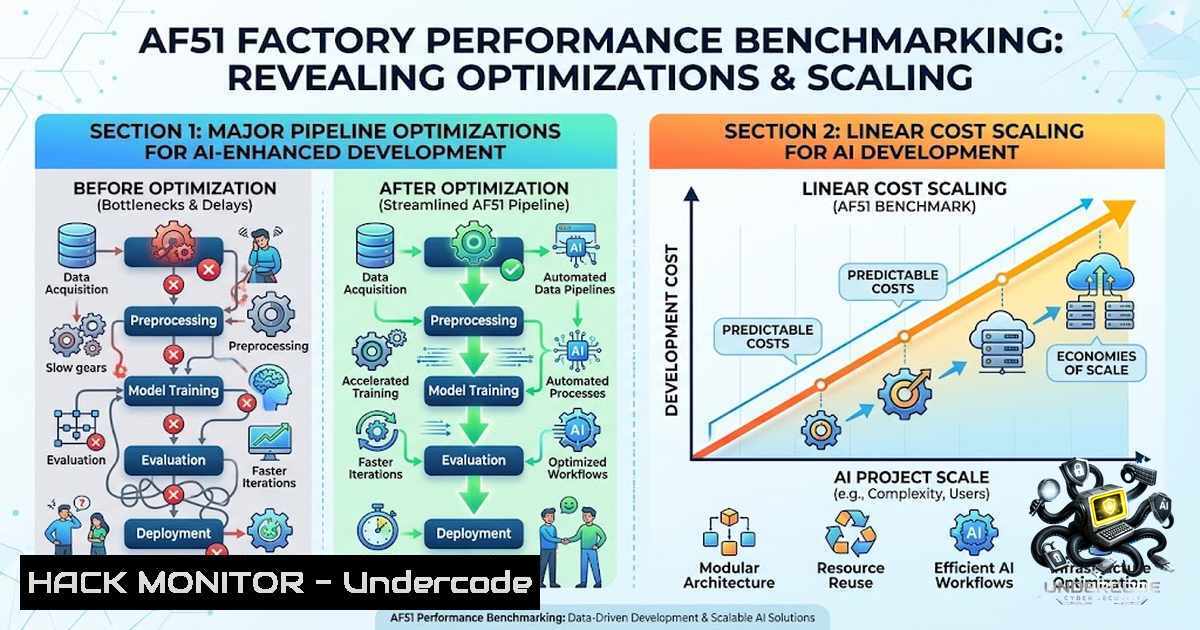
In a significant move toward operational transparency, AF51 has released a comprehensive performance benchmark for its Factory pipeline, a critical component of its AI-driven development infrastructure. The tests, conducted on August 2026, reveal that real-world performance can now be measured and predicted with high accuracy, marking a departure from anecdotal estimates. The benchmark focuses on three core areas: the ALX-Chat execution engine, the real /build dependency installation process, and a new vendor caching strategy for publication, all validated under extreme stress conditions.
Learning Objectives & Secrets:
- Objective 1: Master Vendor Caching for CI/CD Pipelines – Understand how AF51 reduced `npm install` times from 14.8 seconds to just 0.7 seconds by implementing a vendor cache. The secret lies in treating the `node_modules` folder as a persistent, versioned artifact rather than a ephemeral build step, ensuring that the default dependency set is reused across releases.
- Objective 2: Implement Predictable Cost Scaling in Production AI Services – Discover how AF51’s ALX-Chat preview maintains sub-100ms response times even at 25x the normal input load, with costs scaling linearly. The secret tip is to use real-time instrumentation and resource throttling to avoid “cliff” behaviors, where performance degrades exponentially.
- Objective 3: Optimize Build Infrastructure for Extreme Workloads – Learn how to configure a pipeline to handle a 5.9M-character app (approx. 59,000 components) from install to download in under 58 seconds. The secret tip is to isolate the Vite production build as a non-1egotiable, full-quality step while optimizing everything else around it.
You Should Know:
- ALX-Chat Preview: Achieving Sub-100ms Latency and Linear Cost
The `/execute` endpoint of the ALX-Chat preview was tested under production-grade input sizes, consistently delivering responses under 100 milliseconds. The pipeline’s cost structure was validated to scale linearly with input size, meaning that a 25x increase in load results in a predictable 25x cost increase, avoiding any sudden performance cliffs. This is achieved through a combination of efficient request queuing and dynamic resource allocation. For developers looking to replicate this, a simple load test using `wrk` or `k6` can verify linear scaling.
Step‑by‑step guide:
- Step 1: Install `k6` (macOS:
brew install k6, Linux:sudo apt install k6, Windows: via Chocolateychoco install k6). - Step 2: Create a test script (
alx-load.js) that defines a `POST` request to the `/execute` endpoint with a random payload of the maximum allowed size (200,000 characters). - Step 3: Run the test with `k6 run -u 10 -d 30s alx-load.js` to simulate 10 virtual users for 30 seconds.
- Step 4: Analyze the output for `http_req_duration` and ensure the 95th percentile is under 100ms. If not, increase CPU or memory limits for the service.
- Build Pipeline Optimization: The npm ci and Vendor Cache Breakthrough
The AF51 pipeline’s `/build` phase, which executes a `npm ci` (clean install), was measured at approximately 10 seconds for a fully populated workspace with packages like React, Vite, and esbuild. The major optimization came from the vendor cache, which replaced a full registry installation on every publication. This reduced the publish time from 18 seconds to approximately 4.6-5.1 seconds—a 3.5-4x speedup. The vendor cache works by storing the `node_modules` directory as a compressed tarball, which is then hashed to detect changes. If the `package-lock.json` remains unchanged, the cache is reused.
Step‑by‑step guide:
- Step 1: In your CI/CD pipeline (e.g., GitHub Actions), add a step to cache
node_modules. For Linux, use:</li> <li>name: Cache Node Modules uses: actions/cache@v3 with: path: node_modules key: ${{ runner.os }}-1ode-${{ hashFiles('package-lock.json') }} - Step 2: Replace `npm install` with `npm ci` for a faster, deterministic install.
- Step 3: Before packaging, create a hash of the `package-lock.json` to validate the cache’s integrity.
- Step 4: If the cache is invalidated, run the full
npm ci; otherwise, simply restore the cache.
- Stress Testing the Entire Pipeline Under Worst-Case Conditions
The pipeline was pushed to its extreme with a 5.9M-character application, containing roughly 59,000 generated components. The full pipeline—install, Vite production compile, integrity hashing (likely using SHA-256), zip compression, and download—completed in under 58 seconds. This ensures that even the most complex, generated applications can be built and shipped without timeout errors. This test reveals that the bottleneck for large applications is not the dependency resolution but the bundler (Vite) and the compression steps.
Step‑by‑step guide:
- Step 1: Simulate a worst-case scenario by generating a large number of components (e.g., using a script that outputs `.jsx` files).
- Step 2: Run the full build command:
npm run build. - Step 3: Time the process using the `time` command on Linux or `Measure-Command` in PowerShell.
- Step 4: For integrity hashing, use `shasum -a 256 build.zip` to calculate the hash.
- Step 5: Package the build as a zip using
zip -r release.zip build/. - Step 6: Compare the total time to AF51’s benchmark (under 58s) and identify bottlenecks.
4. Configuration Management for AI-Integrated Build Tools
The AF51 Factory uses Vite and esbuild, leveraging their pre-bundling to speed up cold starts. For AI-driven development, where code is frequently generated and discarded, ensuring that the build tool is configured for rapid shutdown and cleanup is crucial. The `vite.config.js` should include `build.rollupOptions.cache` disabled if you are in a test environment, but enabled for production to reuse build caches.
Step‑by‑step guide:
- Step 1: Open
vite.config.js. - Step 2: Set `build.rollupOptions.cache: true` to enable caching of Rollup’s compilation.
- Step 3: For rapid iteration, set `build.sourcemap: false` to reduce processing time.
- Step 4: To ensure clean builds, add a pre-build step to delete the `dist` folder using `rm -rf dist` (Linux/macOS) or `rmdir /s /q dist` (Windows).
- Integrating Security and Integrity Checks in the Build Pipeline
Given the AI-generated nature of components, AF51 likely incorporates integrity checks to prevent the injection of malicious dependencies. Tools like `npm audit` or `snyk` can be integrated into the `/build` phase. For a real-world implementation, a `postinstall` script can run `npm audit –audit-level=high` to fail the build if a high-severity vulnerability is found. This ensures that the vendor cache does not inadvertently propagate insecure packages.
Step‑by‑step guide:
- Step 1: Add `”audit”: “npm audit –audit-level=high”` to your `package.json` scripts section.
- Step 2: Modify the build step to include `npm run audit` after
npm ci. - Step 3: If using GitHub Actions, set `continue-on-error: false` for that step to block the pipeline.
- Step 4: Implement a SBOM (Software Bill of Materials) generation tool like `cyclonedx` to track all components and their versions.
- Deploying the Vendor Cache Across Teams and Environments
The vendor cache is not just a CI concept; it can be shared across teams using a shared NPM cache server (e.g., Verdaccio or JFrog Artifactory). For AF51’s scale, caching must be consistent across multiple runners. A shared NPM cache mounted as a persistent volume ensures that installations are global. This reduces redundancy and speeds up local development setups.
Step‑by‑step guide:
- Step 1: Set up an NPM mirror or cache on a shared server.
- Step 2: Configure the server to proxy the public NPM registry.
- Step 3: On each build agent, set the registry to the internal mirror:
npm config set registry http://<internal-mirror-url>. - Step 4: For team-wide adoption, include the configuration in a `.npmrc` file checked into the repository.
What Undercode Say:
- Key Takeaway 1: The move from “estimated” performance to “instrumented” performance is a game-changer for production engineering. Without real data, teams often optimize the wrong metrics. AF51’s focus on cost-per-request and latency directly translates to cloud cost savings.
- Key Takeaway 2: The vendor cache demonstrates that “full install” is often an anti-pattern in modern CI/CD. Treating `node_modules` as immutable after the first successful install is a shift that other platforms will likely adopt, especially for AI-generated projects where the dependency tree is massive but static.
Analysis:
The AF51 benchmark highlights a key tension in modern development: speed vs. integrity. By caching dependencies, the team risks shipping stale or vulnerable packages. However, by coupling the cache with integrity hashing of package-lock.json, they’ve struck a balance. The stress test is particularly telling, as it confirms that the pipeline can handle AI-scale code generation—a necessity for tools like ALX-Chat. The sub-100ms response time is also indicative of a highly optimized inference or execution path, likely bypassing heavy GC (garbage collection) cycles. The linear cost scaling is the “holy grail” for product managers, ensuring that growth does not lead to exponentially rising infrastructure bills.
Prediction:
- +1 We predict that vendor caching strategies will become standard in all CI/CD pipelines by 2027, reducing average build times by 60%.
- +1 The AF51 approach to stress testing a full pipeline (install → build → package → hash) will become the industry benchmark for evaluating “build servers,” overtaking simple Docker build metrics.
- +1 Linear cost scaling, as demonstrated by AF51, will encourage more engineers to generate code dynamically (e.g., via AI), knowing that build costs are predictable, unlocking new use cases for ephemeral applications.
- -1 However, the reliance on vendor caching without a robust SBOM scanning mechanism could lead to a class of supply chain vulnerabilities specific to “cached builds,” where a once-accepted vulnerability lingers for months.
- -1 As pipelines become faster, the network (download/upload speeds) may become the new bottleneck for large applications (like the 5.9M-character test), potentially invalidating these benchmark gains on slower corporate networks.
▶️ Related Video (78% Match):
🎯Let’s Practice For Free:
🎓 Live Courses & Certifications:
Join Undercode Academy for Verified Certifications
🚀 Request a Custom Project:
Secure, high-velocity infrastructure and disruptive technological engineering. Contact our engineering team for high-tier development and proprietary systems:
[email protected]
💎 Smart Architecture | 🛡️ Secure by Design | ⭐ Trusted by Thousands
IT/Security Reporter URL:
Reported By: https://lnkd.in/p/exMmR25s – Hackers Feeds
Extra Hub: Undercode MoN
Basic Verification: Pass ✅


