Listen to this Post
Introduction
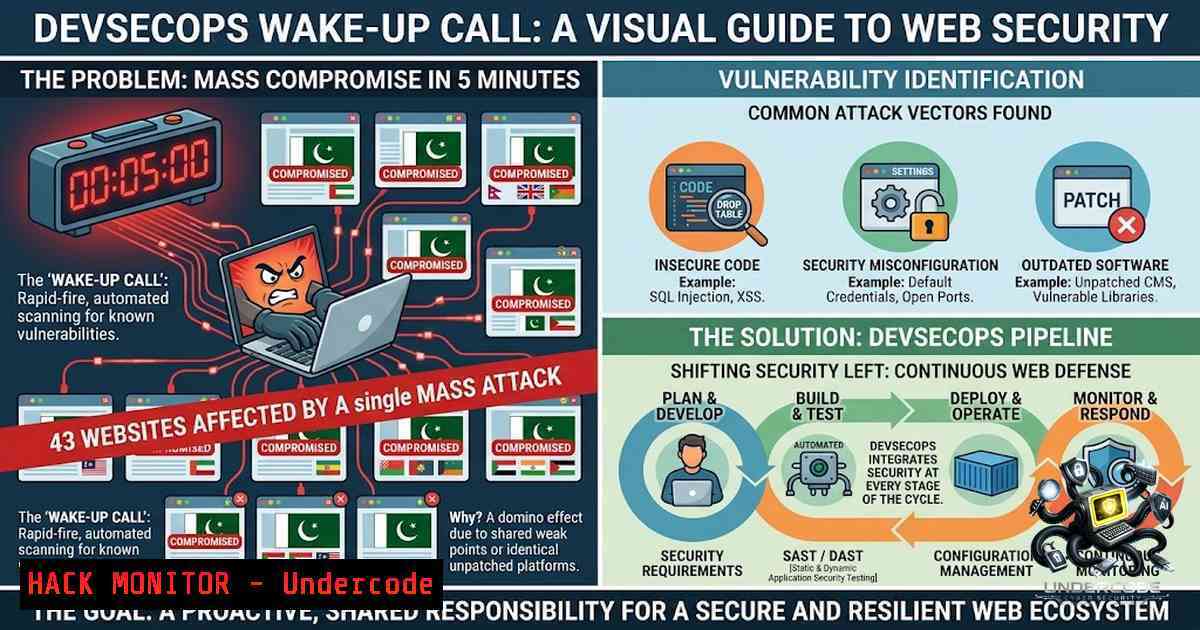
A recent security audit of 50 Pakistani websites revealed a staggering statistic: 43 of them—86%—could be compromised within five minutes. This finding is not an isolated anomaly but a symptom of a broader, systemic failure in web application security across South Asia’s rapidly digitizing economies. With Pakistan recording 517 cybersecurity incidents in 2025—a year-on-year increase of over 25%—and 98 incidents already documented in the first quarter of 2026 alone, the vulnerability of public and private sector websites has escalated from a technical concern to a national security imperative. The National Cyber Emergency Response Team (CERT) has been forced to place government websites into “read-only” mode, disabling forms and logins to prevent exploitation. This article dissects the technical underpinnings of these vulnerabilities, provides actionable DevSecOps strategies to mitigate them, and outlines a roadmap for hardening web infrastructure against the most common attack vectors.
Learning Objectives & Secrets
- Objective 1: Master the OWASP Top 10 (2026 Edition). Understand why Broken Access Control (A01) remains the top web application security risk, surpassing even injection flaws. Learn to identify and remediate Security Misconfiguration (A02), Cryptographic Failures (A04), and Identification and Authentication Failures (A07). Secret tip: Most automated scanners miss logic flaws like Broken Object Level Authorization (BOLA)—manual penetration testing and business logic reviews are non-1egotiable.
-
Objective 2: Implement Proactive Defenses Beyond the Checklist. Move beyond compliance-driven security (SOC 2, ISO 27001) to proactive, runtime defense. Secret tip: Deploy Web Application Firewall (WAF) rules in log-only mode for at least one week before enabling blocking to tune for false positives. Combine this with Cloudflare’s OWASP Paranoia Level PL3 and a medium anomaly score threshold (40+) for layered protection.
-
Objective 3: Embed Security into the CI/CD Pipeline (DevSecOps). Shift security left by integrating Static Application Security Testing (SAST) and Dynamic Application Security Testing (DAST) into your build pipeline. Secret tip: Use GitHub CodeQL or similar tools to identify common vulnerabilities like SQL injection during code commits, not after deployment. Never hardcode secrets—use environment variables or a dedicated secrets management solution.
You Should Know:
- The Anatomy of a 5-Minute Hack: Common Attack Vectors
The 43 websites were compromised using well-documented, yet frequently unpatched, vulnerabilities. The most prevalent attack vectors include:
- SQL Injection (SQLi): Attackers exploit interactive features like contact forms and search bars to inject malicious queries, gaining access to confidential databases.
- Cross-Site Scripting (XSS): Malicious scripts are injected into trusted websites, allowing attackers to steal session cookies, redirect users, or deface content.
- Broken Access Control (BAC)/Insecure Direct Object References (IDOR): Attackers manipulate parameters (e.g., `https://example.com/user?id=123`) to access unauthorized data.
- Security Misconfiguration: Outdated plugins, themes, and default credentials serve as easy entry points.
- Denial of Service (DoS): Complex backend queries are used to overwhelm servers, disrupting services.
Step-by-Step Guide: Conducting a Vulnerability Assessment
- Reconnaissance: Use tools like `nmap` to scan for open ports and services.
nmap -sV -p- target.com
- Automated Scanning: Deploy OWASP ZAP or Burp Suite for automated vulnerability scanning.
- Manual Exploitation: Attempt to exploit identified vulnerabilities (e.g., using `sqlmap` for SQLi).
sqlmap -u "http://target.com/page?id=1" --dbs
- Log Analysis: Review server logs for suspicious activity.
grep "POST /login" /var/log/apache2/access.log
2. Hardening Cloudflare WAF and Implementing Rate Limiting
Cloudflare WAF provides a critical defense layer against common attacks. However, default configurations are insufficient.
Step-by-Step Guide: Cloudflare WAF Hardening
- Enable Managed Rulesets: Activate Cloudflare’s Managed Rulesets, ensuring rules for XSS and SQL injection are enabled.
- Configure OWASP Ruleset: Set the OWASP Paranoia Level to PL3 (higher protection) and the Anomaly Score Threshold to Medium (40+).
- Implement Rate Limiting: Deploy multiple rate limiting rules with escalating penalties:
– Rule 1 (Short Window): 100 requests per 1 minute.
– Rule 2 (Medium Window): 500 requests per 10 minutes.
– Rule 3 (Long Window): 1,000 requests per 1 hour (block).
4. Custom Rules: Create custom rules to block known bad actors, restrict by geography, or protect specific endpoints (e.g., /admin, /api).
5. Log Mode First: Deploy new rules in log mode for one week to monitor for false positives before switching to block.
3. Performance Benchmarking with k6
Load and stress testing are essential for ensuring site reliability and identifying performance bottlenecks that could be exploited in DoS attacks.
Step-by-Step Guide: k6 Performance Testing
- Install k6: Linux/macOS: `brew install k6` | Windows:
choco install k6.
2. Create a Test Script (`script.js`):
import http from 'k6/http';
import { check, sleep } from 'k6';

export const options = {
stages: [
{ duration: '2m', target: 100 }, // ramp-up
{ duration: '5m', target: 100 }, // stay at 100 users
{ duration: '2m', target: 0 }, // ramp-down
],
};

export default function () {
const res = http.get('https://test.k6.io');
check(res, { 'status was 200': (r) => r.status == 200 });
sleep(1);
}
3. Run the Test: `k6 run script.js`.
- Generate a Report:
k6 run --out json=results.json script.js. - Analyze Metrics: Import results into Grafana/InfluxDB for visualization.
4. Automating Security Testing with Playwright
Integrate security assertions into your end-to-end (E2E) testing workflow using Playwright.
Step-by-Step Guide: Playwright Security Testing
1. Install Playwright: `npm init playwright@latest`.
2. Create a Security Test (`security.spec.ts`):
import { test, expect } from '@playwright/test';

test('should not have XSS vulnerabilities', async ({ page }) => {
await page.goto('https://example.com');
await page.fill('input[name="search"]', '<script>alert("XSS")</script>');
await page.click('button[type="submit"]');
// Assert that the script is not executed
await expect(page.locator('text=alert')).not.toBeVisible();
});
3. Integrate with CI: Run Playwright tests in your CI/CD pipeline (e.g., GitHub Actions).
4. Use Security Libraries: Integrate libraries like `qastell` for automated security audits.
5. Implementing ISO 27001 Security Controls
ISO 27001 provides a framework for managing information security.
Step-by-Step Guide: ISO 27001 Controls Implementation
1. Assign Roles: Define security roles and responsibilities.
- Conduct a Gap Analysis: Assess current security posture against ISO 27001 requirements.
- Develop an ISMS: Document your Information Security Management System.
4. Implement Controls (Annex A):
- A.12 (Operations Security): Implement vulnerability scanning (OpenVAS, Trivy).
- A.10 (Cryptography): Enforce TLS 1.2+ on all services.
- A.14 (System Acquisition): Integrate security into the SDLC.
- Monitor and Review: Continuously monitor and review controls.
6. Site Reliability Engineering (SRE) Best Practices
SRE focuses on building reliable and scalable systems.
Step-by-Step Guide: Implementing SRE Practices
- Define SLIs and SLOs: Establish Service Level Indicators (e.g., latency, error rate) and Objectives (e.g., 99.9% uptime).
- Implement Observability: Use metrics, logs, and distributed tracing.
- Manage Error Budgets: Use error budgets to balance reliability and feature velocity.
- Automate Toil: Automate manual, repetitive tasks to reduce toil.
- Conduct Incident Response: Formalize incident response procedures to reduce Mean Time to Resolution (MTTR).
7. DevSecOps Pipeline Integration
Embed security throughout the DevOps lifecycle.
Step-by-Step Guide: DevSecOps Pipeline Integration
- Pre-Commit & Build: Integrate SAST tools (e.g., GitHub CodeQL).
- Continuous Integration: Run DAST and software composition analysis (SCA) scans.
- Secrets Management: Use tools like HashiCorp Vault to manage secrets.
4. Container Security: Scan Docker images for vulnerabilities.
- Deployment & Operations: Implement runtime application self-protection (RASP).
What Undercode Say:
- Key Takeaway 1: The 86% vulnerability rate among Pakistani websites is a stark indicator of inadequate security practices, highlighting the urgent need for DevSecOps adoption and continuous security monitoring.
-
Key Takeaway 2: Proactive measures such as WAF hardening, rate limiting, and automated security testing in CI/CD pipelines are essential to mitigate the risks of SQL injection, XSS, and broken access control—the top OWASP vulnerabilities.
The findings from this audit serve as a critical wake-up call for organizations worldwide. The fact that 43 out of 50 websites could be compromised in under five minutes underscores a fundamental failure in security fundamentals: outdated components, misconfigurations, and a lack of runtime protection. While reactive measures like CERT’s “read-only” mandate provide temporary relief, they are not sustainable solutions. The path forward lies in a cultural shift toward DevSecOps, where security is not an afterthought but an integral part of the development lifecycle. By embedding security into CI/CD pipelines, implementing robust WAF configurations, and adopting SRE principles for reliability, organizations can move from a state of perpetual vulnerability to one of proactive defense. The threat landscape is evolving rapidly, with state-sponsored APT groups and hacktivists increasingly targeting digital infrastructure. The time to act is now—before the next 5-minute window closes.
Prediction:
- +1 The adoption of DevSecOps practices and automated security testing will significantly reduce the average time to detect and remediate vulnerabilities, leading to a more resilient digital ecosystem.
-
+1 Increased awareness and regulatory pressure will drive the implementation of ISO 27001 and SOC 2 compliance, improving overall security posture.
-
-1 Without widespread adoption of proactive security measures, the frequency and severity of cyberattacks on government and private sector websites will continue to rise, potentially leading to significant data breaches and operational disruptions.
-
-1 The reliance on reactive measures like “read-only” mode may create a false sense of security, delaying the investment in necessary long-term security infrastructure.
▶️ Related Video (82% Match):
https://www.youtube.com/watch?v=90beNl7eLXc
🎯Let’s Practice For Free:
🎓 Live Courses & Certifications:
Join Undercode Academy for Verified Certifications
🚀 Request a Custom Project:
Secure, high-velocity infrastructure and disruptive technological engineering. Contact our engineering team for high-tier development and proprietary systems:
[email protected]
💎 Smart Architecture | 🛡️ Secure by Design | ⭐ Trusted by Thousands
IT/Security Reporter URL:
Reported By: https://lnkd.in/p/eTgHT5Wy – Hackers Feeds
Extra Hub: Undercode MoN
Basic Verification: Pass ✅


