Listen to this Post
Introduction
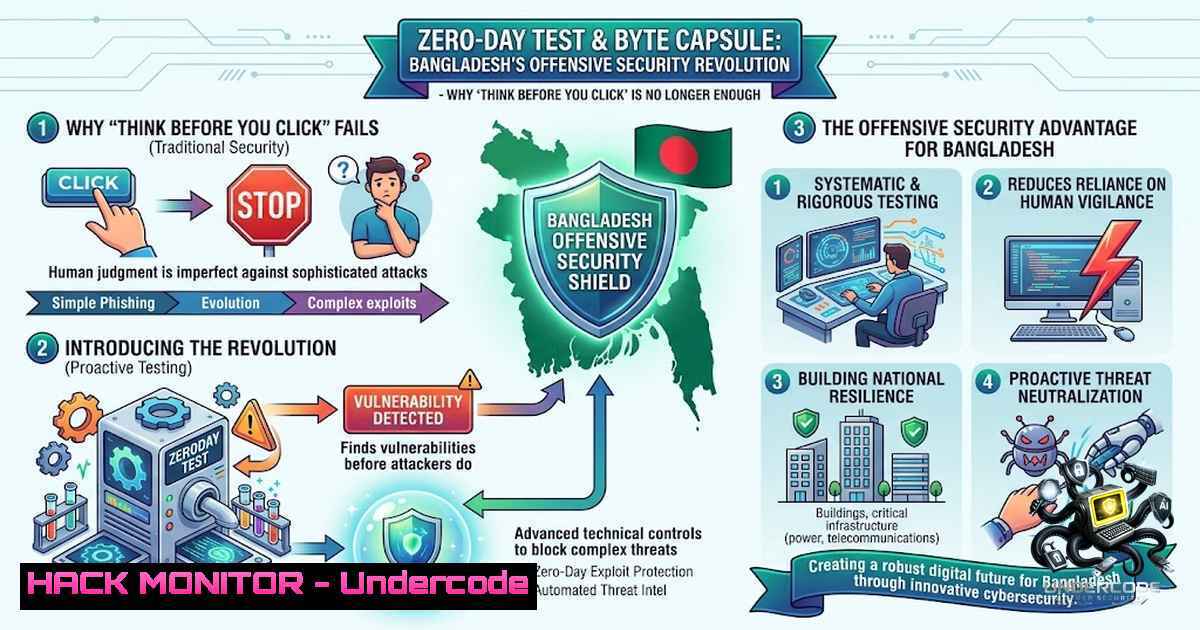
The vast majority of cyberattacks begin with a single, seemingly innocuous mistake: a curious click on a suspicious link or the download of an unfamiliar file attachment. As digital ecosystems expand across Bangladesh and the globe, cyber threats evolve faster than traditional security models can respond. Organizations can no longer rely solely on reactive defenses; they must embrace proactive security frameworks that identify and neutralize vulnerabilities before attackers can exploit them. This article explores the offensive security landscape through the lenses of Byte Capsule – an ISO 27001-accredited cybersecurity startup – and ZeroDay Test – Bangladesh’s first structured Bug Bounty and Vulnerability Disclosure Program (VDP) platform – while delivering actionable technical guidance for security professionals and enthusiasts alike.
Learning Objectives
- Understand the core principles of bug bounty programs and responsible disclosure frameworks
- Master practical command-line techniques for vulnerability assessment and penetration testing across Linux and Windows environments
- Implement multi-factor authentication (MFA), system hardening, and backup strategies to mitigate common attack vectors
- Leverage AI-assisted triage and crowdsourced security models for continuous vulnerability monitoring
- Apply real-world exploitation and mitigation techniques for web application and infrastructure security
You Should Know
1. Bug Bounty Fundamentals & Responsible Disclosure
Bug bounty programs represent a paradigm shift in cybersecurity – they transform ethical hackers from potential threats into active defenders. ZeroDay Test, launched on May 1, 2026, connects organizations with trusted security researchers across the globe, enabling responsible disclosure with strong legal and compliance foundations. Unlike conventional one-time VAPT (Vulnerability Assessment and Penetration Testing) engagements, continuous crowdsourced testing can reduce costs by approximately 60 to 80 percent while establishing ongoing security monitoring.
The platform leverages AI-assisted triage to improve report validation and efficiency, addressing a critical pain point in traditional bug bounty operations: the overwhelming volume of duplicate or low-quality submissions. Over 400 ethical hackers have already participated in pilot projects, with nine organizations awaiting onboarding.
Step‑by‑step guide: Submitting a Vulnerability Report Professionally
- Scope Definition: Before testing, review the organization’s scope document to identify in‑scope assets (domains, IP ranges, applications) and out‑of‑scope targets.
- Reconnaissance: Perform passive reconnaissance using tools like
whois,dnsrecon, and `sublist3r` to map the attack surface. - Vulnerability Discovery: Conduct active testing within the defined scope. For web applications, use Burp Suite or OWASP ZAP.
- Proof of Concept (PoC) Development: Create a reproducible PoC that demonstrates the vulnerability without causing damage. Include screenshots, curl commands, or Python scripts.
- Report Writing: Structure your report with: , Description, Impact, Steps to Reproduce, Remediation Recommendation, and CVSS Score.
- Responsible Disclosure: Submit through the platform’s designated channel. Do not disclose publicly until the organization has patched the issue.
Linux Command Example – Subdomain Enumeration:
 Using sublist3r for passive subdomain discovery
sublist3r -d example.com -o subdomains.txt

Using amass for more comprehensive enumeration
amass enum -d example.com -o amass_output.txt

Resolving subdomains to IP addresses
for sub in $(cat subdomains.txt); do host $sub | grep "has address"; done
Windows PowerShell Example – Basic Port Scanning:
 Test common web ports on a target
1..1024 | ForEach-Object {
$tcp = New-Object System.Net.Sockets.TcpClient
try { $tcp.Connect("target.com", $<em>); Write-Host "Port $</em> open" } catch {}
$tcp.Dispose()
}
- Multi-Factor Authentication (MFA) – Your First Line of Defense
Anisur Rahman’s post rightly emphasizes MFA as a cornerstone of personal and organizational security. MFA adds a critical layer beyond passwords, significantly reducing the risk of account compromise even when credentials are stolen through phishing or data breaches.
Step‑by‑step guide: Enforcing MFA Across Your Infrastructure
- Assessment: Audit all systems that support MFA – email platforms, VPNs, cloud consoles, and critical applications.
- Select MFA Methods: Choose from TOTP (Time‑based One‑Time Password via authenticator apps), FIDO2/WebAuthn (hardware security keys), or SMS (least secure, avoid if possible).
- Enforce for All Users: Implement conditional access policies requiring MFA for all authentication attempts, especially from untrusted networks.
- Backup Codes: Generate and securely store backup codes for account recovery.
- Monitor and Audit: Regularly review MFA logs for anomalies – repeated failed attempts may indicate brute‑force or phishing attempts.
Linux Command – Generate TOTP Secret for Applications:
 Install oathtool
sudo apt-get install oathtool

Generate a base32-encoded secret
head -c 20 /dev/urandom | base32

Generate a TOTP code (for testing)
oathtool --totp -b "JBSWY3DPEHPK3PXP"
Windows Command – Enable MFA via PowerShell (Azure AD):
 Connect to Azure AD
Connect-MgGraph -Scopes "User.Read.All", "Policy.ReadWrite.AuthenticationMethod"

Enforce MFA for all users via authentication methods policy
Update-MgPolicyAuthenticationMethodPolicy -AuthenticationMethodConfigurations @(
@{
"@odata.type" = "microsoft.graph.authenticationMethodsPolicy"
Id = "MicrosoftAuthenticator"
State = "enabled"
}
)
3. Web Application Security Testing – Hands‑On Techniques
Web application vulnerabilities remain the most common entry point for attackers. Byte Capsule offers specialized training in web application penetration testing, while ZeroDay Test provides a platform for ethical hackers to discover and report these flaws. Critical vulnerabilities like authentication bypass (CVE-2026-41940) in cPanel/WHM and CRLF injection attacks highlight the need for rigorous testing.
Step‑by‑step guide: Web Application Vulnerability Assessment
- Intercept and Analyze Traffic: Configure Burp Suite or OWASP ZAP as a proxy to capture all HTTP/HTTPS requests between your browser and the target application.
- Map the Application: Use the proxy’s sitemap feature to discover all endpoints, parameters, and hidden directories.
- Test for OWASP Top 10: Systematically test for Injection (SQL, NoSQL, OS Command), Broken Authentication, Sensitive Data Exposure, XXE, Broken Access Control, Security Misconfigurations, XSS, Insecure Deserialization, and Logging Failures.
- Automated Scanning: Run the proxy’s active scanner to identify low‑hanging fruit, but always verify results manually to avoid false positives.
- Business Logic Testing: Manually test for logic flaws – privilege escalation, rate limiting bypass, and workflow manipulation.
- API Security Testing: Test REST and GraphQL endpoints for excessive data exposure, broken object level authorization (BOLA), and mass assignment.
Linux Command – SQL Injection Detection with sqlmap:
 Basic SQL injection test on a vulnerable parameter
sqlmap -u "http://target.com/page?id=1" --dbs

Advanced test with cookie authentication
sqlmap -u "http://target.com/page?id=1" --cookie="PHPSESSID=abc123" --level=3 --risk=2
Linux Command – XSS Payload Testing with curl:
 Test for reflected XSS
curl -X GET "http://target.com/search?q=<script>alert('XSS')</script>"

Test for DOM-based XSS via URL fragment
curl -X GET "http://target.com/<img src=x onerror=alert(1)>"
Windows Command – Using Nmap for Web Service Discovery:
 Scan for common web ports with service detection
nmap -sV -p 80,443,8080,8443 target.com

Use NSE scripts for vulnerability scanning
nmap --script=http-vuln -p 80 target.com
4. System Hardening & Patch Management
Regular software updates are non‑negotiable. Attackers weaponize known vulnerabilities within hours of public disclosure, making unpatched systems low‑hanging fruit. Byte Capsule emphasizes continuous security awareness and training, which must include rigorous patch management protocols.
Step‑by‑step guide: Automated Patch Management
- Inventory: Maintain an up‑to‑date asset inventory including operating systems, applications, and firmware versions.
- CVE Monitoring: Subscribe to CVE feeds (NVD, CISA KEV) relevant to your technology stack.
- Prioritization: Use CVSS scores and exploit availability to prioritize patches – critical and actively exploited vulnerabilities first.
- Test in Staging: Always test patches in a non‑production environment before deployment.
- Deploy in Batches: Use phased rollouts to minimize disruption.
- Verify and Document: Confirm patch installation and document changes for audit trails.
Linux Command – Automated Updates:
 Ubuntu/Debian – enable unattended upgrades
sudo apt-get install unattended-upgrades
sudo dpkg-reconfigure --priority=low unattended-upgrades

Configure automatic security updates
echo 'Unattended-Upgrade::Allowed-Origins {
"${distro_id}:${distro_codename}-security";
};' | sudo tee /etc/apt/apt.conf.d/50unattended-upgrades
Windows PowerShell – Patch Management with PSWindowsUpdate:
 Install PSWindowsUpdate module
Install-Module PSWindowsUpdate -Force

Check for available updates
Get-WUList

Install critical updates only
Install-WindowsUpdate -MicrosoftUpdate -AcceptAll -AutoReboot -Category "Critical"
Windows Command – Check Installed Patches:
wmic qfe list brief /format:table
5. Cloud Infrastructure Hardening
As organizations migrate to the cloud, misconfigurations become the primary attack vector. Byte Capsule’s risk assessment and security gap analysis services are particularly relevant here, helping organizations identify and remediate cloud‑specific risks.
Step‑by‑step guide: AWS Security Hardening
1. Identity and Access Management (IAM):
- Enforce least privilege with precise IAM policies.
- Enable MFA for all users, especially root accounts.
- Rotate access keys regularly.
- Use IAM roles instead of long‑term credentials for EC2 instances.
2. Network Security:
- Implement Security Groups and Network ACLs with minimal open ports.
- Use VPC Flow Logs to monitor traffic.
- Deploy AWS WAF and Shield for DDoS protection.
3. Data Protection:
- Enable encryption at rest (S3, EBS, RDS) and in transit (TLS).
- Use AWS KMS for key management.
- Implement S3 bucket policies to prevent public exposure.
4. Monitoring and Logging:
- Enable CloudTrail for API audit logging.
- Use GuardDuty for threat detection.
- Configure CloudWatch alarms for anomalous activity.
AWS CLI Command – Enforce S3 Bucket Encryption:
 Enable default encryption on an S3 bucket
aws s3api put-bucket-encryption \
--bucket my-bucket \
--server-side-encryption-configuration '{
"Rules": [
{"ApplyServerSideEncryptionByDefault": {"SSEAlgorithm": "AES256"}}
]
}'
AWS CLI Command – Audit Publicly Accessible S3 Buckets:
 List all buckets and check public access
aws s3api list-buckets --query "Buckets[].Name" | \
while read bucket; do
aws s3api get-bucket-acl --bucket $bucket --query "Grants[?Grantee.URI=='http://acs.amazonaws.com/groups/global/AllUsers']"
done
6. Malware Analysis & Ransomware Protection
Ransomware attacks have become increasingly sophisticated, with attackers using double‑extortion tactics – encrypting data and threatening to leak it. Byte Capsule offers dedicated ransomware protection and detection services, as well as malware assessment capabilities.
Step‑by‑step guide: Ransomware Defense Strategy
- Endpoint Protection: Deploy EDR (Endpoint Detection and Response) solutions with behavioral monitoring.
- Email Filtering: Implement advanced email security with attachment sandboxing and URL rewriting.
- Network Segmentation: Isolate critical systems and data to limit lateral movement.
- Backup Strategy: Implement the 3‑2‑1 rule – 3 copies, 2 different media, 1 offsite/offline.
- Incident Response Plan: Develop and test a ransomware-specific IR plan.
- User Awareness: Train users to identify phishing and social engineering attempts.
Linux Command – Basic Malware Detection with ClamAV:
 Install ClamAV
sudo apt-get install clamav clamav-daemon

Update virus definitions
sudo freshclam

Scan a directory recursively
clamscan -r /home/user/downloads

Scan with removal of infected files (use with caution)
clamscan -r --remove /home/user/downloads
Windows PowerShell – Monitor Suspicious Processes:
 List processes with network connections (potential C2)
Get-1etTCPConnection | Where-Object {$<em>.State -eq "Established"} |
Select-Object LocalAddress, LocalPort, RemoteAddress, RemotePort,
@{Name="Process";Expression={(Get-Process -Id $</em>.OwningProcess).ProcessName}}

Check for scheduled tasks created recently
Get-ScheduledTask | Where-Object {$_.Date -gt (Get-Date).AddDays(-7)}
7. AI-Assisted Security Operations
ZeroDay Test’s integration of AI-assisted triage represents a significant advancement in security operations. AI can dramatically reduce the time between vulnerability discovery and remediation by automating report validation, deduplication, and prioritization.
Step‑by‑step guide: Implementing AI in Your Security Workflow
- Log Aggregation: Centralize logs from all sources (firewalls, servers, applications, cloud) into a SIEM.
- Anomaly Detection: Deploy machine learning models to identify deviations from baseline behavior.
- Automated Triage: Use AI to classify alerts by severity and potential impact, reducing false positives.
- Threat Intelligence Integration: Feed AI models with real‑time threat intelligence for contextual analysis.
- Continuous Learning: Retrain models regularly with new threat data and feedback from security analysts.
Linux Command – Basic Log Analysis with grep and awk:
 Analyze SSH authentication failures
grep "Failed password" /var/log/auth.log | awk '{print $9}' | sort | uniq -c | sort -1r

Identify potential brute-force attacks (more than 10 failures from same IP)
grep "Failed password" /var/log/auth.log | awk '{print $11}' | sort | uniq -c | awk '$1 > 10'
Python Snippet – Simple Anomaly Detection:
import numpy as np
from scipy import stats

Example: Detect anomalous login times
login_times = [8, 9, 8, 10, 9, 8, 22, 9, 8]  Hours
z_scores = np.abs(stats.zscore(login_times))
anomalies = [i for i, z in enumerate(z_scores) if z > 2]
print(f"Anomalous login events at indices: {anomalies}")
What Undercode Say
- Key Takeaway 1: Cybersecurity is not solely the responsibility of IT teams – it is a collective duty that requires awareness, vigilance, and proactive participation from every individual within an organization.
-
Key Takeaway 2: The launch of ZeroDay Test marks a pivotal moment for Bangladesh’s cybersecurity landscape, establishing a structured, legal framework for ethical hacking that bridges the gap between organizations and security researchers while dramatically reducing the cost of continuous security testing.
Analysis: The post by Anisur Rahman encapsulates a critical truth: most cyber incidents stem from human error – a careless click, a missed update, or a disabled security control. Byte Capsule’s recognition with the Bangabandhu International Cyber Security Awareness Award 2023 underscores the growing importance of security awareness in Bangladesh’s rapidly digitizing economy. ZeroDay Test’s crowdsourced model represents a maturation of the cybersecurity ecosystem, moving beyond theoretical awareness to practical, continuous vulnerability discovery. For security professionals, this means embracing both defensive hygiene (MFA, patching, backups) and offensive skills (ethical hacking, bug hunting) as complementary disciplines. The integration of AI-assisted triage further signals that the future of security lies in intelligent automation that amplifies human expertise rather than replacing it. Organizations that fail to adopt these proactive, collaborative models will remain vulnerable to the ever‑evolving threat landscape.
Prediction
- -1 Organizations that continue to treat cybersecurity as an IT-only concern will face increasingly severe breaches, with ransomware attacks and supply chain compromises becoming the primary vectors of financial and reputational damage over the next 24 months.
-
+1 The crowdsourced security model pioneered by platforms like ZeroDay Test will become the global standard for vulnerability discovery, with AI‑assisted triage reducing mean time to remediation by 70% and making continuous security testing accessible to organizations of all sizes.
-
+1 Bangladesh’s cybersecurity workforce will experience significant growth as platforms like ZeroDay Test and training programs from Byte Capsule create a pipeline of skilled ethical hackers, positioning the country as a regional hub for security research and innovation.
-
-1 The rapid adoption of AI in security operations will create a skills gap, as organizations struggle to find professionals capable of managing, interpreting, and acting upon AI-generated security insights without becoming overly reliant on automated systems.
-
+1 Regulatory frameworks for responsible disclosure and bug bounty programs will mature globally, providing clearer legal protections for ethical hackers and encouraging more organizations to adopt proactive security testing models.
▶️ Related Video (70% Match):
https://www.youtube.com/watch?v=3ytqP1QvhUc
🎯Let’s Practice For Free:
🎓 Live Courses & Certifications:
Join Undercode Academy for Verified Certifications
🚀 Request a Custom Project:
Secure, high-velocity infrastructure and disruptive technological engineering. Contact our engineering team for high-tier development and proprietary systems:
[email protected]
💎 Smart Architecture | 🛡️ Secure by Design | ⭐ Trusted by Thousands
IT/Security Reporter URL:
Reported By: Whoami Anisur – Hackers Feeds
Extra Hub: Undercode MoN
Basic Verification: Pass ✅


