Listen to this Post
Introduction:
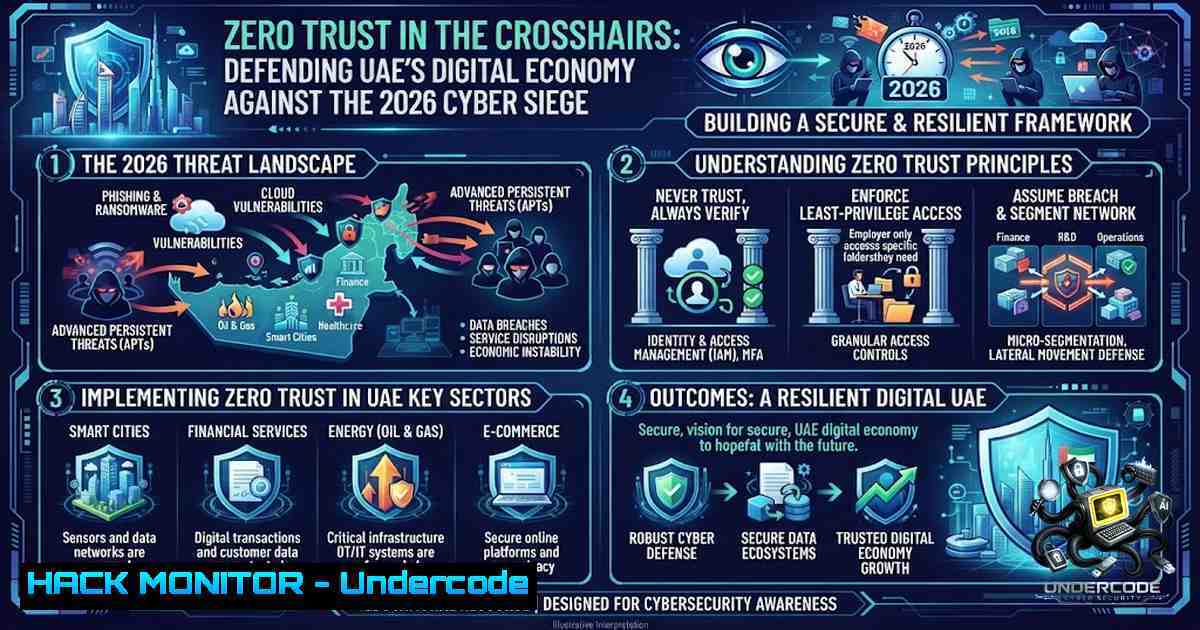
The digital transformation of the UAE has positioned it as a global economic powerhouse, but this rapid digitization has also turned it into a prime target for sophisticated cyber adversaries. Recent reports from the UAE’s Cybersecurity Council, in collaboration with CPX, highlight a staggering 40% surge in cyberattacks during the first half of 2026, with threat actors leveraging AI-driven malware and advanced social engineering tactics to breach critical national infrastructure and financial institutions. This article dissects the current threat landscape, pivoting from traditional perimeter defenses to a Zero Trust Architecture (ZTA) that assumes breach and verifies every access request, providing a technical deep-dive into hardening strategies essential for modern enterprise resilience.
Learning Objectives:
- Understand the core principles of Zero Trust and how they mitigate AI-driven supply chain and credential-based attacks.
- Implement advanced identity and access management (IAM) controls and conditional access policies to thwart lateral movement.
- Apply actionable command-line hardening techniques for Linux, Windows, and cloud-1ative environments to enforce least-privilege access.
You Should Know:
- The Anatomy of the 2026 UAE Threat Landscape
The recent cybersecurity bulletin from the UAE’s Cybersecurity Council reveals a shift in tactics: attackers are no longer just exploiting known vulnerabilities but are utilizing generative AI to create polymorphic phishing payloads and deepfake-based voice/video fraud to bypass legacy authentication. The CPX Threat Report 2026 indicates that 68% of observed attacks involved credential harvesting via malicious OAuth apps and compromised service principals. This methodology allows attackers to gain initial access through seemingly legitimate third-party integrations, avoiding traditional malware detection. To counter this, organizations must assume that their network is already compromised and enforce granular micro-segmentation. The key is to isolate application workloads and data stores, ensuring that even if an identity is compromised, the blast radius is contained. -
Step-by-Step: Implementing Zero Trust Conditional Access in Azure AD
A core tenet of Zero Trust is enforcing risk-based conditional access. Here is a step-by-step guide to hardening your Entra ID (Azure AD) environment against the credential replay attacks prevalent in the region.
- Step 1: Audit Existing Sign-In Logs: Use the Azure portal to navigate to Entra ID > Monitoring > Sign-in logs. Filter for “Interrupted” sign-ins to identify current risk patterns.
- Step 2: Define Risk Policies: Navigate to Security > Conditional Access > Named locations and define your trusted IP ranges (corporate offices). In Conditional Access policies, create a new policy. Set “User and groups” to “All users.” Under “Cloud apps or actions,” select “All cloud apps.”
- Step 3: Configure Grant Controls: Set the “Grant” control to require “Multifactor authentication” and require “Device to be marked as compliant.”
- Step 4: Session Controls: Enable “Sign-in frequency” and set it to “1 hour” for high-risk profiles. Ensure that persistent browser sessions are disabled for sensitive roles.
3. Linux Hardening: Locking Down Privilege Escalation Vectors
To prevent the lateral movement commonly seen in post-exploitation phases, Linux systems require strict privilege controls. Attackers often leverage misconfigured SUDO permissions. Below is a hardening routine focused on the principle of least privilege.
Command Audit and Configuration:
 Audit users with sudo privileges
grep -Po '^sudo.+:\K.$' /etc/group

Run a privileges check on critical binaries
find / -perm -4000 -type f 2>/dev/null  Identify SUID binaries (potential risk)
 Remove write permissions from /etc/sudoers
chmod 440 /etc/sudoers
Step-by-Step Justification:
- Identify: The `grep` command checks the group file to list users authorized to execute root commands. If you find unexpected users (e.g., guest accounts), remove them via
sudo delusersudo</code>.</li> <li>Restrict SUID: The `find` command lists files with the Set User ID bit. Using `chmod 755 [bash]` on unnecessary SUID binaries (like `screen` or <code>pkexec</code>) prevents standard users from executing them with root privileges, stopping potential local privilege escalation exploits (like PwnKit).</li> <li>Harden Audit Logs: Enable process accounting to track command executions: [bash] sudo systemctl start psacct sudo systemctl enable psacct
This logs every command run, providing forensic evidence in the event of a breach.
-
Windows Endpoint Security: Disabling SMB and RDP Hardening
In the wake of ransomware attacks targeting the UAE's healthcare sector, hardening lateral movement protocols like SMB and RDP is critical. While patching is essential, disabling insecure fallback protocols is equally vital.
Step-by-Step Hardening:
- Step 1: Disable SMBv1: Run PowerShell as Administrator and execute:
Disable-WindowsOptionalFeature -Online -FeatureName SMB1Protocol
- Step 2: Network Level Authentication (NLA): Ensure RDP requires NLA. Access `System Properties` > `Remote` > Ensure "Allow connections only from computers running Remote Desktop with Network Level Authentication" is checked.
- Step 3: Block Lateral Movement via Local Admin: Prevent attackers from using pass-the-hash. In PowerShell:
Restrict local admin account access over network
New-ItemProperty -Path "HKLM:\SOFTWARE\Microsoft\Windows\CurrentVersion\Policies\System" -1ame "LocalAccountTokenFilterPolicy" -Value 0 -PropertyType DWord -Force
This blocks remote network logons for local admin accounts, forcing attackers to compromise domain accounts with MFA.
5. Kubernetes and Cloud Security: Implementing Network Policies
The CPX report emphasizes attacks targeting containerized workloads. A common vulnerability is an open network policy. Zero Trust requires explicit allow rules. This segment focuses on restricting pod-to-pod communication in Kubernetes clusters (often deployed in AWS EKS or Azure AKS) to prevent a compromised microservice from accessing backend databases.
Implementation Guide:
- Default Deny: Apply a default deny policy to block all ingress and egress traffic unless explicitly allowed.
apiVersion: networking.k8s.io/v1
kind: NetworkPolicy
metadata:
name: default-deny-all
spec:
podSelector: {}
policyTypes:</li>
</ol>

- Ingress
- Egress
Apply using `kubectl apply -f deny.yaml`.
- Allow Specific Frontend-Backend: Create a policy to allow the frontend pod to only access the backend API on port 8080.
apiVersion: networking.k8s.io/v1
kind: NetworkPolicy
metadata:
name: allow-frontend-to-backend
spec:
podSelector:
matchLabels:
app: backend
policyTypes:</li>
</ol>

- Ingress
ingress:
- from:
- podSelector:
matchLabels:
app: frontend
ports:
- protocol: TCP
port: 8080
This application-layer segmentation ensures that even if the frontend is exploited, the attacker cannot pivot to a database service unless a specific policy exists.
6. API Security & Secret Management
Given the increased reliance on APIs for financial services in the UAE, securing API keys is crucial. Hardcoding secrets in repositories is a primary entry vector. Utilize HashiCorp Vault or Azure Key Vault. For Linux environments, manage service account tokens effectively.
- Linux Commands for Env Vars: Avoid passing secrets in environment variables as they are visible in
/proc. Use encrypted files. - Audit Command: Check for secrets in environment space:
ps eww -u [bash] | grep -i "secret|key|password"
- Remediation: Rotate keys immediately using CLI tools. For AWS CLI:
aws iam create-access-key --user-1ame [bash]
Invalidate old key
aws iam update-access-key --access-key-id [bash] --status Inactive --user-1ame [bash]
Ensure these commands are logged to CloudTrail for audit purposes.
What Undercode Say:
- Key Takeaway 1: The focus must shift from preventing breaches to assuming breach and isolating assets. Micro-segmentation and just-in-time (JIT) access, rather than standing privileges, are the future for mitigating AI-driven threat actors.
- Key Takeaway 2: Incident response plans need to incorporate "identity containment" as a primary playbook. Reeling in compromised OAuth tokens is faster than patching kernel vulnerabilities, requiring a robust SIEM integration for identity anomalies.
- Analysis: The rise of "Malicious OAuth Consent Phishing" demonstrates a fundamental shift in attack vectors. Defenders are currently under-equipped to monitor third-party permissions. Security teams must integrate application governance into their daily alert triage. The UAE's focus on cloud migration requires a workforce capable of managing identity risks over network ports. Furthermore, traditional security training fails to account for deepfake social engineering; therefore, biometric authentication methods must incorporate liveness detection to remain effective. The government's push for a "Zero Trust Mandate" by 2027 will require an overhaul of legacy authentication methods, emphasizing device health checks (compliance) over simple IP allowlisting. This is a wake-up call that supply chain risk is now an identity risk.
Prediction:
- +1: The UAE will emerge as a global leader in Zero Trust implementation, driving innovation in AI-based policy engines that dynamically adjust trust scores based on user behavior analytics (UEBA), leading to a specialized cybersecurity niche market.
- -1: As organizations scramble to implement MFA, we predict a surge in "MFA fatigue" attacks and SIM-swapping campaigns targeting telecom providers in the region, specifically aimed at bypassing SMS-based authentication methods.
- -1: The gap between patching cycles and exploit development (time-to-exploit) will drop below 4 hours for critical cloud infrastructure vulnerabilities, leading to an increased reliance on automated patch management systems and "Chaos Engineering" to test resilience in production.
▶️ Related Video (80% Match):
🎯Let’s Practice For Free:
🎓 Live Courses & Certifications:
Join Undercode Academy for Verified Certifications
🚀 Request a Custom Project:
Secure, high-velocity infrastructure and disruptive technological engineering. Contact our engineering team for high-tier development and proprietary systems:
[email protected]
💎 Smart Architecture | 🛡️ Secure by Design | ⭐ Trusted by ThousandsIT/Security Reporter URL:
Reported By: Santhoshk1 Cybersecurity - Hackers Feeds
Extra Hub: Undercode MoN
Basic Verification: Pass ✅🔐JOIN OUR CYBER WORLD [ CVE News • HackMonitor • UndercodeNews ]
📢 Follow UndercodeTesting & Stay Tuned:
- Linux Commands for Env Vars: Avoid passing secrets in environment variables as they are visible in
- Allow Specific Frontend-Backend: Create a policy to allow the frontend pod to only access the backend API on port 8080.


