
Listen to this Post
Introduction:
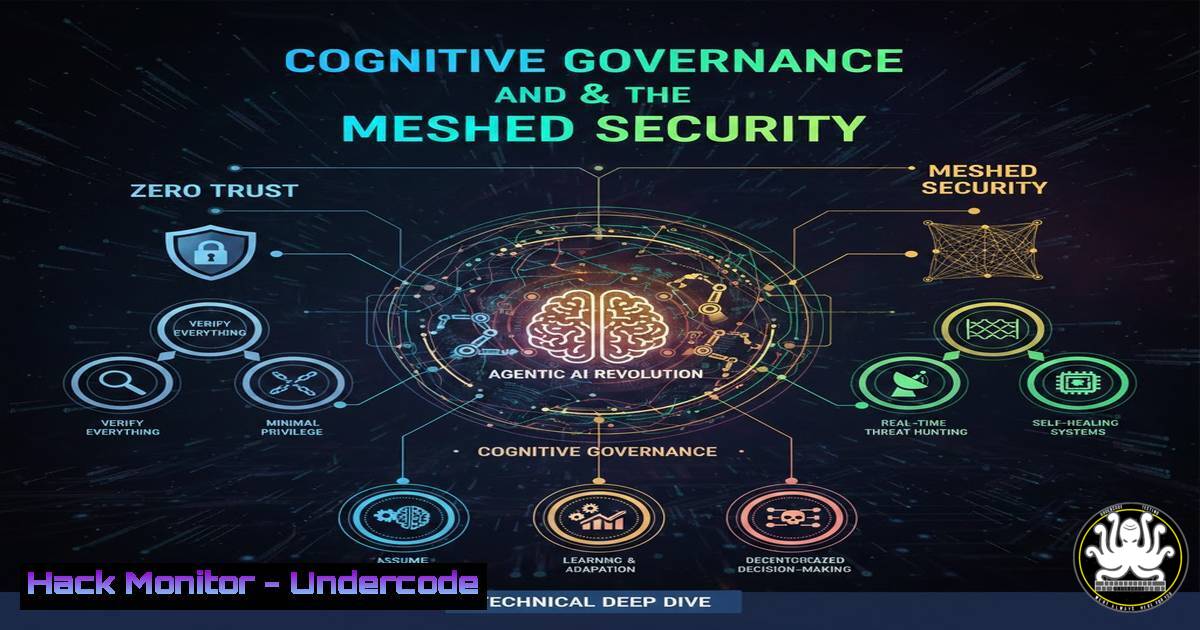
The convergence of Zero Trust Architecture (ZTA), Distributed Ledger Technology (DLT), and cognitive AI is redefining the landscape of information governance. As highlighted by Alan Lloyd’s work on CuMesh, the future lies in “Agentic AI”—autonomous systems operating within a meshed networking framework that requires dynamic, rule-based control. This article dissects the technical underpinnings of building a secure, compliant AI services hub, focusing on the intersection of regulatory mandates (SFDR), digital asset trust, and the practical implementation of ZTA in a world where AI agents act autonomously.
Learning Objectives:
- Objective 1: Understand the architectural shift from perimeter-based security to Zero Trust in the context of Agentic AI.
- Objective 2: Learn to implement core cryptographic trust anchors (PKI, DLT) for AI service verification.
- Objective 3: Acquire practical skills to harden API gateways and apply compliance controls to autonomous agent interactions.
You Should Know:
1. Zero Trust and Micro-segmentation for Agentic AI
The CuMesh approach emphasizes meshed networking. In a Zero Trust model, we assume breach and verify explicitly each request, regardless of origin. For Agentic AI, this means every AI agent-to-agent communication must be treated as a potential threat.
Step‑by‑step guide: Implementing Micro-segmentation with Linux iptables for AI Workloads
To isolate AI agent communication on a Linux host, we can use network namespaces and iptables to enforce strict allow-lists.
 Create a network namespace for an AI agent
sudo ip netns add agent_alpha

Create a virtual Ethernet pair
sudo ip link add veth0 type veth peer name veth1

Move one end to the agent's namespace
sudo ip link set veth1 netns agent_alpha

Configure IPs
sudo ip addr add 10.0.1.1/24 dev veth0
sudo ip link set veth0 up
sudo ip netns exec agent_alpha ip addr add 10.0.1.2/24 dev veth1
sudo ip netns exec agent_alpha ip link set veth1 up
sudo ip netns exec agent_alpha ip link set lo up

Apply strict iptables rules on the host to only allow agent_alpha to talk to a specific API gateway (e.g., 10.0.1.100)
sudo iptables -A FORWARD -s 10.0.1.2 -d 10.0.1.100 -j ACCEPT
sudo iptables -A FORWARD -s 10.0.1.2 -j DROP
This micro-segmentation ensures that if an agent is compromised, it cannot laterally move to other sensitive data stores.
2. PKI and Digital Identity for Trust Anchors
Alan Lloyd’s background in PKI is critical. For Agentic AI, every service and agent must have a verifiable identity. We can leverage mTLS (mutual TLS) to ensure that both the client (agent) and server are who they claim to be.
Step‑by‑step guide: Generating SPIFFE-compliant Identities for Agents using OpenSSL and SPIRE
The SPIFFE (Secure Production Identity Framework For Everyone) standard is ideal for dynamic workloads. While SPIRE is the full implementation, we can simulate the concept by creating short-lived certificates.
 Generate a CA key (if not already present)
openssl genrsa -out ca.key 4096
openssl req -x509 -new -nodes -key ca.key -sha256 -days 1024 -out ca.crt -subj "/C=US/ST=State/O=CuMesh/CN=AgentMeshCA"

Generate a key and CSR for an AI agent (spiffe://example.com/agent/alpha)
openssl genrsa -out agent-alpha.key 2048
openssl req -new -key agent-alpha.key -out agent-alpha.csr -subj "/C=US/ST=State/O=CuMesh/CN=agent-alpha" -addext "subjectAltName = URI:spiffe://example.com/agent/alpha"

Sign the certificate with the CA (valid for 1 hour for zero-trust rotation)
openssl x509 -req -in agent-alpha.csr -CA ca.crt -CAkey ca.key -CAcreateserial -out agent-alpha.crt -days 1 -sha256 -extfile <(printf "subjectAltName=URI:spiffe://example.com/agent/alpha")
These certificates are used by Envoy or NGINX sidecar proxies to enforce mTLS between agent communication channels.
- DLT for Immutable Audit Trails (Reg-Tech & Compliance)
To meet regulatory requirements like SFDR (Sustainable Finance Disclosure Regulation), all AI decisions impacting digital assets must be auditable. Storing hashes of decisions on a blockchain provides an immutable ledger.
Step‑by‑step guide: Anchoring an AI Decision Hash to a Hyperledger Fabric Network
Assuming you have a Hyperledger Fabric network set up, we can invoke a chaincode to store the SHA-256 hash of an AI agent’s decision log.
 1. Generate the hash of the AI decision log
sha256sum decision_log.json | awk '{print $1}' > decision_log.hash

<ol>
<li>Use the Fabric CLI to invoke the chaincode
export CORE_PEER_ADDRESS=peer0.org1.example.com:7051
export CORE_PEER_LOCALMSPID=Org1MSP
export CORE_PEER_MSPCONFIGPATH=/opt/gopath/src/github.com/hyperledger/fabric/peer/crypto/peerOrganizations/org1.example.com/users/[email protected]/msp

Invoke chaincode 'ai_governance' function 'StoreDecision' with the hash and a timestamp
peer chaincode invoke -o orderer.example.com:7050 --tls --cafile /opt/gopath/src/github.com/hyperledger/fabric/peer/crypto/ordererOrganizations/example.com/orderers/orderer.example.com/msp/tlscacerts/tlsca.example.com-cert.pem -C mychannel -n ai_governance -c '{"Args":["StoreDecision","decision_log.hash","2026-03-04T10:00:00Z"]}'
This provides a cryptographic proof that the decision existed at that point in time, satisfying compliance auditors.
- Agentic AI Governance via Open Policy Agent (OPA)
To control the “cognitive” behavior of agents, we need a policy engine that sits in the request path. OPA (Open Policy Agent) allows us to decouple policy from the code.
Step‑by‑step guide: Enforcing Data Access Policies for an AI Agent
Deploy OPA as a sidecar. Create a policy (agent.rego) that restricts an agent from accessing data marked as “confidential” unless it has a specific clearance token.
package agent.authz

default allow = false

allow {
input.method == "GET"
input.path == ["data", "financial_report"]
input.token.clearance == "high"
 Check if the request is within business hours for compliance
time.clock([time.now_ns()])[bash] >= 9  Hour >= 9 AM
time.clock([time.now_ns()])[bash] <= 17  Hour <= 5 PM
}

allow {
input.method == "GET"
input.path == ["data", "public_info"]
}
The AI gateway (e.g., Kong or Traefik) is configured to query OPA before forwarding requests. This ensures the “Agentic” behavior stays within defined regulatory and operational boundaries.
5. API Security Hardening for the Cognitive Hub
The “meshed networking” hub is essentially a sophisticated API gateway. We must harden it against common exploits like injection, excessive data exposure, and broken authentication.
Step‑by‑step guide: Configuring Rate Limiting and Input Validation in Kong API Gateway
Using Kong’s declarative configuration (kong.yml), we can protect the AI agent endpoints.
_format_version: "3.0"
services:
- name: ai-agent-service
url: http://agent-alpha.internal:8080
routes:
- name: agent-route
paths:
- /api/v1/agent/alpha
plugins:
- name: rate-limiting
config:
minute: 100
policy: local
- name: request-transformer  Strip malicious headers
config:
remove:
headers:
- X-Original-API-Key
- Internal-Auth-Token
- name: cors
config:
origins:
- https://trusted-dashboard.undercode.local
credentials: true
Apply this configuration using Kong’s Deck CLI:
deck gateway sync kong.yml
This ensures that even if an AI agent is compromised, the blast radius is limited by rate limiting and header sanitization.
What Undercode Say:
The shift towards Agentic AI as described by CuMesh represents a fundamental change in cybersecurity architecture. It moves us from defending static servers to governing autonomous, mobile code.
- Key Takeaway 1: Zero Trust is not just a concept but a technical necessity for Agentic AI. Implementing micro-segmentation and mTLS (via PKI/SPIFFE) is the only way to prevent a compromised agent from becoming a vector for lateral movement across the entire digital asset mesh.
- Key Takeaway 2: Governance must be “baked in,” not “bolted on.” Using DLT for immutable logging and OPA for dynamic policy enforcement creates a system that is inherently compliant with regulations like SFDR. It allows auditors to verify actions without accessing the operational data plane, preserving privacy and security.
The path forward involves treating every AI model, every data source, and every user as an untrusted entity until verified. The technical stack is shifting from simple firewalls to complex policy engines and cryptographic identity systems. Undercode believes that the organizations mastering this integration of cybersecurity, DLT, and AI will be the ones that lead in the next decade.
Prediction:
We predict that by 2028, the role of the “AI Governance Engineer” will be as critical as the network security engineer is today. As autonomous agents proliferate, we will see the rise of “Agent Firewalls”—specialized security appliances designed to inspect and police inter-agent communication protocols. The biggest future hack will likely not exploit a software vulnerability, but a governance logic flaw in an autonomous financial trading agent, causing a cascading failure across a meshed network of AI systems. The “CuMesh” approach is a proactive blueprint to prevent this scenario.
▶️ Related Video (74% Match):
🎯Let’s Practice For Free:
IT/Security Reporter URL:
Reported By: Alan Lloyd – Hackers Feeds
Extra Hub: Undercode MoN
Basic Verification: Pass ✅


