
Listen to this Post
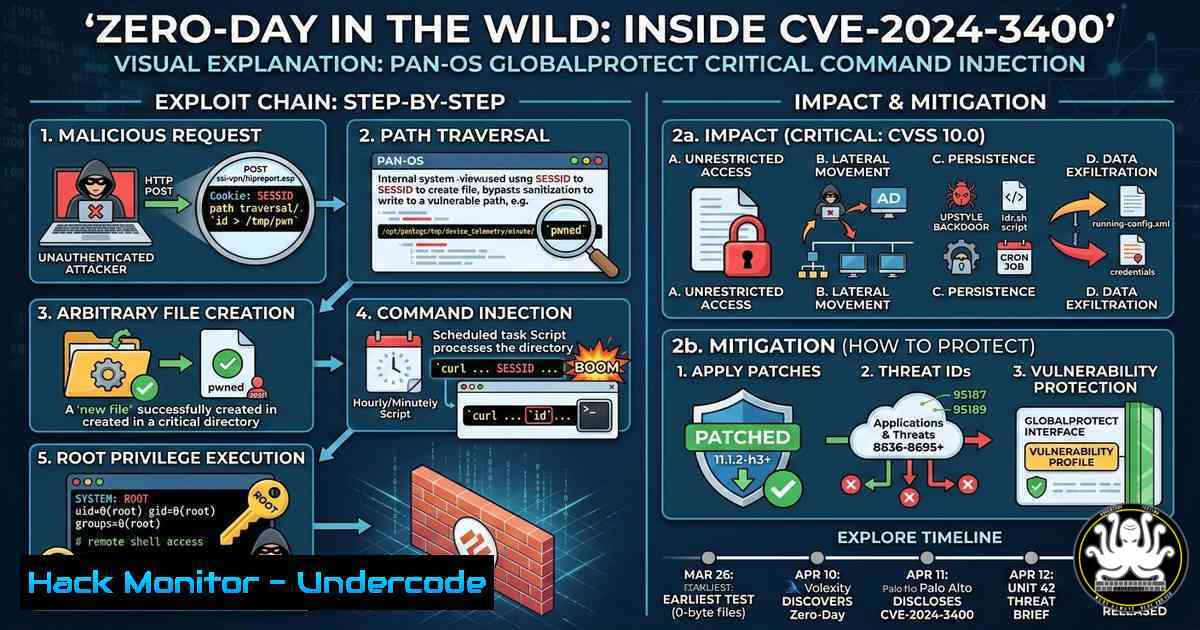
Introduction:
In April 2024, the cybersecurity community was rocked by the disclosure of CVE-2024-3400, a critical command injection vulnerability residing in the GlobalProtect feature of Palo Alto Networks PAN-OS. Exploited actively as a zero-day by a sophisticated nation-state threat actor (dubbed “UTA0218”), this flaw allows an unauthenticated attacker to execute arbitrary code with root privileges on the firewall. This article dissects the technical mechanics of the exploit, provides indicators of compromise (IOCs), and outlines the immediate hardening steps required to mitigate this existential threat to network perimeters.
Learning Objectives:
- Understand the mechanics of the command injection vulnerability within the PAN-OS GlobalProtect portal.
- Learn to identify indicators of compromise (IOCs) by analyzing firewall logs and system files.
- Master the step-by-step application of hotfixes and workarounds to secure vulnerable appliances.
You Should Know:
1. Anatomy of the Exploit: The SessID Parameter
The vulnerability resides in the GlobalProtect portal’s handling of session IDs. Specifically, it affects how the system processes the `SessID` parameter within the cookie. An attacker can inject arbitrary operating system commands by manipulating this parameter, which is then improperly sanitized before being passed to a system shell.
Step-by-step guide to understanding the exploitation vector:
- Vulnerable Endpoint: The flaw exists in the GlobalProtect portal component, typically listening on port 443.
- Attack Vector: A specially crafted cookie is sent to the portal. The cookie format looks like this:
SessID=PASTA;. - Injection Point: The value `PASTA` is the injection point. By appending shell metacharacters, an attacker breaks out of the intended context.
Example malicious payload: `SessID=PASTA; touch /tmp/test.txt;`.
- Code Execution: Because the application does not properly sanitize the input, the entire string is passed to a shell function, executing the arbitrary command.
Linux Command to test for vulnerability (Non-Destructive):
 Use curl to send a benign payload to check if the target echoes the injection.
 Replace <FIREWALL_IP> with the target IP.
curl -k -s -o /dev/null -w "%{http_code}\n" -H "Cookie: SessID=PASTA;echo vulnerable;" https://<FIREWALL_IP>/global-protect/login.esp
 A 500 Internal Server Error might indicate successful injection (though not always).
2. Detecting Compromise: Log Analysis and File Hunting
Given the active exploitation, defenders must hunt for traces of backdoors. The attackers were observed dropping Python-based reverse shells and maintaining persistence.
Step-by-step guide to hunting IOCs:
- Check Firewall Logs: Look for unusual patterns in the GlobalProtect logs. Specifically, look for a high volume of `global-protect/portal` requests with irregular user agents or parameters.
Command on the firewall CLI:
 Check for the specific exploit string in the logs.
grep -r "SessID" /var/log/pan/ | grep -E "python|base64|wget|curl"
2. Scan the Filesystem for Web Shells: Attackers often leave webshells for persistent access.
Command on the firewall CLI (Management Plane):
 Search for recently created files by the 'www' user (the web server user).
find / -user www -type f -name ".php" -o -name ".py" 2>/dev/null | xargs ls -la
3. Detect Reverse Shells: Check for processes initiated by the web server.
ps aux | grep www | grep -E "python|bash|sh"
3. Hardening and Mitigation: The Hotfix Procedure
Palo Alto Networks released hotfixes for the affected versions (PAN-OS 10.2, 11.0, and 11.1). If patching is impossible, disabling device telemetry or restricting GlobalProtect portal access is critical.
Step-by-step guide to applying the workaround:
- Verify Version: Run `show system info | match sw-version` on the firewall CLI.
2. Apply Hotfix:
- Navigate to Device > Dynamic Updates in the web interface.
- Check for the “GlobalProtect Hotfix” content update.
- Download and install. This hotfix modifies the session handling logic without requiring a full reboot.
- API Security (Alternative Workaround): If the hotfix is unavailable, use the CLI to temporarily disable the vulnerable telemetry.
Enter the configuration mode
configure
Navigate to the device config
set deviceconfig system telemetry opt-out
commit
- Network Mitigation: Create a temporary ACL to block access to the GlobalProtect portal from untrusted IP addresses.
4. Windows-Based Post-Exploitation (If Firewall Manages Agents)
While the firewall is the target, if the firewall manages Windows GlobalProtect agents, the attacker might use the compromised firewall to pivot. Defenders should check endpoints for anomalies.
Windows PowerShell Commands (for Endpoint Hunt):
 Check for suspicious scheduled tasks created by the firewall management
Get-ScheduledTask | Where-Object {$<em>.TaskName -like "GlobalProtect" -or $</em>.TaskName -like "PAN"} | Select-Object TaskName, State

Check for modified GlobalProtect binaries
Get-ChildItem -Path "C:\Program Files\Palo Alto Networks" -Recurse -ErrorAction SilentlyContinue | Where-Object {$_.LastWriteTime -gt (Get-Date).AddDays(-7)}
5. Cloud Hardening: Securing Panorama-Managed Firewalls
If you manage firewalls via Panorama (on-prem or cloud), ensure that the communication path is secure. The exploit on a firewall could potentially leak Panorama credentials if they are stored insecurely.
Configuration Best Practices:
- Encryption: Ensure all device-to-Panorama communication uses SSH or TLS.
2. Credentials Rotation:
 On Panorama CLI, force credential re-sync to firewalls after patching
request devicevm sync-credentials-to-devices
What Undercode Say:
- Key Takeaway 1: The CVE-2024-3400 exploit underscores the danger of perimeter devices becoming internal attack platforms. A firewall should be treated as a critical internal asset, not just a boundary guard; its management interface must be strictly air-gapped or heavily access-controlled.
- Key Takeaway 2: Relying solely on signature-based detection for zero-days is futile. The “SessID” injection was a logical flaw, not just a malicious payload. Security teams must shift toward anomaly detection and behavior analysis on network appliances to catch the post-exploitation activity (e.g., outbound `curl` requests from a firewall).
Analysis: The sophistication of UTA0218 indicates that nation-states are now prioritizing network edge devices as initial access vectors. The ability to execute root commands on a firewall effectively neutralizes the organization’s primary defense layer, allowing the attacker to disable logging, modify rules, and observe all internal traffic. This incident is a stark reminder that patching cycles must be measured in hours, not weeks, for exposed critical infrastructure.
Prediction:
We will likely see a surge in attacks targeting SSL VPNs and firewall management interfaces over the next 12 months. Following the playbook of CVE-2024-3400, threat actors will focus on discovering similar command injection flaws in other major firewall vendors. Consequently, regulatory bodies may soon mandate strict network segmentation for management planes, effectively requiring organizations to treat their firewall admin interfaces as isolated “out-of-band” networks, inaccessible from the corporate LAN or internet.
🎯Let’s Practice For Free:
IT/Security Reporter URL:
Reported By: Abdirahman Sj – Hackers Feeds
Extra Hub: Undercode MoN
Basic Verification: Pass ✅


