Listen to this Post
Introduction
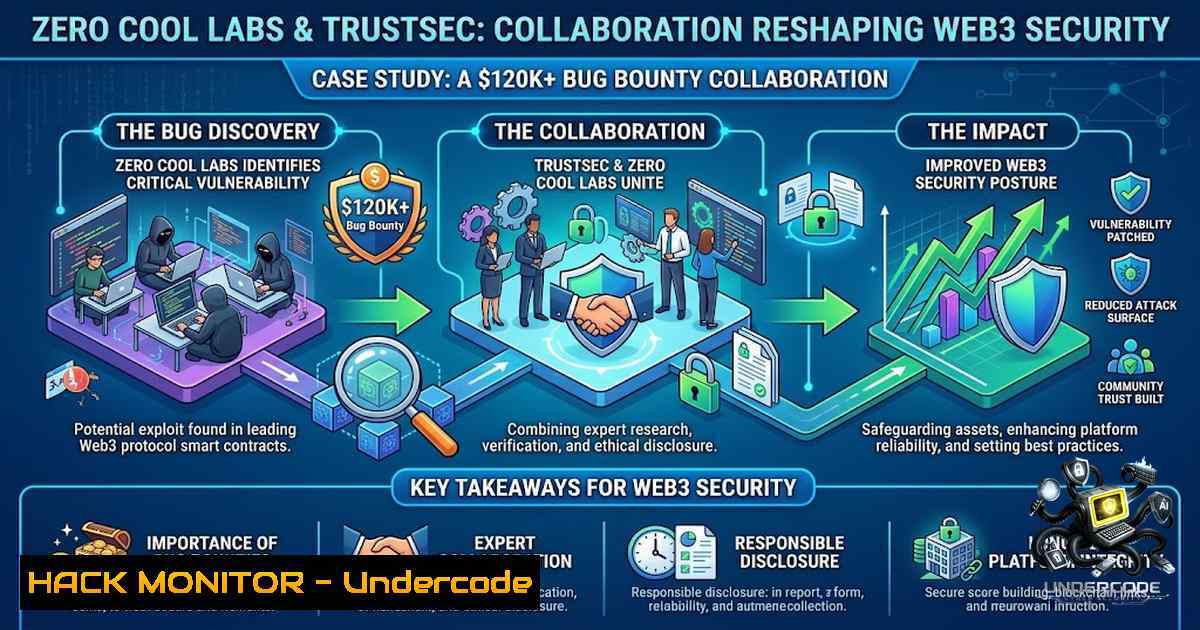
The intersection of artificial intelligence and blockchain security has given rise to a new breed of vulnerability discovery platforms, and Zero Cool Labs stands at the forefront of this revolution. In a landmark achievement, Zero Cool Labs partnered with TrustSec, a boutique Web3 security firm, to launch a bug bounty collaboration that generated over $120,000 in rewards within its first month. This milestone underscores the growing financial incentives and critical demand for specialized security researchers capable of identifying sophisticated vulnerabilities in decentralized protocols, smart contracts, and blockchain infrastructure.
Learning Objectives
- Understand the core mechanics of modern Web3 bug bounty programs and how collaborative models between AI-powered platforms and human-led security firms amplify discovery capabilities
- Master the technical reconnaissance, fuzzing, and exploitation methodologies used by top-tier bounty hunters, including Linux-based toolchains and smart contract analysis frameworks
- Develop a comprehensive vulnerability assessment workflow that spans from initial footprinting to responsible disclosure, with emphasis on DeFi-specific attack vectors
You Should Know
- Reconnaissance and Attack Surface Mapping for Web3 Protocols
Before any vulnerability can be discovered, the attack surface must be systematically mapped. This phase involves both off-chain infrastructure assessment and on-chain smart contract analysis. Zero Cool Labs leverages AI-powered scanners that automatically parse codebases and identify potential attack vectors, while TrustSec’s human researchers perform deep-dive manual audits.
Step‑by‑step guide for Web3 reconnaissance:
Step 1: Smart Contract Static Analysis
Begin by extracting the target protocol’s smart contract source code from Etherscan or the project’s GitHub repository. Use Slither, a static analysis framework, to detect common vulnerabilities:
 Install Slither
pip3 install slither-analyzer

Run analysis on a Solidity file
slither /path/to/contract.sol --print human-summary

Generate a comprehensive report with detector results
slither /path/to/contract.sol --detect-all --json slither-report.json
Step 2: Dynamic Analysis with Foundry
Foundry provides a blazing-fast testing framework for Ethereum development. Use it to simulate attack scenarios:
 Install Foundry
curl -L https://foundry.paradigm.xyz | bash
foundryup

Run fuzzing tests on a specific function
forge test --match-test testVulnerability -vvv

Generate coverage reports to identify untested code paths
forge coverage --report lcov
Step 3: Infrastructure Footprinting
Web3 protocols often rely on off-chain components including APIs, indexers, and relayers. Use standard bug bounty reconnaissance tools to enumerate subdomains and endpoints:
 Install common recon tools on Ubuntu
sudo apt update && sudo apt install -y ffuf sublist3r amass nmap httprobe

Enumerate subdomains for the target domain
sublist3r -d targetprotocol.com -o subdomains.txt

Scan for open ports and services
nmap -sV -p- -T4 targetprotocol.com -oN nmap-scan.txt

Discover live web endpoints
cat subdomains.txt | httprobe -c 50 -t 3000 > live-endpoints.txt
Step 4: API Endpoint Fuzzing
Use ffuf to fuzz for hidden API endpoints that may expose sensitive functionality:
 Fuzz for common API paths
ffuf -u https://api.targetprotocol.com/FUZZ -w /usr/share/wordlists/dirb/common.txt -fc 404

Test for GraphQL introspection vulnerabilities
ffuf -u https://api.targetprotocol.com/graphql -w payloads.txt -X POST -H "Content-Type: application/json" -d '{"query":"FUZZ"}'
What this does: This workflow establishes a complete attack surface map of the target protocol. Static analysis identifies code-level vulnerabilities, dynamic testing validates exploitability, and infrastructure reconnaissance uncovers misconfigured services that could lead to data breaches or privilege escalation. The combination of AI-driven automation (Zero Cool Labs’ approach) and manual deep-dive analysis (TrustSec’s methodology) dramatically increases the probability of finding high-severity issues.
2. Smart Contract Vulnerability Classes and Exploitation Techniques
The $120,000+ bounty haul from the Zero Cool Labs–TrustSec collaboration likely stemmed from identifying critical DeFi vulnerability classes. Understanding these categories is essential for any serious bug bounty hunter.
Step‑by‑step guide for identifying and exploiting common DeFi bugs:
Step 1: Reentrancy Attack Detection
Reentrancy remains one of the most devastating vulnerabilities in Ethereum smart contracts. Use the following Slither detector to identify unsafe external calls:
 Run reentrancy-specific detectors
slither /path/to/contract.sol --detect reentrancy-eth,reentrancy-1o-eth

Manual review pattern: look for .call{value:}() without state changes before the call
Example vulnerable code pattern:
function withdraw(uint256 amount) external {
require(balances[msg.sender] >= amount, "Insufficient balance");
(bool success, ) = msg.sender.call{value: amount}("");
require(success, "Transfer failed");
balances[msg.sender] -= amount; // State update AFTER external call - VULNERABLE
}
Step 2: Access Control Misconfigurations
Privilege escalation through improper access controls is a frequent finding. Use the following checklist:
 Search for functions without appropriate modifiers
grep -r "function " contracts/ | grep -v "onlyOwner" | grep -v "onlyRole"

Identify storage collisions in upgradeable proxies
slither /path/to/contract.sol --print storage-layout
Step 3: Oracle Manipulation and Price Feed Attacks
DeFi protocols relying on manipulated price oracles have lost billions. Test oracle resilience:
// Foundry test for oracle manipulation
function testOracleManipulation() public {
// Flash loan attack simulation
uint256 initialPrice = oracle.getPrice();
// Manipulate liquidity pool
pool.swap(0, 1000000 ether, address(this), "");
uint256 manipulatedPrice = oracle.getPrice();
assert(manipulatedPrice > initialPrice  2);
}
Step 4: Integer Overflow and Underflow (Pre-Solidity 0.8)
For contracts using older compiler versions, test arithmetic boundaries:
// Test for overflow
function testOverflow() public {
uint8 max = type(uint8).max;
uint8 overflow = max + 1; // Will revert in Solidity 0.8+, but vulnerable in older versions
}
What this does: These techniques target the most lucrative vulnerability categories in Web3 bug bounty programs. Reentrancy can lead to direct fund theft, access control flaws enable privilege escalation, oracle manipulation allows price exploitation, and integer overflows can break protocol invariants. TrustSec’s researchers have safely disclosed live issues to major projects including Chainlink, Optimism, Arbitrum, Uniswap, and AAVE—demonstrating the real-world impact of mastering these vulnerability classes.
3. Automated Fuzzing and Property-Based Testing
Zero Cool Labs’ AI-powered platform excels at automated vulnerability discovery through intelligent fuzzing. This section outlines how to implement similar fuzzing strategies.
Step‑by‑step guide for smart contract fuzzing:
Step 1: Echidna Fuzzer Setup
Echidna is a property-based fuzzer for Ethereum smart contracts:
 Install Echidna
cargo install echidna

Run basic fuzzing on a test contract
echidna test /path/to/contract.sol --contract TestContract --config config.yaml

Use corpus for coverage-guided fuzzing
echidna test /path/to/contract.sol --corpus-dir ./corpus --test-limit 100000
Step 2: Foundry Invariant Testing
Foundry’s invariant testing provides similar capabilities:
// Define an invariant test
function testInvariant_TotalSupply() public {
assertEq(token.totalSupply(), token.balanceOf(address(this)) + token.balanceOf(alice));
}

// Run with fuzzing
forge test --match-test testInvariant -vvv --fuzz-runs 10000
Step 3: Differential Fuzzing
Compare your implementation against a reference implementation:
function test_DifferentialFuzzing(uint256 amount) public {
uint256 result1 = implementation.compute(amount);
uint256 result2 = reference.compute(amount);
assertEq(result1, result2, "Differential fuzzing found discrepancy");
}
Step 4: AI-Assisted Payload Generation
Leverage AI tools to generate complex fuzzing inputs that human testers might miss. Tools like Claude Code can analyze thousands of past vulnerability reports to generate targeted test cases:
 Example: Using AI to generate Foundry test templates
 (Conceptual - integrate with your preferred AI assistant)
python3 ai_fuzzer.py --contract contracts/Vault.sol --output tests/fuzz_Vault.t.sol
What this does: Fuzzing automatically generates thousands of test cases to uncover edge cases that manual review might miss. Coverage-guided fuzzing tracks which code paths have been executed and prioritizes inputs that reach new branches. This approach is particularly effective for identifying complex logical errors in DeFi protocols that involve multiple interacting contracts and state variables.
4. Cross-Chain and Bridge Vulnerability Assessment
With the rise of cross-chain interoperability, bridge vulnerabilities have become some of the most critical and highly rewarded findings in Web3 bug bounties.
Step‑by‑step guide for bridge security testing:
Step 1: Understand the Bridge Architecture
Most bridges consist of:
- Source chain contract (lock/burn)
- Off-chain relayers/validators
- Destination chain contract (mint/unlock)
Step 2: Test for Signature Replay Attacks
// Test for replay vulnerability across chains
function testReplayAttack() public {
bytes memory message = abi.encodeWithSignature("transfer(address,uint256)", attacker, 1000 ether);
bytes memory signature = signMessage(validatorPrivateKey, message);

// Execute on source chain
bridge.execute(message, signature);

// Execute SAME message on destination chain - VULNERABLE if chain ID not included
bridgeOnDestination.execute(message, signature);
}
Step 3: Validate Merkle Proof Verification
Many bridges use Merkle trees for batch transactions. Test for proof forgery:
function testMerkleProofForgery() public {
// Attempt to construct a valid proof for an invalid transaction
bytes32[] memory forgedProof = constructForgedProof();
bytes32 root = bridge.getRoot();
assertFalse(bridge.verifyProof(forgedProof, root, forgedLeaf));
}
Step 4: Relayer Compromise Simulation
Test what happens when a threshold of validators is compromised:
function testValidatorThresholdBypass() public {
// Assume we control 3 out of 5 validators
bytes[] memory signatures = getMaliciousSignatures(3);
bool executed = bridge.executeWithSignatures(message, signatures);
assertTrue(executed); // Should fail if threshold is properly enforced
}
What this does: Cross-chain bridges represent some of the highest-value targets in Web3, with exploits often resulting in losses exceeding hundreds of millions of dollars. Testing for signature replay, proof forgery, and validator compromise helps identify critical vulnerabilities before malicious actors exploit them. The Zero Cool Labs–TrustSec collaboration likely identified several such issues given their combined expertise in protocol security.
5. Responsible Disclosure and Reporting
The final phase of any bug bounty engagement is the responsible disclosure process. TrustSec’s dispute with Immunefi over an “out of scope” designation highlights the importance of clear communication and scope definition.
Step‑by‑step guide for professional vulnerability reporting:
Step 1: Reproduce the Vulnerability in a Clean Environment
Before reporting, ensure the vulnerability is reproducible:
 Create a minimal test case
forge test --match-test testExploit -vvv > exploit.log

Capture transaction traces
cast run --debug <transaction_hash> > trace.txt
Step 2: Draft a Comprehensive Report
Include:
- Executive Summary: One-paragraph overview of the vulnerability and its impact
- Technical Details: Step-by-step reproduction steps with code snippets
- Proof of Concept: Minimal, self-contained exploit code
- Impact Assessment: Quantify potential losses (e.g., “Attacker could drain 100% of protocol TVL”)
- Suggested Fix: Specific code changes to remediate the issue
Step 3: Submit Through the Official Channel
Follow the protocol’s bug bounty policy exactly. Most Web3 programs use platforms like Immunefi, Sherlock, or HackenProof.
Step 4: Negotiate Bounty Classification
If a dispute arises regarding severity or scope, prepare technical arguments and reference industry-standard severity classifications. Document all communications to ensure transparency.
What this does: Professional reporting increases the likelihood of receiving full bounty payments and builds a reputation that can lead to higher rewards and exclusive invitations. The Immunefi–TrustSec dispute serves as a cautionary tale about the importance of clear scope definitions and the need for robust dispute resolution mechanisms in the Web3 bug bounty ecosystem.
6. Windows-Based Web3 Security Tooling
While Linux dominates the security research landscape, Windows environments are also relevant for testing wallet applications, browser extensions, and desktop clients.
Step‑by‑step guide for Windows-based Web3 security testing:
Step 1: Install Windows Subsystem for Linux (WSL)
 Run as Administrator
wsl --install -d Ubuntu
Step 2: Set Up Burp Suite for Web3 API Testing
Burp Suite is essential for intercepting and modifying API traffic between dApps and backend services:
1. Download Burp Suite Community Edition
- Configure your browser to use Burp as a proxy (127.0.0.1:8080)
- Install the Burp certificate to intercept HTTPS traffic
Step 3: Analyze Wallet Browser Extensions
Extract and analyze wallet extension source code:
 Locate extension folder (Chrome)
cd "$env:LOCALAPPDATA\Google\Chrome\User Data\Default\Extensions\"

Use 7-Zip to extract .crx files
7z x extension.crx -oextension_source
Step 4: Test for RPC Endpoint Misconfigurations
Web3 wallets often communicate with RPC endpoints. Test for vulnerabilities:
 From WSL, test RPC endpoint for sensitive methods
curl -X POST http://localhost:8545 \
-H "Content-Type: application/json" \
-d '{"jsonrpc":"2.0","method":"eth_accounts","params":[],"id":1}'
What this does: Many Web3 users interact with protocols through browser-based wallets and desktop applications. Testing these client-side components can uncover vulnerabilities that are invisible to pure on-chain analysis, including private key exposure, man-in-the-middle attacks, and insecure local storage practices.
What Undercode Say:
- The $120,000 milestone proves that collaborative bug bounty models between AI-driven platforms and specialized security firms are commercially viable and highly effective. Zero Cool Labs’ AI-powered scanning combined with TrustSec’s manual deep-dive audits creates a synergistic approach that outpaces either methodology alone.
-
The Web3 security market is maturing rapidly, with professional bounty hunters now earning six-figure sums monthly. This financial incentive is attracting top talent from traditional cybersecurity domains, accelerating the overall security posture of the ecosystem.
The Zero Cool Labs–TrustSec collaboration’s first-month performance signals a paradigm shift in how Web3 security is delivered. The traditional model of periodic smart contract audits is being augmented—and in some cases replaced—by continuous, incentivized bug bounty programs that leverage both artificial intelligence and human expertise. However, the recent Immunefi suspension of TrustSec over a bounty dispute highlights persistent challenges in the space: scope definitions remain contentious, dispute resolution mechanisms are still evolving, and trust between platforms and researchers requires constant maintenance. For aspiring bug bounty hunters, the path forward involves mastering both automated tools and manual analysis techniques, developing deep expertise in specific vulnerability classes, and building a professional reputation through clear, responsible disclosure practices. The $120,000 month is not an anomaly—it is a preview of what the Web3 security economy will look like as adoption accelerates and the stakes continue to rise.
Prediction:
- +1 The integration of large language models and AI agents into bug bounty workflows will increase vulnerability discovery rates by 300–500% within 18 months, driving average bounty payouts significantly higher. Zero Cool Labs is well-positioned to lead this transformation.
-
+1 Web3 bug bounty programs will adopt standardized severity classifications and binding arbitration mechanisms to prevent disputes like the Immunefi–TrustSec incident, increasing researcher confidence and participation rates.
-
-1 The growing financial rewards will attract malicious actors posing as ethical researchers, leading to an increase in “bug bounty extortion” cases where vulnerabilities are threatened to be leaked unless a ransom is paid outside the official program.
-
+1 Traditional cybersecurity firms will increasingly partner with or acquire specialized Web3 security boutiques, accelerating the convergence of conventional IT security practices with blockchain-specific methodologies.
-
-1 The complexity of cross-chain protocols and layer-2 solutions will outpace the current rate of security researcher specialization, creating a dangerous gap between protocol innovation and security coverage.
-
+1 Regulatory frameworks will begin recognizing bug bounty programs as essential components of cybersecurity compliance, potentially offering liability protections for protocols that maintain active, well-funded bounty programs.
-
+1 The $120,000+ first-month achievement will serve as a benchmark, inspiring similar collaborations and driving a new wave of investment into Web3 security infrastructure.
▶️ Related Video (78% Match):
https://www.youtube.com/watch?v=8geYe5_UBgQ
🎯Let’s Practice For Free:
🎓 Live Courses & Certifications:
Join Undercode Academy for Verified Certifications
🚀 Request a Custom Project:
Secure, high-velocity infrastructure and disruptive technological engineering. Contact our engineering team for high-tier development and proprietary systems:
[email protected]
💎 Smart Architecture | 🛡️ Secure by Design | ⭐ Trusted by Thousands
IT/Security Reporter URL:
Reported By: UgcPost 7490167435568996353 – Hackers Feeds
Extra Hub: Undercode MoN
Basic Verification: Pass ✅


