Listen to this Post
Introduction:
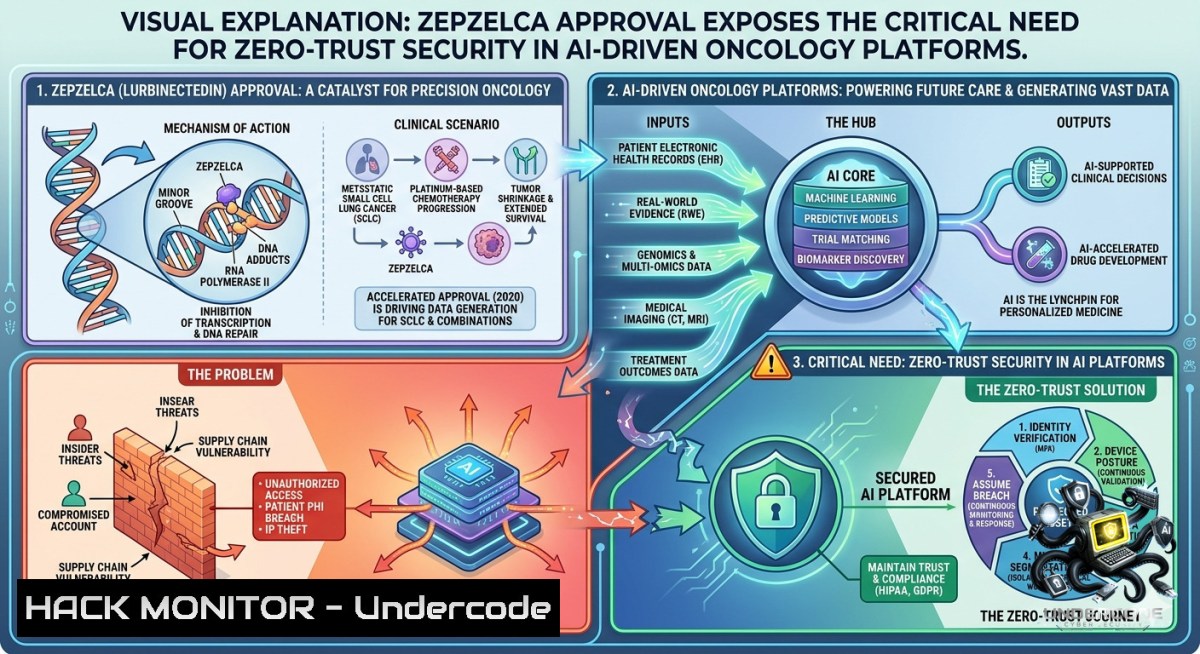
The European Commission’s recent approval of PharmaMar’s Zepzelca® (lurbinectedin) in combination with atezolizumab for extensive-stage small cell lung cancer (ES-SCLC) underscores a significant shift toward data-driven, personalized oncology. This advancement, heavily reliant on AI-powered platforms like those developed by LARVOL, transforms clinical trial data and market intelligence into actionable insights to accelerate pharma innovation. However, the digitization of this highly sensitive ecosystem—comprising patient data, biomarker insights, and competitive intelligence—expands the attack surface dramatically, making robust cybersecurity frameworks a prerequisite for patient safety and regulatory compliance.
Learning Objectives:
- Understand the core security challenges in AI-driven oncology data platforms, including adversarial inputs, model poisoning, and API-driven data exfiltration.
- Implement HIPAA-compliant API security and cloud hardening techniques on AWS, leveraging services like WAF, Secrets Manager, and Certificate Manager.
- Acquire hands-on Linux and Windows commands to monitor, harden, and secure clinical trial data infrastructure against unauthorized access and breaches.
You Should Know:
- Hardening LARVOL-Like AI Pipelines: Linux & Windows Security Controls
AI platforms such as LARVOL CLIN ingest real-time clinical trial data, conference abstracts, and KOL feeds, creating a rich target for attackers who could poison this ingestion layer. Securing the underlying infrastructure is the first line of defense. Below are verified commands to harden both Linux and Windows servers hosting such platforms.
Step‑by‑Step Guide: On a Linux (Ubuntu 22.04 LTS) instance, begin by hardening SSH access and configuring a strict firewall. On a Windows Server 2022, enforce advanced threat protection and audit logging.
Linux (Ubuntu 22.04 LTS):
 Harden SSH and disable root login
sudo sed -i 's/PermitRootLogin yes/PermitRootLogin no/' /etc/ssh/sshd_config
sudo systemctl restart sshd

Set strict iptables rules – allow only necessary ports (e.g., 443, 22)
sudo iptables -A INPUT -m state --state ESTABLISHED,RELATED -j ACCEPT
sudo iptables -A INPUT -p tcp --dport 22 -j ACCEPT  SSH
sudo iptables -A INPUT -p tcp --dport 443 -j ACCEPT  HTTPS
sudo iptables -P INPUT DROP
sudo iptables -P FORWARD DROP
sudo apt install iptables-persistent
Windows Server 2022 (PowerShell as Administrator):
 Enable Windows Defender Advanced Threat Protection
Set-MpPreference -DisableRealtimeMonitoring $false
Set-MpPreference -PUAProtection Enabled

Configure advanced audit policies to track logon events
auditpol /set /category:"Logon/Logoff" /subcategory:"Logon" /success:enable /failure:enable

Block SMBv1 and enforce SMB signing
Set-SmbServerConfiguration -EnableSMB1Protocol $false -RequireSecuritySignature $true -Force
- Fortifying the API Layer: Securing Clinical Data Endpoints
Healthcare APIs are the digital highways for sensitive patient information, yet 84.7% of healthcare organizations have experienced an API security incident. These endpoints are vulnerable to hardcoded keys, broken object level authorization (BOLA), and data exfiltration. A multi-layered defense is essential.
Step‑by‑Step Guide: Implement a zero-trust architecture for your clinical data APIs by enforcing strong authentication, schema validation, and comprehensive logging.
- Authenticate every request: Implement OAuth2 with short-lived JWTs or mutual TLS (mTLS) between your platform and data providers.
- Apply schema validation: Reject any JSON payload that does not conform to the FHIR standard to prevent injection attacks.
- Use AWS Secrets Manager: Securely store and automatically rotate API keys and database credentials. Never hardcode secrets in application code or configuration files.
 Example using AWS CLI to retrieve a secret
aws secretsmanager get-secret-value --secret-id larvol/api-key --version-stage AWSCURRENT --query SecretString --output text
- Monitor API access: Configure AWS CloudWatch to log all API requests and set up alerts for anomalous patterns, such as excessive 403 errors or requests from unusual geolocations.
- Programmatic Data Extraction and Analysis: Balancing Innovation with Risk
The ability to programmatically extract and analyze clinical trial data is a core value of AI-driven oncology platforms like LARVOL CLIN, which curates data from over 25,000 sources including ClinicalTrials.gov. However, this functionality creates a critical supply chain risk if not managed with strict security controls.
Step‑by‑Step Guide: Use Python and `curl` to interact with clinical data APIs, ensuring all data-in-transit is encrypted and authentication tokens are handled securely.
- API Data Harvesting: Use `curl` or Python’s `requests` library to fetch trial data. Always use HTTPS and include authentication headers.
 Example using curl with a Bearer token
curl -X GET "https://api.larvol.com/v1/trials?cancer_type=lung&year=2026" \
-H "Authorization: Bearer YOUR_API_TOKEN" \
-H "Accept: application/json"
- Browser Automation with Python (Selenium): For dynamic portals that lack a public API, use Selenium to automate data extraction, but ensure your automation scripts run from a controlled, secure environment.
from selenium import webdriver
from selenium.webdriver.common.by import By
import time

driver = webdriver.Chrome()
driver.get("https://clin.larvol.com/conference/abstract/ASCO%202026")
time.sleep(5)  Allow page to load

trials = driver.find_elements(By.CSS_SELECTOR, ".trial-title")
for trial in trials:
print(trial.text)
driver.quit()
- Secure the Pipeline: Never commit API keys or credentials to version control. Use environment variables or a secrets management solution to pass them to your scripts.
- Continuous Monitoring and Threat Detection for Clinical Data Pipelines
The shift from debating AI’s potential to demonstrating its scale introduces critical operational security requirements. Data provenance and pipeline integrity are paramount. Continuous monitoring of logs, network connections, and system events is essential to detect unauthorized access or data exfiltration attempts.
Step‑by‑Step Guide: Implement a baseline of log monitoring commands to regularly inspect your clinical data infrastructure for anomalies.
Linux – Inspect authentication logs for unauthorized access attempts:
 Check for failed password attempts
sudo grep "Failed password" /var/log/auth.log

Monitor active network connections and listening ports
sudo netstat -tulpn

Track user logins and sudo sessions
sudo lastlog
Windows (PowerShell) – Monitor logon events and processes:
 Get a list of running processes with network activity
Get-1etTCPConnection | Where-Object {$_.State -eq "Listen"} | Format-Table LocalPort, OwningProcess -AutoSize

Check for failed logon events in the Security log (Event ID 4625)
Get-WinEvent -FilterHashtable @{LogName='Security'; ID=4625} | Select-Object TimeCreated, Message

Check for service creation events (potential persistence)
Get-WinEvent -LogName System | Where-Object { $_.Id -eq 7045 }
- Building a Compliance-Driven Culture: Training for Medical and IT Teams
Technology alone is insufficient. A 15% reduction in data breach risks and improved HIPAA compliance is achievable only when a layered security architecture is paired with a well-trained workforce. Organizations must cultivate a culture of security that spans both IT and medical affairs teams.
Step‑by‑Step Guide: Develop and enforce mandatory training modules focused on AI strategy, data storytelling, and secure data handling practices.
- Role-Based Access Control (RBAC): Implement granular permissions ensuring that no single user has access to all data. Every access to a patient record must be logged and auditable.
- Encryption Everywhere: Enforce TLS 1.2 or higher for all data in transit and AES-256 encryption for data at rest in databases and backups.
- Regular Vulnerability Scanning: Schedule automated scans of your cloud infrastructure and applications, and integrate security testing into your CI/CD pipeline using tools like Snyk to identify known vulnerabilities in dependencies.
 Example using Snyk to test a Node.js project for vulnerabilities
snyk test --severity-threshold=high
What Undercode Say:
- Key Takeaway 1: The digitization of oncology creates an urgent need for a “secure by design” approach, weaving security into every layer—from data ingestion to AI model output—rather than treating it as an afterthought.
- Key Takeaway 2: Practical skills in API security, cloud hardening, and cross-platform monitoring (Linux/Windows) are no longer optional but core competencies for professionals in health-tech and clinical research.
- +Analysis: LARVOL’s infrastructure, built on AWS with services like EC2, ECS, RDS, and WAF, provides a robust model for securing sensitive healthcare data. However, the dynamic nature of AI and the growing sophistication of supply-chain attacks demand constant vigilance. The shift toward federated learning and privacy-preserving techniques represents a positive direction, but organizations must also prioritize basic hygiene: patch management, secrets rotation, and comprehensive audit logging. As AI models ingest more diverse datasets, ensuring data provenance and pipeline integrity will become the defining challenge of the next decade in health-tech.
Prediction:
- -1 The increased reliance on AI-driven platforms for critical treatment decisions will be paralleled by a rise in sophisticated cyberattacks targeting model integrity and patient data exfiltration, with potential consequences for patient safety and regulatory standing.
- +1 The industry will converge on standardized zero-trust frameworks and privacy-preserving technologies like federated learning, turning robust cybersecurity into a key competitive differentiator and a prerequisite for market access in regulated healthcare markets.
▶️ Related Video (82% Match):
🎯Let’s Practice For Free:
🎓 Live Courses & Certifications:
Join Undercode Academy for Verified Certifications
🚀 Request a Custom Project:
Secure, high-velocity infrastructure and disruptive technological engineering. Contact our engineering team for high-tier development and proprietary systems:
[email protected]
💎 Smart Architecture | 🛡️ Secure by Design | ⭐ Trusted by Thousands
IT/Security Reporter URL:
Reported By: Larvol Cancerresearch – Hackers Feeds
Extra Hub: Undercode MoN
Basic Verification: Pass ✅


